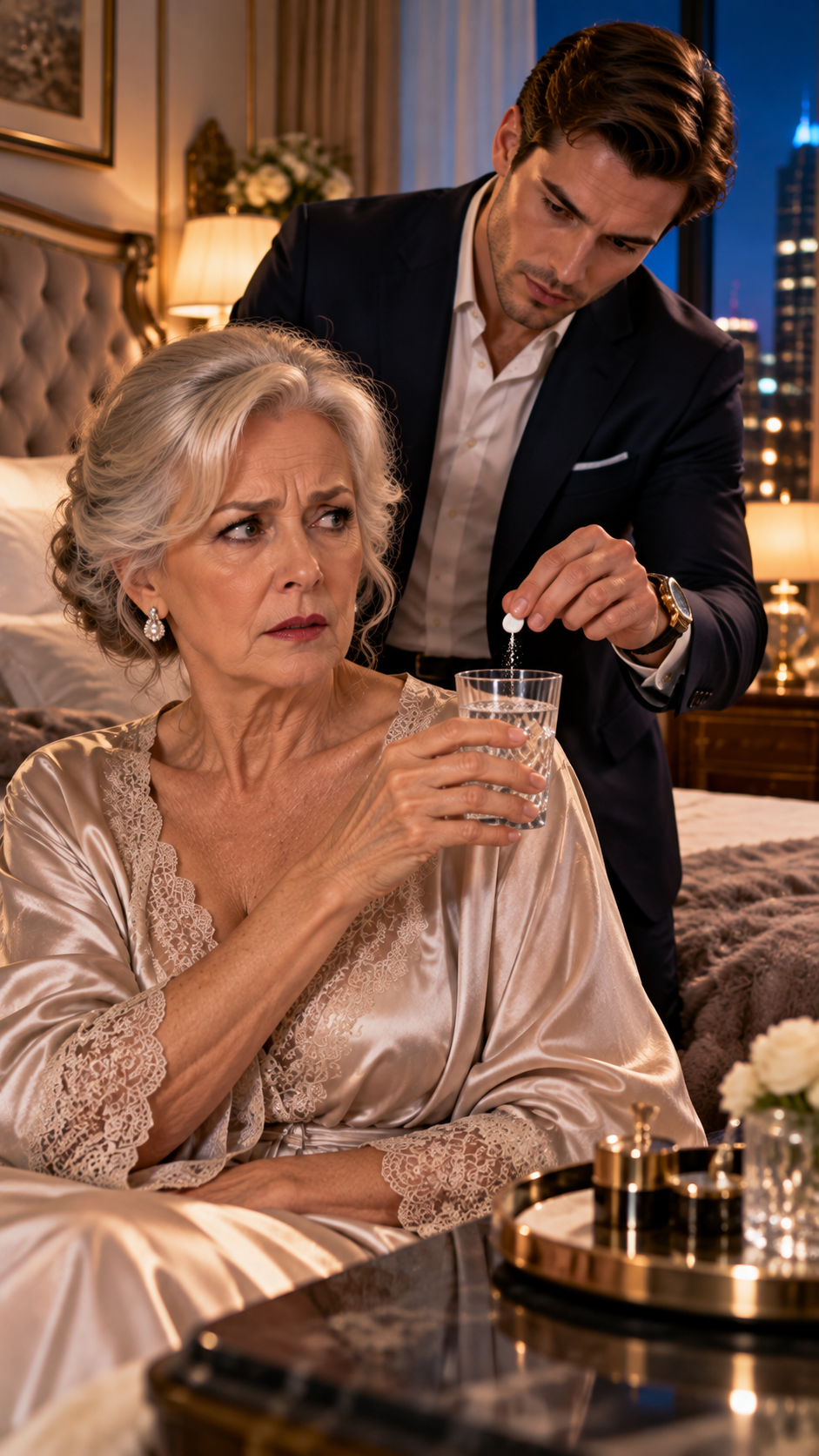
I used to believe that if a man loved you, you never had to be afraid of him.
I was sixty-four when I learned how wrong I could be.
My name was Margaret Bennett, and six months earlier, I had married Daniel, a wealthy man thirty-one years old.
Now, whenever I remembered those first months, I thought about a white ceramic cup, a kitchen light, and the way he always waited for me to finish drinking.
At the time, I thought it was care.
I didn’t understand that I was slowly losing the ability to trust myself.
Daniel and I had married despite the objections of almost everyone who knew us.
Some people were polite about it.
Others weren’t.
They wondered what a successful young businessman could possibly want with a retired schoolteacher who was old enough to be his mother.
My younger sister, Helen, never pretended to understand.
She waited until we were alone one afternoon before asking the question she had clearly been carrying for weeks.
“Margaret, have you really thought this through?”
I put down my cup of tea.
“I wouldn’t have married him if I hadn’t.”
She looked at me for a long moment.
“He’s thirty-one.”
“I know how old my husband is, Helen.”
“And he has more money than most people see in a lifetime.”
I could hear the concern beneath her words, but I heard the insult, too.
I had spent thirty-eight years teaching children to read, solve arithmetic problems, and find their way through the world.
I had managed a classroom, paid my bills, and built a quiet life without needing anyone to rescue me.
I wasn’t a helpless old woman waiting for a rich man to choose me.
At least, that was what I told myself.
“Maybe he loves me,” I said.
Helen didn’t answer immediately.
“I hope he does.”
That was all she said, but it stayed with me.
Daniel had a way of making other people’s doubts seem unimportant.
He was handsome without appearing to know it, confident without being loud, and charming in a way that made people feel he had been waiting all day to speak to them.
His company invested in medical technology, and his success had given him a beautiful house, expensive cars, and a life most people could only imagine.
My life had been different.
I had a retirement income, a collection of well-read books, and photographs from decades of school events.
I liked familiar places and ordinary routines.
Daniel seemed to enjoy those things about me.
He said I brought him a kind of peace he couldn’t find anywhere else.
Whenever I asked why he had chosen me, he gave me the same answer in slightly different words.
“You make everything quiet in my head, Margaret.”
I wanted to believe him.
Perhaps I wanted it more than I admitted.
My first marriage had ended years earlier, and retirement had left me with more silent afternoons than I had expected.
I wasn’t lonely every minute.
But there were days when I wished someone would ask how my morning had gone and actually wait for the answer.
Daniel did that.
He remembered things I mentioned only once.
He knew which flowers I liked and which books I had loved as a child.
He even learned recipes that reminded me of my mother.
When he brought me breakfast, he remembered how I preferred my eggs.
When he bought me a gift, it rarely felt random.
It seemed as if he had paid attention to every little thing I said.
I mistook that attention for proof that I knew him.
Our wedding was beautiful.
I remember standing beside him and looking at his face while we exchanged our promises.
For once, I didn’t care about the whispers or the raised eyebrows.
I felt chosen.
I felt wanted.
And when Daniel took my hand afterward, I believed we were beginning something neither of us had expected to find.
The first few months passed peacefully.
He encouraged me to rest instead of worrying about the house.
He brought flowers home for no particular reason.
Some evenings, I read in the chair beside the sitting-room window while he worked nearby.
Sometimes I caught him watching me.
“What is it?” I asked one night.
He smiled and returned his attention to his papers.
“Nothing. I just like knowing you’re here.”
I laughed.
“You can see that for yourself.”
“I know.”
He said it softly, almost sadly.
At the time, I found it sweet.
Now I wonder what he was thinking.
Three months after our wedding, Daniel began talking about my health.
It started over breakfast.
He asked whether I had been sleeping well and whether I had noticed any changes in my energy.
I told him I was fine.
I had already visited my regular doctor for my annual examination.
There had been no alarming news, and I had no reason to believe I needed another round of tests.
Daniel disagreed.
He told me about a private clinic in a modern building with mirrored windows.
According to him, it offered more advanced screening than an ordinary medical office.
“I want you to have the best care available,” he said.
“There’s nothing wrong with my doctor.”
“I didn’t say there was.”
“Then why do I need another examination?”
He reached across the table and touched my hand.
“Because I love you, and I want you to stay healthy.”
It was difficult to argue with that without sounding ungrateful.
I agreed to go.
Looking back, I wish I had asked more questions.
The clinic was quiet and polished, with clean corridors and reception staff who spoke in low voices.
Everything looked expensive.
A physician named Dr. Adrian Cole greeted us and explained that the appointment would involve several examinations.
He spoke confidently, and Daniel seemed familiar with the place.
That should have made me more cautious.
Instead, it reassured me.
I completed the tests and was given a stack of forms to sign.
Some of the language was unfamiliar.
I stopped at one page and began reading it carefully.
Daniel stood beside me.
“Is something wrong?” he asked.
“I don’t understand this section.”
He glanced at the document.
“It’s standard medical paperwork, sweetheart. I’ve already looked through it.”
I turned another page.
There were terms I couldn’t explain and references to procedures no one had discussed with me in plain language.
I considered asking Dr. Cole to clarify them.
Then Daniel rested a hand on my shoulder.
“You don’t need to worry about every technical detail.”
I had spent most of my adult life teaching children that asking questions was a good thing.
Yet I signed those papers without getting the answers I needed.
I told myself that my husband was helping me.
I told myself the doctor would never ask me to sign anything improper.
I told myself many things that day.
When we left, Daniel seemed pleased.
He said he was glad I had agreed to the examination.
I thought that was the end of it.
I was wrong.
A few days later, he introduced a new evening routine.
He began preparing a warm drink for me before bedtime.
Milk, honey, cinnamon, and vanilla.
The first time he carried it into the sitting room, I smiled.
“My mother used to make something like this when I was little.”
Daniel set the cup beside my chair.
“I remembered you telling me that.”
I felt a little foolish for being so touched.
It was only a drink.
But it reminded me of my childhood kitchen and the comfort of having someone look after me.
Soon, it became part of every evening.
Daniel would prepare it himself, carry it to my chair, and ask whether I had everything I needed.
If I was reading, he placed it on the small table beside my book.
If I was already in bed, he brought it upstairs.
He always seemed to know when I was ready for it.
At first, I drank without thinking.
Then I began waking up tired.
Not the ordinary tiredness that followed a late night, but a heavy feeling that seemed to remain with me long after I got out of bed.
I would sit at breakfast and struggle to follow a conversation.
I misplaced my glasses.
I forgot where I had put a book I had been reading only minutes earlier.
Sometimes Daniel asked me a question, and I needed him to repeat it.
I blamed my age.
That was the easiest explanation.
Daniel agreed that I might simply need more rest.
“You’ve had a lot of changes lately,” he told me.
“Marriage, a new home, a different routine. It can take time to settle.”
He sounded reasonable.
And because I had begun to doubt my own memory, I was grateful that he seemed certain about everything.
Before long, he began speaking for me when we were with other people.
If someone asked how I was feeling, Daniel answered before I could.
“Margaret’s been a little tired recently.”
If I lost my place in a conversation, he stepped in and explained what I meant.
Sometimes he did it gently enough that I barely noticed.
Other times, I felt embarrassed.
I had taught generations of children.
I had organized school events, managed difficult parents, and handled emergencies without falling apart.
Now I sometimes struggled to remember what I had gone into a room to find.
I didn’t know what was happening to me.
I only knew that the man who had promised to care for me seemed increasingly interested in deciding what I needed.
One afternoon, Helen came to visit.
She found me sitting in the sitting room with a book open in my lap.
I had been looking at the same page for several minutes without understanding a word.
She sat opposite me and studied my face.
“You look worn out.”
“I’m fine.”
She didn’t seem convinced.
“Have you been sleeping?”
“More than usual, actually.”
“Then why do you look so exhausted?”
I tried to laugh it off.
Perhaps I had been reading too much.
Perhaps the weather was affecting me.
Perhaps I was simply getting older.
Helen listened, but she didn’t look reassured.
Then she asked a question I wasn’t prepared for.
“Are you happy with Daniel?”
I looked down at the book.
Of course I loved him.
I had married him because I wanted to spend the rest of my life with him.
But love wasn’t the only thing I had been feeling lately.
There was confusion.
There was embarrassment.
And beneath both was a small fear I didn’t want to name.
“Sometimes,” I admitted, “I don’t feel quite like myself.”
Helen moved closer.
“Then please see your own doctor. Someone who can look at everything independently.”
I opened my mouth to answer.
Before I could, Daniel appeared in the doorway with a bouquet of flowers.
His expression changed when he heard what Helen had said.
It lasted only a second.
Then he smiled and crossed the room.
“That’s a good idea,” he said. “I’ll arrange it for her.”
Helen watched him carefully.
I noticed that she did not smile back.
That evening, Daniel prepared my warm milk as usual.
I sat in the kitchen doorway while he stood at the counter.
The light above him was bright, and the rest of the room was quiet.
He lifted my cup.
Then he reached for something beside the kettle.
A small, dark bottle.
I couldn’t see a label.
He tilted it over my drink.
Several drops fell into the milk.
I stopped moving.
For a moment, I wondered whether I had misunderstood what I was seeing.
Then Daniel turned around and found me standing there.
His hand closed around the bottle.
“What’s that?” I asked.
He looked at the cup, then at me.
“Just something to improve the flavor.”
I stared at the bottle.
“Since when do we use that?”
His smile remained, but it no longer reached his eyes.
“Margaret, it’s nothing important.”
I held out my hand.
“Let me see it.”
For the first time since our wedding, he seemed irritated by a simple question.
Then he put the bottle down and lifted my cup.
“Your drink is getting cold, sweetheart.”
He held it out to me.
I looked at the warm milk.
I looked at his hand.
And I realized that I had no idea what he had just put into it.
Source: kaylestore.net
Click here to continue reading: PART 2: He Called It a Harmless Evening Habit, but My Failing Memory and His Sudden Fear of Letting Me Leave Began to Tell Another Story
The Little Bottle Beside My Evening Milk Was the First Thing That Made Me Question the Man Who Had Promised Me Forever
Part 1 of 12