I used to believe that owning a restaurant meant knowing what happened inside it.
I was wrong.
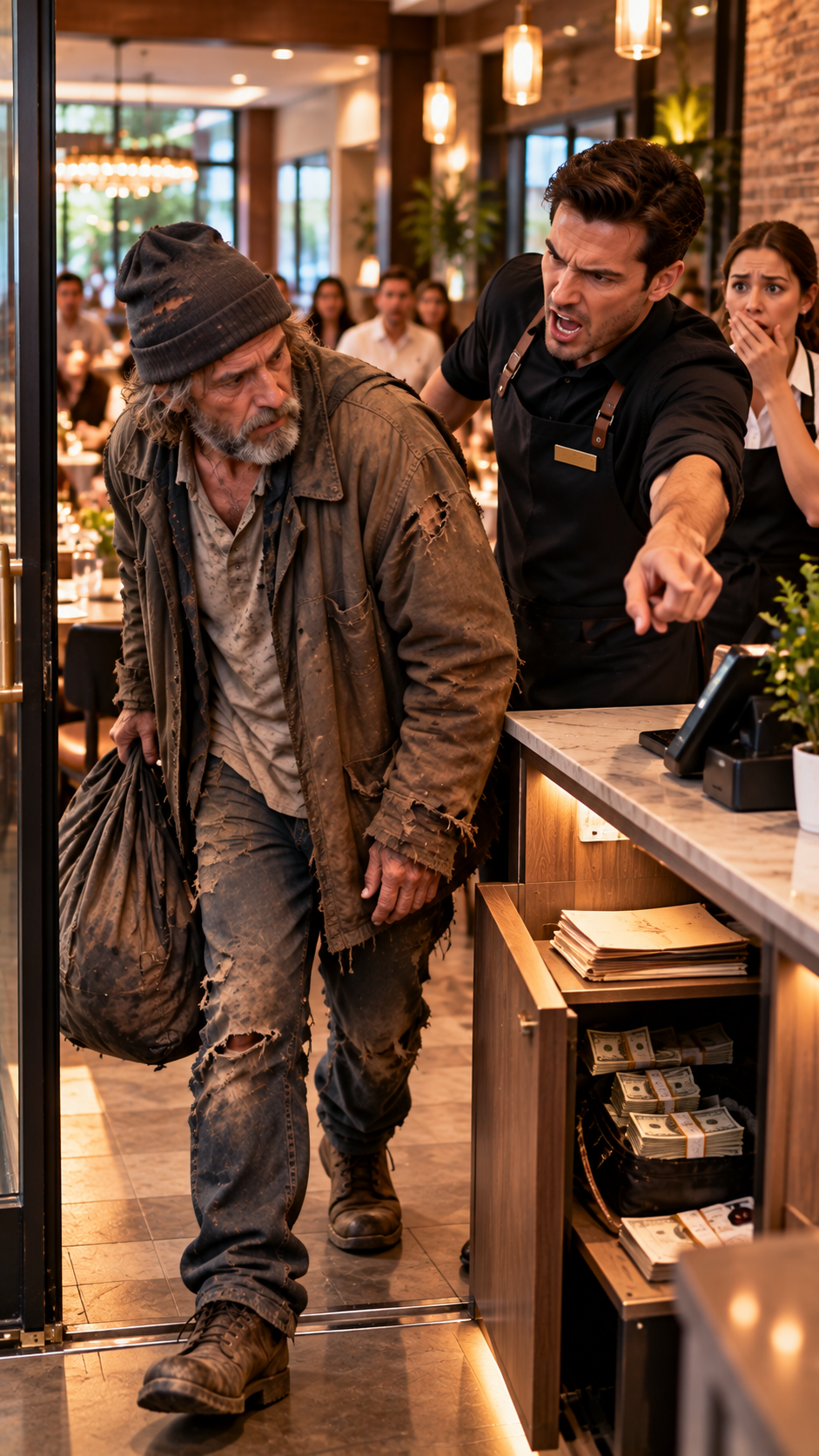
The day I learned that, I was lying on the sidewalk outside my own business, with scraped hands, a torn jacket, and my manager laughing behind the glass doors.
“Don’t bother coming back!”
Kyle Brenner shouted it loudly enough for people walking past to hear.
I looked up at him.
He looked straight back at me.
Then he laughed again.
I was fifty-two years old, and I had never felt so small.
A woman walking her dog crossed to the other side of the street. A man in a business suit stepped around me without breaking his stride.
Nobody asked whether I was hurt.
Nobody asked what had happened.
I could hardly blame them.
To anyone passing by, I looked like another homeless man who had wandered into the wrong place.
But the restaurant behind me belonged to me.
Every table. Every chair. Every plate.
Even the little bell above the entrance had been chosen by my own hands.
And before that afternoon was over, I would discover something beneath the hostess counter that would make me call the police.
I had entered the restaurant to answer a simple question.
Why were my customers leaving?
I never imagined the answer would be so much worse than bad service.
My name is Frank Delgado.
I built Rosie’s from years of exhausting work, borrowed money, and a promise I made to my mother before she died.
For a long time, I believed I had kept that promise.
Then I got distracted.
I started chasing better numbers, bigger opportunities, and the satisfaction of seeing my business grow.
I trusted the wrong person to protect what mattered.
And I nearly lost everything because of it.
To understand why that restaurant meant so much to me, you have to go back twenty years.
Back to a kitchen where nobody knew my name.
Back to a little diner on Fulton Street.
And back to the woman who taught me what a meal could mean to someone who had nothing.
Twenty years earlier, I was washing dishes at Gallagher’s Steakhouse for six dollars an hour.
I was thirty-two.
The factory where I had worked for eleven years had closed, leaving dozens of families scrambling to find work.
My mother was sick, and the bills did not care that I had lost my job.
I took whatever work I could get.
At Gallagher’s, I stood beside industrial sinks for hours, scrubbing plates while steam fogged my glasses.
Waiters dropped stacks of dirty dishes beside me.
Sometimes they thanked me.
Most of the time, they didn’t even look at me.
I understood why.
The restaurant was busy, everyone had a job to do, and I was the man in the back who cleaned up after everybody else.
Still, there were nights when I wondered whether I would spend the rest of my life being invisible.
Then I would think about Mom.
Her name was Rosalind Delgado, but almost everyone called her Rosie.
She had worked at a small restaurant on Fulton Street for thirty-eight years.
The Blue Plate was nothing special to look at.
Eleven tables. A narrow counter. A kitchen barely large enough for two people to move around comfortably.
The chairs had scratches, the floor creaked near the entrance, and the coffee machine made a terrible noise whenever someone ordered a fresh pot.
But people kept coming back.
Mom remembered everything about them.
She knew who wanted cream in their coffee and who drank it black.
She remembered which customers had recently lost their husbands or wives.
She asked about people’s children and remembered when those children graduated.
If somebody missed several mornings, she noticed.
And if someone walked through the door looking as though life had worn them down, she noticed that, too.
When I was twelve, I used to sit at the counter doing my homework while waiting for her shift to end.
I remember the smell of coffee, the rattle of silverware, and the sound of Mom humming while she wiped down the counter.
I also remember the men who sometimes came in with dirty coats and shoes that had nearly fallen apart.
Some carried a few coins in their hands.
Others looked at the menu for a long time before asking how much a cup of coffee cost.
Mom never made them feel uncomfortable.
She would count their money, put it back in their hands, and tell them to sit down.
Then she would bring out soup, bread, and something warm to drink.
Sometimes she paid for the difference herself.
I watched her do it more times than I could count.
One afternoon, I finally asked her about it.
“Ma, how can you afford to keep feeding people who don’t pay?”
She stopped wiping the counter and looked at me.
I expected her to tell me that I was too young to understand.
Instead, she put the cloth down.
“Frankie, what do you see when one of those men walks through the door?”
I thought about it.
“Someone who doesn’t have much money.”
Mom nodded slowly.
“That may be what you see first.”
She leaned against the counter.
“But somebody once held that man as a baby. Somebody worried when he got sick. Somebody hoped he would grow up and have a good life.”
I looked down at my schoolwork.
I had never thought about it that way.
“Maybe his mother is still waiting for him to come home,” she continued. “Maybe she isn’t alive anymore. Either way, he is still somebody’s child.”
She picked up the cloth again.
“And if he comes in here hungry, I can do something about that.”
“But what if he never pays you back?”
Mom smiled.
“Then I will have fed someone who needed a meal. That’s enough.”
I remembered those words for the rest of my life.
At the time, I thought she was simply being kind.
Years later, I understood that she was showing me how to run a business without forgetting the people who walked through its doors.
The Blue Plate never made Mom rich.
She worked long hours, came home exhausted, and sometimes complained about her aching feet.
But customers loved her.
They came for breakfast and stayed to tell her about their lives.
They brought her flowers on her birthday.
Some even came in during their lunch breaks just to ask how she was doing.
Mom gave people a reason to feel welcome.
She did it without a business degree, a marketing plan, or a spreadsheet.
She simply paid attention.
Then, eighteen years before the afternoon Kyle threw me out, Mom became seriously ill.
The diagnosis was pancreatic cancer.
Everything happened faster than I was prepared for.
One week, I was discussing treatment options with doctors.
The next, I was sitting beside her hospital bed, trying to pretend that we still had plenty of time.
She had always been the person who made me feel that things would somehow work out.
Now I was the one telling her not to worry.
She knew I was lying.
One evening, she reached for my hand.
Her fingers were thinner than I remembered, and her voice was barely above a whisper.
“Frankie, I think you’re going to make something of yourself.”
I swallowed hard.
“I hope I can, Ma.”
She watched me for a moment.
“Then I need you to promise me something.”
I leaned closer.
“Tell me.”
“Whatever you build, don’t forget the people who are hungry.”
I tried to smile.
“I won’t.”
She held my hand a little tighter.
“I mean it, Frankie. Don’t get so busy making a living that you forget what living is for.”
I nodded.
She closed her eyes, and I stayed beside her until a nurse came in to check her medication.
That was one of our last conversations.
I never broke that promise on purpose.
But promises can be neglected without anyone deciding to abandon them.
Sometimes you simply become busy.
Sometimes you start believing that the numbers on a report tell you more than the people standing in front of you.
And sometimes you don’t realize how far you’ve drifted until somebody forces you to look.
After Mom died, I kept working.
I moved from washing dishes to preparing ingredients, then to cooking full meals.
I changed restaurants whenever a better opportunity came along.
I took evening culinary classes while my wife, Denise, worked long shifts as a nurse.
For six years, we lived in a cramped apartment above a laundromat.
The washing machines downstairs rattled late into the night.
Our kitchen was so small that Denise and I could barely stand in it together.
We saved what we could.
We stopped buying things we didn’t need.
Whenever I wanted to give up, I pictured Mom standing behind the Blue Plate counter, placing a bowl of soup in front of someone who had walked in with only a few coins.
Eventually, I had enough experience and enough savings to take a chance of my own.
Eleven years before the day I disguised myself, I opened my first restaurant.
I called it Rosie’s.
The building had once been a pharmacy, and the old brick walls needed work.
There was room for forty tables, a long wooden counter, and a small area beside the register where I hung photographs of Mom.
I wanted people to see her face.
I wanted to see it every day myself.
Her chicken-and-dumpling soup became the first dish on our menu.
I used her handwritten recipe.
The card was stained around the edges, and some of her spelling was questionable.
I framed it and hung it above the kitchen stove.
I never corrected a single word.
Whenever I stood beneath that recipe, I remembered the hospital room and the promise I had made there.
I also brought back her little tradition of feeding people who couldn’t afford a meal.
Beside the register, I placed a glass jar.
On its front, I wrote ROSIE’S RULE.
Customers could drop in spare change or leave a few bills to help cover meals for anyone who needed them.
There were no forms.
No questions about income.
No explanations required.
If someone came in hungry and couldn’t pay, we fed them.
That was the rule.
And I made sure every employee understood it.
For years, Rosie’s became the kind of place I had hoped to build.
Older neighbors gathered at the counter in the mornings.
Parents brought their children for birthday lunches.
Retired men played cards over coffee.
People who had moved away sometimes stopped by whenever they returned to town.
One regular, Mrs. Kowalczyk, visited every Sunday after church.
She was eighty-one and always ordered chicken soup with half a tuna sandwich.
When she finished, she left two dollars on the table.
I tried to tell her that she didn’t have to.
She always ignored me.
“Frankie, I know what I owe.”
Then she would smile and leave.
Walt Henshaw was another familiar face.
He was seventy-four and came in almost every weekday morning.
Two eggs.
Rye toast.
Black coffee.
He had been ordering the same breakfast for nine years.
I knew where he liked to sit, and he knew which days I was likely to be in the kitchen.
Those customers weren’t just names on a receipt.
They were part of the reason Rosie’s felt like home.
I thought I understood that.
I thought I would always protect it.
Then I made a decision that slowly pulled me away from the place I had worked so hard to create.
Two years before my humiliating afternoon on the sidewalk, a property developer approached me with an offer.
A new shopping center was opening in the suburbs.
The location was attractive, the foot traffic looked promising, and the developer wanted a restaurant with an established name.
I could have turned it down.
Denise suggested we take our time.
She wanted us to examine the costs, think about staffing, and decide whether opening another location was worth the risk.
I told her I had considered all of that.
I hadn’t.
I was excited by the idea of growing the business.
I imagined more customers, greater profits, and a future where the hard years behind me finally seemed worthwhile.
So I signed the agreement.
And Rosie’s Two opened its doors.
At first, I was proud.
Then the problems began.
Staffing became difficult.
Suppliers missed deliveries.
Equipment broke down.
The new location needed constant attention, and every decision seemed to produce three more decisions behind it.
I worked sixteen-hour days.
I rushed between locations.
I returned home so tired that Denise sometimes had to repeat questions before I understood what she was asking.
My original restaurant, the place that had started everything, began receiving less of my time.
I told myself the situation was temporary.
I told myself I would return to a normal schedule once the second location settled down.
I kept saying that for months.
Then, needing someone to manage the original restaurant, I hired a man named Kyle Brenner.
He was thirty-four, had a business degree from Rutgers, and had experience working for several restaurant chains.
He dressed well and spoke with confidence.
In meetings, he used expressions like “revenue optimization” and “customer turnover.”
I didn’t always understand what he meant, but I liked the way he presented his ideas.
He showed me reports that looked impressive.
He promised to reduce waste, improve scheduling, and increase profits.
When I offered him the position, he shook my hand.
“You can trust me with this place, Frank.”
I believed him.
That was my mistake.
Source: kaylestore.net
Click here to continue reading: PART 2: The Reports Looked Better Every Month, but My Oldest Customers Were Disappearing and Nobody Wanted to Tell Me Why
I Thought My Restaurant Was Losing Its Heart, Until My Own Manager Threw Me Outside and Made Me Question Everything I Had Built
Part 1 of 12