I was afraid my son might be right about the man I loved.
Then I saw the wooden ramp.
I had driven nearly forty minutes to Wendell Haskins’s house because I could no longer live with the questions.
My son believed Wendell was hiding something from me.
He thought the widower had found a lonely woman with money and decided to take advantage of her.
I wanted to believe that was nonsense.
But doubt had a way of following me into quiet rooms and sitting beside me when I tried to sleep.
That Thursday morning, I finally decided to find out for myself.
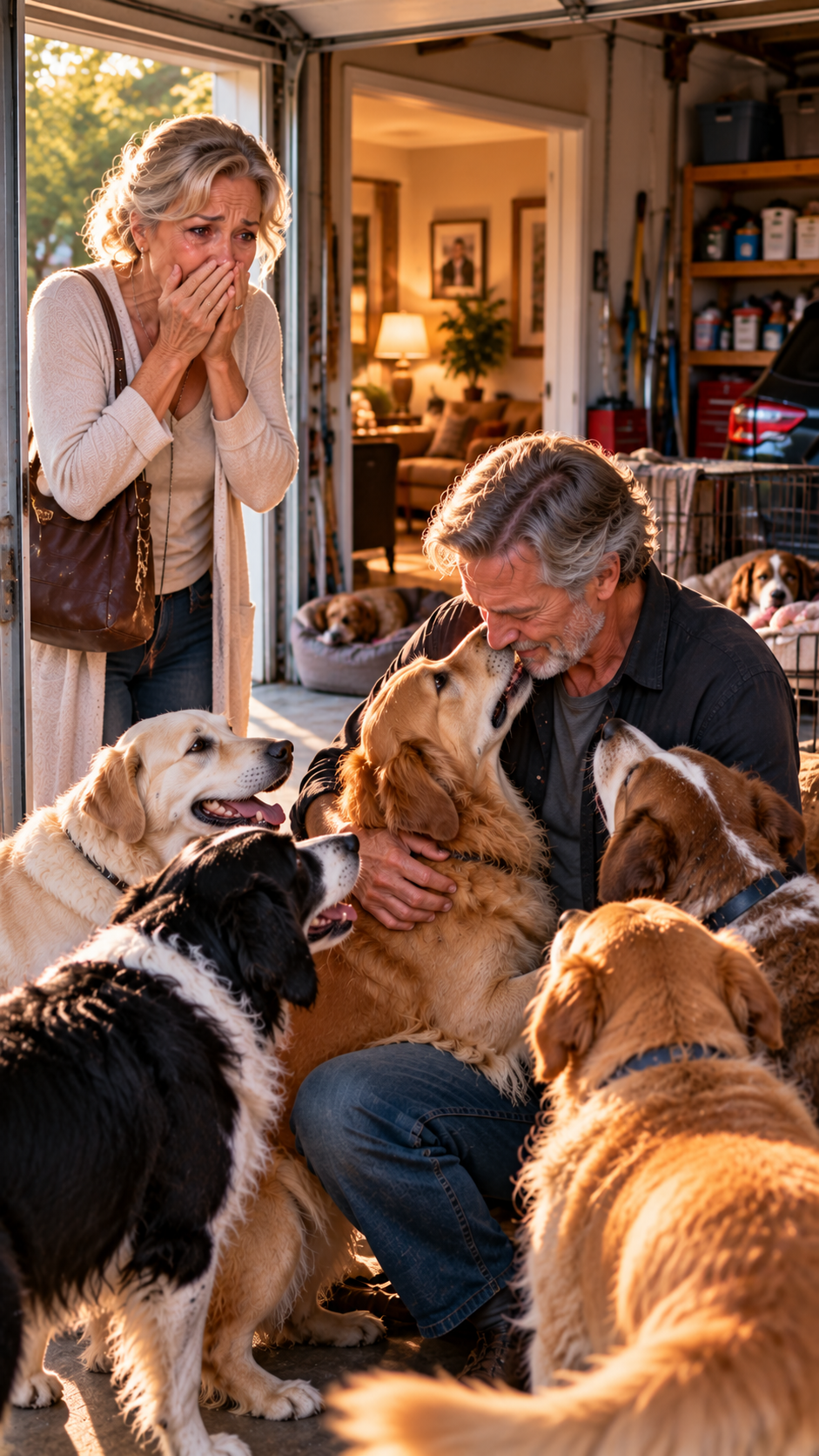
The garage door was open when I arrived.
Country music drifted from an old radio, barely loud enough to hear over the breeze.
The smell of fresh lumber and paint reached me before I reached the workbench.
I stopped in the driveway.
Then I noticed what Wendell had built.
A wooden ramp led from the garage floor toward the entrance of his house.
It was broad enough to walk on comfortably, with polished handrails running along both sides.
I stepped closer and wrapped my fingers around one rail.
The height was just right for me.
Not for Wendell.
He was a tall man who could reach the top shelf of almost any cupboard without standing on his toes.
I needed something to hold when my knees started hurting.
And there I was, standing beside a ramp that seemed to understand my body better than I sometimes did.
I couldn’t explain it.
Not yet.
My name is Winona Pruitt, though most people who know me well call me Winnie.
I was sixty-four years old when this happened.
For thirty-four years, I had worked as an emergency-room nurse in Dallas.
I had watched people arrive frightened, injured, and sometimes too sick to speak.
I had learned to recognize trouble in the smallest details.
A change in someone’s breathing.
A face that suddenly lost its color.
A hand that wouldn’t stop shaking.
I was good at noticing things.
At least, I had always thought I was.
My husband, Dwight, used to joke that I couldn’t turn off my nursing instincts even on Sundays.
He would catch me watching someone across the church aisle and shake his head.
“Winnie, you’re not on duty today.”
I’d tell him I was only looking.
He’d smile and take my hand.
I could recognize trouble in strangers.
But when it came to my own husband, I had missed something I could never forgive myself for missing.
Dwight had been mowing the lawn when he came inside one afternoon and said his arm felt wrong.
He looked tired, but he didn’t seem frightened.
He lowered himself into his favorite brown recliner beside the living-room window.
“Bring me something cold to drink, sweetheart. I’ll feel better in a minute.”
I went to the kitchen.
It took only a short time to pour his iced tea.
When I returned, he was no longer sitting upright.
He had collapsed.
I dropped the glass and went straight to him.
I began CPR while waiting for the ambulance, working as quickly as I could.
I knew what to do.
I had done it for strangers more times than I could count.
But knowing the procedure didn’t mean I could bring my husband back.
Dwight died.
For months afterward, I replayed that afternoon in my head.
I questioned every decision.
I wondered whether I should have recognized the danger sooner, whether a different response might have changed the outcome.
I knew, professionally, that emergencies didn’t always offer warnings a person could recognize in time.
Knowing that didn’t make the guilt disappear.
The recliner remained where Dwight had left it.
I dusted the wooden arms every week.
I cleaned beneath it.
I straightened the cushion.
But I never sat in it, and I couldn’t bear to let anyone else use it.
It was a foolish thing to preserve, perhaps.
Still, I wasn’t ready to move it.
My daughter, Megan, occasionally suggested we rearrange the living room.
I always gave her the same answer.
“Not yet.”
She stopped asking.
After Dwight died, my world became smaller than I expected.
I went to the supermarket when I needed groceries.
I attended church when I could manage the walk from the parking lot.
I visited Dwight’s grave and spoke to him as though he might answer.
Then I went home and repeated the same routine.
There were no great adventures.
No plans I looked forward to.
Just one day following another.
My knees made even that simple life difficult.
Years of walking hospital corridors had taken their toll, and the pain had become worse as I grew older.
Some mornings, I stood at the front door and studied the steps before attempting them.
I hated having to think about something as ordinary as walking.
My mother had eventually needed a wheelchair for the final eight years of her life.
I sometimes wondered whether I would follow the same path.
The thought frightened me more than I admitted.
I didn’t want to become someone who needed help with every small task.
I didn’t want my children watching me struggle.
And I certainly didn’t want to spend the rest of my life sitting inside because getting outdoors had become too difficult.
Then my neighbor Carla decided she had watched me grieve long enough.
Carla was seventy-one, had been widowed herself, and wore bright pink lipstick as though it were part of her daily uniform.
One morning, she appeared at my door with her purse already over her shoulder.
“There’s a grief group at the senior center. You’re going with me.”
I told her I wasn’t interested.
She looked past me into the house.
“You’re spending all day in there anyway. At least this place has coffee.”
I tried to explain that talking about my feelings with strangers wouldn’t bring Dwight back.
Carla listened without changing her expression.
Then she told me to put on my shoes.
I went because arguing with Carla took more energy than attending the meeting.
That decision changed my life.
The support group met in a modest room at the senior center.
There were folding chairs, a table covered with paper cups, and a coffee pot that seemed to have been there since the building opened.
People introduced themselves one at a time.
Some cried.
Some talked about their spouses.
Others sat quietly and listened.
I was relieved to discover that nobody expected me to say anything profound.
That was where I met Wendell.
He was sixty-six, tall, and broad through the shoulders.
His hair had turned gray, and his hands looked strong enough to carry heavy boxes without much effort.
But when he spoke, there was a gentleness about him that didn’t match his size.
He told the group that he had lost his wife, Ruth, fourteen months earlier.
He had spent thirty-eight years working for an electric cooperative before retiring.
That was all he wanted to say about himself.
“My wife died last year,” he told us. “I’m not ready to talk much more than that.”
The group leader assured him he didn’t have to.
Wendell lowered his eyes toward his coffee.
I recognized the look on his face.
I had seen it on relatives waiting outside hospital rooms, trying to prepare themselves for news they didn’t want to hear.
He wasn’t asking for sympathy.
He was simply trying to get through the hour.
I understood that feeling.
The next week, my knees were aching badly enough that I arrived late.
Most of the chairs were occupied.
Before I could decide where to sit, Wendell stood and brought me a cup of coffee.
He had added two creams.
I stared at the cup, then at him.
“How did you know I take it that way?”
He shrugged.
“You did last week.”
It was such a small thing.
Two creams.
Nothing more.
But he had paid attention when I hadn’t even realized anyone was watching.
For the first time in a long while, I felt seen without feeling examined.
I sat beside him.
We didn’t talk about anything important that morning.
We discussed the weather, the senior center’s terrible biscuits, and whether the television in the lobby had always been so loud.
When the meeting ended, Wendell walked with me to the parking lot.
He didn’t offer to take my arm.
He didn’t tell me I was walking too slowly.
He simply matched my pace.
I noticed that.
I noticed everything.
And for once, what I noticed made me feel a little less alone.
Source: kaylestore.net
Click here to continue reading: PART 2: He Remembered the Things I Forgot Telling Him, Yet Every Time I Asked About His Home, He Found Another Reason to Wait
I Thought My Son Was Protecting Me Until I Saw What a Man Was Building Behind the Garage Door
Part 1 of 12