I used to believe that if I made myself small enough, my family would eventually stop treating me like a problem.
I was wrong.
The first time my mother told me to leave before my brother brought his girlfriend home, I thought it was temporary.
By the time I understood what she was doing, I had spent eight years learning how to disappear on command.
It started two days before Easter.
I was walking through the hallway when I noticed the empty spaces on our living room wall.
Six family photographs had been taken down.
The hooks were still there, and the lighter rectangles on the paint showed exactly where the frames had been hanging.
I stopped and looked at the wall for a while.
My mother came out of the kitchen carrying a dish towel.
“I’m having the pictures updated,” she said.
I asked which pictures she meant.
She glanced at the wall.
“The old family ones.”
There was one photograph of me left in the living room.
It was my high school portrait from my junior year, framed in silver and placed on a shelf beside a white candle.
The candle wasn’t there before.
I pointed at it.
“What’s that for?”
“Easter,” she said.
She spoke as though the answer should have been obvious.
Then she reached past me, picked up my seven-day pill organizer from beside the toaster, and put it inside the silverware drawer.
I watched her close the drawer.
“Why are you moving my medicine?”
“Because the kitchen needs to be tidy.”
She didn’t wait for me to answer.
That was how conversations with my mother usually ended. She gave an explanation that sounded reasonable if you didn’t look at it too closely, then moved on before you could ask another question.
I opened the drawer and took my organizer back.
She watched me do it.
“Mitch is coming home this weekend,” she said. “He’s bringing Avery.”
I knew the name.
Avery Lockheart.
My brother had mentioned her a few times since starting college at the University of Alabama.
Mom had already learned enough about her family to talk about them as if they were people we needed to impress.
“They’re from Mountain Brook,” she continued.
We lived near Hoover, roughly twenty minutes away.
To my mother, though, the difference between the two places seemed enormous.
She said the Lockhearts had been through a terrible tragedy.
“They’ve had enough sadness in their lives. We don’t need to make things uncomfortable for them.”
I thought she meant the family photographs.
I thought she meant the candle.
Then she looked directly at me.
“You should stay somewhere else this weekend.”
I remember the sound of the refrigerator running behind her.
I remember holding my pill organizer in one hand.
I also remember how quickly I started looking for reasons she might be right.
Maybe Avery was sensitive.
Maybe the family tragedy had made certain subjects difficult.
Maybe Mom was worried I would say something inappropriate.
I didn’t ask what I was supposed to do that was so embarrassing.
I already knew the answer she would give.
My situation.
That was the phrase she used when she wanted to refer to the period after my hospitalization without explaining anything about it.
She never said the word illness.
She never said I had struggled.
She called it my situation, as if I were an inconvenient stain on a perfectly clean shirt.
I was nineteen when this began.
Mitch was twenty, studying engineering in Tuscaloosa, and still the only person in our family who called me Stace.
He arrived Friday evening.
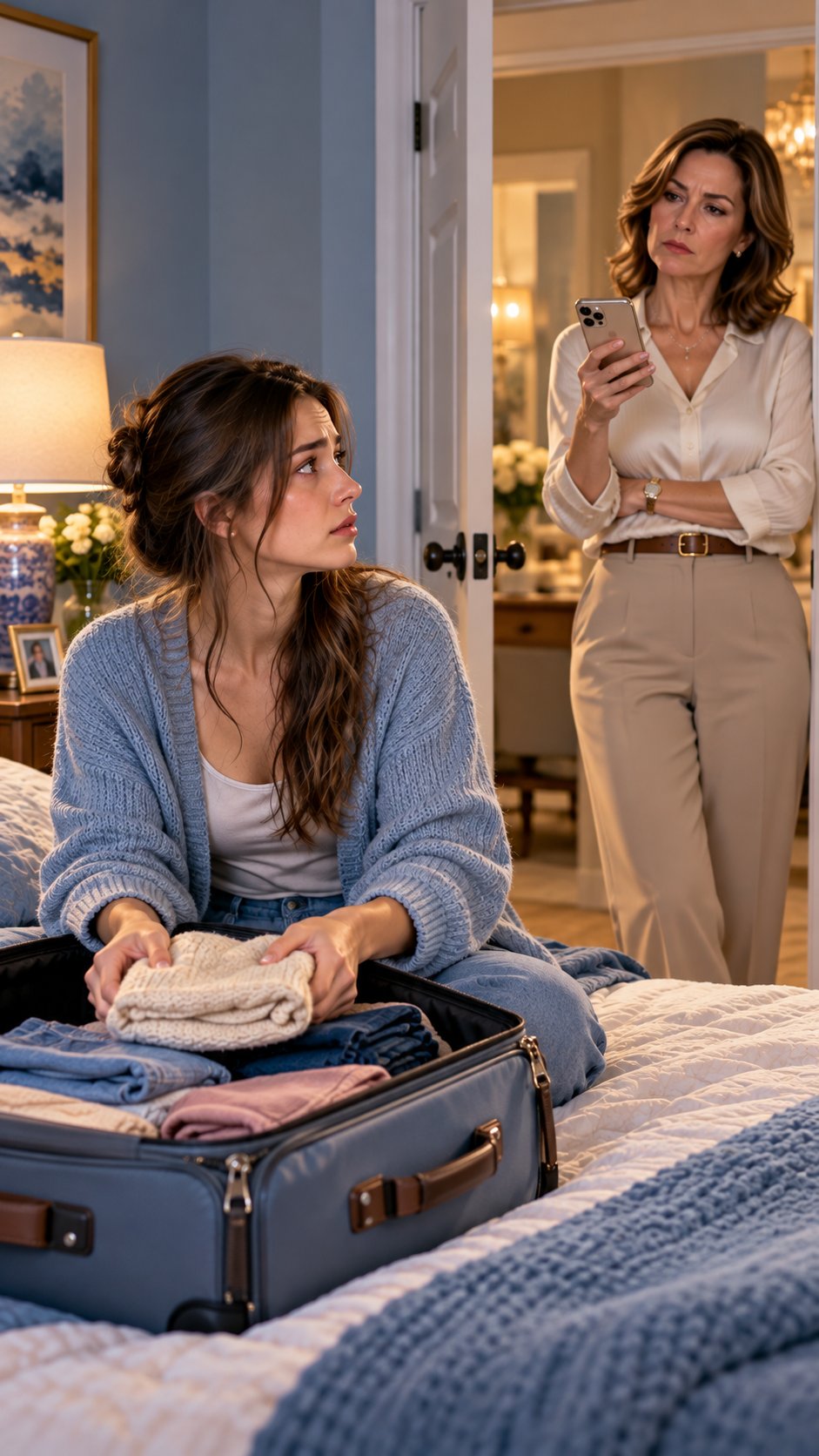
I was sitting on my bed, putting clothes into a duffel bag, when he appeared in the doorway.
He looked at the bag.
Then he looked at me.
“I’m sorry, Stace.”
I thought he meant he was sorry about Mom and Dad.
I thought he might finally tell them I had a right to stay in my own house.
“Sorry about what?” I asked.
He looked as though he wanted to say something else.
Instead, he lowered his eyes and walked away.
I sat there with a shirt in my hand.
For years afterward, I wondered whether I should have followed him.
Maybe I should have demanded an explanation.
Maybe I should have asked him what he knew.
But I had grown accustomed to accepting half an apology in place of a real one.
I finished packing.
The next morning, Dad placed my car keys beside the kitchen sink.
He didn’t tell me to hurry.
He didn’t need to.
I knew what time I was expected to leave.
At 10:59, I backed out of the driveway.
I watched the house in my rearview mirror.
A few moments later, Mitch’s Jeep turned onto our street.
A girl sat beside him, laughing at something he had said.
I knew it was Avery from the photographs Mom had shown me.
She never saw me.
That was exactly how my mother wanted it.
I drove south for about forty-five minutes, heading toward Chilton County.
I had nowhere else I particularly wanted to go.
But there was a peach farm there, and the woman who owned it had never asked me to explain why I kept arriving with a bag.
Her name was Ruth Tidwell.
Her granddaughter, Casey, had been my best friend since high school.
When I pulled into the farm, Ruth was working outside.
She saw me get out of the car and noticed the duffel bag on my shoulder.
She didn’t ask why I had come.
She didn’t ask what my parents had done.
She simply looked at my hands.
“Come wash up first,” she said. “We can talk later.”
I followed her to the sink.
Then she gave me a pair of gloves and showed me where to begin thinning the peach trees.
I had studied horticulture, so I understood the work.
A tree could produce more fruit than its branches could support.
If you left every little peach in place, the branches would carry too much weight, and the fruit would compete for the same limited resources.
You had to remove some of the young peaches so the others had room to grow.
By lunchtime, the ground was scattered with small green fruit.
I kept working.
It was easier than thinking about the house.
It was easier than wondering why my mother had placed a candle beside my photograph.
That afternoon, Ruth took me to a tree near the edge of the orchard.
Everyone had assumed it was dead after the January freeze.
The branches were gray, and the smallest twigs looked brittle.
Ruth took out a small knife and gently scraped the surface of one twig.
Beneath the dull outer layer was a thin line of green.
She turned the twig so I could see it.
“That’s how you tell,” she said.
I leaned closer.
“Even after a winter like that?”
“Especially after a winter like that.”
She released the branch.
“There’s still life underneath.”
I didn’t tell her how much I needed to believe her.
I simply stood there and looked at the green beneath the bark.
On Sunday evening, I drove home.
The house smelled of ham and lilies.
The candle beside my portrait had burned down to about half its original height.
Mom asked whether I had enjoyed my weekend.
I said yes.
She nodded, satisfied.
I didn’t tell her about the peach trees.
I didn’t tell her about Ruth’s words.
And I didn’t ask why nobody had called to see whether I was safe.
That was my first mistake.
I thought if I behaved as though nothing had happened, perhaps nothing worse would happen next time.
I had no idea how many next times there would be.
That summer, my mother began referring to Avery as Mitch’s fiancée, even though he hadn’t proposed.
The distinction didn’t matter to Mom.
She had decided what the relationship was going to become, and she was already arranging the rest of our lives around it.
In May, she installed a keyed lock on the outside of my bedroom door.
She said it was to prevent Avery from accidentally walking into my messy room.
My room was the neatest room in the house.
The key stayed on Mom’s key ring.
If she went out and I needed something from my bedroom, I sometimes had to wait until she returned.
My toothbrush eventually moved into a plastic bag in my car.
My mail began disappearing before visits.
My car was no longer allowed to sit in the driveway because someone might ask who owned it.
There was always a reason.
There was always a visitor.
There was always something about my presence that needed to be managed.
At first, I thought these were separate rules.
I hadn’t yet understood that they were all serving the same purpose.
I was being removed from the picture.
Source: kaylestore.net
Click here to continue reading: PART 2: I Paid Rent for a Bedroom I Was Forbidden to Enter, While My Family Quietly Built a Life That Had No Place for Me
The Weekend My Mother Hid My Medicine and Removed My Photographs, I Still Believed I Was the Problem in Our Family
Part 1 of 8