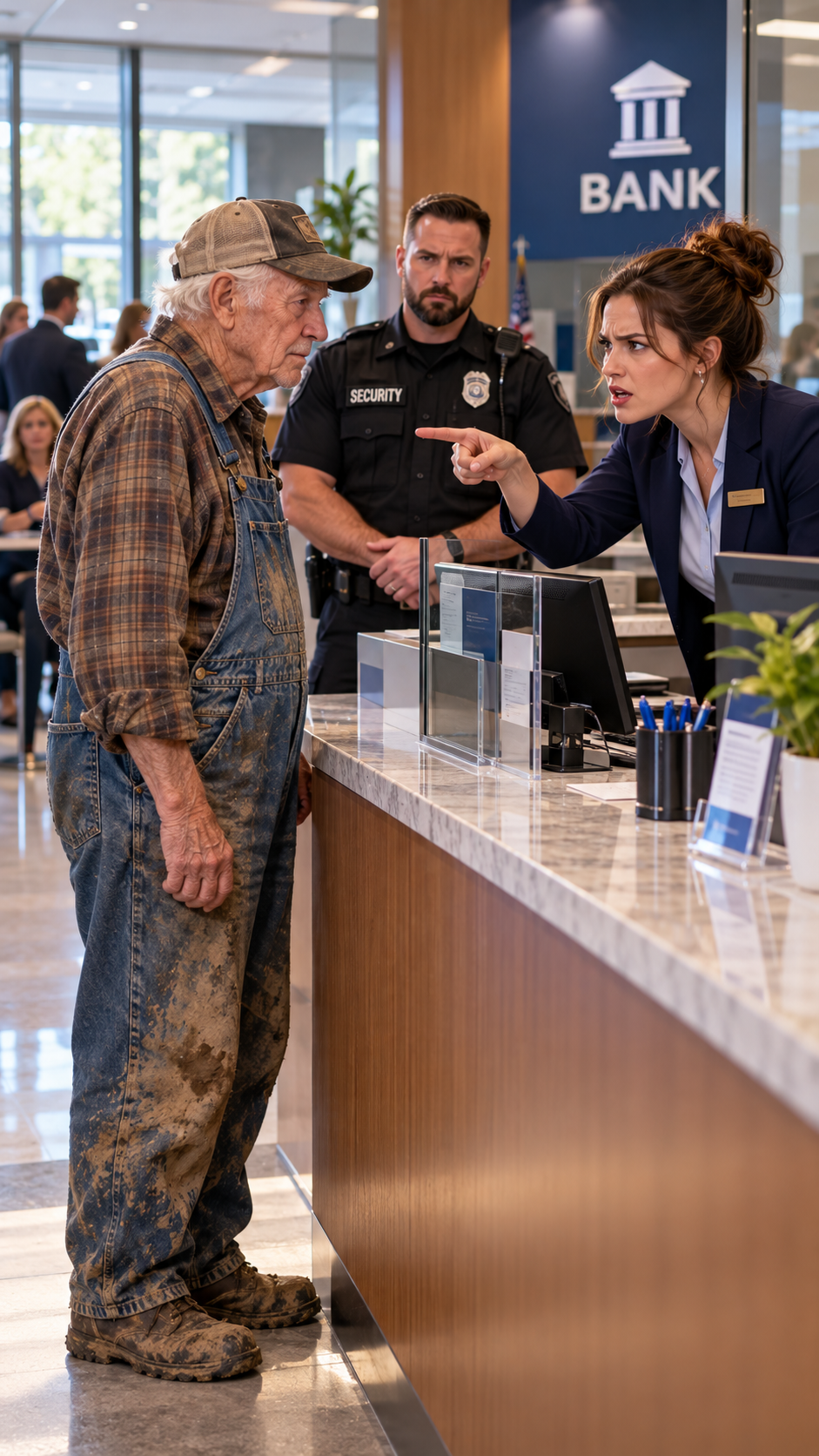
The first thing I remember is the guard reaching for his belt.
The second is my grandfather standing perfectly still.
He held his old baseball cap between his hands, his boots leaving dark marks on the bank’s new carpet. Around us, people had stopped pretending not to watch.
Then the bank president came hurrying across the lobby.
“Rick, take your hand away from your belt.”
Tom Callahan spoke quietly.
The guard obeyed at once.
I remember looking at the teller behind the counter. Her name tag said Brittany, and the color had drained from her face.
Tom stopped beside my grandfather.
“Do you know who you’re dealing with?”
Brittany tried to answer.
“He told me his name was Earl Doyle.”
Tom looked at her for a moment.
Then he turned toward Grandpa.
“Earl put up his own land to help this bank survive when nobody else would.”
Nobody moved.
“He helped open the Dunmore branch in 1974,” Tom continued. “If he hadn’t signed those papers, this place might never have existed.”
He glanced around the expensive lobby.
“Neither would a lot of the people standing in it.”
I was twenty years old, studying agronomy at Iowa State, and I had never heard any of this before.
My grandfather had never mentioned it.
To me, Earl Doyle was a farmer who measured his life in acres, rainfall, broken machinery, and the number of hours left before sunset.
He was eighty-four.
He still wore the same kind of overalls he’d worn for most of my childhood. His cap came from a feed store, and his boots had been repaired so many times that I sometimes wondered whether the original leather was still underneath all the patches.
He drove an old Ford pickup that rattled on cold mornings.
He bought tools only when the old ones couldn’t be fixed.
And he never acted as though anybody owed him anything.
That Tuesday in October, all he wanted was two thousand dollars.
Nothing more.
If the morning had gone as planned, we would have collected the cash, driven to the dealership in Ames, and returned to the farm before the afternoon got away from us.
Instead, we ended up standing in a bank lobby while strangers watched my grandfather being treated like a criminal.
I had started the day believing that knowing someone well meant knowing their story.
By lunchtime, I understood how wrong I had been.
That morning had begun before sunrise.
Grandpa was already in the farmhouse kitchen when I came downstairs. His coffee sat beside the old radio, and the agricultural report was playing softly through a speaker that crackled whenever the announcer mentioned the weather.
I poured what remained in the pot.
Grandpa glanced toward the window.
“Looks like we’ll get a decent day.”
I followed his eyes across the yard.
The sky was clear, but the air had that sharp October bite that made the metal handles on the doors cold against your fingers.
We had been harvesting since the beginning of the season.
I’d been helping him every fall since I was nine, and by then, working beside him felt less like a chore than a part of who I was.
He owned six hundred and forty acres near Marlow, Iowa.
His father had worked the same ground with horses back in 1936. Grandpa had spent his life improving it, one field and one season at a time.
He knew which low spots held water after heavy rain.
He knew where the soil changed color and where the corn would struggle if the summer turned dry.
He could look at a field from the road and tell me more about it than I could learn from an hour staring at a computer screen.
I was studying agronomy because of him.
He never told me that was why he was proud of me.
He didn’t need to.
Whenever I came home from college, the porch light was on before I reached the driveway. My favorite mug was always clean, and there was usually something in the refrigerator he thought I might like.
That was Grandpa’s way of saying what other people said out loud.
We finished breakfast and headed toward the machinery shed.
The combine was supposed to finish another stretch of corn that morning.
Instead, the machine gave a hard jerk and stopped.
Grandpa shut off the engine.
Neither of us spoke for a moment.
He climbed down, crouched beside the drive assembly, and examined the damage.
The belt had shredded itself around a pulley that had bent out of alignment.
I crouched beside him.
“Can we fix it with what we’ve got?”
“Not this one.”
He pulled a piece of torn rubber free and turned it between his fingers.
The replacement needed to come from a John Deere dealership in Ames. It was a special-order part, and the dealership wanted cash when we collected it.
The price was two thousand dollars.
Grandpa stood, wiped his hands on a rag, and looked toward the pickup.
“Guess we’re going to town.”
He didn’t complain about the cost.
He didn’t blame the machine.
He simply accepted that the day had changed and adjusted his plans.
That was another thing I’d learned from him.
You could be angry about the weather, the machinery, or the price of a replacement part. None of it would make the work disappear.
We climbed into the Ford and headed toward Marlow.
Mud had dried along the doors, almost reaching the handles. Grandpa’s boots were dirty, and his overalls carried the usual evidence of a morning spent working around machinery.
He could have changed clothes.
He didn’t see a reason to.
The bank was on Main Street, in a building I’d known since I was little.
Back then, the place had worn-looking floors and small bowls of butterscotch candies beside the teller windows. I remembered visiting with my parents and receiving a lollipop from Tom Callahan, who had worked there long enough to become a familiar face around town.
The building had changed considerably since those days.
The entrance now had automatic glass doors. The floors were covered with fresh gray carpet, and a polished white counter stretched across the lobby.
Near a coffee station stood an elaborate espresso machine.
On the wall, a large advertisement showed an older couple sailing beneath a promise about retirement.
Everything looked expensive.
Everything looked carefully arranged.
Grandpa parked the pickup outside, and we went in.
The automatic doors slid apart with a soft mechanical sound.
A few customers stood near the teller windows. Someone was stirring coffee, and a machine hissed behind us.
Grandpa removed his cap as we approached the counter.
Brittany was working at one of the windows.
She looked young, perhaps twenty-five, with carefully painted nails and a lanyard decorated with tiny charms. I had seen her before, but I didn’t know her name until I read the tag pinned to her blouse.
Grandpa waited until she looked up.
“Good morning. I’d like to withdraw two thousand dollars in cash.”
She held out her hand for his identification.
He gave her his driver’s license.
She studied it.
Then her eyes moved to his clothes.
They went from his overalls to his boots and finally to the mud on the carpet.
She looked back at the license.
“Two thousand dollars?”
“Yes, ma’am.”
“What do you need that much cash for?”
I remember how ordinary the question sounded at first.
Then I heard the way she asked it.
“It’s for a replacement part for my combine,” Grandpa explained.
Brittany gave a tight little smile.
Behind us, somebody made a quiet sound that might have been a laugh.
I turned around, but the person was already looking elsewhere.
Something inside me tightened.
Grandpa was asking for money from his own account. He wasn’t demanding special treatment or asking anyone to do him a favor.
He had come in politely.
He had handed over his identification.
And somehow, the condition of his boots seemed to matter more than any of that.
“He’s withdrawing his own money,” I said.
My voice came out sharper than I’d intended.
Brittany looked at me.
Then she reached beneath the counter for the telephone.
I watched her speak into it, her eyes occasionally returning to Grandpa.
A moment later, the security guard began walking toward us.
His name was Rick.
He was broad-shouldered, with a graying mustache and the steady walk of someone accustomed to people moving aside when he approached.
His gaze settled on my grandfather.
One of his hands drifted toward his belt.
Grandpa didn’t step back.
He didn’t raise his voice or demand to know what was happening.
He simply held his cap.
I had seen him stand like that before, at funerals and beside fields ruined by hail. He could remain still through things that made everyone around him restless.
But this was different.
I was angry enough to say something I might regret.
Then a voice came from across the lobby.
“Earl?”
Tom Callahan was crossing the floor toward us.
He was wearing a gray three-piece suit, with a folded pocket square in his jacket. His shoulders leaned forward slightly, as if years of listening to people across desks had left him permanently bent toward whoever needed his attention.
He didn’t stop to speak to Brittany.
He didn’t stop to question Rick.
He came straight to my grandfather.
And when he reached him, he took Grandpa’s hand in both of his.
“Earl, I’m sorry. I wish you’d called me before coming in.”
Grandpa gave him a small nod.
“Morning, Tom.”
“I could have come to the farm.”
“Didn’t need you at the farm. Just needed the cash.”
Tom’s expression changed.
He looked at the teller window, then at the guard, and finally at the muddy tracks leading across the carpet.
I had never seen him look so disappointed.
He turned toward Brittany.
“Please step out from behind the counter.”
She did.
Her hands were clasped in front of her, and the little charms on her lanyard trembled as she moved.
“I didn’t know who he was,” she said.
Tom kept his voice level.
“You didn’t know him, so you made up your mind about him.”
Brittany stared at the floor.
Tom asked her something I still remember because of how simply he put it.
“If a man wearing a suit had asked you for the same amount, what would you have done?”
She hesitated.
“I would have asked how he wanted it.”
“Exactly.”
Nobody behind us spoke.
Tom told her to apologize to Grandpa, not to him.
Brittany turned toward the old farmer she had judged a few minutes earlier.
She struggled to get the words out, then finally admitted that she had been rude and had made an unfair assumption.
Grandpa listened without interrupting.
When she finished, he asked how long she’d been working at the bank.
“Eleven days,” she whispered.
He asked where she’d worked before.
An insurance call center in Des Moines, she said. Before that, she had grown up in Waterloo, where her mother cleaned offices at night.
Grandpa turned his cap between his hands.
“Then you know what it feels like when somebody thinks they’re better than you.”
Her face crumpled.
“Yes, sir.”
He studied her for another moment.
“I won’t tell you what you did was right. It wasn’t.”
Brittany wiped at her cheeks.
“But you can choose what you do next,” he said.
Tom gave her the rest of the morning off and told her to meet him in his office the following day.
She collected her purse and left through the glass doors.
The lobby slowly began to move again, but the silence stayed with me.
I thought Tom would finish the withdrawal and send us on our way.
Instead, he called over another teller and asked him to prepare Grandpa’s two thousand dollars.
Then he asked for Grandpa’s account history.
Grandpa frowned.
“What do you need to look at that for?”
Tom didn’t answer immediately.
He glanced toward the office at the back of the bank.
“There’s something I’ve wanted to show you for a long time, Earl.”
He paused.
“Something I should have shown you years ago.”
And as he led us away from the counter, I noticed the old photograph hanging behind his desk through the open office door.
It showed a group of men standing outside a brick building in 1974.
One of them was wearing a work jacket.
A familiar-looking cap rested against his chest.
Source: kaylestore.net
Click here to continue reading: PART 2: The Photograph Behind the Bank President’s Desk Held a Secret My Grandfather Had Kept From His Family for More Than Fifty Years
My Grandfather Only Wanted Two Thousand Dollars, but the Way They Looked at His Muddy Boots Changed Everything I Believed
Part 1 of 12