I used to think my parents would eventually see me for who I was.
I was wrong.
By the time we stood in court over my grandmother’s $4.7 million estate, they had spent thirty-five years convincing themselves that I was the least capable person in the family.
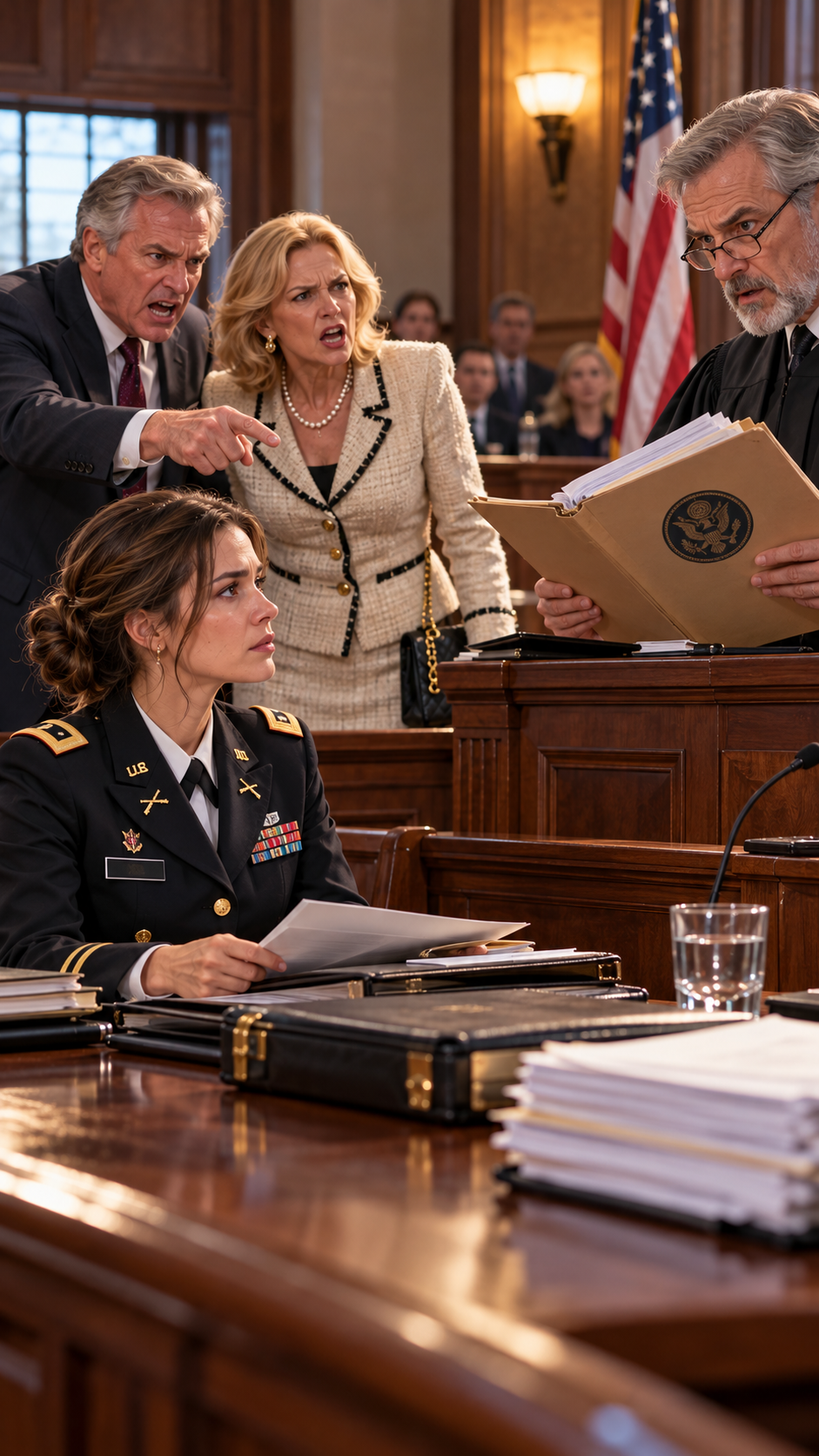
My mother sat in a cream-colored suit beside my father, speaking softly to their lawyer.
My father looked comfortable.
Too comfortable.
He had the expression of a man who believed the outcome had already been decided.
I sat across the room beside Rebecca Hayes, the attorney I had hired to defend my grandmother’s final wishes.
My hands rested on a folder in my lap.
Inside it were documents my parents had never expected to see.
But before I could explain any of that, Judge Harrison picked up a page from the file in front of him.
He read it once.
Then he read it again.
Finally, he raised his eyes toward me.
“Ms. Bennett, do you serve as an attorney with the Judge Advocate General’s Corps?”
For a moment, I forgot how to breathe.
My father turned so quickly that his chair made a scraping sound against the floor.
“What did he just say?”
I stood.
“Yes, Your Honor.”
My mother stopped whispering.
My father stared at me as if I had walked into the courtroom wearing someone else’s face.
“She’s a military lawyer?”
The judge instructed him to remain quiet.
I sat down again.
I had spent years wishing my parents would ask about my life.
Now, when they finally discovered what I did, it was because they were trying to prove I was unworthy of my grandmother’s money.
That was the part I couldn’t stop thinking about.
My name is Caroline Bennett.
I was thirty-five years old when my parents challenged the inheritance my grandmother, Eleanor Bennett, had left me.
They claimed I had influenced her decisions.
They questioned her ability to understand her own estate.
And they portrayed me as a daughter who lacked the judgment and experience to handle a substantial fortune.
What they didn’t understand was that my grandmother had made her decision long before any of us entered that courtroom.
She had thought about it carefully.
She had kept records.
And she had left behind a statement explaining her reasons.
There was also another matter involving $620,000 that my parents had received from her over the years.
I knew some of those financial arrangements existed.
I didn’t know their full extent until the legal proceedings began.
But the story really started much earlier, in a house outside Portland, Oregon, where I learned that being noticed was not the same as being loved.
My father, Richard Bennett, ran a commercial property business.
My mother, Diane, organized charity events and spent much of her time maintaining friendships with people who seemed to know everyone worth knowing.
We lived comfortably.
Our home was clean, our holidays were organized, and our family photographs always looked good.
From the outside, there was very little to criticize.
Inside, though, I understood my place.
My older brother, Andrew, could do almost anything and receive praise for it.
When he joined the school basketball team, my parents arranged a celebration.
My mother invited relatives, and my father talked about Andrew’s potential as if he had already become someone important.
My sister, Melissa, received similar attention for her academic achievements.
She was confident, sociable, and good at making people feel comfortable around her.
My parents liked introducing her to people.
They liked telling stories about her grades.
They liked having something impressive to say.
I was different.
I kept to myself.
I read a lot.
I thought carefully before speaking, and I rarely interrupted anyone.
My parents seemed to interpret those qualities as evidence that I had little to offer.
I didn’t argue with them.
At sixteen, I still believed that if I worked hard enough, eventually they would notice.
Then I won a statewide writing competition.
I remember carrying the certificate into the kitchen.
The paper was slightly bent because I had held it too tightly on the way home.
I placed it on the table where my father was reading the newspaper.
He glanced at the award.
“Good for you, Caroline.”
Then he looked back at the page in front of him.
“Have you taken care of your chores?”
That was all.
I picked up the certificate and went upstairs.
I told myself it didn’t matter.
I told myself plenty of things like that in those days.
The truth was that I had wanted him to ask what I had written.
I wanted my mother to read the certificate and tell me she was proud.
I wanted one of them to look at me as though something I had done was worth stopping for.
None of that happened.
The following Saturday, I drove to my grandmother’s house.
Eleanor lived about twenty minutes away, in an older home with a garden she tended herself.
Rose bushes lined the walkway.
Flowering trees stood near the fence, and the porch had a wooden chair that creaked whenever someone sat down.
I loved that house.
Nothing there made me feel as if I had to compete for attention.
Grandma was in the kitchen when I arrived.
She had flour on one sleeve and a dish towel tucked into the waistband of her skirt.
I handed her the certificate.
She read every line.
Then she looked at me.
“You worked hard for this, didn’t you?”
I nodded.
She smiled and carried the paper into the living room.
Before I understood what she was doing, she had placed it on the mantel beside a framed photograph of my grandfather.
I felt embarrassed.
“Grandma, you don’t have to put it there.”
“Why not?”
“It’s just a school competition.”
She adjusted the certificate so it sat straight.
“And you earned it. That seems reason enough to me.”
Then she decided we needed cake.
She baked the lemon cake I liked best and invited two neighbors to stop by that afternoon.
They congratulated me, asked about the competition, and listened while I explained what I had written.
It wasn’t a grand celebration.
There were no expensive gifts or speeches.
But I remember the warmth of the kitchen, the smell of lemons, and the way Grandma looked at me when I spoke.
She was paying attention.
For the first time that week, I didn’t feel foolish for being proud of myself.
I carried that feeling home with me.
I returned to Grandma’s house whenever I could.
On Saturdays, I helped her pull weeds, trim the rose bushes, or plant flowers along the garden path.
Sometimes we worked for an hour before sitting on the porch with tea.
Sometimes she made lunch and asked me to tell her about school.
She remembered the names of my friends.
She remembered which books I liked.
If I mentioned something that had bothered me, she asked about it the following week.
Those small things mattered more than I knew how to explain.
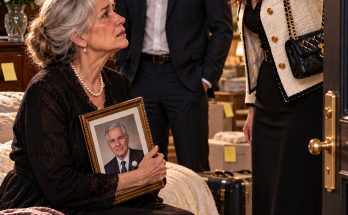
My grandfather had died years earlier, leaving Eleanor with a comfortable investment portfolio and a house she loved.
She worked with financial advisers to manage her assets, but she never seemed interested in displaying her wealth.
She preferred handwritten notes to expensive presents.
She enjoyed tending her plants more than visiting department stores.
When relatives gathered for dinner, she cared more about whether everyone had enough to eat than about how the table looked.
She used to tell me that money could make life safer and open doors that would otherwise remain closed.
But she never believed it made one person more deserving of respect than another.
I heard that lesson many times.
I didn’t realize how important it would become.
One afternoon, when I was seventeen, Grandma and I were sitting outside after finishing the garden beds.
She had removed her gloves and placed them beside her teacup.
“What do you think you’ll do after school?” she asked.
I looked down at my hands.
“I’ve been thinking about studying law.”
She didn’t laugh or tell me to be realistic.
She simply asked why.
I explained that I liked understanding how decisions were made, how rules worked, and how people could be treated fairly.
I wasn’t sure I had explained it very well.
Grandma seemed satisfied.
“Then give yourself the chance to find out if it’s right for you.”
I hesitated.
“Dad thinks I’m too quiet.”
She turned toward me.
“Your father seems to believe that speaking less means knowing less.”
I didn’t answer.
She picked up her teacup.
“Those are two very different things, Caroline.”
I remembered that sentence for years.
Not because it solved everything.
It didn’t.
But it gave me another way to understand myself.
My father could continue believing I was weak.
I didn’t have to accept his judgment as the truth.
When I received a university scholarship, Grandma was the first person I told.
She hugged me, asked when I needed to leave, and helped me prepare for the move.
My parents were less enthusiastic.
They questioned whether I needed to attend a university so far from home and whether I understood how difficult the next few years would be.
I listened to their concerns.
Then I accepted the scholarship.
Before I left, Grandma slipped a handwritten note into my suitcase.
She told me to read it when I needed encouragement.
I didn’t open it until I was alone in my dormitory.
The note was short.
She reminded me that other people’s reactions were not a reliable measure of my worth.
I folded it carefully and kept it.
I carried it through college.
I carried it through law school.
And I kept it after I began my career in military service.
My parents never understood that part of my life very well.
They knew I had joined the military, but they rarely asked what my responsibilities involved.
When I became an attorney with the Judge Advocate General’s Corps, my grandmother celebrated with me.
She wanted to hear about my work, although I was careful not to discuss matters I couldn’t share.
She asked about my training, my professional development, and the challenges of making decisions under pressure.
She listened.
My mother, meanwhile, described my work to relatives as administrative support.
Once, during a family dinner, she mentioned that I spent my days handling paperwork for the military.
I corrected her.
“I work as an attorney, Mom.”
She nodded briefly.
Then she began asking Andrew about a new business project.
I sat at the table and finished my meal.
After that, I stopped trying to explain my career to my parents.
I wasn’t hiding anything.
I was tired of offering pieces of my life to people who seemed determined not to see them.
Grandma never made that mistake.
She knew I had worked hard to earn my place.
She also knew I didn’t believe my career made me better than anyone else.
That was one reason I trusted her.
She never asked me to perform success for her.
She simply wanted me to build a life I could respect.
Years later, when I stood in court and watched my parents discover what I had become, I thought about that quiet kitchen and the certificate on Grandma’s mantel.
I wondered what she would have said about the way they were treating me.
Then I remembered something else.
My parents had never been particularly interested in my achievements.
But as Grandma grew older, they became very interested in her money.
And that was when the distance between the family they presented to the world and the family I knew began to matter in a way none of us could ignore.
Source: lessoninlife.net
Click here to continue reading: PART 2: Grandma Never Asked Me to Earn Her Love, but the More My Parents Needed Her Money, the More Carefully She Began Keeping Track
My Parents Were Certain I Had No Right to Grandma’s Fortune, Until the Judge Stopped Reading and Looked Straight at Me
Part 1 of 8