I used to believe that sending money every October meant I had done my part.
I was wrong.
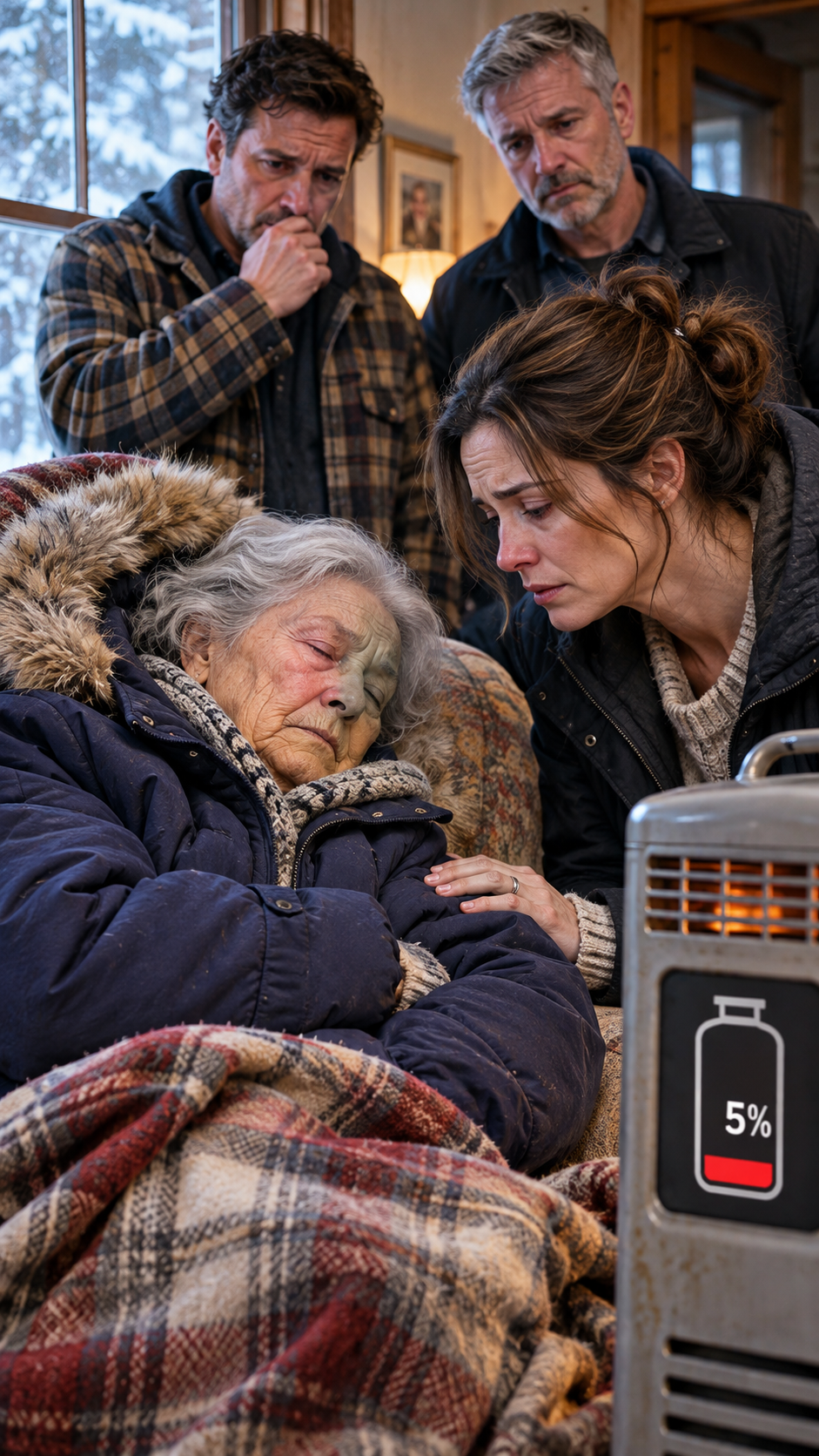
And I didn’t understand how wrong until I found my eighty-two-year-old mother sleeping in her winter coat in a house that had become colder than it should ever have been.
It happened during the third week of January.
The temperature had dropped so far that even people who had lived their entire lives in North Dakota were struggling to remember a winter quite like it.
The radio in Bismarck reported thirty-one degrees below zero.
That was the actual temperature.
With the wind, it felt closer to fifty-five below.
At those temperatures, exposed skin could become dangerous in minutes. Metal burned against bare fingers, and breathing outside hurt.
I knew all of that.
I had grown up on a farm.
But I wasn’t prepared for what I was about to discover.
On Wednesday evening, I called my mother.
She didn’t answer.
At first, I didn’t think much about it. Mom was eighty-two, and falling asleep in front of the television wasn’t unusual for her.
She loved watching old Lawrence Welk programs on public television.
Sometimes she’d leave her phone charging in the bedroom and forget to bring it back to her favorite chair.
I called again around nine.
Nothing.
At nine-thirty, I tried once more.
Still nothing.
I told myself she was asleep.
The following evening, I called again.
No answer.
I tried six times, maybe seven.
Then I contacted the Schmidts, the couple who lived closest to her property.
Their farm was approximately two miles away.
They usually checked on Mom whenever the weather became particularly bad.
Their telephone was busy.
I waited and called again.
Still busy.
That was when I started feeling uneasy.
I stood in my Bismarck kitchen holding my phone, staring at the number on the screen.
Something didn’t feel right.
My husband, Steve, was working for Burleigh County during the storm.
He operated a snowplow, and when the roads became dangerous, the county kept its drivers working around the clock.
He had been on duty since Tuesday afternoon.
Sometimes he slept for an hour or two inside his truck before returning to the roads.
I knew he couldn’t simply leave his assignment.
But I called him anyway.
“Steve, I can’t get Mom to answer.”
He didn’t interrupt.
“I tried last night, too. And I’ve called the Schmidts, but their line is busy.”
There was a brief silence.
“Do you think something happened?”
“I don’t know.”
He understood from my voice that I wasn’t asking him to guess.
I needed to go.
“Take the Suburban,” he said. “Fill it up in Washburn before you get too far. Bring the emergency supplies and the extra blanket.”
“Are you sure I shouldn’t wait?”
“No, Connie. Go.”
He couldn’t come with me.
He had roads to clear, and other people were depending on him.
“Call me when you arrive,” he added.
“I will.”
“And please be careful.”
I packed a flashlight, an extra blanket, gloves, and a few things from the emergency kit.
Then I headed north.
The drive from Bismarck to Mom’s farm was about 115 miles.
I followed Highway 83 before turning east onto Highway 200, passing through Turtle Lake and McClusky.
There was hardly another vehicle anywhere.
The headlights illuminated the snowbanks along the road, while the sky above the prairie looked almost completely black.
Stars were scattered across it.
I kept both hands on the steering wheel.
Every few minutes, I checked my phone, hoping Mom might finally call.
She didn’t.
I thought about Dad.
He had been gone for four years.
Since then, Mom had insisted on staying in the farmhouse where they had raised their children.
We had offered alternatives.
She could move into town.
She could stay with me in Bismarck.
Rob had even suggested building a small apartment near his house.
She refused every suggestion.
That farmhouse was her home.
Grandpa had settled the property in 1912.
The land covered 320 acres, with wheat fields, sunflower fields, and pasture.
The white farmhouse stood beside an old red barn.
Its northern roof had partly collapsed, and the shelterbelt Grandma planted decades earlier surrounded the yard.
There was a white propane tank beside the house.
Five hundred gallons.
I had seen it hundreds of times throughout my childhood.
It was an ordinary part of farm life.
But in winter, that tank meant everything.
Our area had no natural gas service.
Families depended on propane, heating oil, or wood to keep their homes warm.
Without propane, Mom’s furnace couldn’t operate.
And with temperatures dropping below thirty, the consequences could become serious very quickly.
I knew this.
I had simply never imagined that my mother might be sitting in a freezing house while the rest of us believed everything was taken care of.
I arrived at the farm at 11:20 that night.
The outside light was on.
That gave me a little comfort.
But the kitchen window was dark.
I parked near the back entrance, took my flashlight, and stepped outside.
The cold hit immediately.
I could feel it against my cheeks and around my eyes.
By the time I reached the door, my eyelashes were already collecting moisture that began freezing.
The kitchen door was unlocked.
Mom had always been that way.
Even after Dad died, she rarely remembered to lock it.
I opened the door.
And immediately noticed something missing.
The furnace.
There was no sound coming from the basement.
That furnace had been installed in 1987.
I had heard it running throughout my childhood visits.
It made a low mechanical rumble, followed by a clicking sound whenever it started or stopped.
Usually, it was the loudest thing in the house.
That night, I heard nothing.
Only the kitchen clock.
It was an old Westclox with a rooster printed on its face.
Dad had bought it at the hardware store in Harvey in 1970.
It still hung above the kitchen table.
Tick.
Tick.
Tick.
I stood there listening.
Then I noticed my breath.
I could see it.
Inside the house.
I removed one glove and touched the kitchen wall.
It was cold.
I walked toward the living room.
My boots left small patches of snow on the linoleum.
Then my flashlight moved across the furniture.
And I saw her.
Mom was sitting in Dad’s old recliner beside the picture window.
Her body was slightly tilted to one side.
She appeared to be asleep.
But something about her clothing made me stop.
She was wearing her long brown winter coat.
The same coat she had worn to church for years.
It had large buttons, a thick collar, and a little imitation fur around the neckline.
The coat was fastened all the way up.
She also had a red-and-green knitted hat on her head.
My niece had made it for her two Christmases earlier.
Across her legs was Grandma’s old crocheted blanket.
Orange.
Brown.
Gold.
The same blanket that had covered us when we were children.
Mom’s hands were resting together.
She was wearing gloves.
I couldn’t move.
I looked toward the windows.
Frost had formed on the inside of the glass.
Not a little frost.
Thick white patterns covered almost the entire surface.
I could barely see the yard light outside.
Then I looked back at Mom.
For one terrible moment, I thought she might be dead.
I stepped closer.
“Mom?”
Nothing.
I watched her chest.
The blanket moved slightly.
Once.
Then again.
She was breathing.
Relief.
I placed my flashlight on the floor and approached the recliner.
The thermostat was mounted near the hallway.
It was an old beige Honeywell model with a small pointer that could be moved by hand.
I checked its setting.
Fifty-eight degrees.
Then I looked at the thermometer underneath it.
The actual temperature was fifty-one.
Fifty-one degrees.
I stood there looking at those numbers.
My mother was eighty-two years old.
She had been sleeping in that room wearing her winter coat, hat, and gloves.
And I had driven 115 miles to discover that the house we believed was being heated properly had become dangerously cold.
I didn’t know what to say.
I didn’t even know whom to blame.
But I knew one thing.
This could not continue.
Source: kaylestore.net
Click here to continue reading: PART 2: Three Siblings Had Been Sending Money Every October, but One Pink Delivery Receipt in the Kitchen Made Me Question Everything
I Thought My Mother Was Simply Sleeping Through Another North Dakota Winter, Until I Walked Into Her Living Room and Realized Something Was Terribly Wrong
Part 1 of 12