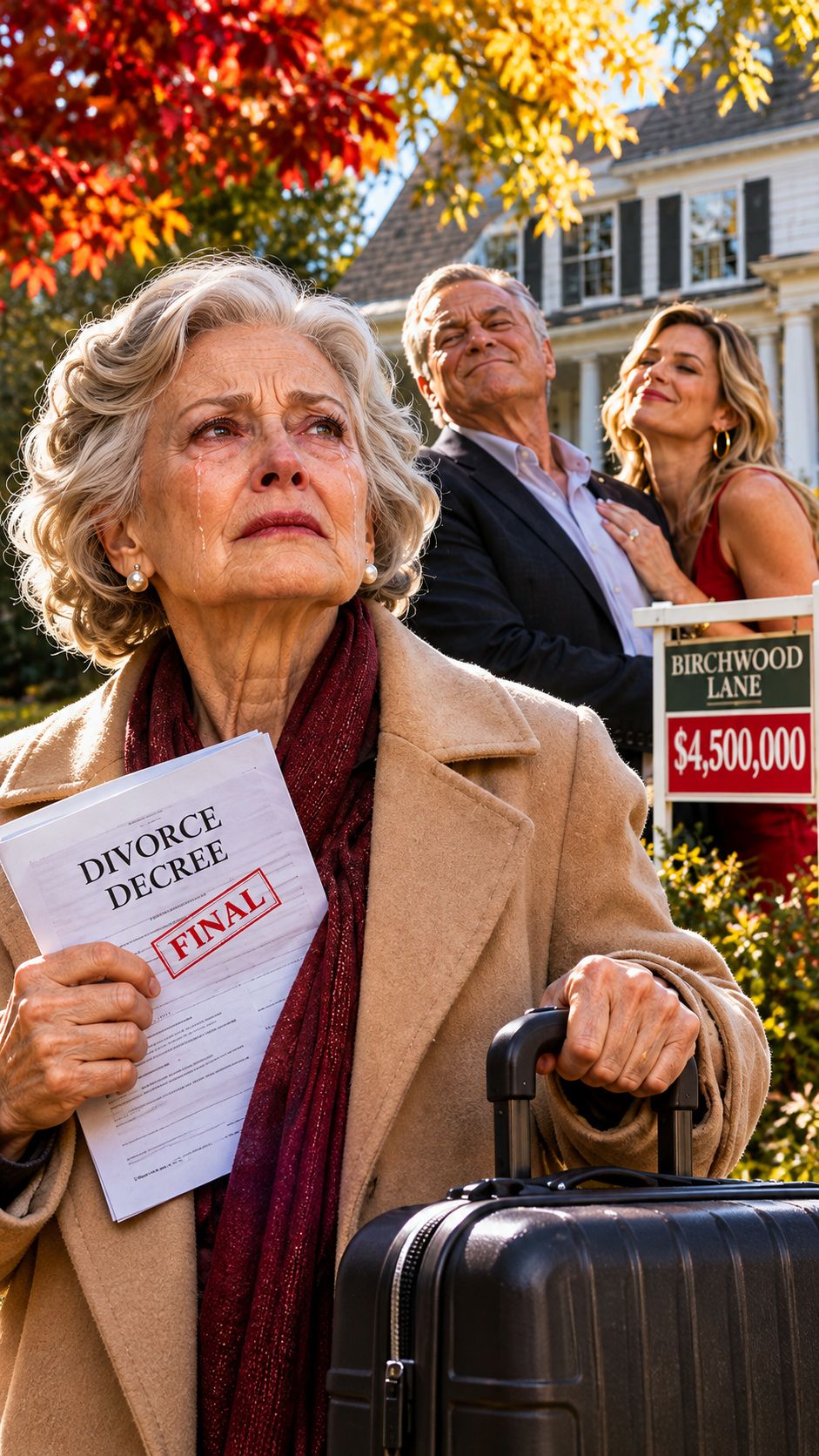
FINAL PART: AT 78, MY HUSBAND TOOK OUR $4.5 MILLION HOME—BUT ONE PHONE CALL EXPOSED THE SECRET HE THOUGHT HE’D BURIED FOREVER
The woman on the phone spoke carefully, as though she had been instructed not to frighten me.
“Mrs. Whitmore, my name is Detective Sarah Collins. I’m calling from the Westport Police Department.”
I tightened my grip on the phone.
“Has something happened to my husband?”
There was a pause.
“Your former husband, Harold Whitmore, was transported to the hospital earlier this morning.”
I stood beside Lydia Mercer’s desk, looking down at the documents we’d just uncovered.
“Is he alive?”
“Yes, ma’am. He’s conscious and receiving medical treatment. But there’s something else we need to discuss.”
I closed my eyes.
For fifty-two years, Harold had been the person I called when something terrible happened.
Now he was the terrible thing someone was calling me about.
“What happened?” I asked.
“Emergency services responded to a call from his residence. When officers arrived, they discovered signs of a disturbance inside his private study.”
I looked at Lydia.
She was watching me closely.
“What kind of disturbance?”
“An overturned desk, damaged furniture, and several open filing cabinets. We also recovered documents that may be relevant to an ongoing financial investigation.”
My heart began pounding.
“What financial investigation?”
The detective hesitated.
“Ma’am, your name appears repeatedly in the materials we recovered. We’d like to speak with you.”
I looked at the email on Lydia’s desk.
I want to be sure the property is outside the marital estate before I file.
For weeks, I had believed Harold had simply found a clever way to take our house.
Now I wondered whether the truth was much worse.
“I have an attorney,” I said.
“That’s fine, Mrs. Whitmore. We would welcome her presence.”
I gave Lydia the telephone.
She listened for several minutes, asked a series of precise questions, and wrote down an address.
When she finally hung up, she didn’t speak immediately.
Instead, she looked at the thick envelope on her desk.
Then at me.
“Eleanor,” she said quietly, “I think your husband may have made a very serious mistake.”
I sat down.
“What kind of mistake?”
She turned one of the documents toward me.
“The company holding your house appears to have used a deed bearing your signature.”
I frowned.
“I never signed a deed.”
“I know.”
She tapped the page.
“And that’s why we’re going to look very carefully at how it got there.”
The hospital smelled of disinfectant and stale coffee.
I hadn’t seen Harold since the divorce hearing.
I had imagined the next time we met, I would be stronger.
I would wear something beautiful.
I would look him in the eye and show him that losing the house hadn’t destroyed me.
Instead, I arrived wearing my old navy coat, with a lawyer beside me and my hands shaking inside my gloves.
Harold was sitting upright in a hospital bed when we entered.
He had a bandage above his right eyebrow.
His left wrist was wrapped.
But it was his expression that shocked me.
The confidence was gone.
The man who had smiled outside the courtroom looked twenty years older.
“Eleanor?”
I stopped near the doorway.
He stared at me.
“What are you doing here?”
“Someone called me.”
His gaze shifted to Lydia.
His face hardened.
“You brought your lawyer?”
Lydia stepped forward.
“Mr. Whitmore, I’m Lydia Mercer. We don’t need to discuss anything without your attorney present.”
Harold looked at her for a moment.
Then turned back to me.
“You always did know how to make a scene.”
I almost laughed.
Even now.
Even lying in a hospital bed.
He couldn’t resist making me responsible for his discomfort.
“What happened to you?” I asked.
He looked toward the window.
“An accident.”
“An accident in your study?”
His head snapped toward me.
“Who told you about that?”
I said nothing.
His eyes narrowed.
“Eleanor, listen to me. Whatever the police say, don’t believe everything.”
Lydia quietly touched my elbow.
We hadn’t come to interrogate him.
And I wasn’t about to give him the satisfaction of another argument.
I took one step backward.
“I’m glad you’re alive, Harold.”
He stared at me.
Then I added:
“But I’m not here to protect you from the truth.”
I turned and walked out.
Behind me, he called my name.
For the first time in fifty-two years, I didn’t turn around.
We met Detective Collins in a small conference room at the police station.
She was a woman in her forties with dark hair pulled into a neat ponytail.
She didn’t speak to me as though I were a confused elderly woman.
She placed a recorder on the table, explained the interview process, and asked whether I was comfortable proceeding with Lydia present.
I nodded.
Then she showed me a photograph.
It was Harold’s study.
The room I had dusted every Thursday for decades.
The room where he’d kept his expensive fountain pens, his business awards, and a framed photograph of himself shaking hands with a former governor.
Now papers covered the floor.
A lamp lay broken beside the desk.
One cabinet door hung crookedly from its hinges.
“What happened?” I asked.
“Your former husband told responding officers that someone entered the property and confronted him over financial documents. We’re still investigating the circumstances.”
“Who?”
“We can’t confirm that yet.”
She placed another photograph in front of me.
A cream-colored card.
My stomach tightened.
I recognized the paper immediately.
It looked just like the card I’d found in Harold’s coat.
The one signed with a single letter.
K.
“Have you seen something like this before?” she asked.
“Yes.”
I explained what I’d found the previous winter.
The handwriting.
The expensive paper.
The single initial.
Detective Collins listened without interrupting.
Then she showed me a second photograph.
This one was of a document.
Across the top were the words:
BIRCHWOOD PROPERTY HOLDINGS LLC
My hands went cold.
“That company owns my house.”
“According to the current property records, yes.”
She nodded toward the photograph.
“Do you recognize the signature at the bottom?”
I leaned closer.
There it was.
My name.
Eleanor Whitmore.
Written in a style that looked almost perfect.
Almost.
The capital E had the same long loop I always made.
The W leaned slightly to the right.
But something was wrong.
I stared at it until I understood.
“The middle initial,” I whispered.
Lydia leaned forward.
“What about it?”
I pointed.
“I stopped using my middle initial on legal documents twelve years ago.”
Detective Collins looked at me.
“Why?”
“Because my middle name is Louise, but an old bank account had it recorded incorrectly. We had trouble proving my identity when we changed banks, so my attorney at the time advised me to use my full first and last name consistently.”
I looked at the signature again.
“Harold knew that.”
The detective made a note.
Then I noticed something else.
“The date.”
Lydia turned the paper.
The deed was dated June 14.
I stared at it.
“That’s impossible.”
“Why?” she asked.
“Because on June 14, I was in Vermont.”
Lydia looked up sharply.
I continued.
“My sister Ruth had knee surgery. I stayed with her for nine days.”
Detective Collins leaned forward.
“Do you have anything documenting that?”
I almost smiled.
“Detective, I’m seventy-eight years old. I keep receipts for everything.”
That evening, Ruth answered my call on the second ring.
“Eleanor? Are you all right?”
“I need something.”
“Anything.”
“Do you remember when I came to help after your knee operation?”
“Of course.”
“Do you still have the hospital paperwork?”
Ruth made an offended noise.
“Do I still have it? Eleanor, I have the parking tickets, the pharmacy receipts, and the grocery list you wrote when you bought me those awful frozen dinners.”
Despite everything, I laughed.
“I need copies.”
“What’s happening?”
I sat on the edge of the guest bed.
For a moment, I considered protecting her from the details.
Then I remembered how many years I’d spent protecting people from uncomfortable truths.
“Harold may have forged my signature.”
There was silence.
Then Ruth said something I’ll never forget.
“Eleanor, I want you to listen carefully.”
I waited.
“You don’t owe that man one more minute of your silence.”
I started crying.
Not because I was frightened.
Because someone had finally said aloud what I needed to hear.
The investigation moved faster after that.
Lydia obtained certified copies of the property records.
The company had been formed months before Harold filed for divorce.
Its registered agent was a legal services firm in Connecticut.
Its ownership structure led through another company.
Then another.
But eventually, the records pointed toward a woman named Katherine Vale.
Katherine.
K.
I remembered the perfume on Harold’s coat.
The Saturday drives.
The hidden card.
I had spent months wondering whether he was having an affair.
Now I knew his relationship with Katherine might have reached far beyond romance.
She was forty-nine.
A former real estate consultant.
Recently divorced.
And, according to the records Lydia obtained, involved in several property transactions with Harold before our marriage ended.
One afternoon, Lydia called me into her office.
When I arrived, she had three folders waiting.
She opened the first.
“Eleanor, we’ve established that Katherine had a financial interest in the company holding Birchwood Lane.”
I nodded.
She opened the second.
“We’ve also found evidence that your former husband transferred significant funds into entities connected to her.”
“How much?”
“Approximately nine hundred thousand dollars across the accounts we’ve identified so far.”
I stared at her.
Nine hundred thousand.
While I had been carefully clipping grocery coupons.
While I’d been turning down the thermostat to save on heating.
While I’d been wearing the same winter coat for eleven years.
Harold had been moving nearly a million dollars toward another woman.
Lydia watched me.
“There’s more.”
She opened the third folder.
Inside was a bank document showing a transfer of two hundred thousand dollars.
The date was three days before our final divorce hearing.
The recipient was a business account linked to Katherine.
I read the document twice.
Then I looked up.
“What does this mean?”
“It means we have reason to investigate whether substantial marital assets were deliberately concealed.”
I folded my hands in my lap.
“Can we get the house back?”
Lydia was careful.
“We have grounds to seek relief, but the outcome will depend on what the court finds. A completed divorce judgment isn’t simply erased because someone discovers suspicious records.”
I nodded.
I appreciated that she never promised miracles.
Then she leaned forward.
“But Eleanor, this is no longer just a disagreement about who received what. We have evidence serious enough to justify asking the court to reconsider parts of the financial settlement.”
For the first time since I’d walked out of that courtroom, I felt something stronger than hope.
I felt prepared.
The grandchildren came back into my life on a Sunday afternoon.
Not because Harold allowed it.
Because my granddaughter, seventeen-year-old Emma, found my new phone number.
I was sitting on Ruth’s porch when the call came.
“Grandma?”
I almost dropped the phone.
“Emma?”
She started crying.
“I’ve been trying to find you.”
My throat closed.
“Oh, sweetheart.”
“Dad said you didn’t want to see us.”
I stood so quickly my chair scraped the wooden boards.
“What?”
“He said you needed space. Grandpa said you were angry with everybody.”
I closed my eyes.
Harold hadn’t simply threatened to keep the grandchildren away.
He’d begun telling them I wanted nothing to do with them.
“Emma, listen to me.”
I struggled to keep my voice steady.
“There is nothing in this world that could make me stop loving you.”
She cried harder.
“Then why didn’t you call?”
“I tried, sweetheart. I left messages.”
“Dad said you were making things difficult.”
I felt the familiar pain rising.
But I refused to speak badly about her parents.
Instead, I asked:
“Are you safe? Are you doing well in school?”
She sniffled.
“Yes.”
“Good. Then here’s what I want you to know. Whatever disagreements the adults have, they are not your responsibility.”
There was a pause.
“Can I see you?”
I looked out at the Vermont hills.
“Of course you can.”
Two weeks later, I met Emma and her younger brother Noah at a café in Hartford.
Their father brought them.
My son looked uncomfortable.
He couldn’t meet my eyes.
I didn’t confront him in front of the children.
I simply opened my arms.
Emma ran into them.
Noah followed.
And when both of them hugged me, I realized something.
Harold could arrange property transfers.
He could hire attorneys.
He could manipulate documents.
But he couldn’t simply erase thirty years of bedtime stories, birthday cakes, school concerts, and grandmotherly love.
My grandchildren still knew who I was.
And that was worth more than the house.
The real turning point came in February.
Katherine Vale contacted Lydia’s office through her attorney.
She wanted to talk.
Not to me directly.
Not to the police.
To the lawyers.
Her relationship with Harold had collapsed after the incident in his study.
According to information later disclosed during the proceedings, Katherine had demanded access to certain financial records.
Harold had refused.
There had been an argument.
The confrontation ended with damaged furniture and Harold injured.
The police continued examining the circumstances, but what mattered to my civil case was something Katherine’s attorney offered to provide.
Copies of communications and documents involving the property transfers.
Lydia called me immediately.
“Eleanor, I need you in Hartford tomorrow.”
I heard the excitement she was trying to conceal.
“What happened?”
“We may finally have evidence showing who planned the transfer and why.”
The next morning, I sat in her office while she read an email aloud.
It had been sent months before Harold filed for divorce.
From Harold.
To Katherine.
Once Birchwood is moved into the company, Eleanor won’t have any practical way to challenge it before the divorce. We need to finish everything before the attorneys begin reviewing the assets.
I stared at the table.
Lydia continued.
A second email discussed preparing the deed.
A third referred to making the paperwork appear routine.
Then came the message that made me feel as though the floor had disappeared.
She signs whatever I put in front of her. If necessary, we can use the old signature samples.
I pressed a hand against my chest.
Fifty-two years.
Fifty-two years of shared meals.
Of illnesses.
Of holidays.
Of raising children.
And somewhere inside that marriage, my husband had begun treating my trust as a tool he could use against me.
Lydia stopped reading.
“Are you all right?”
I nodded.
But I wasn’t.
Not yet.
I looked at the emails again.
Then I asked:
“Did Katherine agree to this?”
Lydia chose her words carefully.
“The communications suggest she understood more than she originally admitted. Her attorney is cooperating with the process, but that doesn’t automatically remove any potential responsibility she may have.”
I nodded.
I wasn’t interested in making excuses for Katherine.
But I wasn’t interested in pretending she was the only person responsible either.
Harold was my husband.
Harold had made promises to me.
Harold had known exactly what fifty-two years meant.
And he was the person who had decided those promises were disposable.
Our first major court hearing took place several weeks later.
I wore a dark blue dress.
Pearl earrings.
And the same shoes I’d worn to my daughter’s wedding.
Ruth sat beside me.
Lydia had warned me that legal proceedings could be slow, that evidence could be challenged, and that even strong documentation didn’t guarantee a particular result.
I was ready to hear the truth.
Not a comforting version of it.
Harold entered with two attorneys.
He looked thinner.
His face was pale.
But when his eyes met mine, I recognized the same old anger.
He was furious that I hadn’t disappeared quietly.
During the hearing, Lydia presented the property records, financial documents, communications, and evidence concerning the disputed signature.
She also explained why the timing of the transfer mattered.
The judge listened.
Harold’s attorneys disputed several claims and challenged the interpretation of certain documents.
The arguments continued for hours.
At one point, Lydia asked the court to consider the evidence that I had been in Vermont on the date shown on the deed.
Ruth’s medical records.
Pharmacy receipts.
Travel documentation.
And records showing I had used my credit card near her farmhouse.
I watched Harold.
For the first time, he didn’t look triumphant.
He looked trapped by facts he hadn’t expected anyone to check.
The judge ultimately allowed further proceedings and discovery concerning the disputed transfers and financial disclosures.
It wasn’t a final victory.
But it meant the questions would be examined.
Outside the courthouse, Ruth squeezed my hand.
“You did it.”
I shook my head.
“Not yet.”
She looked at me.
I smiled faintly.
“But he doesn’t get to decide when this ends anymore.”
Harold called me that evening.
I almost didn’t answer.
Then I remembered something Lydia had told me.
Keep records.
Don’t argue.
Don’t make agreements outside the legal process.
I answered with a notebook beside me.
“Hello, Harold.”
His voice sounded rough.
“Eleanor, this has gone far enough.”
I looked out Ruth’s kitchen window.
Snow was falling across the empty fields.
“What has?”
“This investigation. The lawyers. Dragging the family through court.”
I said nothing.
He continued.
“We can settle this privately.”
I held the phone tighter.
“What are you offering?”
A pause.
“I’ll make sure you’re comfortable.”
I almost laughed.
“Comfortable?”
“Yes. You can have a proper place to live. Enough income. I’ll see that you’re taken care of.”
I thought about the courtroom.
The suitcase.
His smile.
The words he’d whispered about the grandchildren.
“Harold, I lived with you for fifty-two years.”
He sighed.
“I know that.”
“No. I don’t think you do.”
He fell silent.
“I wasn’t a guest in that house. I wasn’t an employee. I wasn’t someone you took care of out of generosity.”
My voice remained steady.
“I was your wife. I helped build our life.”
He snapped:
“And I worked for everything we had!”
There it was.
The sentence I’d heard in different forms for decades.
He worked.
I helped.
He earned.
I spent.
He decided.
I adjusted.
I looked at the snow.
“Who stayed home with our children while you traveled?”
He didn’t answer.
“Who managed the household when your business nearly collapsed?”
Silence.
“Who cared for your mother during the last two years of her life?”
He exhaled sharply.
“Eleanor, don’t start listing old grievances.”
I smiled sadly.
“That’s the problem, Harold. You think fifty-two years of work are grievances because nobody gave me a paycheck for them.”
He didn’t speak.
I continued.
“If you want to make an offer, send it to Lydia.”
Then I ended the call.
My hands were shaking.
But I wasn’t frightened anymore.
The months that followed were difficult.
There were depositions.
Financial reviews.
Arguments over documents.
Long conversations with lawyers.
Nights when I lay awake wondering whether I had the strength to keep going.
Sometimes I missed the house so badly I could hardly breathe.
Not Harold.
The house.
I missed the sound of rain against the porch roof.
The way the afternoon sunlight crossed the dining room.
The maple tree that turned bright red every October.
I missed the kitchen drawer where I’d kept birthday candles.
The little marks on the pantry wall where we’d measured the children’s heights.
The garden I’d planted with my own hands.
People who haven’t lost a home sometimes think it’s only walls and furniture.
It isn’t.
A home is where your memories learned to live.
And I wanted mine back.
But I also began to understand that returning to Birchwood Lane wouldn’t return me to the woman I’d been before.
That woman had spent years apologizing for taking up space.
I was done apologizing.
By early summer, Lydia had assembled a much clearer picture of what had happened.
The disputed property transfer was part of a series of transactions undertaken before the divorce.
Financial records revealed money moving through multiple accounts.
The communications described efforts to keep certain assets beyond the reach of the marital property review.
A forensic document examiner identified significant concerns about the signature attributed to me.
And additional records supported my statement that I had not appeared to sign the deed on the date it carried.
Harold’s legal team continued to contest aspects of the evidence.
But the risks of continuing the litigation were becoming impossible for him to ignore.
Then Lydia called with news.
“Eleanor, we’ve received a substantial settlement proposal.”
I was pruning roses in Ruth’s garden.
I put down the shears.
“Tell me.”
“The proposal would restore your ownership interest in Birchwood Lane through a negotiated transfer, provide a significant financial adjustment, and resolve the contested civil claims.”
I sat on the garden bench.
For a moment, I couldn’t speak.
“The house?”
“Yes.”
I closed my eyes.
“Really?”
“The proposal is in writing. We still need to review the terms, the title issues, the tax consequences, and the protections needed to ensure the transfer can be completed.”
I listened carefully.
I had learned not to mistake a promise for a result.
But for the first time, the house was no longer just a memory.
It was a possibility.
Over the following weeks, the attorneys negotiated.
There were revisions.
Disagreements.
More records.
More delays.
Then, after the necessary approvals and closing steps, the settlement was finalized.
The disputed ownership arrangement was unwound through the agreed legal process.
My title interest was restored under the settlement.
I also received a financial payment intended to address part of the assets and losses at issue.
I didn’t receive everything I believed I should have.
But I received enough to rebuild my life securely.
And the house on Birchwood Lane was mine again.
I returned on a Thursday.
The same day of the week I used to dust Harold’s study.
Ruth drove me.
Neither of us spoke much during the trip.
When we turned onto Birchwood Lane, I saw the tall maple tree.
Its leaves were green now.
The porch still wrapped around the front of the house.
The white railing needed paint.
A few weeds had grown along the walkway.
But there it was.
My home.
Ruth parked.
I sat in the passenger seat for a long moment.
“Are you ready?” she asked.
I nodded.
Then shook my head.
Then laughed.
“I don’t know.”
She reached across the console.
“That’s all right.”
I stepped out.
The air smelled of freshly cut grass.
Somewhere nearby, a lawn mower was running.
I walked slowly up the front path.
Every step brought back a different memory.
My son learning to ride his bicycle.
My daughter running through the sprinkler.
A Christmas morning when the power went out and we cooked breakfast over the fireplace.
I reached the porch.
The key felt strangely heavy in my hand.
I unlocked the door.
And walked inside.
The rooms were almost empty.
Harold had removed much of the furniture.
The dining table was gone.
So was the grandfather clock.
Several framed photographs had disappeared from the walls.
For a moment, grief rose so sharply that I leaned against the doorway.
Then Ruth stepped inside behind me.
“Eleanor?”
I wiped my eyes.
“I’m all right.”
She looked around.
“It’s going to take some work.”
I nodded.
Then I smiled.
“Good.”
She frowned.
“Good?”
I walked toward the kitchen.
“Now I get to decide what it looks like.”
The first thing I bought was a new dining table.
Not because the old one had been expensive.
Because I wanted something that belonged to the life I was building now.
I chose a long oak table with room for ten people.
Then I bought curtains.
New lamps.
A comfortable chair for the porch.
I hired someone to repair the railing.
And I planted roses beneath the front windows.
The house gradually began to feel like mine.
Not ours.
Mine.
That distinction would once have frightened me.
Now it felt peaceful.
In September, Emma called.
“Grandma, are we still having Thanksgiving at your house?”
I sat at the kitchen table.
I could almost smell the nutmeg.
“Would you like that?”
She laughed.
“Are you kidding? Everybody misses your stuffing.”
I smiled.
“Then Thanksgiving it is.”
She hesitated.
“Grandma?”
“Yes, sweetheart?”
“Can Dad come?”
I looked out at the maple tree.
My relationship with my son was still complicated.
He had believed Harold’s version of events for too long.
He had repeated things about me that hurt.
And rebuilding trust would take time.
But he had also apologized.
He’d begun making an effort to understand what had happened.
I took a breath.
“Yes, Emma. Your father can come.”
She sounded relieved.
Then she asked:
“What about Grandpa?”
I closed my eyes.
That was harder.
Harold and I were divorced.
The legal proceedings had exposed things that could never be forgotten.
I didn’t want to spend another holiday pretending.
But I also didn’t want my grandchildren to believe loving one grandparent required rejecting the other.
“Sweetheart,” I said gently, “your grandfather and I have separate lives now.”
She was quiet.
“That doesn’t mean you can’t love both of us.”
“I know.”
“And it doesn’t mean you have to solve our problems.”
She sniffled.
“Okay.”
I smiled.
“Now tell me something important.”
“What?”
“Do you still like extra marshmallows on your sweet potatoes?”
She laughed.
“Grandma!”
I laughed too.
And for the first time in a very long while, Thanksgiving felt like something to look forward to.
The morning of Thanksgiving, I woke before sunrise.
I made coffee.
I turned on the kitchen lights.
And I stood for a moment in the quiet house.
The turkey was waiting in the refrigerator.
The table was set.
There were fresh flowers in a vase.
Outside, the maple tree had lost most of its leaves.
I opened the kitchen drawer and found the little box of birthday candles I’d brought back from Vermont.
I held it in my hand.
Such a small thing.
Yet I had cried over that drawer more than once during the months I was away.
At ten o’clock, my daughter arrived.
She hugged me for a long time.
“Mom, the house looks beautiful.”
“Thank you.”
She looked around.
Then her eyes filled.
“I should have helped you sooner.”
I took her hands.
“Yes,” I said softly. “You should have.”
She started crying.
I pulled her into my arms.
“But you’re here now.”
At eleven, my son came.
He stood awkwardly on the porch with a pumpkin pie.
For a moment, neither of us knew what to say.
Then he whispered:
“Mom, I’m sorry.”
I looked at the man I’d raised.
The boy who once brought me dandelions from the backyard.
The teenager who’d practiced driving in this very driveway.
The adult who had believed his father’s money and confidence meant he must be telling the truth.
I held his gaze.
“You hurt me.”
He nodded.
“I know.”
“You kept the children away.”
His eyes filled.
“I know.”
I took a slow breath.
“I want us to have a relationship. But we can’t pretend those things never happened.”
He nodded again.
“I don’t want to pretend.”
I stepped aside.
“Then come in.”
He entered the house.
And we began again.
Not from where we’d left off.
From somewhere more honest.
That evening, after everyone had eaten, Emma asked if she could make a toast.
She stood beside the dining table holding a glass of sparkling cider.
Noah sat beside her, grinning.
My daughter reached for a tissue.
Emma looked at me.
“I just want to say I’m happy Grandma’s home.”
My throat tightened.
She continued.
“This year was really confusing. A lot of things changed. And I didn’t understand why people weren’t talking to each other.”
She glanced toward her father.
Then back at me.
“But Grandma always told me that when things get hard, you shouldn’t stop loving people.”
I covered my mouth.
Emma smiled.
“So I’m glad we’re all here.”
Noah raised his glass.
“To Grandma!”
Everyone laughed.
Glasses clinked.
And I looked around the table.
My children.
My grandchildren.
My sister.
The people who had been part of my life long before lawyers and property companies and court orders.
Not everything was repaired.
Not every apology had been enough.
Not every wound had healed.
But the room was full.
And the laughter was real.
For that evening, it was enough.
Later, after everyone had gone, Ruth and I sat on the porch.
The air was cold.
We had blankets over our knees.
A single porch light illuminated the front steps.
Ruth looked at me.
“Do you ever think about Harold?”
I considered the question.
“Yes.”
“Do you miss him?”
I watched the leaves move across the lawn.
“I miss who I thought he was.”
Ruth nodded.
“That makes sense.”
I took a sip of tea.
“For fifty-two years, I thought staying meant I was strong.”
“And now?”
I smiled faintly.
“Now I think sometimes leaving takes more strength.”
She reached over and patted my hand.
We sat in silence.
Then she asked:
“If you could go back to that day in court, what would you tell yourself?”
I pictured the woman I’d been.
Seventy-eight years old.
Standing in a marble hallway.
One suitcase.
A folded court order.
Her husband smiling because he believed he’d taken everything.
I remembered how small I’d felt.
How frightened.
How certain that my life had ended.
I looked at Ruth.
“I’d tell her to keep walking.”
Ruth smiled.
“That’s all?”
I shook my head.
“No.”
I looked toward the front door.
“I’d tell her that losing the house doesn’t mean losing herself.”
My sister squeezed my hand.
And somewhere inside me, something finally rested.
Harold never returned to Birchwood Lane.
Our communications remained limited.
There were still legal and financial matters to manage after the settlement, but I let the professionals handle them.
I no longer answered angry telephone calls.
I no longer explained myself to people determined not to understand.
And I no longer treated peace as something I had to purchase with my own silence.
Sometimes I heard news about Harold through our children.
He’d moved into a smaller property.
His relationship with Katherine had ended.
He was still angry about the settlement.
I hoped he would find some measure of peace.
But I understood that his future was no longer mine to arrange.
That freedom felt strange at first.
Then wonderful.
On my seventy-ninth birthday, I stood in front of the mirror in my bedroom.
The same bedroom I’d once shared with Harold.
The same window overlooking the maple tree.
But the room looked different now.
I’d painted the walls a soft cream.
I’d replaced the heavy curtains.
I’d moved the bed closer to the window so I could see the morning light.
On the dresser stood photographs of my grandchildren.
Beside them was a framed picture of Ruth and me from our childhood.
Two girls in summer dresses.
Laughing at something the camera couldn’t capture.
I studied my reflection.
My hair was almost entirely white.
There were wrinkles around my eyes.
My hands showed the years.
But I didn’t see a woman whose life was over.
I saw a woman who had survived something she once thought would destroy her.
Downstairs, the doorbell rang.
Emma and Noah had arrived with a birthday cake.
I could hear them laughing.
I smiled at my reflection.
Then I said aloud:
“Happy birthday, Eleanor.”
For the first time in years, I meant it.
People sometimes ask me whether I regret fighting for the house.
They point out that the legal proceedings were exhausting.
That I spent months dealing with documents, attorneys, and uncertainty.
That at seventy-eight, I could have chosen a quieter life.
Perhaps they’re right about one thing.
It would have been easier to walk away and never look back.
But easier isn’t always the same as right.
Harold believed he knew exactly who I was.
He thought I was the woman who would accept whatever he decided.
The woman who wouldn’t question legal documents.
The woman who would believe the first explanation she was given.
The woman who would be too frightened, too tired, and too old to fight.
He was wrong.
And it wasn’t because I had suddenly become fearless.
I was frightened almost every day.
I was frightened when I hired Lydia.
I was frightened when the police called.
I was frightened when I learned someone might have forged my signature.
I was frightened walking into court.
I was frightened that my children would never understand.
I was frightened that the house I’d loved for decades would remain nothing more than a memory.
But I learned something important.
Courage isn’t the absence of fear. Sometimes courage is being seventy-eight years old, carrying one suitcase, and deciding that your story isn’t finished.
The house on Birchwood Lane is worth millions.
But it isn’t the most valuable thing I recovered.
I recovered my voice.
I recovered my relationship with my grandchildren.
I recovered the right to make decisions about my own future.
And perhaps most importantly, I recovered the woman I’d slowly abandoned while trying to keep everyone else happy.
Harold once told me I’d never see my grandchildren again.
He said it with a smile.
He believed he was delivering the final sentence of my life.
But last Sunday, Noah sat beside me on the porch, eating a piece of apple pie.
Emma was in the garden taking photographs of the roses.
My son was helping repair a loose step.
And my daughter was inside making coffee.
Noah looked up at me.
“Grandma?”
“Yes, sweetheart?”
“Are you going to live here forever?”
I looked at the house.
The porch.
The maple tree.
The windows glowing warmly in the late afternoon sun.
Then I looked at my grandson.
“I don’t know about forever,” I said.
He frowned.
“Why not?”
I smiled.
“Because I might decide to go on an adventure.”
He laughed.
“At your age?”
I pretended to be offended.
“At my age?”
He grinned.
I leaned closer.
“Especially at my age.”
He threw his arms around me.
And I held him tightly.
There was a time when I thought the most important thing I could do was keep my family together, no matter what it cost me.
Now I know better.
Love should never require a person to disappear.
A home should never become a prison.
And a marriage, no matter how long it lasts, doesn’t give one person the right to erase the other.
I was seventy-eight when my husband divorced me.
He took our $4.5 million house.
He threatened my relationship with my grandchildren.
And he thought I would walk away with nothing.
I did walk away.
With one suitcase.
With tears I refused to shed in front of him.
And with a question that eventually changed everything.
How did he do it?
That question led me to the truth.
The truth led me back to my home.
And the journey taught me something I wish every woman could understand before she reaches my age.
It is never too late to stand up for yourself. It is never too late to demand the truth. And it is never too late to begin a life that finally belongs to you.
Because on the day Harold thought he’d taken everything from me, he accidentally gave me something I hadn’t had in decades.
My freedom.
And this time, I intend to keep it.
THE END