
I knew something was wrong before I reached the bedroom.
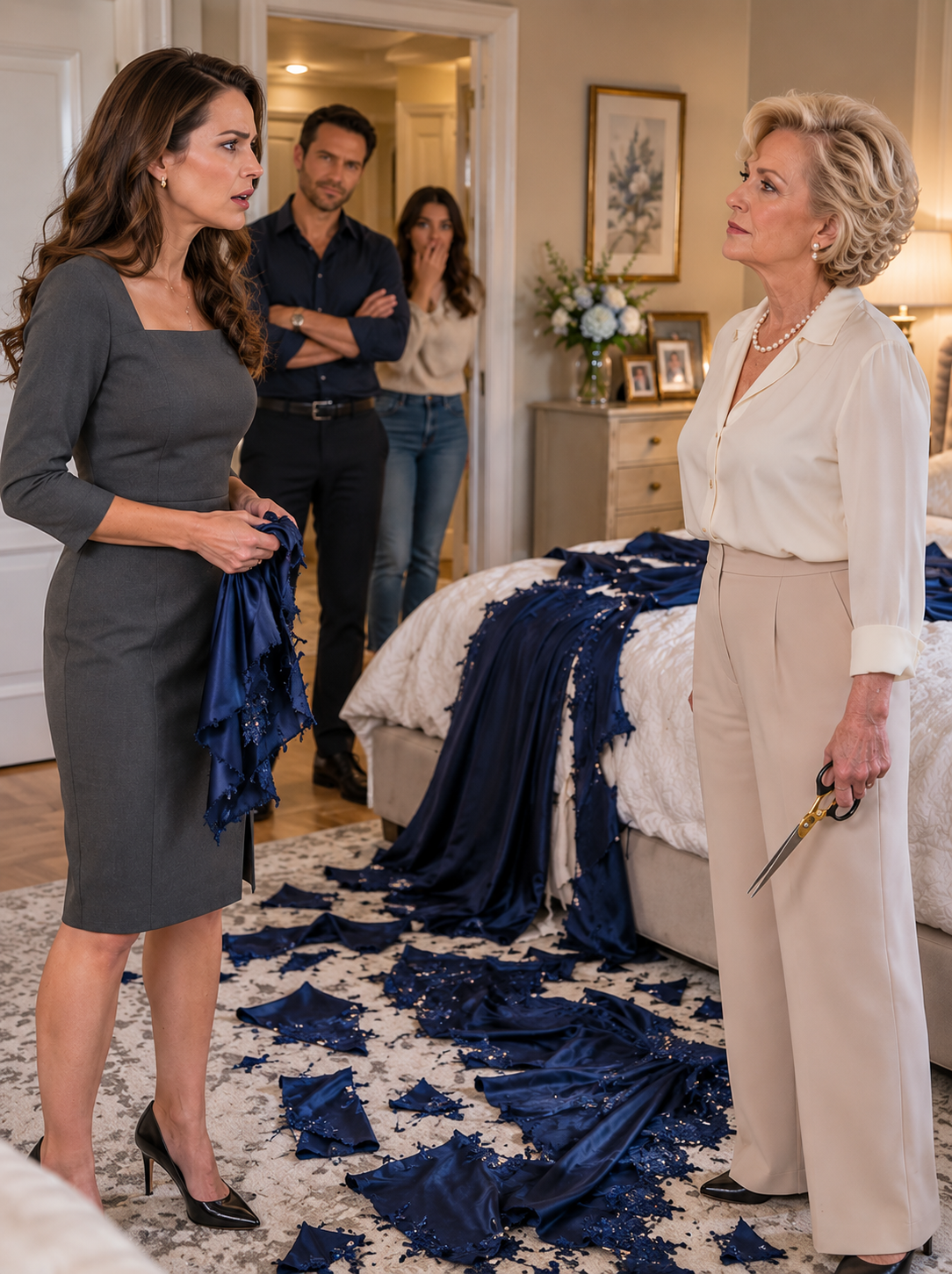
There was a sharp, repetitive sound coming from inside the room—snip, pause, snip—that did not belong in a house at nine on a Friday night. When I pushed the door open, I saw Patricia standing beside my bed with a pair of sewing scissors in her hand.
My gown was on the floor.
Not folded. Not hanging from the wardrobe. Cut apart.
One sleeve had been separated from the bodice. The skirt had been sliced nearly to the waist, and several long pieces of midnight-blue fabric lay scattered across the rug as if someone had deliberately dismantled the dress one section at a time.
Patricia looked at me without the slightest hint of surprise.
I stared at the scissors.
Then at her.
Then at what had once been the most beautiful dress I owned.
“Why did you do that?”
She lowered the scissors.
“Now you won’t need it.”
For a few seconds, I genuinely wondered whether I had misunderstood her.
“Need what?”
“The dress.”
“My dress?”
She gave a small sigh, the kind she used whenever she believed I was making something unnecessarily difficult.
“Clare, don’t make this into a whole thing.”
I stepped farther into the room and picked up one of the pieces. The fabric was still smooth beneath my fingers. I had spent nearly three weeks deciding whether I could justify spending fourteen hundred dollars on that gown.
I had finally bought it because I was going to receive a national award the following evening.
It wasn’t extravagant. That was what had irritated Patricia when she first saw it. The shoulders were simple. The waist was fitted. The skirt fell straight and clean, without sequins or feathers or anything remotely theatrical.
It was simply beautiful.
For one night, I had wanted one beautiful thing.
Patricia folded her arms.
“Who else is going to serve dinner tomorrow?”
I looked at her.
“What dinner?”
“My dinner.”
“What dinner?”
“The one I told you about.”
“You said you were considering having a few people over.”
“I invited twelve.”
I glanced at the shredded gown.
Then back at her.
“My award ceremony is tomorrow.”
“I know.”
“You cut up my dress because you invited twelve people to dinner?”
Patricia’s expression hardened.
“Someone has to cook.”
She began counting the reasons on her fingers.
“Linda can’t stand for very long because of her hip. Harold won’t eat spicy food. Susan doesn’t like restaurants. And you make that pot roast everyone likes.”
I almost laughed.
The absurdity of it was so complete that my mind struggled to hold it.
“You destroyed a fourteen-hundred-dollar dress because Harold doesn’t like spicy food?”
“That’s not what I said.”
“It is exactly what you said.”
“No. I said I have twelve people coming tomorrow, and I assumed you would help.”
“You assumed I’d spend the night before my award ceremony cooking for twelve people.”
Patricia’s mouth tightened.
“You have responsibilities.”
There it was.
The phrase she’d used for years whenever she wanted something from me.
Responsibilities.
It had never mattered whether the responsibility belonged to her, Mark, Melissa, or someone else. If I could do it, somehow it became mine.
Before I could answer, I heard footsteps in the hallway.
Mark appeared in the doorway.
He looked at me first, then at the dress.
“What happened?”
“Your mother cut up my gown.”
His eyes moved toward Patricia.
She shrugged.
“She was going to leave me with twelve guests.”
“I wasn’t leaving you with anyone,” I said. “You invited them.”
Mark looked at the pieces on the floor.
Then, to my disbelief, the corner of his mouth lifted.
It wasn’t a full smile.
It was worse.
It was amusement.
“Mom,” he said, “really?”
Patricia gave him a wounded look.
“I had no choice.”
I held up the ruined sleeve.
“Apparently she did.”
Mark looked at me.
“Clare, don’t start.”
I stared at him.
“Don’t start what?”
“This.”
He waved vaguely at the room.
“The drama.”
I felt something inside me go still.
“This is my dress.”
“So wear something else.”
“I’m supposed to accept an award tomorrow.”
He sighed.
“I know.”
“A national award.”
“I know.”
“And you think this is funny?”
His face hardened.
“You’re a wife, Clare. Not a celebrity. Act like one.”
The sentence landed more heavily than I expected.
Not because it was clever.
Because it wasn’t.
It was ordinary.
Casual.
The sort of sentence someone says when they believe they are stating an obvious fact.
Patricia looked satisfied.
Mark looked annoyed that the conversation had taken this long.
And I realized neither of them thought they had crossed a line.
Melissa appeared at the end of the hall.
She was thirty-one, old enough to have her own mortgage, career, and family, but in my mind I could still see the nine-year-old girl who used to fall asleep against my shoulder during thunderstorms.
She looked at the dress.
“Oh my God.”
Patricia immediately said, “Don’t be dramatic.”
Melissa crouched and picked up a strip of fabric.
“Can this be fixed?”
“I don’t know,” I said.
She looked at me.
“Could they just mail you the award?”
I almost smiled.
After twenty-two years of helping her with homework, school projects, job applications, and wedding invitations, apparently the national awards circuit had been reduced to something similar to replacing a lost credit card.
“No,” I said quietly. “They can’t.”
Mark rubbed his forehead.
“Can we please not turn this into a family crisis?”
I looked at him.
“I won’t.”
He seemed relieved.
That relief told me something.
He expected me to argue.
He expected tears.
He expected explanations.
He expected me to eventually make everybody comfortable again.
Instead, I bent down and gathered the pieces of my gown.
Patricia immediately began talking about tomorrow.
“I need the roast started by two.”
I stood.
“No.”
She blinked.
“What?”
“I said no.”
The room became completely silent.
Patricia looked at Mark.
Mark looked at me.
I carried the pieces into the guest room and shut the door.
For the next hour, I sat on the edge of the bed surrounded by ruined fabric.
I could have called the event organizers.
I could have said I was sick.
I could have told them I couldn’t attend.
I could have let someone else accept the award.
For a while, I seriously considered it.
That was the embarrassing part.
Not the dress.
Not Patricia.
Me.
I had spent so many years smoothing over other people’s discomfort that standing up for myself felt almost aggressive.
At 10:43, I walked outside and sat in my car.
I didn’t start the engine.
Through the windshield, I could see the living-room curtains.
Patricia was inside drinking tea.
She looked perfectly comfortable.
My phone buzzed.
Sam Ortega, the event producer.
Please arrive by 4:30 tomorrow. Your presenter has requested a private meeting before the ceremony.
I read the message twice.
Then I typed:
Who is presenting my award?
The typing bubble appeared.
Disappeared.
Returned.
Finally, Sam answered.
She specifically asked us not to tell you.
I stared at the screen.
The next morning, Patricia behaved as though nothing unusual had happened.
That was one of her talents.
She could destroy something important on Friday night and wake up Saturday morning ready to discuss groceries.
At eight-thirty, I entered the kitchen with coffee.
She sat at the table with a yellow legal pad.
Mark was reading his phone.
Patricia pushed the paper toward me.
“Your list.”
I looked down.
Pot roast.
Carrots.
Green beans.
Dinner rolls.
Cheesecake.
I raised my eyes.
“You cut up my dress last night.”
“Yes.”
“And this morning you’re giving me a grocery list.”
“People still need to eat.”
I laughed before I could stop myself.
Patricia frowned.
“I don’t see what’s funny.”
“Neither do I.”
Mark lowered his phone.
“Clare.”
That warning again.
I slid the paper back.
“I’m not cooking tonight.”
Patricia stared.
“Then what are we supposed to serve?”
“I don’t know.”
“You’re the one who knows how to cook for everyone.”
“No. You’re the one who invited them.”
Mark’s chair scraped the floor.
“This is getting ridiculous.”
I picked up my coffee.
“No. It’s getting simple.”
Then I walked out.
I had been married to Mark since I was twenty-nine.
Melissa had been nine when we married.
I never tried to replace her mother.
I simply became another adult in her life.
The adult who remembered she hated mayonnaise.
The adult who drove three hours through freezing rain when a teenage boyfriend abandoned her at a party.
The adult who bought poster board at ten at night because Melissa suddenly remembered a school presentation was due the next morning.
The adult who knew which birthday cake she liked and which side of the bed she slept on when she was sick.
Patricia used to tell people, “Clare is the one you call when something goes wrong.”
I had always thought that was a compliment.
It took me years to understand that being useful and being valued are not the same thing.
Useful people get called.
They get thanked.
Then they get handed another task.
By noon, I still had no gown.
I drove to three stores.
The first had a dress that made me look like a lounge singer on a cruise ship.
The second didn’t fit across my shoulders.
The third had a burgundy dress that made me look like I was about to present quarterly earnings to a regional bank.
I sat inside the fitting room and stared at myself.
Then I nearly gave up.
My phone rang.
Denise.
My closest friend.
I answered.
“Where are you?”
“Shopping.”
“For what?”
“A miracle.”
She laughed.
“Stay there.”
“Denise—”
“Just stay there.”
Forty minutes later, she arrived carrying a garment bag.
Inside was the black dress she’d worn to her daughter’s wedding.
I stared at it.
“I can’t take this.”
“You can.”
“It’s yours.”
“You gave me a suit fifteen years ago when I couldn’t afford one for an interview.”
“That was different.”
“No. It was Tuesday. This is Saturday.”
I laughed.
Then, unexpectedly, I cried.
Denise looked at me.
“Good. Get it out.”
I wiped my face.
“You’re very comforting.”
“I know.”
The dress fit.
Not perfectly.
But well enough.
I added pearl earrings, simple heels, and a little makeup.
Around four, I left for the ceremony.
As I reached the front door, Patricia looked at me.
“Where are you going?”
I stopped.
“The award ceremony.”
She looked me up and down.
“Like that?”
“Yes.”
Mark came from the kitchen.
“Clare.”
I turned.
“Your mother invited twelve people.”
He hesitated.
“What are we supposed to do?”
I opened the door.
“Order dinner.”
Then I walked out.
I made it twenty minutes down the road before pulling into a pharmacy parking lot.
My hands were cold.
I stared at the steering wheel.
Maybe I should go back.
Maybe I was being selfish.
Maybe I could still cook.
Maybe I could attend the ceremony and return home early.
Then my phone rang.
Denise.
“You haven’t turned around, have you?”
“How did you know?”
“Because I know you.”
I closed my eyes.
“I think I’m making everything worse.”
“No.”
“Everyone is angry.”
“That’s different.”
“I could go home.”
“You could.”
I waited.
“But?”
“But you’ve let other people drive your life for twenty-three years.”
I opened my eyes.
“That’s dramatic.”
“I learned from you.”
I laughed.
Then she said quietly, “Let somebody else be disappointed tonight.”
I looked through the windshield.
The pharmacy sign glowed red against the darkening sky.
Then I started the car.
For once, I was going somewhere because I had chosen to.
Click here to continue reading: PART 2: Clare Arrived Without the Dress Her Family Had Ruined, Only to Discover the Woman Presenting Her Award Knew Far More About Her Life Than Expected
The Dress on the Floor Was Only Fabric, but the Reason It Had Been Destroyed Made Clare Realize Something Much Bigger Was Being Taken From Her
Part 1 of 12

