
The first thing I remember is the sound of my mother’s suitcase zipper closing.
It was an ordinary sound, almost domestic enough to be comforting. The zipper dragged across the fabric in short metallic pulls while sunlight fell through the front windows and turned the dust above the entryway golden. My father stood beside the door checking his phone for the third time. My sister Camille was upstairs, still choosing between two dresses for the trip.
I had come to see them off.
That was the ridiculous part.
Even after years of being treated like the dependable daughter who could manage herself without anyone asking whether she wanted to, I had still wanted to stand in that doorway and tell them to have a safe flight.
My mother studied herself in the hall mirror and touched the corner of her lipstick with one fingertip.
“You really didn’t need to come over,” she said.
“I know.”
She looked at me through the mirror.
“Then why did you?”
I almost smiled.
“Because you’re my family.”
My father’s phone chimed. He glanced at it and frowned.
“Boarding information,” he said. “We need to leave in forty minutes.”
I nodded and reached for the handle of my coat.
That was when I felt the flutter.
It began beneath my breastbone, so faint that I almost dismissed it. For years, I had experienced strange little episodes—light-headedness, sudden fatigue, moments when my heartbeat seemed to trip over itself. I had always found a reason. Too much coffee. Too little sleep. Stress at work. A skipped meal.
This time was different.
The room seemed to move sideways.
I caught the edge of the console table.
My mother turned.
“Florence?”
I tried to answer, but my tongue felt thick.
The flutter became a violent pounding. My vision narrowed until the room looked like a tunnel with my father standing at the far end of it.
“Dad…”
He stepped toward me, but not quickly.
I remember that detail.
He did not run.
My knees buckled before I could say anything else.
My shoulder struck the hardwood floor. Somewhere above me, my mother gasped. I heard my father say my name, then another voice—Camille’s—coming from the stairs.
“What happened?”
“I think she fainted,” my mother said.
My father crouched beside me.
“Florence? Can you hear me?”
I could.
I just couldn’t move.
Then my heart seemed to disappear.
There was no dramatic sensation, no cinematic flash of darkness. One moment I was aware of the ceiling, the next I was floating somewhere far away from my body while voices came and went around me.
My father’s voice reached me first.
“She fainted?”
Someone answered that an ambulance was coming.
My mother said something about the flight.
I wanted to tell her I could hear her.
I wanted to tell her I was frightened.
Instead, my body became very still.
The next thing I remember was fluorescent light.
A ceiling panel passed above me as someone pushed my bed down a hospital corridor. Wheels rattled beneath me. A monitor screamed in short bursts, and a paramedic kept saying numbers I couldn’t understand.
A doctor leaned over me.
“Florence, stay with us.”
I tried.
I really did.
But the darkness came again.
When I woke, my chest burned.
There were adhesive pads across my skin, an IV in my arm, wires running beneath my gown, and a plastic tube near my face. I couldn’t tell whether it was morning or night.
My father stood near the foot of the bed.
My mother was beside him.
Camille was holding her phone.
For one brief second, relief washed through me.
They had come.
They were there.
Then my father looked at his watch.
“Is she awake?”
A nurse glanced at him.
“She is now.”
My father nodded as if I had successfully completed an appointment.
My mother leaned closer.
“Can you hear us?”
I swallowed.
“Yes.”
Camille stepped forward.
“Oh, thank God.”
She sounded relieved, but her eyes immediately went toward my father.
He was staring at the clock on the wall.
The doctor entered a moment later and explained that I had experienced a dangerous cardiac event. They were still determining exactly what had caused it. I needed monitoring, more tests, and possibly a procedure.
My father listened.
Then he looked at my mother.
“We have to go.”
The doctor paused.
“Go where?”
“Our flight,” my father said. “We’re supposed to leave at six.”
The doctor stared at him.
“I’m sorry?”
My mother adjusted the strap of her purse.
“Camille has been looking forward to this trip for months.”
The words landed harder than the diagnosis.
I turned my head toward my father.
“Dad?”
He came closer.
“She fainted,” he said, almost reassuringly. “They’re keeping her here. She’ll be fine.”
I watched his mouth move.
My heart was still misbehaving beneath the electrodes.
I was terrified.
But apparently not terrified enough to cancel a flight.
“Stay,” I whispered.
My mother looked at my father.
Camille looked uncomfortable.
My father sighed.
“Florence, listen to the doctors. You’re in a hospital. They know what they’re doing.”
“You can’t leave.”
“We already paid for everything.”
I thought I had misunderstood him.
The words were so ordinary that my mind refused to connect them to what was happening.
My mother came closer and touched my arm.
“We’ll call when we land.”
Then she kissed my forehead.
It was gentle.
That somehow made it worse.
My father gave me the same small smile he had used when I was a child and had scraped my knee.
“You’ll be all right.”
They left.
I watched the door close behind them.
For several seconds, I waited for it to reopen.
It didn’t.
That was the moment something inside me changed.
Not because they had chosen a vacation.
Because they had looked at my fear, heard me ask them to stay, and decided that leaving was reasonable.
The door remained shut.
The monitor beside me continued its steady rhythm.
A nurse came in to adjust my IV.
She looked toward the doorway.
“Your family?”
I stared at the closed door.
“They had a flight.”
She said nothing.
That silence was kinder than any explanation.
The first night was the longest night of my life.
Every time the monitor changed its rhythm, I woke.
Every time footsteps stopped outside my room, I looked toward the door.
Nobody came.
I had my phone on the tray beside me. I could have called my parents.
I didn’t.
I knew exactly what would happen.
My father would tell me not to worry.
My mother would remind me that Camille had been planning the trip for months.
Someone would eventually make me feel guilty for frightening everyone.
So I lay there alone and listened to the hospital breathe around me.
Near midnight, an older nurse entered.
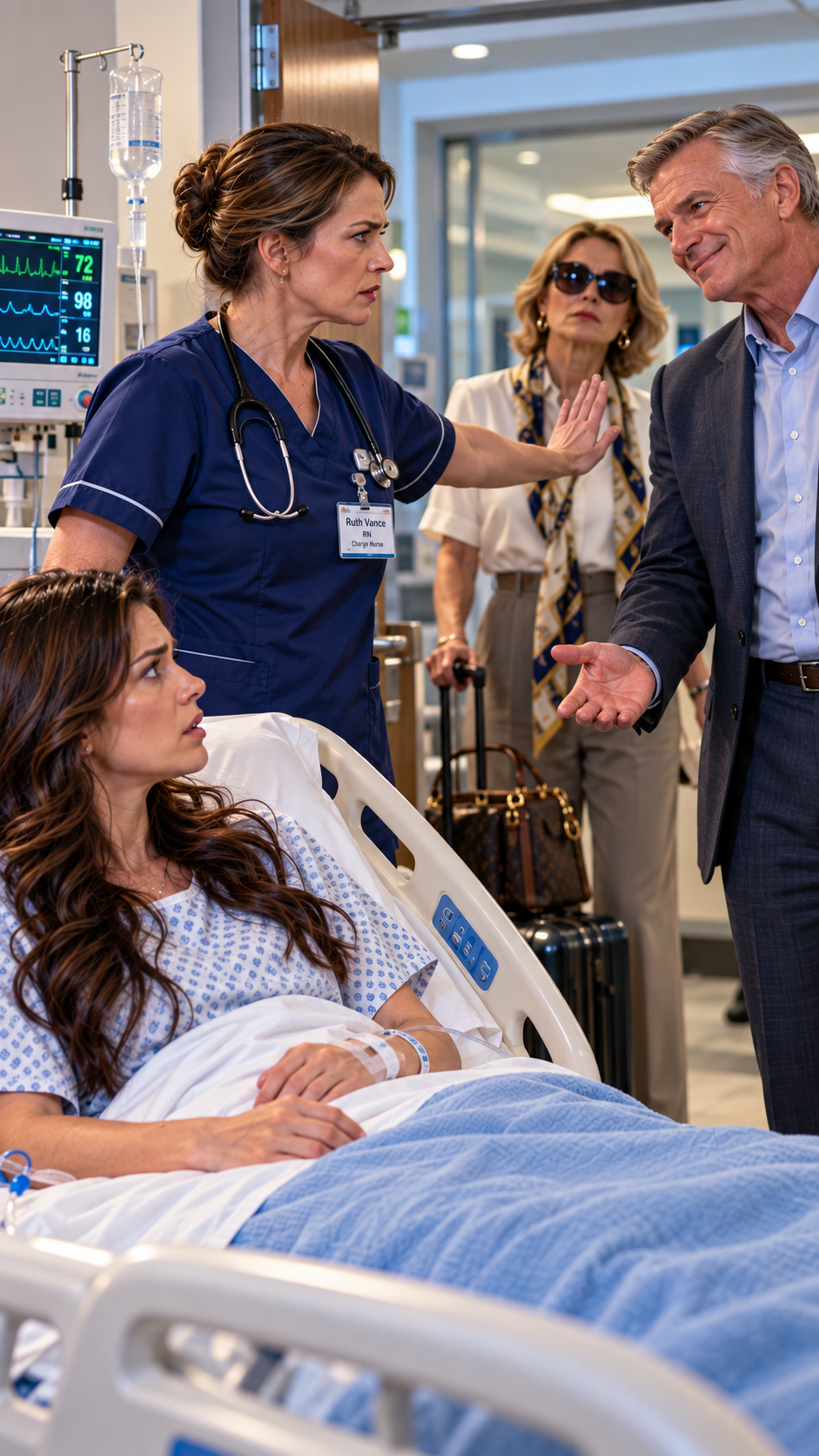
She had silver threaded through her dark hair and reading glasses resting on top of her head. Her badge said Ruth Vance, Charge RN.
She checked my monitor.
Then my IV.
Then she looked directly at me.
“Your throat hurts?”
I nodded.
She left and returned with a small cup of ice chips.
“Take them slowly.”
I stared at the cup.
It was such a small thing.
She could have simply placed it on the tray.
Instead, she pulled the chair closer, took my hand carefully around the cup, and made sure I could hold it.
“Let them melt,” she said. “Don’t swallow too quickly.”
“Thank you.”
Ruth looked toward the empty visitor’s chair.
“You need anything, press the button.”
I nodded.
“I mean it,” she said.
Then she left.
I sat there holding that cup of ice.
For the first time since I collapsed, someone had done something for me without asking what it cost, what schedule it interrupted, or whether someone else needed it more.
I didn’t cry.
In my family, crying had always been treated like evidence.
Evidence that you were unstable.
Evidence that you were making things bigger than they were.
Evidence that everyone else had to manage your emotions.
So I had learned not to cry.
Instead, I looked at the ceiling and remembered another floor.
A gymnasium floor.
I had been nine years old.
I had collapsed during a school event while my parents were watching from the bleachers.
I remembered waking up to fluorescent lights then, too.
But there was something else I remembered now.
My father had told me afterward that I had embarrassed the family.
My mother had said I needed to stop being dramatic.
Nobody had asked why I had fainted.
Nobody had taken me to a specialist.
The memory disappeared as quickly as it came.
I closed my eyes.
Twenty-five years.
Twenty-five years of explaining away symptoms that should have been investigated.
By morning, I was exhausted.
Ruth returned at seven.
She carried another cup of ice.
“You’re predictable,” she said.
I almost smiled.
“So are you.”
“Fair.”
She checked my blood pressure.
“Sleep?”
“A little.”
“That means no.”
I looked at her.
She smiled faintly.
“You’re not the first patient to lie to a nurse.”
Later that morning, Dr. Lingren explained what the tests were showing.
My heart had a dangerous rhythm disorder.
They needed additional monitoring and would likely recommend an implanted defibrillator once they understood the full picture.
I stared at her.
“A device?”
“Yes.”
“And if I hadn’t come here?”
She paused.
“I don’t want to speculate.”
That answer told me enough.
My phone lit up.
A photograph from Camille appeared on social media.
A hotel lobby.
Champagne glasses.
My sister smiling beside my parents.
I stared at it for several seconds.
Then I turned the phone face down.
I didn’t call them.
Instead, I pressed the nurse button.
Ruth entered.
“What do you need?”
I looked at her.
“I don’t know.”
She pulled the chair closer.
“That’s allowed.”
Those three words stayed with me.
That’s allowed.
For thirty-four years, everything I needed had apparently required permission.
That morning, I began to wonder what would happen if I stopped asking.
Click here to continue reading: PART 2: Nine Days Passed Without a Visit, Until an Old Voice on My Phone Reminded Me Someone Had Never Actually Left
The Morning My Heart Failed, My Family Had Already Decided Which Life Mattered More Than Mine
Part 1 of 12

