
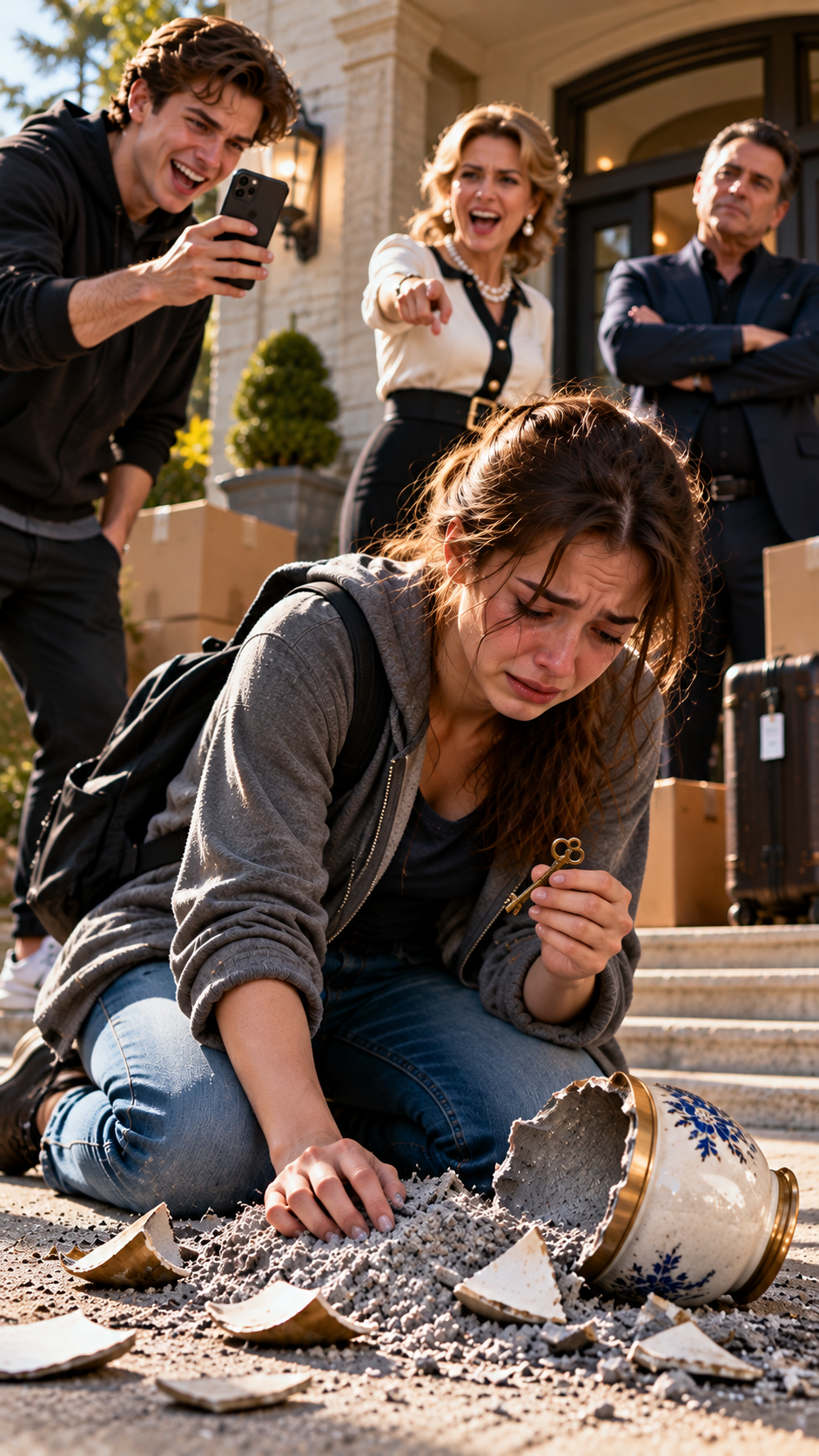
The first thing I noticed was the sound of my mother’s urn breaking.
It struck the stone driveway with a hollow crack, rolled once through the rainwater, and split open near the front tire of my father’s car. Gray ash spilled across the wet pavement and immediately began dissolving into thin streams that ran toward the street.
Celeste did not flinch.
She stood beneath the covered entrance of the house, dry and perfectly composed, one hand resting against the doorframe as if she were watching a delivery she had been expecting.
“Ten minutes,” she said. “Take whatever belongs to you.”
I stared at her.
The words made no sense because there was almost nothing left that I could take.
My suitcase was already on the driveway. One wheel had snapped when Grant threw it down the steps. My clothes lay scattered among puddles, some still inside the torn lining, others plastered against the stone.
Behind Celeste, my stepbrother Blake held up his phone.
He was recording.
His mouth curved into a grin.
“Come on,” he said. “Give us something worth posting.”
I looked down at the ashes.
My mother had been buried that morning.
My father had been buried that morning too.
And now, before I had even reached the point where grief could settle into something I understood, I was kneeling in the rain with my hands pressed against the driveway, trying to gather what remained of her.
Blake moved closer.
“Smile, orphan.”
The word landed harder than the rain.
I looked up at him.
He lowered the phone just enough for me to see his face clearly.
“You finally got what you wanted,” he said. “No parents left to keep you here.”
I almost answered.
Instead, I turned back to the pavement.
My fingers were already gray.
The ash had mixed with rainwater and tiny pieces of ceramic. Every time I tried to scoop one handful into the torn sweater I was using as a makeshift cloth, the powder slipped between my fingers.
My knees hurt against the cold stone.
I could hear Celeste speaking to Grant behind me.
“Make sure she doesn’t come back.”
Grant was her older brother, a thick-built man with a shaved head and the habit of standing too close to people. He had never liked me. I had learned that years earlier, when he began appearing at family dinners and stopped pretending I belonged there.
He came down the steps.
“You heard her.”
I kept collecting the ash.
“I heard her.”
“You have ten minutes.”
“I heard you too.”
His jaw tightened.
For several seconds, neither of us moved.
Then he turned toward Celeste.
“She needs to leave.”
“She will.”
I pressed my palm against a patch of wet gray dust.
That was when I remembered that I was twenty-two years old.
Twenty-two.
Old enough, apparently, to be told that my childhood home was no longer mine.
Young enough that the adults around me believed I would simply accept it.
My parents had been divorced for years, but their relationship had never become bitter. They had built separate lives while remaining friends. My father remarried Celeste. My mother lived across town. Somehow, despite the divorce, my parents still showed up for one another.
That was why their deaths had felt impossible.
Last Tuesday, they had both been near my father’s accounting office when a gunman approached.
The police had called the attack targeted.
They had not explained much more.
There had been witnesses, detectives, questions, photographs, and then funerals.
Two funerals on the same morning.
I had spent the entire day moving from one room to another without really knowing where I was.
And now Celeste was throwing me out.
I finally gathered the last visible pieces of my mother’s ashes.
I wrapped them inside my sweater and stood.
My legs shook.
Blake laughed quietly.
“Look at that. She survived.”
I ignored him.
My eyes went to the house.
The upstairs window of my father’s study was visible from the driveway.
His reading lamp was still on.
That small yellow rectangle behind the rain-streaked glass made my chest tighten.
“Can I get his watch?” I asked.
Celeste folded her arms.
“No.”
“It was my grandfather’s.”
“It belonged to your father.”
“And he gave it to me.”
She smiled without warmth.
“Everything valuable stays.”
I looked at her.
“What does that mean?”
“It means exactly what it means.”
Grant stepped between us.
“Don’t make this difficult.”
I almost laughed.
“You broke my suitcase.”
“You’re lucky you still have clothes.”
Celeste looked at Blake.
“Stop filming.”
He lowered his phone.
For the first time, I noticed something strange in her expression.
Not grief.
Not anger.
Calculation.
She wasn’t simply trying to get rid of me.
She was worried about what I might find.
That thought stayed with me.
I picked up the broken urn carefully.
Most of it was beyond repair, but one curved piece remained intact. I wrapped it in my sweater beside the ashes.
Then I knelt beside my suitcase.
My clothes were soaked.
I pushed them back inside.
A small metal object caught against the torn fabric near the bottom.
I reached for it.
My fingers closed around a tiny brass key.
For one second, I stopped breathing.
Nobody noticed.
Celeste was talking to Grant.
Blake had started recording again.
I slipped the key into my palm and closed my fingers.
The key was old, no longer than the first joint of my thumb. A narrow brass tag was attached to it with a thin ring.
I had not seen it in years.
My grandfather had given it to me when I turned eighteen.
At the time, I had thought it was nothing more than one of his strange sentimental gestures.
He had placed it in my hand at the birthday dinner and told me not to lose it.
“Your father understands numbers,” he had said.
I had laughed.
“What does that have to do with a key?”
He had leaned closer.
“I understand relatives.”
Then his expression changed.
“Keep it somewhere they won’t look.”
I had asked what it opened.
He hadn’t answered.
I thought about that now.
My grandfather had been dead for almost four years.
My father was dead.
My mother was dead.
And this key had somehow survived every move, every drawer, every argument, every year.
I slipped it into the pocket of my jeans.
Then I stood.
“I’m leaving.”
Celeste stepped aside.
“Good.”
I carried my broken suitcase down the driveway.
Nobody offered to help.
At the gate, I turned once.
The house looked exactly as it had when I was a child.
Same stone walls.
Same wide windows.
Same old oak tree beside the entrance.
But the people standing beneath that roof had made it feel unfamiliar.
I walked away.
Behind me, Blake shouted something.
I didn’t turn around.
Rain ran down my face, hiding whatever tears might have appeared.
I walked until the house disappeared.
The motel was six miles away.
By the time I reached it, my shoes were soaked through and my hands were stained gray.
The woman at the front desk looked at my suitcase, then at me.
“Rough night?”
“Yes.”
She slid a key across the counter.
I carried my things upstairs.
The room smelled faintly of detergent and old carpet.
I set the broken urn on the table.
For several minutes, I simply stared at it.
Then I went into the bathroom and washed my hands.
Gray water spiraled down the sink.
I washed twice.
Then a third time.
It didn’t help.
I returned to the room and placed the brass key beside the urn.
The tag had a number engraved on it.
I had never paid attention to it before.
Now I read it three times.
Then I picked up my phone.
There was an old number saved beneath my grandfather’s name.
I had never called it.
I wasn’t even sure it still belonged to anyone.
I pressed dial.
The call rang twice.
A woman answered.
“Marianne Vale.”
My throat tightened.
“Marianne?”
“Yes.”
“This is Nora.”
Silence.
Then I heard a chair scrape across a floor.
“Nora?”
“Yes.”
“What happened?”
I looked at the broken urn.
“They threw me out.”
Another pause.
“Are you somewhere safe?”
“For tonight.”
“Did you sign anything?”
I frowned.
“No.”
“Good.”
Her voice changed.
“Do not sign anything tomorrow either.”
I sat on the edge of the bed.
“Why?”
“Come to my office at nine.”
“Marianne, I need to know what’s happening.”
“You will.”
She hesitated.
“But I need you to answer one question first.”
“What?”
“Do you still have the key?”
I stared at it.
“Yes.”
Her breath caught.
“Then they didn’t find it.”
“Find what?”
“I’ll explain tomorrow.”
I looked toward the window.
Rain tapped against the glass.
“Marianne.”
“Yes?”
“Do I actually own the house?”
This time, the silence lasted longer.
Then she said, very quietly:
“You have since your grandfather died.”
My hand tightened around the phone.
“What?”
“You heard me.”
“Then why did Dad let Celeste live there?”
“Because your father was living there with her. That doesn’t make her the owner.”
I looked at the brass key.
“Why didn’t he tell me?”
“Your father had his reasons.”
“What reasons?”
“I don’t know all of them.”
I stood.
“Then tell me what you do know.”
“Come tomorrow.”
She ended the call.
I remained standing beside the bed.
Outside, headlights passed through the rain.
For the first time since the funerals, the numbness inside me shifted.
Not into anger.
Not yet.
Into suspicion.
I picked up the key.
It felt heavier than it had an hour earlier.
And suddenly, I understood the one mistake Celeste had made.
She had assumed that when she threw me out, she was sending away the only person who could challenge what she had taken.
She had never asked what my grandfather had left me.
She had never asked what my father had protected.
And she had never looked closely enough at the torn lining of my suitcase.
Click here to continue reading: PART 2: By Morning, the Woman Who Knew My Grandfather Had Laid Out Documents That Changed What I Thought My Father Had Hidden
The Rain Was Still Falling When They Took Everything From Me, But One Small Key Had Already Escaped Their Hands
Part 1 of 12

