
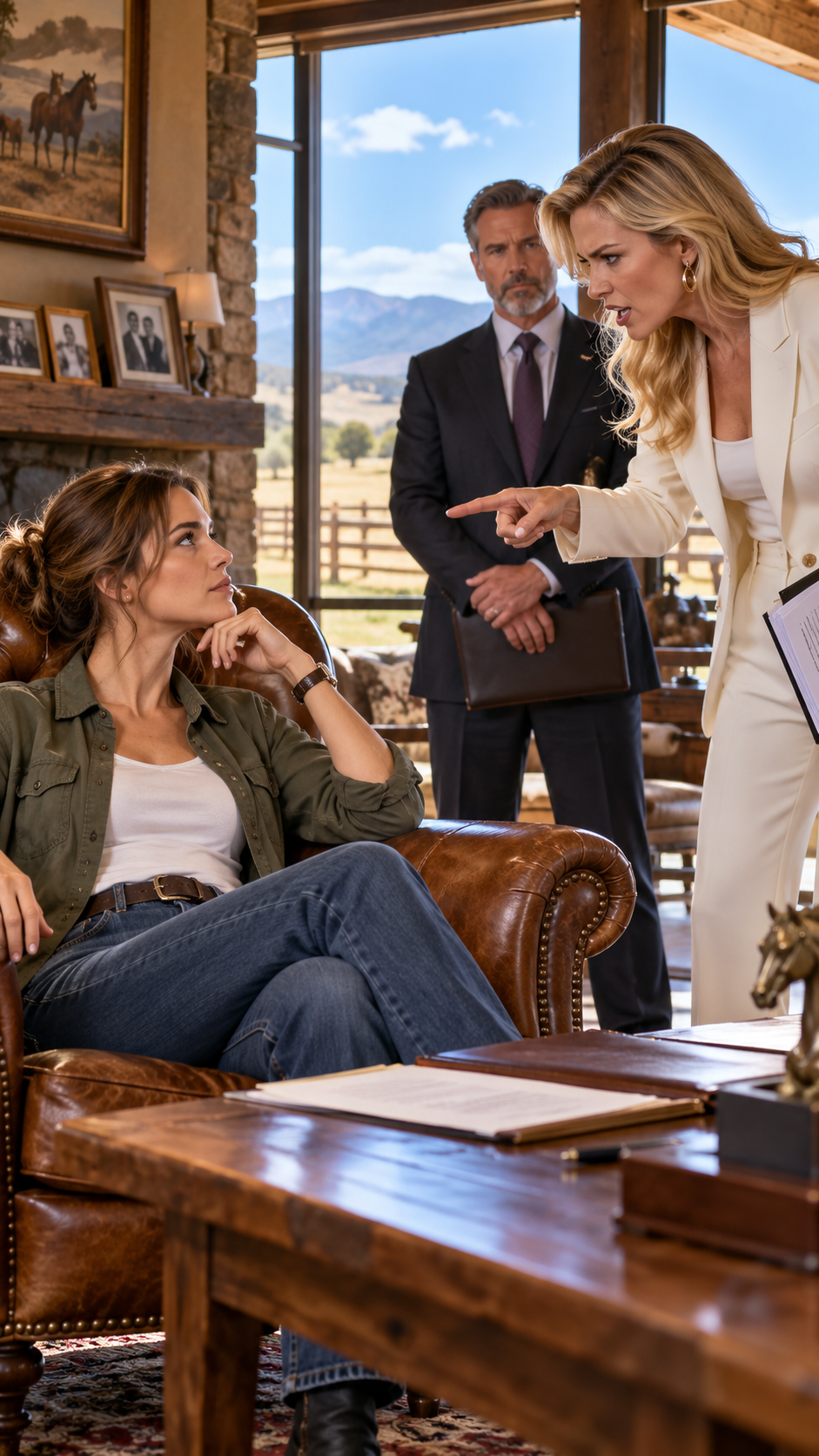
The first thing Clare said when she stepped through my front door was not hello.
She dropped a thick folder onto my father’s old kitchen table and looked at me as though she had already won.
“The ranch is mine now,” she said. “You need to start making arrangements to leave.”
Outside, rain tapped steadily against the windows. Inside, the refrigerator hummed in the corner, and the clock above the stove clicked through each second with irritating precision.
I stared at the folder.
Then at my sister.
Then back at the folder.
“That’s an interesting way to announce something,” I said.
Clare smiled.
She had always smiled like that when she believed she was several steps ahead of everyone else.
Behind her stood a man I didn’t recognize, dressed in a dark suit and carrying a leather briefcase. He had the polished, expressionless look of someone accustomed to delivering bad news for a living.
“My attorney,” Clare said.
The man gave me a brief nod.
I didn’t return it.
I was twenty-nine years old, and for the past year I had been trying to keep the family ranch alive while grieving the two people who had built my entire understanding of home.
Now my sister had arrived with a lawyer and claimed that the place belonged to her.
The strange part was that I wasn’t completely surprised.
A year earlier, when my parents’ will had been read, the ranch had been left to me.
Not divided.
Not placed into some complicated family trust.
Mine.
The property covered eighty acres of rolling pasture, woodland, fencing, stables, an aging farmhouse, and the barn my father had rebuilt almost entirely by himself after a fire when I was fourteen.
The property had been valued at approximately $1.2 million.
But the number had never meant much to me.
I remembered the smell of my mother’s cinnamon bread drifting from the kitchen on winter mornings.
I remembered Dad coming through the back door before sunrise, his boots wet with dew.
I remembered learning to ride before I could properly ride a bicycle.
That ranch wasn’t an investment account.
It was the last place where nearly every corner still contained something of them.
Clare had never seen it that way.
She was three years older than me, a lawyer, and had left for the city after college.
She was ambitious, organized, and very good at getting people to agree with her without realizing they had done so.
She visited on holidays.
She called on birthdays.
She rarely stayed more than a night.
I stayed because Dad needed help.
Then because Mom needed help.
Then because, eventually, there was no one left to help.
After the funeral, the lawyer read the will in a quiet office downtown.
When he told us the ranch had been left entirely to me, Clare went silent.
Only for a few seconds.
Then she smiled.
“Congratulations,” she said.
I thanked her.
At the time, I thought that was the end of it.
I was wrong.
The first comment came three days later.
We were sitting at Aunt Linda’s house, eating leftovers from the funeral reception.
Clare looked across the table at me.
“You really did well for yourself.”
I thought she was joking.
“I inherited a house that needs a new roof.”
“And eighty acres.”
“Which also need work.”
She lifted one shoulder.
“Still. Not bad.”
I didn’t answer.
A few weeks later, she came to the ranch and began asking questions.
How much was the property worth?
Was the agricultural land zoned for development?
Had I considered subdividing?
Was the old barn structurally sound?
I told her I hadn’t thought about selling anything.
She laughed.
“You don’t have to sell. There are other ways to make money from land like this.”
That phrase stayed with me.
Land like this.
Not home.
Not Mom and Dad’s place.
Land.
Soon, Clare began visiting more frequently.
At first, she said she wanted to make sure I was handling everything properly.
Then she started making suggestions.
The kitchen should be remodeled.
The guesthouse could become a rental.
The pasture could be leased.
The western section might support cabins.
She even brought her fiancé one weekend and casually pointed toward the orchard.
“We could put a nursery somewhere around here.”
I laughed because I assumed she was being playful.
She wasn’t.
I looked at her.
“You know you’re talking about my house, right?”
She shrugged.
“Our family’s property.”
That was the first time I noticed the change.
She no longer said my ranch.
She said our property.
A few weeks later, she appeared with paperwork.
“Nothing dramatic,” she said. “Just some estate cleanup.”
I should have asked more questions.
Instead, I trusted her because she was my sister.
I sat at the kitchen table and looked over the pages.
There were transfer provisions.
Ownership language.
References to estate administration.
Some sections were dense enough that I couldn’t immediately understand what they meant.
“Why does this say transfer?”
Clare reached for the papers.
“It’s standard.”
“Then why do I need to sign it?”
She sighed.
“Because you’re making everything harder than it needs to be.”
I didn’t sign.
She left angry.
That night, I called a friend who worked in real estate law.
I sent him photographs of the documents.
He called me back less than an hour later.
“Jacob, don’t sign anything else.”
My stomach tightened.
“Why?”
“Because these aren’t routine housekeeping documents.”
I sat very still.
“What are they?”
He explained what the provisions could potentially accomplish if executed and recorded properly.
I didn’t tell him that the papers had come from Clare.
I didn’t need to.
He heard the silence on the other end.
“Is this a family member?”
“Yes.”
“Then be especially careful.”
The next week, I hired independent counsel.
Not someone who knew Clare.
Not someone recommended by the family.
Someone whose only responsibility was protecting my interests.
That was when I learned how vulnerable the ranch could become if I simply assumed the inheritance documents were enough.
We discussed the property’s title, liability, taxes, estate records, and the structure of ownership.
Then my attorney suggested forming a limited liability company and transferring the ranch into it, provided the transfer was legally and financially appropriate.
I asked him why.
“Because you need a clean ownership structure,” he said. “And because if someone is already positioning themselves to challenge your control, you shouldn’t make their job easier.”
I didn’t tell him how much that sentence frightened me.
I established the LLC.
Every step was documented.
The ranch was transferred according to the proper legal process.
The records were filed.
The accounts were organized.
I paid the required fees.
When it was done, I sat in my truck outside the county office for almost ten minutes before starting the engine.
I felt guilty.
Not because I had done anything wrong.
Because I had protected myself from my sister.
For the first time in my life, I understood that being family didn’t automatically mean someone would protect your interests.
Sometimes it meant the opposite.
For several weeks, nothing happened.
Clare stopped calling.
She didn’t visit.
She didn’t mention the paperwork.
The silence should have reassured me.
Instead, it made me uneasy.
Then, one Monday morning, she appeared at the ranch with the same attorney who stood behind her now.
That was the moment I realized she had known about my precautions.
She looked around my kitchen as though she were already inspecting a property that belonged to her.
Then she placed the folder on the table.
“The deed is in my name now,” she said.
My pulse slowed instead of racing.
That frightened me more than panic would have.
I looked at the attorney.
“Is that supposed to mean something to me?”
“It means,” Clare said, “that you no longer have ownership rights here.”
I opened the folder.
There were recorded documents.
A court stamp.
Affidavits.
Statements from relatives.
And a transfer document that appeared, at first glance, to support her claim.
I read the first page.
Then the second.
Clare watched me.
She expected shock.
Instead, I felt something colder.
Recognition.
She had not arrived suddenly.
She had been preparing.
The documents didn’t prove everything she wanted them to prove, but they showed me that she had built an argument.
And she had built it quietly.
I closed the folder.
“You’re asking me to leave my home?”
“I’m telling you,” she replied.
The attorney finally spoke.
“You should obtain independent legal advice before taking any action.”
I almost laughed.
“I already did.”
Clare’s expression changed.
Only slightly.
But I saw it.
“You knew,” she said.
“I suspected.”
She leaned against the counter.
“You really think that little company you created is going to protect you?”
I said nothing.
Her smile returned.
“We’ll see.”
She picked up her handbag.
At the doorway, she stopped.
“Pack carefully, Jacob. I don’t want you claiming later that anything was damaged.”
Then she walked outside.
The attorney followed.
I watched them cross the porch.
Neither looked back.
I waited until their car disappeared down the driveway before returning to the table.
I opened the folder again.
This time, I wasn’t looking at the claim.
I was looking for the part Clare hadn’t explained.
And on the third page, I found it.
A name.
One I recognized.
A relative who had been at my parents’ funeral.
Someone who had told me, only months earlier, that I was doing exactly what Dad would have wanted.
I reached for my phone.
This wasn’t going to be a family disagreement anymore.
It was going to be a legal fight.
Click here to continue reading: PART 2: The Papers My Sister Brought Looked Convincing Until I Traced the Names Behind Them and Discovered Why She Needed My Parents’ Ranch So Desperately
My Sister Said the Ranch Was Hers Now, But One Detail in the Papers Made Me Realize She Had Planned This Long Before She Arrived
Part 1 of 12

