
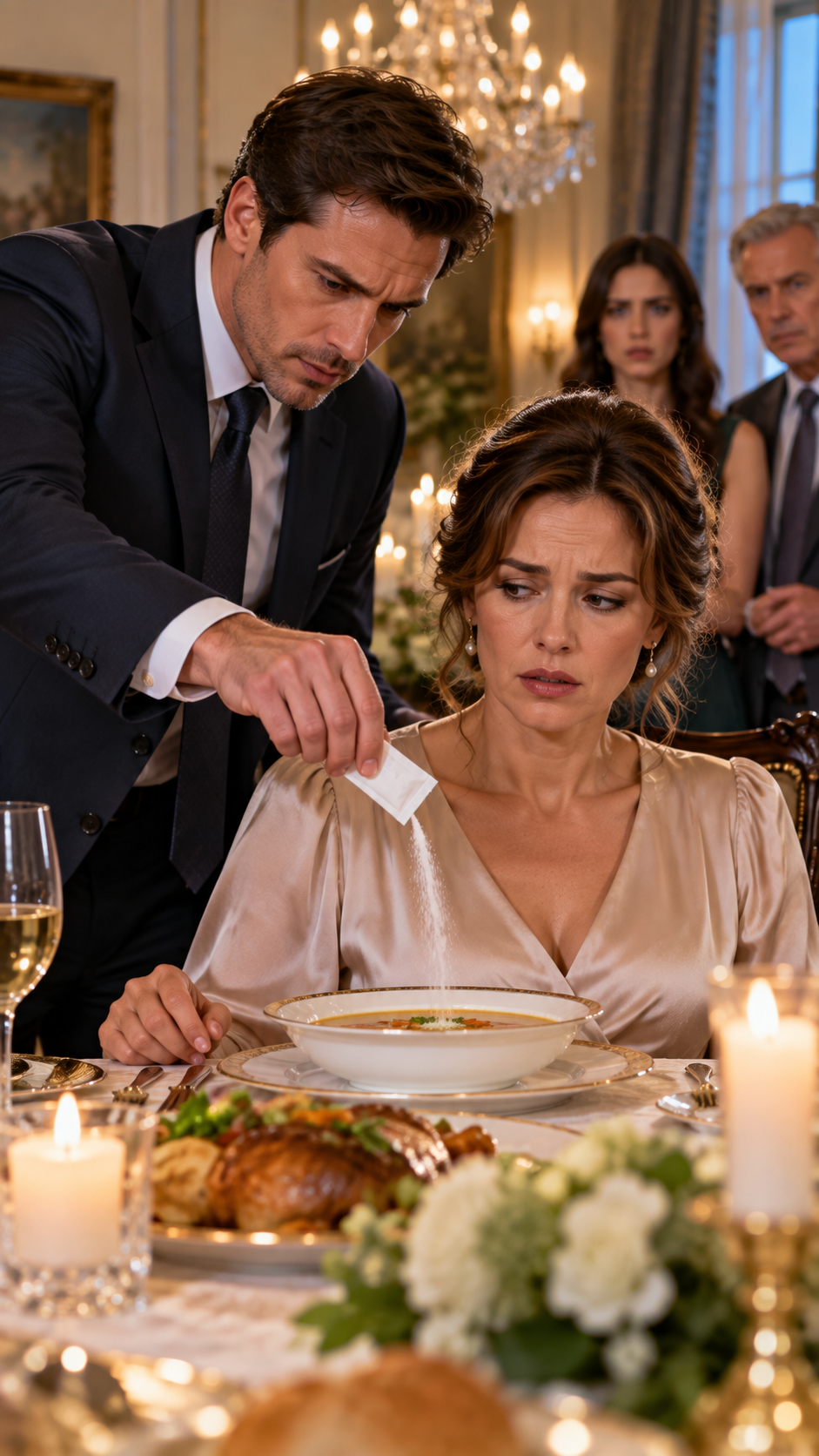
I was standing in the dark hallway when I saw my husband slip a tiny white packet from his pocket.
He glanced toward the dining room before tearing it open.
Then he emptied the contents into my bowl of chicken soup.
He stirred it twice, slowly, with the same spoon he had been using to serve dinner.
I didn’t move.
I didn’t breathe.
For twenty-six years, I had known the small habits of Mark Foster. I knew the way he scratched his jaw when he was irritated, the way he tapped his wedding ring against a glass when he was impatient, and the little pause that came before he lied about something insignificant.
What I saw that evening was different.
Mark wasn’t nervous.
He wasn’t hurried.
He looked completely comfortable.
That was what frightened me most.
I backed away before he could turn around and see me.
My hand found the wall.
For several seconds, I stood there in the dim hallway, staring at nothing, while the pounding in my chest seemed impossibly loud.
Then I walked into the guest bathroom and locked the door.
The woman in the mirror looked like someone I barely recognized.
My face was pale.
There were dark circles beneath my eyes.
My hair, once thick and brown, had begun turning silver around my temples.
I looked tired because I was tired.
For nearly six months, I had been tired all the time.
Headaches came without warning. Sometimes I felt dizzy when I stood up. I had started forgetting ordinary words in the middle of conversations. Twice, I had walked into a room and completely forgotten why I had gone there.
And then there were the strange episodes.
A glass slipping from my hand.
A sudden wave of sleepiness in the middle of the afternoon.
A forgotten appointment.
A grocery list that I could no longer remember writing.
Every time I had mentioned it to Mark, he had offered the same explanation.
“You’re overworked.”
“You haven’t been sleeping.”
“You’re getting older, Diane.”
Once, when I complained that I had felt confused while driving home from the supermarket, he had laughed gently.
“Welcome to fifty.”
I had laughed too.
What else was I supposed to do?
My name is Diane Foster.
I was fifty years old that Sunday evening, and until that moment, I would have sworn I understood my husband better than anyone alive.
Now I wasn’t sure I understood him at all.
The strange part was that nothing about the evening had looked unusual when it began.
Mark and I had driven to his parents’ house in Carmel, Indiana, for the family’s traditional Sunday dinner.
The Foster family had been having Sunday dinners for as long as I could remember.
Five-thirty.
Every Sunday.
No excuses.
His mother, Judith, treated that schedule as if it had been written into the family Bible.
That evening, we arrived three minutes late.
Judith opened the door before Mark could knock a second time.
“You’re late.”
Mark smiled.
“Three minutes.”
“Three minutes becomes ten, and ten becomes half an hour.”
Harold, his father, called from the living room.
“They’re here now, Judith.”
Judith turned toward him.
“You always say that.”
Harold shrugged and went back to watching television.
Normally, I would have laughed.
Instead, I watched Mark.
He had barely spoken during the drive.
Usually he filled every silence with complaints about traffic, his office, the neighbors, sports, or whatever news story had irritated him that day.
That evening, he kept checking the clock.
“You okay?” I asked him in the car.
“Fine.”
“You’ve been quiet.”
“Just tired.”
He reached over and squeezed my hand.
The gesture should have comforted me.
Instead, I remembered the soup.
I forced myself to smile.
Inside, Steve and Karen were already there.
Steve was Mark’s younger brother, and Karen had married him fourteen years earlier.
Karen met me in the kitchen while Judith arranged food.
“I brought the pie,” she whispered.
Judith looked over.
“You bought it.”
Karen smiled innocently.
“I bought the ingredients.”
I laughed despite myself.
“That’s what I tell people.”
Karen leaned closer.
“Exactly.”
For a few minutes, everything felt normal.
The smell of roast beef filled the house.
Butter melted over warm rolls.
Judith complained that Harold had opened the wine too early.
Steve argued with his father about a football game.
Karen asked me whether I had decided where we were going for Christmas.
Ordinary family noise.
Ordinary family problems.
Ordinary Sunday.
Then Judith carried six bowls of chicken soup into the dining room.
“Eat before it gets cold.”
Mark stood immediately.
“I’ll help.”
He picked up my bowl.
I looked at him.
“That’s mine.”
“I know.”
“You don’t have to.”
“You like more pepper.”
His smile appeared.
That same smile.
Polite.
Controlled.
Not quite reaching his eyes.
“I can do it,” he said.
I watched him walk toward the kitchen.
My stomach tightened.
“I need to wash my hands.”
Nobody answered.
I stepped away from the table.
Instead of going directly to the bathroom, I stopped near the kitchen entrance.
And that’s when I saw the packet.
I watched him open it.
A fine white powder disappeared into my soup.
He stirred it.
Once.
Twice.
Then he picked up the bowl and walked back toward the dining room.
I moved quickly into the hallway.
The guest bathroom was empty.
I locked the door.
Now, staring into the mirror, I tried to think logically.
There had to be another explanation.
Maybe it was salt.
Maybe it was some seasoning I didn’t recognize.
Maybe he had added medication because he thought I needed something.
But if it were harmless, why had he hidden it?
Why had he looked over his shoulder first?
And why had my husband been so interested in convincing me that my recent health problems were simply age or stress?
I opened the bathroom door.
Mark was already sitting beside me.
My soup steamed between us.
“You okay?” he asked.
“Fine.”
“You look pale.”
“I’ve been tired.”
“You’re always tired lately.”
The words landed differently now.
I looked at him.
He lifted his spoon.
“Eat.”
I stared at the bowl.
“I’ll wait.”
He smiled.
“Diane, stop pretending you’re sick for attention.”
No one else seemed to notice.
Judith was talking about Thanksgiving.
Steve was arguing with Harold.
Karen was laughing.
Only Mark watched me.
Waiting.
That was when I made the first decision of the night.
I reached for my bowl.
But instead of lifting the spoon, I quietly moved it across the table.
Judith’s bowl was directly beside mine.
The bowls looked identical.
I switched them while everyone was distracted.
Then I sat back.
Mark didn’t notice.
Or at least I thought he didn’t.
Judith picked up her spoon.
She took a bite.
Then another.
I watched Mark.
He wasn’t looking at his mother.
He was looking at me.
A few seconds passed.
Judith frowned.
“Something feels strange.”
Harold lowered his fork.
“What?”
“My hands.”
Her spoon slipped from her fingers.
It struck the bowl with a sharp metallic sound.
Judith tried to stand.
Her knees buckled.
Steve was beside her immediately.
“Mom?”
She swayed.
Karen grabbed her arm.
“Call 911.”
The room erupted.
Chairs scraped the floor.
Harold shouted for someone to get her medication list.
Steve held his mother upright.
Karen called emergency services.
And Mark stood completely still.
He wasn’t looking at Judith.
He was staring at me.
Our eyes met.
The color drained from his face.
That expression answered a question I hadn’t dared ask.
He knew something was wrong.
He knew exactly what was wrong.
And for the first time in twenty-six years, I was afraid of my husband.
Click here to continue reading: PART 2: The Symptoms I Had Blamed on Age Suddenly Looked Different After I Found the Empty Packet Beneath the Family Dinner Table
I Watched My Husband Put Something Into My Soup, and in That Quiet Moment I Realized the Man I Married Might Know More Than He Ever Admitted
Part 1 of 12

