
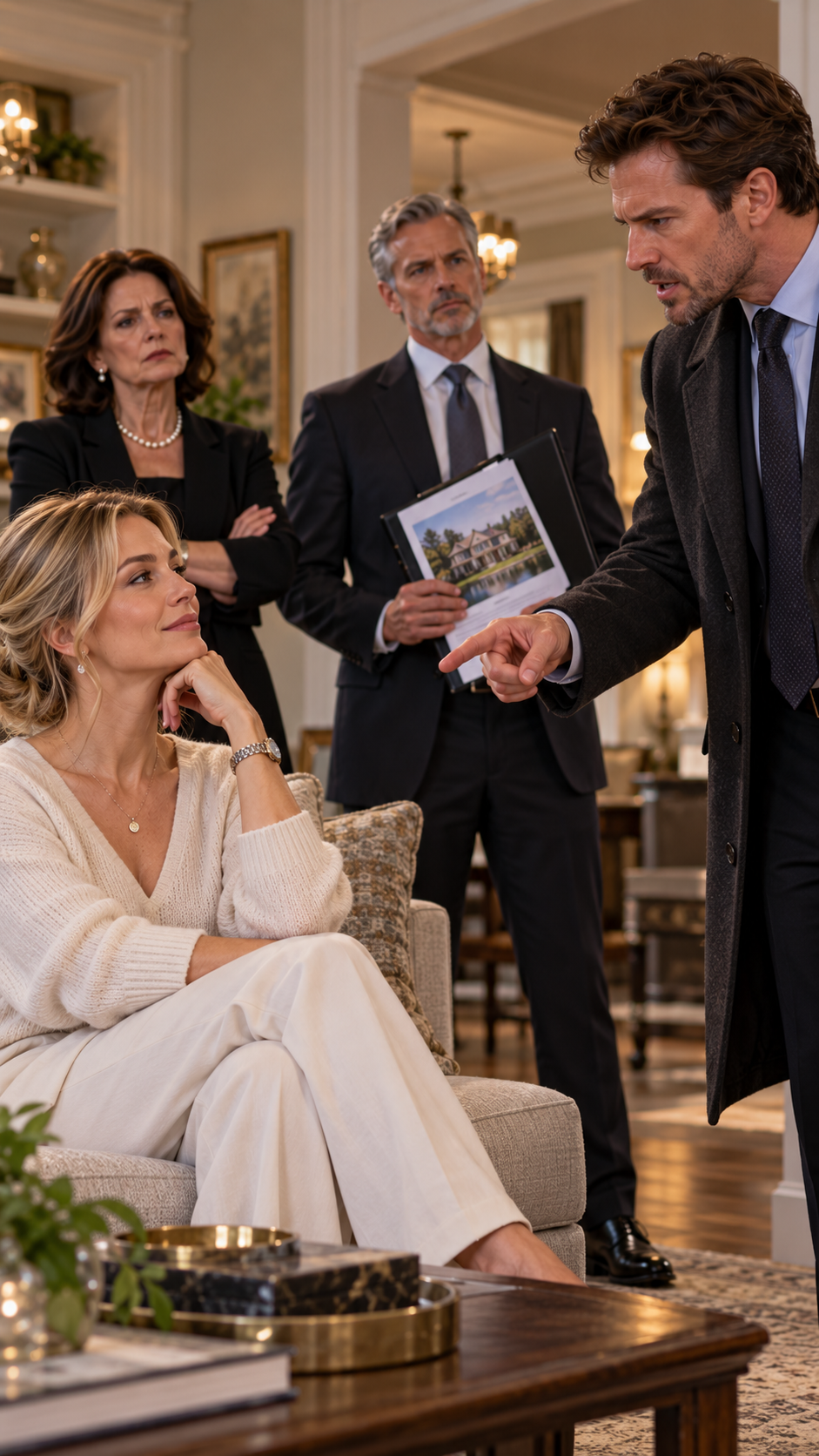
Two weeks after David’s funeral, his brother Travis walked into my living room carrying a folder, followed by a real-estate agent I had never met. Behind them came David’s mother, dressed in black, her face composed in a way that made the whole visit feel less like mourning and more like a transaction. Travis did not ask whether I was all right. He did not even take off his coat. He looked around the room and said, “You have thirty days to leave.”
For several seconds, I simply stared at him. David’s wedding ring rested on a thin chain around my neck. I had stopped wearing it on my finger because my hand kept reaching for the empty side of the bed, and every time I saw the ring there, the truth became harder to ignore. David was gone. But apparently his family had already decided that his death meant they could begin dividing everything he had left behind.
His mother stepped into the room and folded her gloved hands over her purse. “This house needs to be sold quickly,” she said. “Travis has already spoken with an agent. You should find something smaller.”
I looked past her toward the hallway.
The walls were painted a pale blue because David and I had spent one entire summer arguing over shades of blue before finally choosing the one that looked best in afternoon light. Near the kitchen stood the little wooden cabinet he had built after our miscarriage, even though he had never admitted how much the loss had hurt him. His boots were still beside the back door. I had not moved them.
They wanted to sell all of that.
They wanted to turn the place where I had spent the last years of my husband’s life into a number on a listing sheet.
“I live here,” I said quietly.
Travis gave a short laugh. “You lived here because David allowed you to.”
The agent shifted uncomfortably.
I turned my eyes toward Travis. “He allowed me?”
“You know what I mean.”
“I do.”
He dropped the folder onto the coffee table. Several pages slid forward. “Mom and I discussed everything. The market is strong. We can have this listed within days. Once it sells, you can use your share to find an apartment.”
“My share?”
His expression changed slightly, as if he had realized he had said something he should not have.
His mother answered for him. “David was our son. This property has always been considered a family asset.”
I almost laughed.
Not because anything was funny.
Because I suddenly understood.
They had not come to see me because they were worried about a grieving widow. They had come because they believed David’s death had opened a door, and they intended to walk through it before I had enough strength to close it.
I glanced at the papers again.
The listing agreement had already been prepared.
They had expected me to sign.
Mallory, Travis’s wife, entered behind them holding a tablet. “Hannah, please don’t make this more difficult than it needs to be. Nobody wants a fight.”
“Nobody?”
She looked at me.
“David would want his mother taken care of,” she said.
There it was.
That sentence had become their favorite weapon.
David would want this.
David would want that.
They used his name whenever they wanted something from him while he was alive, and apparently they planned to keep using it after his death.
When Travis needed money, David would want to help his brother.
When his mother borrowed jewelry, David would understand.
When Travis kept David’s truck for nearly three years, David would want him to have transportation.
And when David became sick, they suddenly discovered that he had a responsibility to protect everyone except the woman sitting beside his hospital bed.
I remembered the final month of his life.
The cancer had weakened him so severely that even ordinary conversations exhausted him. His voice had become thin, but his mind remained clear. On the evening before one of his last procedures, he had asked me to close the bedroom door.
“Hannah,” he had said.
I sat beside him.
“Promise me something.”
“Anything.”
He looked toward the window for a long time before speaking.
“When I’m gone, don’t let them turn my death into their payday.”
I had tried to stop him.
“You need to rest.”
“I need you to promise.”
So I did.
At the time, I thought he was talking about arguments over money.
I did not realize how quickly those arguments would begin.
Travis tapped the listing agreement with one finger.
“We’re trying to make this simple.”
I looked at him.
“Simple for whom?”
His jaw tightened.
“For everyone.”
“No,” I said. “For you.”
The agent finally spoke. “Mrs. Bennett, perhaps we should all take a moment. There may be estate matters that need to be reviewed before anything is signed.”
“I agree.”
Travis frowned.
“You don’t need an estate lawyer for this.”
“I already have one.”
That made the room noticeably quieter.
His mother looked at me sharply. “Since when?”
“Since David got sick.”
She looked toward Travis.
He shook his head slightly.
I could see the calculation beginning behind their faces.
They had expected me to be alone.
They had expected grief to make me disorganized.
They had expected me to sign whatever they placed in front of me.
What they did not know was that David and I had spent months preparing for exactly this kind of situation.
After his diagnosis became serious, he began reviewing every document we owned. At first, I hated those conversations. I wanted to talk about vacations we would take when he recovered, not deeds and beneficiary forms.
But David insisted.
One evening, he had spread documents across the dining table while rain struck the windows.
“I don’t want you fighting with my family after I’m gone,” he said.
“I won’t.”
“You don’t know them as well as I do.”
“I know them well enough.”
He smiled sadly.
“No. You know the version of them they show when I’m watching.”
That sentence stayed with me.
The next morning, he contacted Miles Carter, the attorney who had handled several of our legal matters over the years.
There were meetings I did not attend.
There were documents David insisted on reviewing privately.
There were signatures I watched him make.
And there were decisions he never discussed with his family.
I had not mentioned any of that since the funeral.
Not to Travis.
Not to his mother.
Not to Mallory.
They believed silence meant ignorance.
I had allowed them to believe it.
His mother moved closer to the coffee table.
“You’re making a mistake, Hannah.”
“Am I?”
“You have no children with David.”
I felt something inside me go still.
She continued.
“You’re not the one who should be making decisions about everything he built.”
I looked at the photograph on the mantel.
It showed David and me at the lakeside cabin. His arm was around my shoulders, and I was laughing because he had just thrown a pinecone at me. Neither of us knew the photograph would eventually become one of the last pictures we had together.
“I was his wife,” I said.
His mother lifted her chin.
“Only his wife.”
The words landed harder than I expected.
I had heard her say variations of them before.
Never directly.
Never when David was present.
But now she had said them plainly.
Only his wife.
I looked at Travis.
Then at Mallory.
Then at the realtor.
None of them spoke.
I reached for my purse.
Travis watched me carefully.
“What are you doing?”
“Leaving.”
“You can’t leave. We need to finish this.”
“No.”
I stood.
“I think you need to finish it without me.”
His mother frowned.
“You haven’t signed anything.”
“I know.”
Travis stepped toward me.
“Hannah.”
I stopped at the doorway.
For the first time that morning, I smiled.
Not because I was happy.
Not because I had won.
Because they had walked into my house believing they were holding all the cards.
They weren’t.
“You’re too late,” I said.
Travis stared at me.
His mother narrowed her eyes.
“Too late for what?”
I looked at the papers on the coffee table.
“To sell a house you don’t understand.”
I left the room before anyone could answer.
But I knew they would not simply walk away.
They had come expecting a widow who could be pressured.
They were about to discover that David had left me something far more valuable than money.
He had left me proof.
Click here to continue reading: PART 2: The Papers on My Coffee Table Were Not What Travis Expected, and One Question About the Cabin Changed Everything
Two Weeks After David’s Funeral, His Family Arrived With a Realtor and a Deadline They Thought I Had No Power to Refuse
Part 1 of 12

