
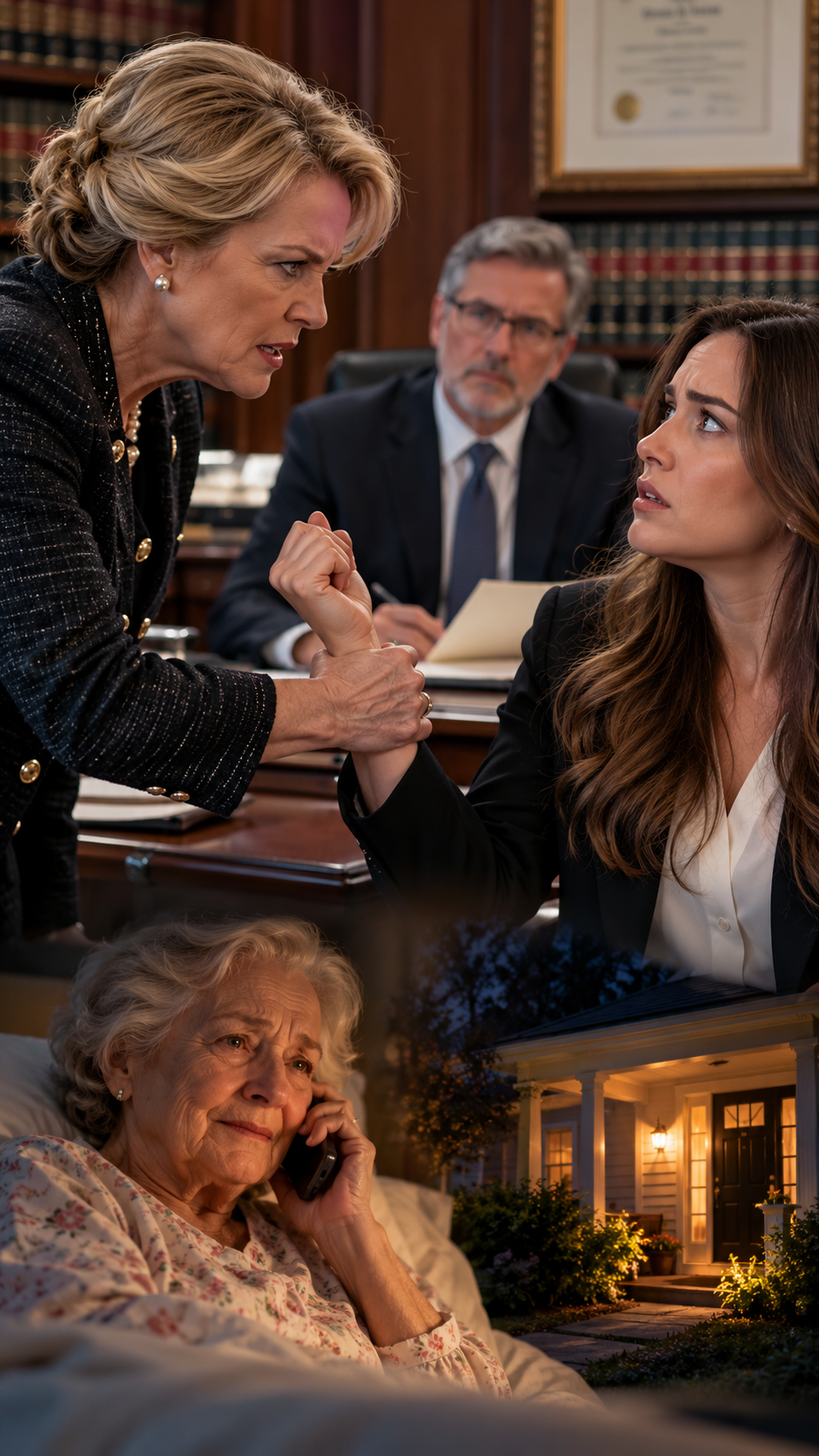
I knew my mother was serious when her fingers dug into my wrist hard enough to leave crescent-shaped marks.
We were sitting inside Mr. Callahan’s law office, surrounded by dark wood, framed certificates, and the faint smell of coffee that had been sitting too long on a warmer. Across the conference table, the attorney was arranging several documents into neat stacks.
My mother leaned toward me without looking at my face.
“If you get one dollar from her estate,” she whispered, “I will ruin your life.”
I stared at her.
She released my wrist and folded both hands in her lap as if nothing had happened.
Mr. Callahan cleared his throat. “Before we proceed, I want everyone to understand that this meeting concerns the final distribution of your grandmother’s estate.”
My mother smiled politely.
I didn’t.
Six months earlier, I had been standing beside my grandmother’s hospital bed when she made me promise something I still didn’t understand.
She had been dying then.
Not dramatically. There were no sudden alarms or doctors rushing into the room. Her body had simply become tired of fighting. Her breathing was shallow, her hands thin and cool, and the skin around her eyes had taken on that translucent quality that made her look both older and strangely peaceful.
She had waited until my mother left the room.
Then Grandma opened her eyes.
“Come closer,” she said.
I pulled the chair toward the bed.
She reached beneath her pillow and touched my fingers.
“Whatever happens,” she whispered, “I’ve already taken care of it.”
I thought she was talking about funeral arrangements.
I remember smiling sadly. “Grandma, you don’t have to worry about that.”
Her expression changed.
“No. Not that.”
She looked toward the closed bedroom door.
“Keep the porch light on.”
I frowned.
“The porch light?”
She nodded.
“You’ll understand.”
I wanted to ask what she meant, but she had already closed her eyes.
Three days later, she was gone.
And six months later, I was sitting in an attorney’s office while my mother threatened me over the inheritance.
My name is Claire Bennett.
I’m thirty-six years old, and for most of my life, I had learned that asking my mother for anything came with a price.
She was not the kind of woman who shouted all the time. That would have been easier.
My mother was controlled.
She could destroy someone with a quiet sentence and then spend the afternoon making tea as if nothing had happened.
My grandmother had been different.
She believed people should be given room to make mistakes. She kept old birthday cards in a shoebox. She remembered the names of grocery-store clerks. She left coins in the washing machine for children who might need them.
And she had always treated me as if I mattered.
That was one of the reasons my mother resented our relationship.
Growing up, I never understood why.
Now I was beginning to.
Mr. Callahan adjusted his glasses.
“Claire, your grandmother’s will was executed properly, and there are several accompanying documents that need to be reviewed.”
My mother shifted in her chair.
“What accompanying documents?”
He looked at her.
“I’m getting to that, Elaine.”
That was the first time I saw uncertainty cross my mother’s face.
It lasted less than a second.
But I saw it.
Elaine leaned back.
“I assume everything is straightforward.”
“It is not entirely straightforward.”
Her jaw tightened.
I looked at Mr. Callahan.
“What does that mean?”
He opened a folder.
“Your grandmother made several changes during the final year of her life.”
My mother gave a small laugh.
“Her health was failing. She was confused.”
Mr. Callahan didn’t respond immediately.
Instead, he removed a document from the folder.
“Your grandmother was evaluated by two physicians during that period. Both documented that she was mentally competent when these changes were made.”
My mother’s smile disappeared.
I felt my stomach tighten.
There were things happening in that room that I didn’t understand.
And suddenly I remembered Grandma’s hand beneath the pillow.
Whatever happens, I’ve already taken care of it.
Mr. Callahan continued.
“The final will was signed six months before her death.”
My mother looked directly at me.
I didn’t know what she expected to see.
Fear, perhaps.
Guilt.
Confusion.
Instead, I was thinking about a porch light.
The old house had one above the front door.
Grandma had kept it on every night.
When I was a child, I used to ask why.
“So people know somebody’s waiting for them,” she’d say.
At the time, I thought it was just something sentimental.
Now I wasn’t so sure.
Mr. Callahan placed another document on the table.
“This is a letter your grandmother instructed me to deliver only after her death.”
My mother reached for it.
He stopped her.
“It is addressed to Claire.”
Silence filled the room.
My mother slowly withdrew her hand.
I looked at the envelope.
My name was written across the front in my grandmother’s unmistakable handwriting.
Claire.
Nothing else.
Mr. Callahan pushed it toward me.
My fingers trembled as I picked it up.
My mother leaned closer.
“Don’t open that here.”
I looked at her.
“Why?”
“Because you’re being emotional.”
“I haven’t opened it.”
“Exactly.”
Mr. Callahan watched us both.
Then he said quietly, “Your grandmother specifically requested that Claire read it in this office.”
My mother’s face hardened.
I turned the envelope over.
There was a small handwritten note beneath the seal.
Keep the porch light on.
My heart stopped.
My grandmother had not forgotten.
She had been preparing me.
And whatever she had left behind was apparently important enough to frighten my mother.
I broke the seal.
Inside was a single sheet of paper.
I read the first line.
Then I looked up at my mother.
For the first time in my life, she looked afraid.
Click here to continue reading: PART 2: Grandma’s Letter Explained Why She Had Been Afraid of My Mother Long Before Anyone Knew the Truth
The Threat in the Attorney’s Office Was Only the Beginning of What My Mother Had Been Hiding From Me
Part 1 of 12

