
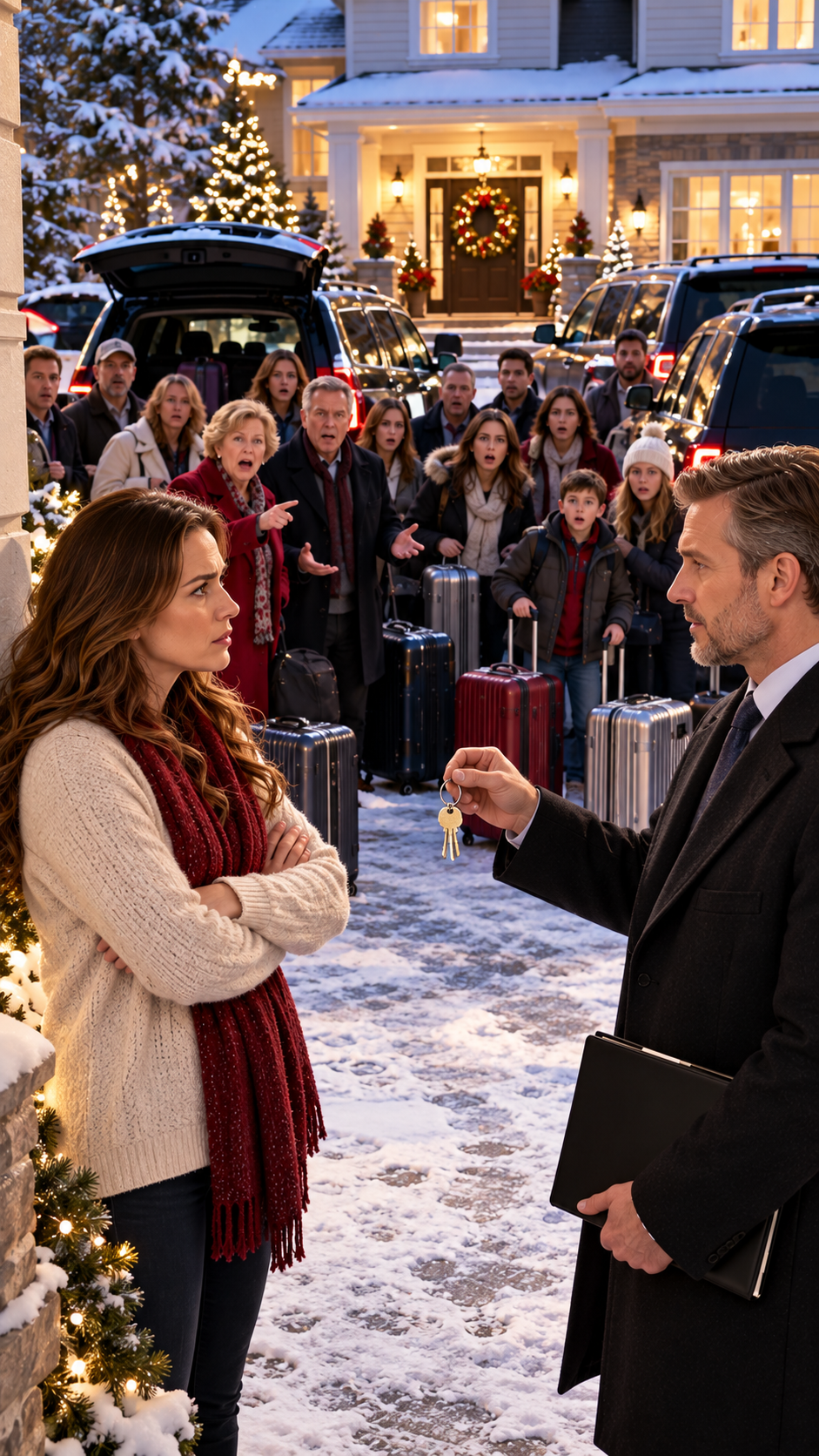
“If they treat my house like a free hotel again, I’m not opening the door this Christmas.”
I said it while standing at the kitchen sink, my hands submerged in warm dishwater, listening to the refrigerator hum behind me. Outside, December rain streaked the windows and turned the backyard into a dark sheet of mud. David sat at the table with his phone in one hand and a mug of coffee in the other. He looked up slowly.
“You mean you’re really serious this time?”
I shut off the faucet.
“Yes.”
David watched me for a moment, then glanced toward the dining room. The table still had the faint scratches from last Christmas, when seventeen people had crowded around it in shifts because there weren’t enough chairs. I had spent three days cooking, two days cleaning, and most of Christmas morning pretending I wasn’t exhausted.
“I don’t blame you,” he said.
That was the problem. David always understood me when we were alone. He knew how tired I became before Christmas. He knew that everyone else’s holiday seemed to begin when they arrived at our front door, while mine began weeks earlier with grocery lists, sleeping arrangements, towels, sheets, food, cleaning supplies, and messages asking whether someone could bring “just one more person.”
But knowing wasn’t the same as stopping them.
For six years, our house had become the unofficial headquarters for my family during the holidays. The first year had been innocent enough. My sister Karen had asked whether she, her husband, and their two children could stay for three nights because their hotel reservation had fallen through.
Of course I said yes.
They slept in the guest room, the children took the downstairs sofa, and David and I gave up our bedroom on Christmas Eve because my parents decided to arrive earlier than expected.
Nobody complained about the inconvenience.
Nobody thanked me for it, either.
The following year, people simply assumed they were coming.
By the third Christmas, I had stopped asking how many guests there would be. I would discover the number when vehicles started filling the driveway.
One December afternoon, my brother Mark called while I was shopping.
“Don’t forget we’re bringing Mom and Dad.”
“I didn’t know they were staying.”
“They always stay.”
“They stayed last year.”
There was a pause.
“Exactly.”
That became the family rule: once something happened twice, it became my responsibility forever.
The house itself had never been especially large. It had four bedrooms, a finished basement, one and a half bathrooms, and a living room that looked spacious when only four people occupied it. During Christmas, however, every available surface became a bed.
Children slept on air mattresses.
Adults shared rooms.
Someone always ended up on the basement sofa.
The bathroom door never stayed closed for more than thirty seconds.
And I cooked.
That part never changed.
I cooked because my mother said Christmas dinner was “my gift to the family.” I cooked because Karen’s children were picky. I cooked because Mark’s wife claimed she didn’t know how to use my oven. I cooked because Dad liked the potatoes prepared a certain way and because David’s family expected a separate dessert.
I cooked because everyone knew I would.
Then, after dinner, I cleaned.
One year I stood alone in the kitchen at 1:30 in the morning, scraping dried gravy from serving dishes while laughter drifted down the hallway.
I remember looking at the clock.
Everyone else was having Christmas.
I was washing it away.
The next morning, my mother found me asleep sitting upright at the kitchen table.
“You should have gone to bed earlier,” she said.
I looked at her.
“So should everyone else.”
She laughed as though I had made a joke.
This year, something had changed.
Maybe it was simply exhaustion.
Maybe it was the fact that I had turned another year older and suddenly realized I didn’t want to spend every December proving my love by making myself miserable.
Whatever the reason, I knew one thing.
I wanted Christmas morning to be quiet.
I wanted coffee while it was still hot.
I wanted to sit beside David in my own living room.
I wanted the house to remain clean for more than ten minutes.
Most of all, I wanted to stop feeling like a hotel manager who wasn’t allowed to charge.
David set down his mug.
“You should tell them soon.”
“I will.”
“You know they’re going to be angry.”
“I know.”
“And they’ll probably say you’re being selfish.”
I dried my hands and leaned against the counter.
“I know that too.”
He gave me a tired smile.
“Then what are you going to do?”
“For once?”
I picked up my phone.
“I’m going to let them be angry.”
I created a family group message.
My thumb hovered over the screen for several seconds.
Then I typed.
I told them that this Christmas would be different. I explained that David and I needed a quiet holiday at home and would not be hosting overnight guests. I said we loved everyone, but the house would not be available for the usual extended stay.
I reread it twice.
Then I pressed send.
For nearly four minutes, nothing happened.
Then Karen responded.
Seriously?
Mark followed.
What happened?
My mother wrote:
This doesn’t sound like you.
I stared at that sentence.
She was right.
It didn’t sound like the version of me they had become accustomed to.
The version who said yes before hearing the request.
The version who turned inconvenience into hospitality.
The version who paid for extra groceries without mentioning the cost.
The version who apologized whenever someone else was disappointed.
David read the messages over my shoulder.
“Don’t answer yet.”
I nodded.
The phone buzzed again.
Karen:
We already made plans.
Then Mark:
Everyone was counting on your house.
My mother’s message came next.
After everything family has done for you, I can’t believe you’re doing this now.
I felt something inside me go very still.
Not angry.
Not even surprised.
Just tired.
I typed one sentence.
I understand you’re disappointed, but my decision isn’t changing.
I sent it and placed the phone face down.
For perhaps ten minutes, the kitchen was silent.
Then David’s phone rang.
He looked at the screen.
“It’s your mother.”
“Don’t answer.”
He didn’t.
The call stopped.
Then started again.
He turned the phone over.
“They’re calling everyone.”
“Let them.”
The rain continued against the windows.
For the first time in years, Christmas felt as though it might actually belong to me.
I was wrong.
Because two hours later, Karen sent another message.
We’re coming anyway.
David read it before I did.
He looked at me.
“I think you should see this.”
I took the phone.
Under Karen’s message were several laughing emojis from other relatives.
Then Mark wrote:
Don’t worry. We’ll handle food this year.
I stared at those words.
Handle food.
As though the problem had never been that I was exhausted.
As though my boundary was merely an inconvenience they could work around.
Then my mother added:
We’re family. You can’t lock us out.
I slowly put the phone down.
David’s expression had changed.
“What are you thinking?”
I looked toward the window.
The rain had stopped.
Beyond the glass, the bare trees stood against a pale winter sky.
“I don’t know yet.”
But that wasn’t completely true.
For the first time, a thought had entered my mind that I hadn’t allowed myself to consider before.
Maybe the house wasn’t the problem.
Maybe keeping the house was.
Click here to continue reading: PART 2: They Thought My Silence Meant I Had Given In, So I Let Them Make Their Plans While I Made One They Never Saw Coming
The Christmas I Finally Said No Was Supposed to Be Ordinary Until My Family Decided My Boundary Was an Invitation
Part 1 of 12

