
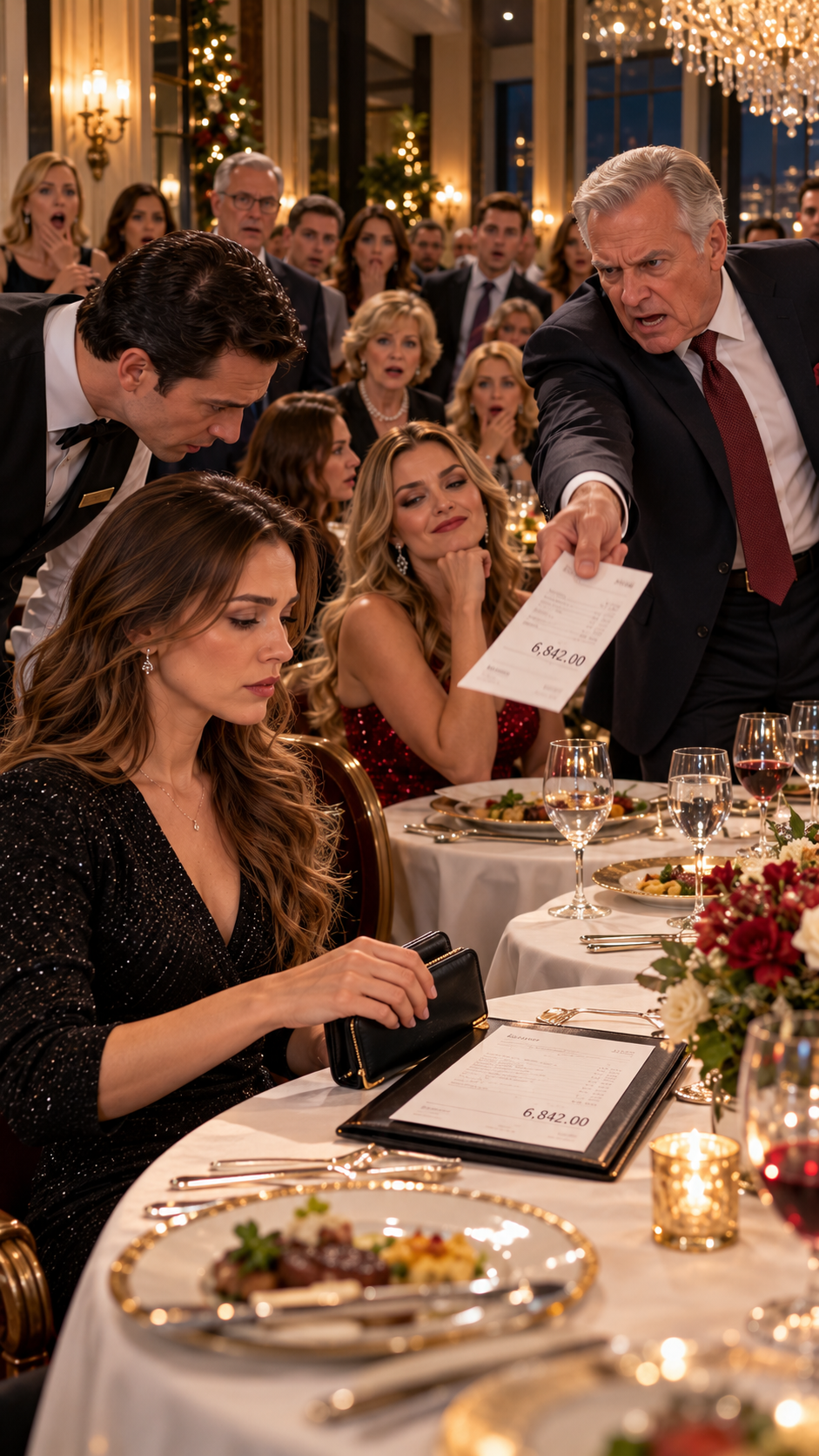
The bill landed beside my plate with enough force to make my water glass tremble.
“Seventeen people,” my father said. “You’re paying.”
The private dining room went quiet for exactly three seconds. Then my sister Vanessa laughed.
Not a nervous laugh. Not the kind someone makes because they do not know what else to do.
She laughed because she had been waiting for this moment.
I looked down at the bill.
$6,842.17.
The number sat there in thick black ink beneath the Bellamy House logo, surrounded by charges for wine I had never tasted, steaks I had barely touched, champagne I had watched Vanessa pour freely into glasses that were already half full.
My father leaned back in his chair as though he had just completed a clever business negotiation.
“That’s your responsibility,” he said.
Across the table, my aunt covered a smile with her napkin.
One of my cousins whispered something to his wife.
She glanced at me, then quickly looked away.
There were seventeen relatives in that room.
Every one of them had heard him.
Every one of them understood exactly what he meant.
I was not family tonight.
I was the person they expected to make the bill disappear.
Vanessa lifted her champagne flute.
“You should be thankful Dad even invited you, Claire.”
The room gave her the reaction she wanted.
A few people chuckled.
I kept my hands beneath the table.
My name is Claire Harrington, and for most of my adult life, my family had been very good at making me feel like an unwanted guest in my own home.
Tonight was simply the first time they had put a price tag on it.
The restaurant was expensive enough that the carpet seemed softer than the floor in my apartment.
Gold light reflected from crystal fixtures overhead. A pianist played somewhere beyond the closed doors, the notes faint enough to feel more like background noise than music.
Vanessa’s thirty-eighth birthday was being celebrated as though she were royalty.
She had ordered the private room.
She had chosen the wine.
She had insisted on the most expensive entrées.
And my father had encouraged all of it.
He had spent the first two hours smiling proudly at his favorite daughter while occasionally glancing toward me as if checking whether I understood how much I did not belong.
Vanessa sat beside her husband, Mark, wearing a black dress with a diamond bracelet our father had given her earlier that evening.
I had noticed the bracelet when she arrived.
I had also noticed the way Dad had kissed her cheek and told everyone, “She deserves the best.”
He had not looked at me when he said it.
He rarely did.
Not anymore.
When we were children, Vanessa had been the loud one.
I had been the quiet one.
She liked attention. I liked numbers.
She could walk into a room and make three strangers feel like old friends.
I could spend four hours with a ledger and notice a discrepancy nobody else saw.
My grandfather had understood the difference.
My father never did.
To him, Vanessa had ambition.
I had excuses.
Vanessa had loyalty.
I had abandoned the family business.
Vanessa was building something.
I was wasting my education doing “little accounting jobs.”
That was the phrase Dad always used.
Little accounting jobs.
He never mentioned that I had spent years helping small companies uncover financial irregularities. He never mentioned that I had clients who trusted me with their books because I did not treat numbers as suggestions.
He certainly never mentioned why I had left Harrington Supply Group.
He told everyone I had quit because I could not handle pressure.
The truth was less flattering to him.
I had found something.
And when I asked questions, my father had made it clear that some questions were not welcome.
But that night, none of that mattered to the seventeen people around the table.
They were watching me reach for my purse.
Vanessa leaned toward Mark.
“Watch her calculate whether she has enough.”
Mark gave a short laugh.
I heard it.
I heard everything.
I opened my purse.
My father smiled.
That expression was familiar.
It was the expression he had worn when I was twenty-five and standing in his office, holding a set of invoices that did not make sense.
It was the same expression he had worn when he told me I was confused.
It was the expression of a man who believed the room belonged to him.
I removed my wallet.
Vanessa’s smile widened.
My father folded his hands across his stomach.
“There,” he said. “That wasn’t difficult.”
I looked at him.
“No.”
He raised an eyebrow.
“No, what?”
I said nothing.
There was no point.
The truth was not ready yet.
And neither was he.
I pulled one credit card halfway from my wallet.
That was when the waiter approached my chair.
He bent slightly, pretending to adjust the arrangement of silverware.
His voice dropped low enough that only I could hear.
“Ma’am.”
I looked up.
“The person you asked us to contact has arrived.”
I stopped moving.
My father noticed.
“What is it?”
I slid the card back into my wallet.
“Nothing.”
The waiter straightened.
“Shall I send him in?”
“Yes.”
My father’s expression changed.
“Send who in?”
I looked at the door.
“Someone I invited.”
Vanessa frowned.
“You invited someone?”
“I did.”
“This is my birthday.”
“I know.”
Her smile disappeared.
“You weren’t supposed to bring anyone.”
“I didn’t.”
The waiter stepped away.
My father stared at me.
“What did you do?”
I closed my purse.
“Nothing you didn’t force me to do.”
He started to answer.
The dining-room door opened.
A silver-haired man entered carrying a dark leather folder.
He wore a charcoal suit without a tie. His movements were unhurried, almost deliberately calm.
My father saw him.
The color left his face.
He pushed his chair backward.
The legs scraped sharply against the floor.
Nobody spoke.
The man looked directly at my father.
“Good evening, Richard.”
My father stood.
“You.”
Vanessa looked from Dad to the newcomer.
“Who is that?”
Dad did not answer.
The man’s name was Martin Graves.
He was a forensic attorney.
And for the past six months, he had been following a trail my father had assumed nobody would ever find.
I watched my father’s hand tighten around the back of his chair.
He looked at me.
“What did you do?”
I reached for the folded dinner bill and straightened its edges.
“Nothing.”
Martin walked toward us.
My father’s voice dropped.
“Not here.”
Martin stopped beside my chair.
“I disagree.”
Vanessa stood.
“This is ridiculous. Claire, if you’ve hired someone to embarrass Dad because he asked you to pay for dinner—”
Martin opened his folder.
“I am not here because of dinner.”
The room became still again.
He removed several documents.
“I am here regarding Harrington Supply Group.”
Vanessa’s face changed.
My uncle Stephen stopped eating.
Dad looked at Martin.
Then at me.
Then toward the closed door.
It was the first time that evening my father looked as though he was searching for an exit.
I folded my hands on the table.
“Now,” I said quietly, “we can talk.”
And the $6,842.17 bill suddenly seemed like the least important piece of paper in the room.
Click here to continue reading: PART 2: Six Months Earlier, One Impossible Signature Had Turned My Grandfather’s Final Gift Into a Question Nobody Could Safely Ignore
The Dinner Was Supposed to Humiliate Me, Until the Waiter Whispered That Someone Important Had Arrived
Part 1 of 12

