
There are moments when grief does not announce itself. It simply finds you in an ordinary place and suddenly makes the past feel close enough to touch.
For me, it happened outside a church on a bright Saturday in April.
My five-year-old granddaughter, Margot, was spinning in circles on the pavement in a pink dress, laughing because the little black shoes on her feet made a satisfying click each time they struck the ground. She had been waiting for this wedding for weeks. She had told the woman at the dry cleaner about it. She had told our neighbor. She had even announced the news to a dog that belonged to the couple who lived across the street.
She was going to be in Daddy’s wedding pictures.
That was the part she cared about most.
Watching her that morning, I suddenly thought of Phoebe.
My daughter should have been there.
She would have fixed the ribbon at the back of Margot’s dress at least five times. She would have taken too many photographs and complained afterward that none of them had come out properly. She would have cried when she saw her little girl walking into the church.
But Phoebe had been gone for three years.
I had buried my daughter when she was far too young to leave this world, and grief had changed shape several times since then. At first, it had been unbearable. Later, it became something quieter that waited behind ordinary moments.
Seeing Margot happy could bring it rushing back.
Not because Margot reminded me only of what I had lost.
She also reminded me of what remained.
She had Phoebe’s eyes.
That was impossible to miss.
The same wide brown eyes, the same habit of narrowing them slightly when she was trying to understand something. But everything else seemed to belong to Margot alone. Her laugh was louder than her mother’s. Her legs were always moving. She approached new things with the confidence of a child who had not yet learned how often adults complicated life.
She was Phoebe’s daughter.
And she was Emmett’s little girl.
That mattered.
Margot had lost her mother when she was two years old. She remembered almost nothing about Phoebe herself, so Emmett and I had made a quiet agreement without ever formally saying it.
We would keep Phoebe present without turning her into a ghost.
Margot knew her mother through photographs.
Through stories.
Through small memories.
Sometimes I would tell her, “Your mother used to sing that song while she cooked.”
Or, “Your mother loved strawberries when she was your age.”
Or, “You know that funny face you make when you’re pretending not to listen? Your mother did exactly that.”
I wanted Margot to know that her mother had been a real person, not simply a photograph on a shelf.
Emmett understood that.
He had every reason to disappear into his own grief after Phoebe died. Instead, he stayed.
He became a father in the middle of the worst year of his life.
He worked.
He came home.
He learned how to braid hair badly enough that Margot once told him he was “not ready for advanced hairstyles.”
When she got sick, he called me.
When he had to work late, I watched her.
When something happened that Phoebe would have laughed about, one of us usually called the other.
The three of us became the little family that remained.
That was why I was not angry when Emmett eventually told me he had met someone.
We were sitting at his kitchen table after Sunday dinner. Margot had gone upstairs to brush her teeth, and Emmett had been unusually quiet for several minutes.
Finally, he put his fork down.
“I need to tell you something.”
I looked at him.
“All right.”
“I’ve been seeing someone.”
He watched me carefully.
I could see that he had been rehearsing those words.
“How long?”
“About three months.”
“And her name?”
“Claire.”
“What can you tell me about Claire?”
He smiled for the first time that evening.
“She teaches third grade.”
“That sounds dangerous.”
He laughed.
“She’s patient.”
“That’s good. You need someone patient.”
“She’s kind.”
“And?”
“And Margot likes her.”
That last part mattered more than anything else.
I leaned back in my chair.
“Are you happy?”
He hesitated.
“I think I am.”
“Then you have nothing to apologize for.”
His shoulders relaxed.
“You really mean that?”
“Of course.”
I meant it.
Phoebe was gone.
I could not bring her back by making Emmett lonely.
And I would never want Margot to grow up believing that loving another woman meant betraying her mother’s memory.
When Emmett told me he intended to marry Claire, I supported him.
I attended the wedding because I wanted it to work.
I wanted Claire to become someone Margot could trust.
I wanted Emmett to have companionship again.
I wanted the family to grow rather than remain permanently frozen around a grave.
And that is why what happened later hurt so much.
It had nothing to do with me being unwilling to accept a new woman.
It had nothing to do with believing Phoebe should somehow remain the center of Emmett’s life forever.
It had to do with a five-year-old child who had spent two weeks believing she had an important place in her father’s wedding.
That morning, Margot was certain of it.
“Grandpa,” she said, holding up one shiny shoe, “listen.”
She stamped her foot.
Click.
Then she stamped the other.
Click.
“Very impressive.”
“They make the best sound.”
“I agree.”
“Daddy said I’m going to be in the pictures.”
“He did.”
“All the family pictures.”
“That’s what he told me.”
She grinned.
Then she turned toward the church.
“Do you think Mommy would like my dress?”
The question caught me off guard.
I crouched beside her.
“I think your mother would have loved it.”
“How do you know?”
“Because she would have picked something pink.”
Margot smiled.
“I knew it.”
Then she ran ahead.
I watched her disappear through the church doors.
About an hour later, I went looking for her.
The bridal party had been moving around constantly, and Emmett had asked that Margot spend some time near the wedding preparations so she would feel included.
I expected to find her with the other children.
Instead, I heard Claire’s voice.
The bridal suite door was open just enough for sound to escape.
I was already reaching for the handle when I heard the words.
“You need to understand something.”
I stopped.
Claire continued.
“You are not the most important girl in your father’s life anymore.”
There was a pause.
Then Claire said something that made my hand fall away from the door.
“You should stay out of the family photographs.”
For several seconds, I could not move.
I heard nothing after that.
Then the door opened.
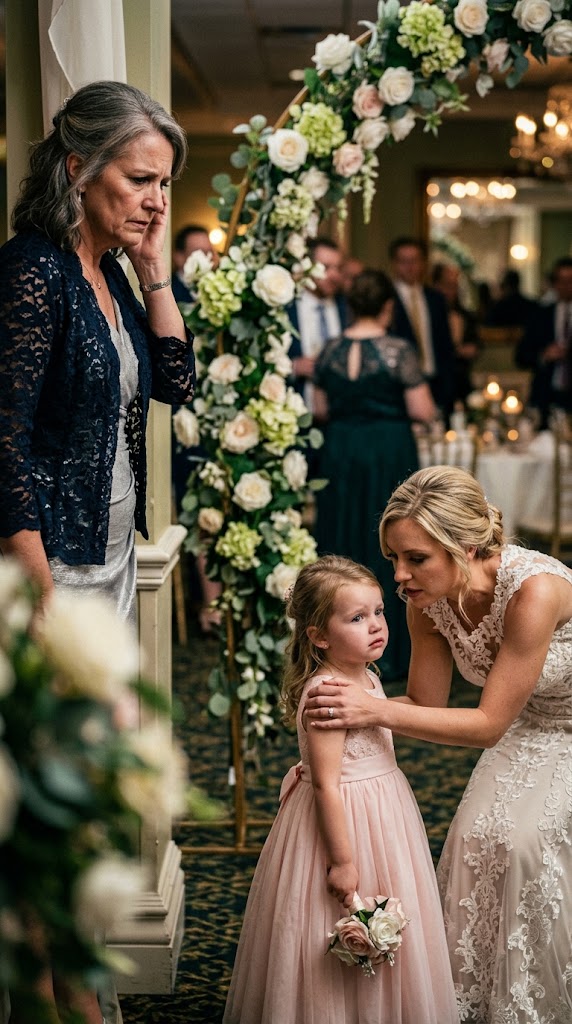
Margot walked out.
Her face was wet.
She was crying so quietly that someone unfamiliar with children might not have noticed.
She came toward me without looking up.
Then she sat on a chair beside the window.
Her little hands went to her shoes.
She stared at them.
Those were the same shoes she had been proudly showing me that morning.
I wanted to storm through that door.
I wanted to ask Claire how she could possibly speak to a child that way on a wedding day.
But Margot needed something from me that was more important than my anger.
She needed safety.
So I sat beside her.
I put my arm around her shoulders.
She leaned into me.
Neither of us spoke for a while.
Finally, she whispered, “Did I do something wrong?”
“No.”
Her chin trembled.
“She said I shouldn’t be in the pictures.”
“I heard her.”
“Why?”
I took a breath.
“Because she was wrong.”
“But she’s going to be Daddy’s wife.”
“Yes.”
“Does that mean she’s more important than me?”
I looked at the little girl sitting beside me.
There was no simple answer that would satisfy a child that age, but there was one truth she needed to hear.
“Your father loves you because you are his daughter. Nobody can replace that.”
“But he loves her too.”
“He can love her too.”
She looked at me suspiciously.
“Then who is the most important?”
“That isn’t how love works.”
She frowned.
I continued gently.
“There is only one Margot. Nobody else can take your place as your father’s daughter.”
She looked down again.
“What about the pictures?”
“You’re going to be in them.”
She looked up.
“How do you know?”
“Because I’m going to make sure of it.”
“Promise?”
“I promise.”
She studied my face.
“Really?”
“Really.”
A few seconds later, she asked if we could go outside.
“Why?”
“I want to hear my shoes.”
So we went.
She walked across the pavement.
Click.
Click.
Then she began running.
Within minutes, she was laughing again.
I watched her spin beneath the spring sunlight, and something inside me settled.
I had two choices.
I could turn that hallway into a battlefield.
Or I could protect Margot first and deal with the adults afterward.
I knew which one my daughter would have wanted.
And before the wedding ceremony even began, I knew what I was going to do.
Click here to continue reading: PART 2: I Chose Not to Confront the Bride Before the Ceremony, Because the Child Needed a Promise Kept More Than a Battle Won
The Little Girl in the Pink Dress Had Been Promised a Place Beside Her Father, Until One Sentence Changed Everything
Part 1 of 12

