
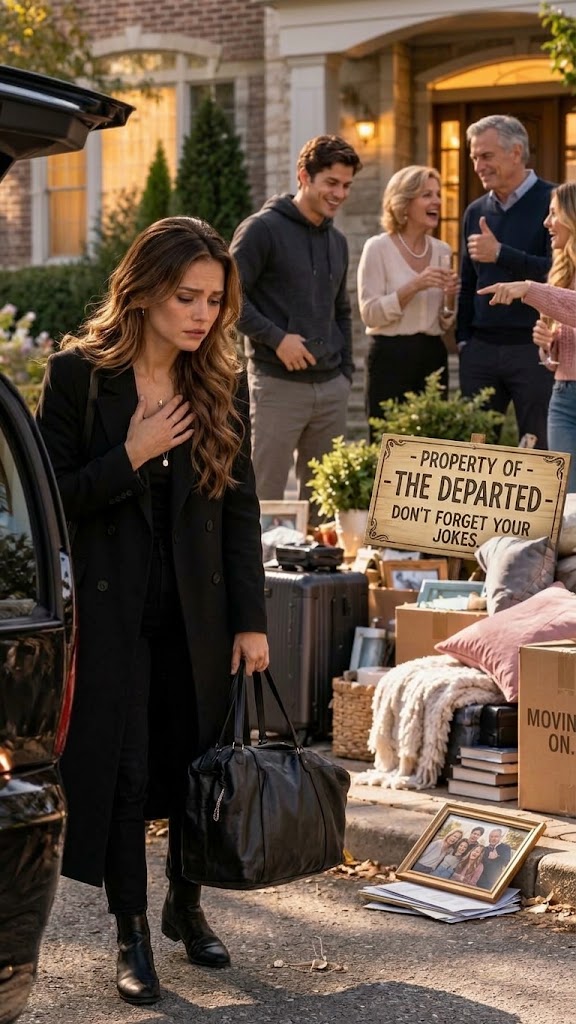
The photograph was still loading when I realized Dylan had not simply thrown my belongings outside. He had wanted an audience.
Rain blurred the edges of the boxes scattered along the curb, soaking the cardboard until the corners sagged inward. My drafting table lay on its side beside them, one metal leg scraped bright from being dragged across the pavement. My winter coat was half-covered by a black trash bag. A framed photograph of Grandma Evelyn rested face-down near the mailbox.
And standing behind all of it, visible beneath the porch light, was my younger brother.
Dylan had taken the picture himself.
The caption appeared beneath it: “FINALLY, WE GOT RID OF HER.”
I read the rest slowly.
He called me the family burden. He wrote that everyone could finally move forward without carrying someone who refused to grow up. He made it sound like my family had staged some brave intervention rather than quietly deciding, without warning, to put my life on the curb.
Mom had already commented.
“Fresh beginnings.”
Dad had reacted with a thumbs-up.
My sister Chloe had filled the comments with champagne emojis.
I stood in the rain holding my phone while the four people I had spent most of my adult life protecting watched from the porch.
Nobody looked ashamed.
That was the part I remembered most.
Not the wet cardboard. Not the cold water running down the back of my neck. Not even the photograph.
Their faces.
Mom stood with her arms folded tightly across her chest, her mouth drawn into the expression she used whenever she wanted me to feel guilty for making a situation uncomfortable.
Dad remained beside the front door, one hand resting on the railing.
Chloe was looking at her phone.
And Dylan looked pleased.
He had gotten exactly what he wanted.
A victory.
“What?” I asked.
Dylan slipped his phone into his jacket pocket.
“You saw the post.”
“I did.”
He smiled.
“Good.”
I looked at the boxes.
“Why are my things outside?”
Nobody answered immediately.
The silence itself gave me the answer before Dylan finally spoke.
“You’re moving out.”
I stared at him.
“Tonight?”
“Tonight.”
The word landed with an absurd finality.
I looked toward Mom.
“Is this what you agreed to?”
She sighed.
“Mara, don’t make this harder.”
“I’m asking a simple question.”
Dad cleared his throat.
“We’ve discussed it.”
“With whom?”
Dylan stepped forward.
“With the adults.”
I almost laughed.
I was twenty-eight years old.
Dylan was twenty-six.
Chloe was twenty-four.
Yet somehow, in the space of one evening, my younger brother had decided he was the adult in the room and I was the problem everyone else had to solve.
I looked past him toward the staircase visible through the open front door.
“My room?”
“I’m taking it,” Dylan said.
“For what?”
“My office.”
I blinked.
“You’re taking my bedroom because you want an office?”
“It has the best light.”
For a moment I thought he was joking.
He wasn’t.
Dylan had recently started working for Mercer Freight Systems, a regional logistics company. He had spent the previous month talking endlessly about his new position, his business clothes, the executives he had met, and the career he was supposedly building.
Apparently, the next step in that career was taking my bedroom.
“You have the spare room.”
“It’s too small.”
“Then use the dining room.”
Mom shook her head.
“Dylan needs something permanent.”
I looked at her.
“And I don’t?”
She avoided my eyes.
That was when I understood this conversation had been decided long before I came home.
I stepped inside.
Four cardboard boxes sat in the center of the living room. My winter clothes were piled across the top. A stack of technical drawings had been shoved underneath a pair of old towels. My desk lamp was missing its shade.
I walked toward the stairs.
“My computer.”
“It’s in the box,” Dylan said.
I turned around.
“You packed my computer?”
“We packed everything.”
“Who is we?”
Nobody answered.
I walked upstairs.
The bedroom door was open.
My mattress had been stripped. My books were stacked in uneven piles. The drafting table I had worked at for years was gone.
I found it downstairs near the front door.
Someone had dragged it across the floor hard enough to leave a pale line through the finish.
I ran my fingers over the damaged corner.
That table had been with me since college.
Grandma bought it for me after I won a regional design competition when I was nineteen. She had saved for months to afford it.
I remembered her standing beside it, smiling as I unfolded the first set of drawings.
“You’ll build something beautiful one day,” she had said.
I had believed her.
I still did.
“What are you looking for?” Dylan called from downstairs.
“My work.”
“You have your laptop.”
“That isn’t the point.”
He laughed.
“You always make everything complicated.”
I came back downstairs.
“No, Dylan. You’re making my belongings complicated. You decided to throw them outside.”
Dad finally spoke.
“Watch your tone.”
I looked at him.
“My tone?”
“You’re being disrespectful.”
I stared at the man who had once called me his dependable daughter.
The same man whose mortgage payments I had covered when his construction supply business began collapsing.
The same man whose property taxes I had paid.
The same man who had called me three months earlier because the furnace had stopped working.
I had paid for that furnace too.
“Dad, how much money have I put into this house in the last four years?”
He looked away.
Dylan answered for him.
“Here we go.”
“How much?”
Mom’s voice softened.
“Mara, nobody is denying that you’ve helped.”
“Then why am I being treated like a burden?”
“Because helping doesn’t mean you get to stay forever,” Dylan said.
I turned toward him.
“I never asked to stay forever.”
“You’re almost thirty.”
“I’m twenty-eight.”
“Exactly.”
I stared at him.
He folded his arms.
“You should have your own place.”
“You’re right.”
The agreement seemed to unsettle him.
I looked around the room.
“You’re right.”
Mom’s eyebrows lifted.
“Mara?”
“I’ll leave.”
Dylan’s expression changed.
He had expected an argument.
I could see it.
He had expected me to cry, accuse them, beg, or demand that Dad intervene.
Instead, I walked toward the boxes.
I opened the first one.
My passport was missing.
I checked the second.
Nothing.
The third contained kitchen items I barely recognized.
“Where is my passport?”
Dylan shrugged.
“Probably in one of the boxes.”
I looked at him.
“Find it.”
He rolled his eyes.
“You can look yourself.”
I began opening every box.
An hour later, I had found my passport, my external hard drives, Grandma’s photographs, and the blue ceramic mug she had given me when I graduated.
I packed them carefully into my car.
Rain had become heavier.
Mom stood beneath the porch.
“Do you have somewhere to go?”
“Yes.”
“Where?”
“Somewhere you don’t need to worry about.”
She flinched.
I almost apologized.
Almost.
Then I remembered the photograph Dylan had posted.
I looked at my phone one final time.
The comments were multiplying.
Friends of his were laughing.
Someone had written, “About time.”
Another person responded with a laughing emoji.
Dylan had turned the worst night of my life into entertainment.
I blocked him.
Then Chloe.
Then Mom.
Then Dad.
One by one.
Dylan watched me.
“What are you doing?”
“Making things simpler.”
I got into my car.
Before closing the door, I looked back at the house.
For years, I had thought of it as home.
At that moment, it looked like a building.
Nothing more.
I drove away.
Behind me, four people stood beneath the porch light believing they had finally gotten rid of their biggest problem.
They had no idea that the woman they had just thrown out had been carrying far more of the family than they understood.
And they certainly had no idea who actually owned the house.
Click here to continue reading: PART 2: The Morning After I Left, a Call From My Brother’s Boss Revealed That Dylan Had Been Using My Name for Something Far More Dangerous
They Thought Throwing Me Out Would End Their Family Problem, Until One Public Post Exposed a Secret None of Them Knew I Had Been Keeping
Part 1 of 12

