
The packet was almost too small to notice. If Mark had not glanced over his shoulder at exactly the wrong moment, I might have spent another six months blaming myself for everything that had been happening to me.
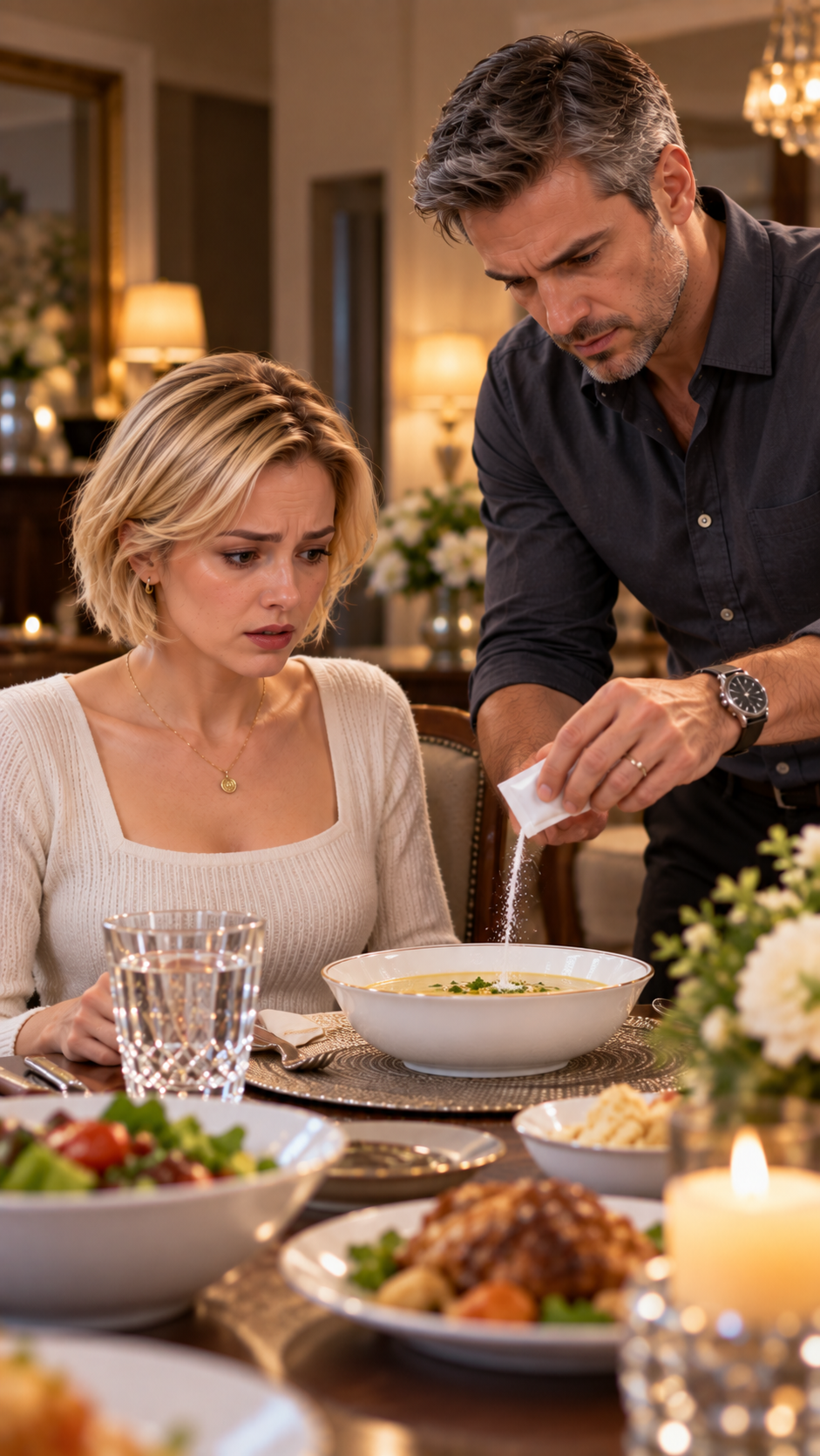
I was standing just outside the kitchen at his parents’ house, pretending I had forgotten something in the bathroom. Mark had taken my bowl from the dining table, saying he would add more pepper. Instead, he reached into his pocket and unfolded a tiny white packet. He shook a pale powder into my soup, stirred it twice, and placed the spoon beside the bowl.
Then he looked toward the hallway.
I stepped backward before he could see me.
My shoulder touched the wall. For several seconds, I stood there without moving, listening to the blood pounding in my ears. I did not call his name. I did not confront him. I did not even look at the soup again. I walked quietly into the guest bathroom and closed the door.
The woman in the mirror looked exhausted. Fifty years old, I thought. Not eighty. Not helpless. Not some confused stranger who needed other people to make decisions for her. Yet that was how I had begun to feel during the previous six months, and I had gradually accepted the possibility that something was wrong with me.
My name is Diane Foster. Mark had been my husband for twenty-six years. Until that Sunday evening, I would have said I knew him better than anyone else on earth. I had believed that knowing someone’s habits, expressions, silences, and moods for more than two decades meant knowing the person himself.
I had been wrong.
Mark and I lived in Carmel, Indiana, in a brick ranch house we had bought when we were young. We had never had children. There had been no dramatic decision behind it. Life simply moved in another direction. We filled our years with work, vacations, friends, church gatherings, family dinners, and the small routines that gradually become so familiar you stop noticing them.
Sunday dinner at Mark’s parents’ house was one of those routines.
Judith and Harold Foster lived near Geist Reservoir. Judith expected everyone at the table at five-thirty sharp. Being late by even a few minutes offended her sense of order. When Mark and I arrived that evening at five thirty-three, she opened the door before we had reached the bell.
“You’re late.”
“Three minutes,” Mark said.
Harold lowered the television volume from his recliner. “There wasn’t traffic.”
Judith gave him a look that ended the discussion.
Under normal circumstances, I would have laughed. Instead, I noticed Mark’s hand resting against the small of my back. His fingers felt cold through my sweater. During the drive, he had hardly spoken. He usually filled silence with complaints about traffic, clients, construction, grocery prices, football, or whatever stranger had annoyed him that week.
That afternoon, he had kept checking the dashboard clock.
“You okay?” I had asked him.
“Just tired.”
He smiled when he said it.
I knew that smile. After twenty-six years, I knew the difference between Mark’s genuine smile and the one he used when he wanted a conversation to end. I had noticed the difference, but I had let it go.
Steve and Karen arrived a few minutes later carrying a blueberry pie. Karen slipped into the kitchen beside me while Judith inspected the crust as though she had personally baked it.
“She still thinks homemade means pretending you didn’t buy it,” Karen whispered.
I laughed.
“She caught me last Thanksgiving.”
“You deserved whatever speech followed.”
For a few minutes, everything felt ordinary again. Then Judith called everyone to the table.
Chicken soup came first. Six bowls steamed beneath the dining-room lights. Rosemary floated on the surface, and the broth smelled of thyme and roasted chicken. Judith had made the recipe for years. It was one of those dishes everyone associated with her house.
She had prepared the soup herself.
The main course waited in the kitchen: pot roast, potatoes, carrots, warm rolls, and the pie Karen had brought.
“I forgot the crackers,” Judith said.
“I’ll get them,” Mark replied.
He stood immediately.
Then he picked up my bowl.
I looked at him. “Mine?”
“You like more pepper.”
He gave me that smile.
“I’ll fix it.”
I watched him carry the bowl toward the kitchen. Something about the movement bothered me, though I could not have explained why. I excused myself a moment later, then slowed before reaching the bathroom. Instead of continuing down the hallway, I turned just enough to see through the kitchen entrance.
Mark was alone.
He reached into his pocket.
The little white packet appeared between his fingers.
He opened it.
The powder disappeared into my soup.
Two quick stirs.
Then he looked over his shoulder.
I retreated before he could see me.
Inside the bathroom, I gripped the edge of the sink. My first thought was that there had to be an innocent explanation. My second thought was that innocent things usually did not require checking whether anyone was watching.
Then the last six months came back to me.
The headaches. The dizziness. The strange heaviness behind my eyes. The mornings when eight hours of sleep left me feeling as though I had barely rested. The moments when I walked into a room and forgot why I had gone there.
Sometimes words simply disappeared halfway through a sentence.
Once, I had driven to a grocery store I had visited for years and suddenly could not remember which entrance I normally used. I pulled into a parking space and sat there crying because I could not understand what was happening to my mind.
When I told Mark, he squeezed my hand.
“You’re stressed.”
“I don’t think that’s it.”
“You’ve been working too much.”
“I’ve been doing the same work for years.”
He smiled.
“Diane, you’re fifty. People change.”
I hated that sentence.
Eventually, I started believing it.
Even my doctor had struggled to find an explanation. My tests had not shown anything dramatic. Nothing seemed serious enough to explain the collection of symptoms, but I knew something was wrong. I had begun wondering whether I was simply getting older faster than I had expected.
Now, standing in Judith’s bathroom, another possibility entered my mind.
Someone might have been making me sick.
I returned to the dining room.
Mark was already seated. My bowl waited directly in front of me. He watched me sit down. His knee moved beneath the table in a steady rhythm.
Judith was talking about Thanksgiving decorations. Harold and Steve were arguing about football. Karen was laughing.
Everything looked normal.
That was what frightened me most.
I stared at the soup. Steam curled from its surface. I picked up my spoon, then put it down.
Mark leaned toward me.
“You’re not eating.”
“It’s hot.”
“You can wait a minute.”
His voice was gentle.
Almost encouraging.
I looked at him and wondered how many times in twenty-six years I had heard that same voice without ever considering what might be underneath it.
Nobody seemed to be watching.
I made a decision.
When Judith reached across the table for the salt, I moved my bowl.
It was such a small action that even I nearly doubted I had done it. My bowl went in front of Judith. Her bowl came in front of me. They were identical.
Mark did not react.
Or perhaps he realized what had happened a second too late.
Judith lifted her spoon.
I stopped breathing.
She tasted the soup.
Then she took another spoonful.
A minute passed.
Then another.
She was halfway through a story about Thanksgiving decorations when her voice faltered.
“My hands feel strange.”
Harold lowered his fork.
“What do you mean?”
Judith flexed her fingers. The spoon slipped from her hand and struck the bowl.
“Mom?” Steve stood.
Karen caught Judith’s arm as she tried to rise.
“Sit down.”
“I’m dizzy.”
Then her knees buckled.
The room erupted.
Harold shouted her name. Steve pulled out a chair. Karen grabbed her phone and called emergency services. A glass tipped over. A fork struck the floor. Someone moved the table away from Judith.
I stayed in my chair.
I was looking at Mark.
He was not looking at his mother.
He was looking at me.
His face had gone pale.
Not confused.
Not frightened.
Caught.
That expression answered the question I had been terrified to ask.
The paramedics arrived within minutes. They checked Judith’s blood pressure, asked questions, examined her pupils, and loaded her into the ambulance. Harold went with her. Steve followed. Karen promised she would bring clothing to the hospital later.
Eventually, Mark and I stood alone outside.
The evening air felt cool against my face.
He put both hands into his pockets.
“You should get checked too.”
I turned toward him.
“For what?”
“You’ve been tired lately.”
I stared at him.
For six months, he had told me I was imagining things. Now he was suddenly concerned about my health.
“I feel fine.”
His jaw tightened.
The drive home was nearly silent.
When we reached the house, Mark went upstairs to shower. I waited until I heard the bathroom door close. Then I took a pair of disposable gloves, several clean plastic bags, and my keys.
I drove back to his parents’ house.
The dining room looked abandoned. A chair sat crooked. A napkin lay beneath the table. Half-full glasses remained where everyone had left them.
The bowls were still there.
I carefully secured the bowl Judith had eaten from. Then I took the spoon.
As I reached for another item, I noticed something beneath the table.
A tiny white packet.
Empty.
I stared at it for several seconds before sealing it separately.
I had no idea whether anyone would care about a packet that small. I did not know whether a laboratory could identify what had been inside it. I only knew that I could not leave it behind.
When I returned home, Mark was waiting downstairs.
“Where were you?”
“I went back to your parents’ house.”
His expression changed.
“Why?”
“I thought I had left something.”
“You weren’t carrying anything when we left.”
I looked at him.
He looked at me.
The house seemed impossibly quiet.
Then I gave him a small smile.
“It’s been a long night.”
I walked upstairs.
Neither of us slept much.
The following morning, Karen called.
Her voice sounded different.
“They don’t think Mom had a stroke.”
I sat on the edge of the bed.
“What do they think?”
“They’re running more tests.”
Across the room, Mark stood holding a newspaper.
He wasn’t reading it.
He was listening.
And for the first time in twenty-six years, I understood that the man sleeping beside me was capable of something I had never imagined.
Click here to continue reading: PART 2: One Question From My Doctor Forced Me to Reconsider Every Coffee, Smoothie, and Meal My Husband Had Quietly Taken Responsibility For
The Small White Packet in My Husband’s Hand Changed the Meaning of Every Symptom I Had Been Trying to Explain
Part 1 of 12

