
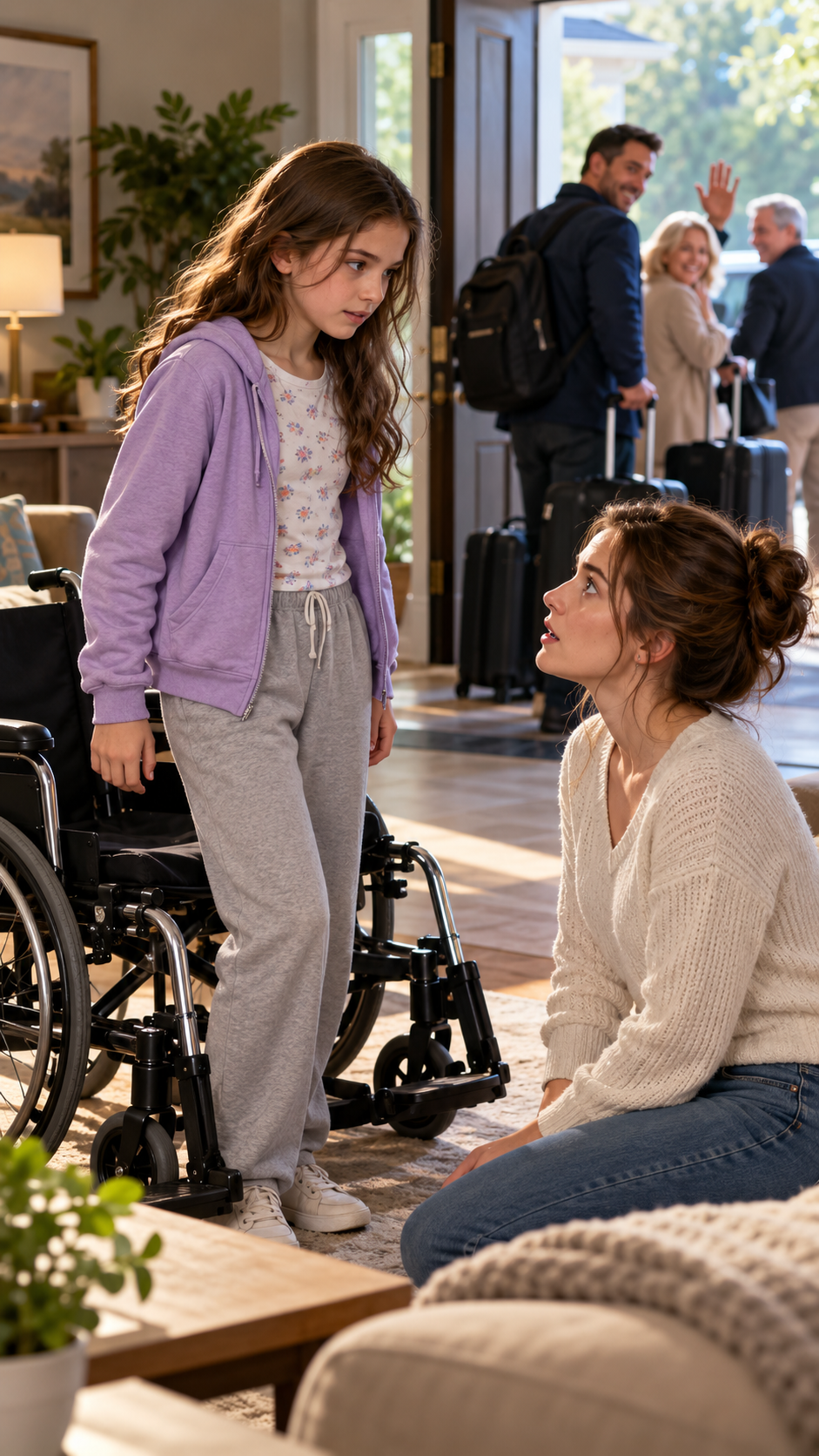
The first thing I noticed after Marcus’s family left was the silence. It settled over the house so completely that I could hear the refrigerator cycling in the kitchen and the faint tick of the clock near the staircase. Seven days, Marcus had said. His brother’s wedding would keep everyone away for a week, and Chloe would be safer at home where someone could watch her. I had agreed because, until that morning, I believed every word he had ever told me about his daughter.
Chloe was seventeen and, according to Marcus, had been living with a severe condition since she was fourteen. She supposedly struggled to walk, spoke only in short fragments, and tired so easily that she required constant supervision. The wheelchair beside the living-room window had become part of the house as naturally as the sofa or the piano. I had never questioned it. Why would I? Marcus was her father. I was the stepmother who had entered their lives later, and every medical document he showed me seemed to confirm his account.
I stood at the front window until the last car disappeared behind the hedges. Helen had been in the passenger seat, still calling instructions over her shoulder about Chloe’s medication. Marcus had repeated them twice before leaving. Morning dose at nine. Another at two. No unnecessary exertion. Keep her in the chair unless she needed the bathroom. Call him immediately if she seemed confused or unusually tired.
I closed the curtains and turned around.
Chloe was exactly where Marcus had left her.
She sat beside the window with her hands resting on her thighs, her shoulders slightly rounded, her face turned toward the floor. The room looked almost staged after everyone had gone. The cushion on her wheelchair was perfectly straight. A blanket had been folded across the footrest. A bottle of water stood within easy reach.
“You all right?” I asked.
She raised her eyes.
For years, Chloe had answered me with gestures. A nod. A shake of the head. Occasionally a faint sound when Marcus encouraged her to speak. I had never heard her hold a normal conversation with me. Marcus always explained that communication exhausted her, so I learned not to press.
This time, however, she looked past me toward the hallway.
Then she looked back.
“I’m fine,” she whispered.
I stopped moving.
The words were quiet, but they were clear.
“What did you say?”
Her eyes darted toward the ceiling.
I followed her gaze and saw the small camera Marcus had installed above the archway. A red indicator light blinked steadily.
Chloe lifted one finger to her lips.
Then she pointed toward the kitchen.
Something cold moved through my stomach.
“Do you want something to eat?”
She shook her head.
She rolled the wheelchair a short distance, stopped, and looked toward the hallway again. I realized she was checking for footsteps. The house remained still.
Then she placed both hands on the armrests.
“Chloe?”
She pushed herself upward.
I reacted before I understood what I was seeing. I stepped toward her, ready to catch her if she fell.
She did not fall.
Her feet landed squarely on the hardwood.
She straightened.
I stared.
Her knees did not buckle. Her ankles did not tremble. She did not reach desperately for the nearest piece of furniture. She simply stood there, breathing hard from what looked less like physical effort than fear.
I could not find a single word.
Chloe looked directly at me.
“Please don’t scream.”
Her voice was stronger now.
My gaze dropped to her bare feet and then returned to her face.
“You can walk.”
She swallowed.
“I always could.”
For several seconds, neither of us moved.
Then she took a step.
One.
Then another.
She crossed the room slowly, cautiously, not because her body seemed incapable of the movement, but because she appeared terrified that someone might see her doing it.
I felt tears burning behind my eyes.
“Chloe, what is happening?”
She glanced toward the camera.
“Not here.”
She walked toward the downstairs study.
Marcus had always called that room her quiet room. He said she needed a place where she could rest when the house became overwhelming. I followed Chloe inside and closed the door behind us.
She lowered her voice.
“There’s a place the camera can’t see.”
“Where?”
She pointed toward the closet.
I opened it.
Behind several neatly folded blankets was a wooden panel I had never noticed. Chloe reached around me and pressed against one corner. The panel shifted inward, revealing a narrow cavity in the wall.
Inside was a black fabric pouch.
She pulled it out.
Her hands were shaking.
“How long have you had that?”
“A long time.”
She sat on the floor. I lowered myself across from her.
She opened the pouch.
Inside were folded papers, an old phone with a cracked screen, a flash drive, several pharmacy packets, and a small silver voice recorder.
I looked from the objects to her.
“What is all this?”
“Proof.”
The word was barely audible.
She picked up one of the medicine packets.
“This is what Dad gives me.”
I recognized the pharmacy label.
“Marcus said these were prescribed.”
“They are.”
“Then why are you calling them proof?”
“Because they make me weak.”
I stared at the packet.
“What do you mean?”
“They make me look sick.”
The room seemed to contract around us.
Chloe told me that when she was fourteen, she really had been ill. She had suffered a serious infection, spent weeks away from school, and struggled with pain and exhaustion. For a while, everyone had been frightened. She had needed treatment. She had needed rest.
Then she recovered.
At least, her body did.
Her father, she said, did not want anyone to notice.
“At first, people came because they felt sorry for us,” Chloe said. “Then they started helping.”
I remembered the photographs in the hallway.
Marcus smiling beside church leaders.
Marcus accepting checks at charity events.
Marcus standing behind Chloe’s wheelchair while she looked pale and exhausted.
I had always thought those photographs showed devotion.
Now I could barely look at them in my mind.
“He liked it,” Chloe said.
“What?”
“Being the father of the sick girl.”
My mouth went dry.
She explained that meals began arriving at the house. A local church organized a fundraiser. People created a donation account. Friends started asking what equipment she needed and how much her treatment cost.
“Then it became bigger,” she said. “He started talking about how I might need care forever.”
“And the doctors?”
“He controlled what they heard.”
She told me that some appointments were conducted remotely. Others were arranged without her mother knowing. When Chloe tried to tell doctors that she was getting stronger, Marcus would interrupt and explain that she was confused, tired, or unable to understand her own condition.
“He spoke for you?”
“He always spoke for me.”
Her fingers tightened around the recorder.
“So I started recording.”
I picked it up.
“Does he know you have this?”
“No.”
“Does anyone know?”
She shook her head.
“Why are you telling me now?”
Chloe looked at me for a long moment.
“Because you signed something.”
I frowned.
“What?”
“The medical authorization.”
I remembered it immediately.
Months earlier, Marcus had placed several forms on the kitchen counter and asked me to sign them. He had said they were temporary emergency permissions in case he was away and Chloe needed urgent medical attention.
“You said I could make emergency decisions for her.”
“You can.”
“Then what?”
“If I go to a hospital with you,” Chloe said, “you can take me somewhere he doesn’t control.”
My heart began pounding.
“You want to go to a hospital?”
“I need someone to see me without him.”
Her eyes filled.
“Someone needs to see me as I really am.”
I reached for her hand.
She flinched instinctively, then let me take it.
“We’ll go,” I said.
She stared at me.
“You believe me?”
“I watched you stand.”
For the first time, Chloe cried.
She made no sound. Tears simply slipped down her cheeks while she covered her mouth.
Then my phone rang.
Marcus.
Chloe froze.
“Answer it,” she whispered.
I accepted the call.
“Hey.”
“How is Chloe?”
His voice sounded relaxed. I could hear laughter and clinking dishes behind him.
“She’s fine.”
“Did she take her medication?”
I looked at Chloe.
“No. I was just about to give it to her.”
A pause.
“Don’t forget.”
“I won’t.”
“Put me on speaker. I want to say hello.”
Chloe gripped my wrist.
“She’s in the bathroom,” I said.
Marcus was silent.
“She is?”
“Yes.”
“Alone?”
I looked at Chloe standing beside me.
“She’s fine, Marcus.”
His voice changed.
“Sarah, don’t change her routine.”
“I know.”
“I mean it.”
“I heard you.”
He ended the call.
Chloe released my wrist.
“He knows.”
“He suspects.”
“That’s almost the same thing.”
We moved quickly.
Chloe changed into jeans and a sweatshirt she had hidden behind the closet panel. I packed the pouch, the medication packets, the old phone, and the authorization papers. Before leaving the room, she stopped beside the wheelchair.
She looked at it for several seconds.
Then she pushed it hard.
The chair rolled across the hardwood and struck the wall.
The sound echoed through the quiet house.
Chloe flinched.
I looked at her.
“Ready?”
She took a breath.
“No.”
She opened the door.
“But I’m going anyway.”
Click here to continue reading: PART 2: At the Hospital, One Honest Examination and a Mother’s Voice Began Pulling Apart the Story Marcus Had Controlled
When the House Fell Silent, My Stepdaughter Showed Me the Secret She Had Been Forced to Hide for Years
Part 1 of 12

