
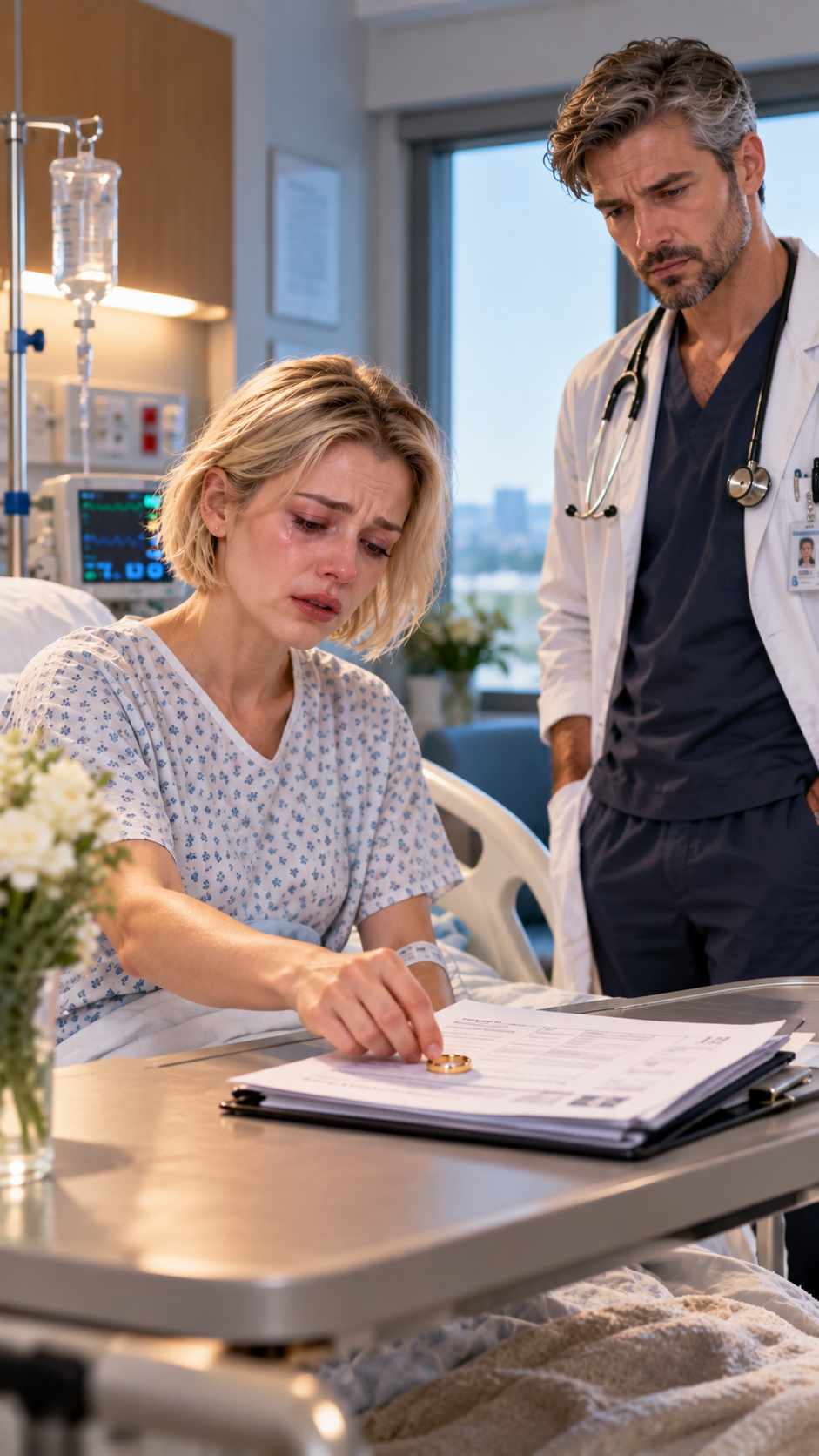
The day I was discharged from Metropolitan General, I kept looking toward the elevator as if Marcus might appear at the last possible second. My hands were still weak, my abdomen ached beneath the loose sweater I had brought from home, and every movement reminded me that thirty days earlier I had nearly died. The discharge nurse placed my medications into a paper bag and reviewed each instruction twice. Rain slid down the seventeenth-floor windows, turning Chicago into a gray blur. When she finally asked who was taking me home, I glanced toward the empty hallway and said, “My husband is probably still working.”
She paused with the medication list in her hand. “Your husband is Dr. Marcus Hayes?”
“Yes.”
“He works here?”
“Five floors below me.”
Her expression changed slightly. “Is he coming?”
I smiled because the truth was too complicated to explain to a stranger. “He’s probably in a procedure.”
I had used that answer so many times that it almost sounded natural. For the first twenty days of my hospitalization, I had defended Marcus before anyone could accuse him of anything. My appendix had ruptured, infection had spread through my abdomen, and emergency surgery had become only the beginning of a month filled with complications. I had spent days drifting between fever, pain, medication, and exhaustion. Whenever someone asked about my husband, I gave them a reason for his absence.
He was part of a major international transplant program at Metropolitan General. The initiative had attracted visiting specialists, administrators, reporters, and enormous attention from the medical community. Marcus was one of the surgeons assigned to it, and the team had strict isolation requirements. I understood that. I had spent years working in healthcare quality and knew that complicated clinical programs often required rules ordinary people never saw. So when my mother called and asked why Marcus hadn’t visited, I told her the restrictions were probably preventing him from leaving.
When Sarah, my closest friend, asked whether he had at least called, I said he was exhausted. When one of my nurses gently observed that spouses often found ways to stay connected during serious illnesses, I smiled and told her, “Marcus is saving lives.” The sentence made me feel better. It gave his absence a noble explanation, and I needed something noble to hold on to while I lay beneath fluorescent lights listening to machines beep beside my bed.
My days became measured by small details. The IV pump clicked and hissed beside me. Rubber soles squeaked across the polished hallway. The broth tasted different depending on how much medication I had taken. In the mornings, a thin line of sunlight appeared between two buildings outside my window, and I learned to recognize it as proof that another day had started. My phone stayed beside my pillow. Sometimes I woke during the night and reached for it before remembering there would be no message waiting.
Marcus never called.
I kept finding explanations anyway. He was operating. He was exhausted. He was under orders. He was carrying too much responsibility. Perhaps he had been told that contact with me would compromise the transplant team’s isolation. Perhaps he was waiting until my condition stabilized. I could make almost any absence sound reasonable if I worked hard enough.
Then, on the twentieth day, I discovered something that made all those explanations wobble.
I had gone to the family lounge because my room felt unbearably warm. While waiting for a cup of tea, I noticed a hospital bulletin on one of the computers. I almost ignored it. Instead, I leaned closer and read the announcement twice. The transplant team’s isolation restrictions had been modified. Personnel were no longer confined under the same conditions that had applied during the first portion of the project.
I stared at the screen.
For several seconds, I felt relief.
Marcus could come now.
That was the first thought that entered my mind, and I hated how quickly hope returned. After twenty days of trying not to expect anything, I suddenly imagined the elevator doors opening. I pictured him walking into my room with that familiar tired smile, pulling a chair beside my bed, asking what the doctors had said. I imagined being angry for a minute and then forgiving him because he had finally come.
The next morning, the chair beside my bed remained empty.
So did the next morning.
On the third day, I saw Marcus in a photograph on the hospital’s public social-media account. He stood beneath a banner celebrating the transplant initiative, surrounded by visiting specialists and senior administrators. His suit was immaculate. His shoulders were straight. He was smiling.
He did not look trapped.
He did not look exhausted.
He certainly did not look like a husband who had been waiting twenty days to see his critically ill wife.
I enlarged the photograph until the image became grainy. I studied his face as though there might be an explanation hidden in the pixels. That evening, I saw him again on a local television segment filmed inside the hospital. He spoke confidently about the transplant program while reporters praised the team’s achievements.
I watched from my bed with the volume barely audible.
There was nothing visibly wrong with the man on the screen. He looked accomplished, calm, respected. He answered questions with the same measured confidence I had seen countless times at professional dinners. But I could not stop thinking about the chair beside me.
Ten days remained in my hospitalization.
Ten days during which Marcus could have taken an elevator to the seventeenth floor.
He didn’t.
Something in me shifted then. It wasn’t anger exactly. It was the part of my professional training that had always insisted on separating assumptions from evidence. I had spent years auditing healthcare systems, reviewing records, comparing policies with actual behavior. If I wanted to understand what had happened to me, I couldn’t keep relying on what I hoped was true.
That afternoon, I opened the hospital’s administrative portal.
The transplant protocol was available to authorized personnel. I found the section dealing with emergency leave and read it carefully. Section 4, Paragraph B stated that personnel under isolation could request temporary leave for an immediate family medical emergency, including a life-threatening illness or surgical procedure. The permitted period was limited, and sanitation procedures were required afterward.
I read the paragraph again.
Then once more.
My stomach tightened.
The rule didn’t say Marcus was forbidden from seeing me.
It said he could request permission.
I searched the administrative records for his name.
The system returned the result almost immediately.
There was no approved request.
No rejected request.
No pending request.
Nothing.
I sat motionless in front of the screen.
For the first twenty days, Marcus had not been unable to come.
He had simply never asked.
I checked the dates again because I wanted to be certain. Then I reviewed his work schedule, public appearances, and hospital events. The information only made the silence harder to understand. During those final days, Marcus attended project dinners. He appeared on television. He participated in a ceremony recognizing the transplant team. At one event, he accepted a clinical excellence award.
He had found time for those things.
He had not found time to ask whether his wife was still alive.
I downloaded the protocol and the relevant administrative logs. I saved his schedule information and the public records in secure cloud storage. I wasn’t yet sure what I would do with them. I only knew that I had reached the point where facts mattered more than excuses.
The following morning, the discharge nurse returned with my final paperwork.
She glanced toward the doorway.
“Your husband still isn’t coming?”
I shook my head.
She hesitated. “Would you like us to arrange transportation?”
“Yes.”
She asked for my destination.
I gave her Sarah’s law-office address instead of our home.
Sarah had been my friend since university. She was also a family-law attorney, and I trusted her because she had always been willing to listen before telling me what she thought. When the car dropped me outside her building shortly after noon, I was still wearing the clothes I had left the hospital in. My body was weak, my hair was unwashed, and I had two folders of documents tucked beneath my arm.
Sarah opened the office door herself.
“Clara.”
I tried to smile.
“Hi.”
She looked at me for several seconds. “You look awful.”
“Thank you.”
She almost laughed, but the expression disappeared when she saw my face.
“What happened?”
I placed my tablet on her desk.
“I need divorce papers.”
Sarah stared at me.
“For Marcus?”
“Yes.”
She pulled out a chair. “Sit down before you fall down.”
I sat.
She studied me carefully. “Are you sure this isn’t the medication talking?”
“No.”
“Then tell me exactly what happened.”
I opened the file.
First came the protocol.
Then the emergency-leave provision.
Then the administrative search showing that Marcus had never requested leave.
Finally, I showed her the dates of his appearances after the restrictions changed.
Sarah read everything without interrupting.
When she finished, she leaned back and looked at me.
“He could have requested emergency leave.”
“Yes.”
“And after the restrictions ended?”
“He had ten days.”
“And he still didn’t come.”
“No.”
Sarah rubbed her forehead.
“What do you want from me?”
I looked down at my bare hands. My wedding ring was still on my finger, but for the first time it felt less like a symbol and more like something I had been carrying out of habit.
“I want a clean separation agreement.”
“You want his money?”
“No.”
“Revenge?”
“No.”
“Then what do you want?”
I looked at her.
“I want to stop making excuses for someone who keeps choosing not to be there.”
Sarah was quiet.
Then she pulled a legal pad toward herself.
“Okay,” she said. “We’ll do it carefully.”
We went through the practical details. Marcus and I had no children. We owned a brownstone in Lincoln Park that we had purchased during the early years of our marriage. I wanted the property divided fairly. Our individual accounts, vehicles, retirement funds, and personal belongings would remain separate.
I didn’t want revenge.
I didn’t want a public fight.
I didn’t want to humiliate him.
I wanted an ending that could not be turned into another argument about whether I was emotional, frightened, medicated, or confused.
That afternoon, I returned to our house.
The familiar smell greeted me before I even closed the door: polished wood, old coffee grounds, cedar from the hall closet. Everything looked exactly as it had before I left for the hospital. That was almost the worst part.
I walked upstairs and packed two suitcases.
Clothes went into one.
Books, framed degrees, and a few personal belongings went into the other.
I left the furniture.
I left the photographs.
I left most of the things that belonged to the life we had built together.
Before leaving, I stood alone in the dining room.
Then I removed my wedding ring.
For seven years, I had worn it so automatically that the pale strip of skin beneath it looked strange.
I placed the ring on top of my hospital discharge papers.
Then I walked out.
I rented a furnished apartment in the Gold Coast, changed my phone number, and instructed Sarah to handle every communication. For two weeks, Marcus heard nothing directly from me.
Then, one evening, he was attending a reception celebrating the completion of the transplant project.
Residents surrounded him.
Administrators congratulated him.
Someone handed him a glass of sparkling water.
Marcus was smiling when a process server entered the conference room carrying a manila envelope.
“Dr. Marcus Hayes?”
He turned.
“Yes?”
“Personal service.”
Marcus took the envelope.
The room seemed to quiet around him.
He opened it.
His expression changed before he finished reading the first page.
The divorce petition was in his hands.
And for the first time, Marcus was forced to face something he had apparently never expected.
His wife had stopped waiting for him.
Click here to continue reading: PART 2: He Thought I Had Left in Anger Until the Records Made Him Realize the Decision Had Been Building Long Before He Opened the Envelope
The Empty Chair Beside My Hospital Bed Was Easier to Explain Than the Record I Found After His Restrictions Ended
Part 1 of 12

