
The first thing my mother did when I entered the ballroom was look past me.
Her eyes went straight to the podium, where my stepsister stood beneath a wash of white stage lights, smiling beside the hospital’s chief medical officer. Two hundred doctors, donors, administrators, and invited guests filled the room behind her. Crystal glasses caught the light. Conversations softened. Cameras lifted.
Then my mother saw me.
For half a second, something unreadable crossed her face.
Not surprise.
Calculation.
She walked toward me with the practiced smile she used whenever strangers were watching.
“You actually came,” she said.
“I was invited.”
“That wasn’t what I meant.”
She glanced at my dark dress, then at the small military pin on my lapel. I had worn it because the ceremony was being held to recognize people connected with emergency medical operations. I had not expected my uniform history to become part of the evening.
My mother touched my arm.
“Please don’t make tonight difficult.”
I almost laughed.
“I haven’t said anything.”
“That has never stopped you from making people uncomfortable.”
Before I could answer, she turned toward the stage.
My stepsister was already being introduced.
Her name was Evelyn.
She had been my mother’s favorite long before either of us was old enough to understand what favoritism meant. Evelyn was polished, careful, and perfectly comfortable in rooms where people measured one another by titles and donations.
Tonight, she had been promoted to executive director of the hospital foundation.
The applause was immediate.
My mother clapped hardest.
I joined in.
Evelyn looked toward our table and smiled.
When the applause faded, my mother took the microphone.
She had not told me she intended to speak.
That was the first warning.
“My daughter Evelyn has spent years proving that leadership is not simply about ambition,” she began. “It is about knowing where you belong.”
Several people nodded.
I sat very still.
My mother continued.
“Some children understand that naturally. Others spend their lives chasing difficult paths because they need to prove something.”
Her eyes found mine.
A few people followed her gaze.
The room suddenly felt smaller.
“My older daughter chose the Army,” she said. “A respectable career, certainly. But military service is not the same as building something that lasts.”
Someone at the table beside me shifted uncomfortably.
I kept my hands folded.
My mother smiled.
“Not every daughter is meant to lead.”
The applause that followed was uncertain.
Not because anyone disagreed.
Because no one knew whether they were supposed to laugh.
Evelyn lowered her eyes.
I could see the embarrassment on her face, but she did not stop her mother.
That hurt more than the words.
I had spent years learning not to react when my mother compared us. The Army had taught me something useful about humiliation: you could survive it without giving the person who caused it the satisfaction of seeing you break.
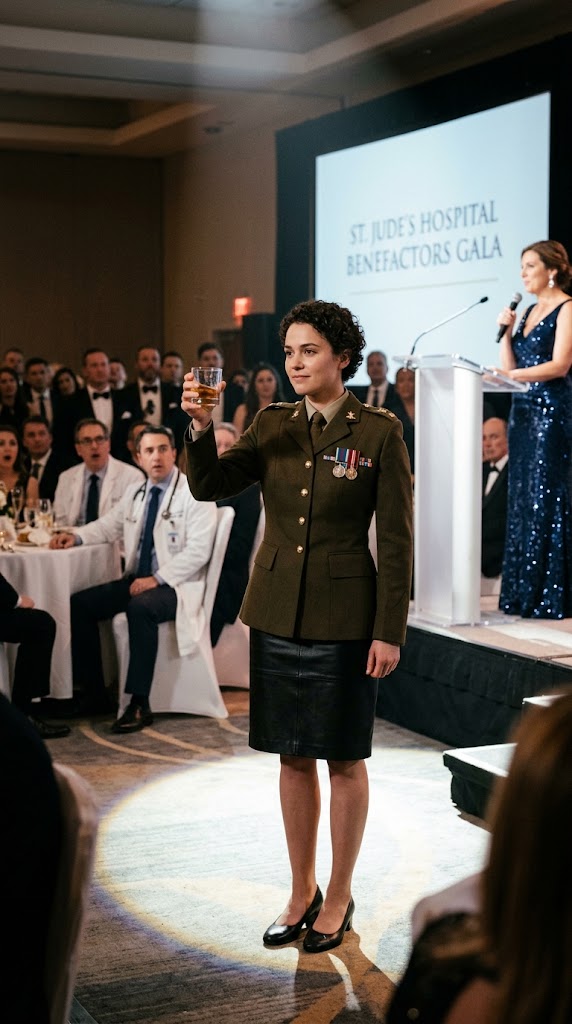
So I lifted my glass.
My mother watched me carefully.
I stood.
“For Evelyn,” I said.
The room quieted again.
She looked at me.
I raised my glass higher.
“And for every doctor, nurse, driver, warehouse worker, technician, and donor who keeps lifesaving supplies moving when patients cannot afford to wait.”
This time the applause was real.
People stood.
Several doctors near the front table lifted their glasses.
My mother did not.
She was staring at me.
I smiled politely, set down my glass, and walked out.
The ballroom doors closed behind me.
Only then did I let my shoulders drop.
Outside, the hotel corridor was cool and nearly empty. I could hear the muted pulse of music through the doors behind me.
My phone vibrated.
A message from my operations director.
WE NEED TO TALK TONIGHT.
I stopped walking.
Another message appeared.
URGENT. IT CONCERNS MERIDIAN MEDICAL.
I stared at the screen.
Meridian Medical was my company’s largest hospital logistics client in the region.
My mother’s hospital was part of that network.
I typed back.
ABOUT WHAT?
The reply came almost immediately.
YOUR MOTHER SIGNED SOMETHING THIS MORNING.
I felt the muscles in my jaw tighten.
WHAT DID SHE SIGN?
Three dots appeared.
Then disappeared.
Then appeared again.
I called instead.
My director answered on the first ring.
“Where are you?”
“At the hospital gala.”
“Are you alone?”
“Yes.”
“Good. Don’t discuss this with anyone there.”
I moved farther down the corridor.
“What happened?”
“We received an authorization changing several supply contracts.”
“Who authorized it?”
There was a pause.
“Your mother’s name is on the paperwork.”
My stomach tightened.
“That doesn’t make sense.”
“It gets worse.”
“How?”
“The authorization attempts to move several emergency distribution contracts away from your company.”
I leaned against the wall.
My company had spent years building the hospital network’s emergency supply system. We handled temperature-controlled medications, surgical equipment, blood-storage containers, emergency kits, and transportation coordination.
If the contracts disappeared overnight, patients would feel the consequences before shareholders did.
“Who is taking them?”
“We’re still checking.”
“Why didn’t you tell me before tonight?”
“Because we only received the documents this afternoon.”
I closed my eyes.
My mother had spent the evening humiliating me in front of two hundred people.
Meanwhile, somewhere inside the same hospital system, someone had tried to dismantle the infrastructure my company operated.
“Send me everything.”
“I already did.”
I checked my phone.
An encrypted message had arrived.
Three attachments.
The first was a contract amendment.
The second was an authorization letter.
The third was a scanned page containing my mother’s signature.
I opened the last file.
At first glance, everything looked legitimate.
Then I noticed the date.
My mother had supposedly signed the authorization at 9:12 that morning.
I knew she had been at the hospital’s executive board meeting at that exact time.
That was not unusual.
What bothered me was the signature.
It looked like hers.
But it was not quite right.
My mother had a distinctive habit when signing her name. She always lifted her pen slightly before the final letter.
The scanned signature did not.
Someone had reproduced it.
I zoomed in.
The image became pixelated.
Then I noticed something else beneath the signature.
A handwritten reference number.
I recognized it.
It belonged to a logistics account that had been closed three years earlier.
I called my director again.
“Do not process anything yet.”
“Why?”
“I think someone is using an old authorization.”
There was silence.
“Are you sure?”
“No.”
I looked back toward the ballroom doors.
“But I’m sure this is bigger than a contract change.”
I ended the call.
For several seconds, I stood alone in the corridor.
Then the doors opened behind me.
Evelyn stepped out.
She had removed the microphone from her dress and was carrying her shoes in one hand.
“You left without saying goodbye.”
“I didn’t want to interrupt your celebration.”
She looked at me carefully.
“You embarrassed Mom.”
“I gave a toast.”
“You know what I mean.”
“No. I don’t.”
She sighed.
“You always do this.”
“Do what?”
“Turn everything into a competition.”
I almost told her about the contracts.
Instead, I asked, “Did you know Mom signed something this morning?”
Her expression changed.
Only slightly.
But I saw it.
“What?”
“Forget it.”
She looked away.
That was another answer.
“Evelyn.”
“I don’t know what you’re talking about.”
“You’re lying.”
Her eyes snapped back to mine.
“You’ve been gone for years. You don’t know what happens here anymore.”
I looked at her.
“Maybe that’s true.”
Then I held up my phone.
“But someone just tried to change contracts worth millions using Mom’s signature.”
Evelyn went pale.
She whispered, “You shouldn’t have that.”
The corridor seemed to stop breathing.
I lowered my phone.
“Why?”
She did not answer.
I took one step toward her.
“What do you know?”
She looked toward the ballroom.
Then back at me.
“Nothing.”
But she was no longer convincing herself.
She was trying to convince me.
And for the first time that night, I understood that my mother’s cruel speech had not been the real reason I had been pushed into the spotlight.
Someone had needed me distracted.
Click here to continue reading: PART 2: The Contract Was Only the First Layer, and the Signature Beneath It Pointed Toward Someone My Family Had Trusted for Years
My Mother Raised Her Glass for My Stepsister, Then Turned the Room Against the Daughter She Had Never Learned to See
Part 1 of 12

