
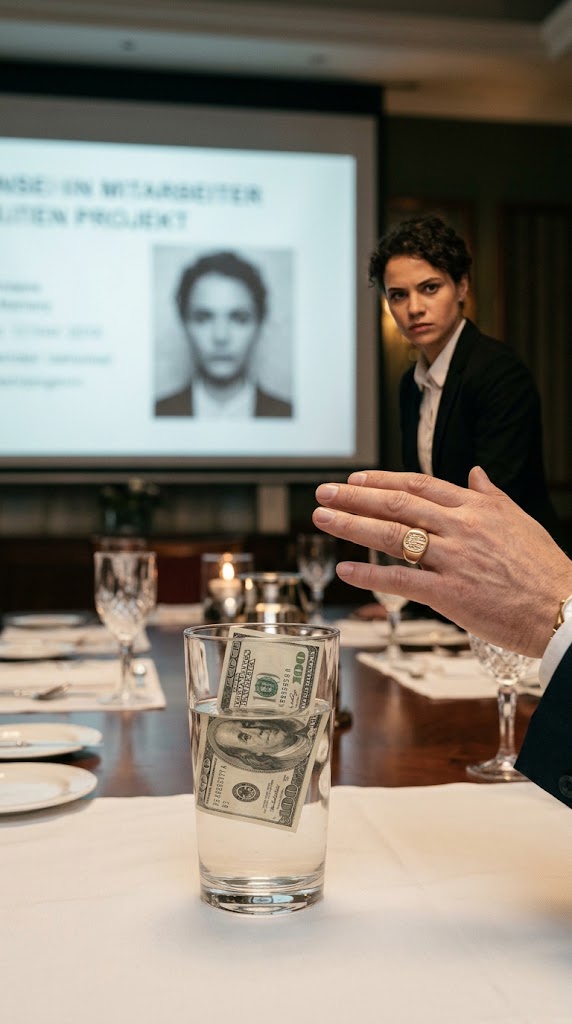
The hundred-dollar bill landed in my water pitcher with a soft slap.
For half a second, nobody at the table moved. The bill floated on the surface, slowly darkening as the water soaked into the paper. Then the man who had dropped it leaned back in his chair and laughed.
“Bring me someone intelligent,” he said in German.
He had spoken quietly enough that the other guests might have missed the words. I hadn’t.
I kept my eyes on the pitcher.
The dining room was expensive in the way certain rooms were designed to announce that expense without ever mentioning it. Dark wood covered the walls. Brass lamps cast warm pools of light over white linen. A pianist played somewhere beyond the partition, the notes soft enough to become part of the background.
I stood beside the table with a tray balanced against my left hip.
Nobody looking at me would have guessed that I understood him.
That was exactly how I intended to keep it.
I had been working at the restaurant for six weeks. Long enough to learn which customers tipped well, which ones complained about ice cubes, which managers disappeared when there was a difficult table, and which wealthy men treated service workers as though they were furniture.
The man across from me belonged firmly to the last category.
His name was Viktor Reinhardt.
At least, that was what I had heard the hostess call him when he arrived.
He was in his early fifties, broad-shouldered, silver beginning to show at his temples, and dressed in a charcoal suit that probably cost more than I earned in several months. His watch caught the light every time he lifted his glass.
Around him sat five guests.
Two men in tailored jackets.
A woman with a diamond bracelet large enough to draw attention from across the room.
Another woman who had barely spoken since I arrived.
And a younger man who kept laughing whenever Viktor laughed, as if waiting for permission to find something funny.
Viktor looked at me again.
“Did you understand?”
His question was in English.
I gave him the polite expression I had perfected during years of working jobs where politeness mattered more than dignity.
“Would you like another bottle of water, sir?”
The younger man laughed.
Viktor smiled.
“No. I want someone who can understand what I’m saying.”
His guests chuckled.
I reached into the pitcher with the serving spoon and carefully lifted the wet bill out.
Water ran from it onto the tablecloth.
I placed the bill beside his plate.
“I’m sorry about that,” I said.
He stared at me.
“You’re sorry?”
“Yes, sir.”
“For what?”
“The water.”
A few people at the table laughed.
Not with me.
At me.
I didn’t react.
I had learned long ago that humiliation became more powerful when you showed the person delivering it that they had reached you.
Viktor picked up the bill between two fingers.
“You should keep it.”
I shook my head.
“I can’t accept money that was put in a water pitcher.”
His expression changed slightly.
That was the first moment I saw something other than amusement in his face.
Interest.
Not respect.
Not yet.
But interest.
“Why not?”
“Because it would be a strange tip.”
He smiled again.
“You’re very careful.”
I lowered my eyes.
“I try to be.”
He dismissed me with a small wave.
I walked away.
I made it three steps before I heard him speaking German again.
“She’s pretending to be stupid.”
The younger man laughed.
Viktor continued.
“She probably doesn’t understand a word.”
I kept walking.
My hands were steady.
That was important.
Because I understood every word.
I spoke eighteen languages.
German was one of the first foreign languages I had learned well enough to think in. I could follow formal business discussions, regional accents, technical vocabulary, and the kind of careless slang people used when they believed nobody around them could understand.
Viktor’s German was polished.
His arrogance was even more fluent.
I hadn’t planned on using either fact that evening.
I had only come to work.
I needed the money.
More than that, I needed to keep the job.
My father’s rehabilitation bills had become a second clock ticking inside my head. Every week brought another invoice. Therapy. Medication. Equipment. Transportation. The numbers accumulated faster than my paycheck could erase them.
So I had learned to swallow things.
Insults.
Long shifts.
Bad tips.
Customers who snapped their fingers.
Managers who called me by the wrong name.
None of those things mattered as much as the man waiting for me to recover.
My father had once told me that dignity was not something other people could give or take away.
I had not believed him when I was younger.
I did now.
When I returned to the kitchen, my coworker Maya was arranging plates beneath the heat lamps.
She looked at me.
“What happened?”
“Nothing.”
She glanced toward the dining room.
“That table?”
I nodded.
“Rich people being rich?”
“Something like that.”
Maya lowered her voice.
“That’s Reinhardt.”
“I know.”
“He’s some kind of investor.”
“I figured.”
“Apparently he’s here because of a presentation tomorrow.”
I stopped.
“What kind of presentation?”
She shrugged.
“Business. Big company. Big money. Big secrets, probably.”
I smiled faintly.
“You’ve been watching too many movies.”
“Have you seen his security?”
I hadn’t.
Now I wondered why.
Maya nodded toward the dining room.
“Two men outside. One by the entrance. Another in the hallway. They’re not restaurant staff.”
I looked toward the swinging kitchen doors.
For a moment, I considered going back to my work and forgetting everything.
Then I remembered the German sentence.
Bring me someone intelligent.
It wasn’t the insult that bothered me.
It was the way he had said it.
Not like a joke.
Like a test.
I returned to the dining room twenty minutes later carrying coffee.
Viktor was no longer laughing.
His laptop had been opened on the table.
The screen was angled away from the other diners.
I could see only the edge of a presentation slide.
A corporate logo.
Several lines of German.
And a photograph.
I almost dropped the coffee pot.
The photograph was mine.
Not one from social media.
Not an old school picture.
A professional photograph taken years earlier, when I had worked at an international conference.
My face appeared on a slide beneath a block of text.
I stopped walking.
Viktor looked up.
Our eyes met.
He closed the laptop.
Too late.
He had seen that I had seen it.
And for the first time that evening, his smile disappeared completely.
Click here to continue reading: PART 2: The Photograph on His Hidden Presentation Was Impossible, and Suddenly His Cruel Joke Became a Question I Could Not Ignore
The Hundred-Dollar Bill That Was Meant to Humiliate Me Revealed Something Far More Dangerous Than Arrogance
Part 1 of 12

