
The call came three nights before Christmas, just as I was turning the key in my office door.
I had one hand on the lock, my coat hanging from my left shoulder, and my phone wedged between my ear and collar. My father did not bother with a greeting.
“Don’t come home this year.”
For several seconds, I thought I had heard him incorrectly.
“What?”
“I said, don’t come home.”
The hallway outside my office was nearly empty. Fluorescent lights hummed overhead, and somewhere down the corridor a vending machine rattled as its cooling system kicked in.
I straightened slowly.
“Dad, my flight is Thursday.”
“I know.”
“I bought it two months ago.”
“I know that too.”
There was a pause. Not the awkward pause of someone searching for words. This was different. It sounded rehearsed, as though he had already had this conversation in his head several times before deciding to have it with me.
“Jason is going to be here,” he finally said.
My grip tightened around the phone.
Jason was my stepbrother. He was thirty-one, recently promoted, newly married, and apparently the center of my father’s Christmas plans.
“I know Jason is coming,” I said. “That’s why I was coming.”
“That’s not what I mean.”
“Then what do you mean?”
My father exhaled.
“People are going to ask about your Army career.”
I stared at the closed office door.
“I don’t usually bring it up.”
“You don’t have to. They ask.”
“They ask because I’m in the Army.”
“Exactly.”
His answer landed with a strange finality.
I leaned against the wall.
“So what are you asking me to do?”
“I’m asking you not to make the evening about you.”
I almost laughed, but there was nothing funny about it.
“Dad, I haven’t even arrived yet.”
“You know what I mean.”
“No. Actually, I don’t.”
He lowered his voice.
“Jason just got promoted. This is supposed to be his night.”
There it was.
Not hidden anymore.
For eighteen years, I had worn a uniform, moved whenever the Army told me to move, missed birthdays, funerals, Thanksgivings, anniversaries, and ordinary Sunday dinners. I had learned to make absence sound harmless because complaining never brought anyone back.
Now my father was telling me that simply sitting at his Christmas table might take something away from Jason.
I looked through the narrow window in my office door. My desk lamp was still on. Beside my computer sat a photograph I had taken months earlier, before a training exercise, when three of my soldiers had been arguing about which fast-food restaurant deserved the title of best breakfast in Colorado.
Normal things.
The kind of things my family rarely saw.
“Dad,” I said carefully, “are you telling me not to come because people might ask about my work?”
“I’m trying to avoid an uncomfortable situation.”
“For Jason?”
“Yes.”
I swallowed.
“What exactly do you think I’m going to do?”
“I don’t know. Nothing, probably. That’s not the point.”
“Then what is the point?”
He did not answer immediately.
Finally he said, “I just want one Christmas where Jason gets the attention.”
I closed my eyes.
There are sentences that hurt because they are cruel.
And there are sentences that hurt because the person saying them doesn’t understand what they are admitting.
That one belonged to the second category.
“I understand,” I said.
“You do?”
“Yes.”
“You’re not angry?”
I almost told him the truth.
Instead, I said, “I said I understand.”
He seemed relieved.
“We’ll call you Christmas morning.”
“Okay.”
“Take care of yourself.”
“You too.”
The line went dead.
I stayed where I was for another minute, phone still pressed against my ear.
Then I slipped it into my pocket, locked my office, and walked toward the parking lot.
I did not cry.
I did not call my stepmother.
I did not call Jason.
I did not ask my father to reconsider.
By the time I reached my truck, I had already made the decision.
If my presence was such a threat to someone else’s celebration, I would remove myself from it.
The drive home took twenty minutes.
My apartment was quiet when I walked in. The suitcase I had packed two days earlier was sitting open beside the bedroom door.
A red sweater was folded across the top.
I had bought it specifically for Christmas dinner.
I stood over the suitcase for a long time.
Then I sat on the edge of the bed and opened my laptop.
The airline confirmation appeared immediately.
Denver to Kansas City.
Thursday morning.
Return Sunday evening.
I clicked “Manage Trip.”
The cancellation screen appeared.
There was a warning about the fare being nonrefundable.
I already knew.
I clicked through it anyway.
When the final confirmation appeared, I stopped.
There was a small box asking why I was canceling.
Optional.
My fingers rested above the keyboard.
For a moment, I considered typing: Because my father doesn’t want me there.
Instead, I closed the box.
The confirmation arrived by email.
Trip canceled.
I shut the laptop.
The apartment seemed unusually quiet afterward.
I made dinner and ate half of it. I turned on a movie and watched maybe ten minutes. At nine-thirty, I went to bed even though I wasn’t tired.
Sleep didn’t come easily.
Every time I closed my eyes, I pictured the Christmas table.
My father’s old dining room.
The ivory tablecloth my mother had sewn years before she died.
Jason sitting near my father.
Erica, his wife, meeting relatives.
And one empty chair where I had been expected to sit.
I turned onto my side and stared at the wall.
At some point after midnight, I realized something uncomfortable.
I wasn’t mostly angry.
I was embarrassed.
I had been looking forward to going home.
I hadn’t admitted that to anyone.
Not even myself.
The next morning, Sergeant First Class Alvarez found me in the operations building.
She was small, direct, and had an irritating habit of noticing things I preferred to keep private.
“Ma’am, what time are you leaving for the airport tomorrow?”
“I’m not.”
She stopped.
“Flight changed?”
“No.”
She studied my face.
“Plans changed.”
“That sounds like a statement, not an answer.”
I gave her a tired smile.
“It’s an answer.”
She let the silence sit between us.
Then she said, “My sister has room at her house.”
“Alvarez.”
“I haven’t finished.”
“I know where this is going.”
“Twenty-two people are already coming. One more won’t matter.”
I shook my head.
“I appreciate it.”
“You shouldn’t spend Christmas alone.”
“I won’t be alone.”
“Who are you spending it with?”
I looked toward the window.
“The unit.”
She frowned.
“That wasn’t what I asked.”
“I know.”
She didn’t push.
Instead, she glanced down at the duty roster.
“You want overnight?”
“Yes.”
“Christmas Eve?”
“Yes.”
“Seriously?”
“Very.”
She stared at me for another moment.
Then she nodded.
“Fine.”
That should have been the end of it.
But later that afternoon, I learned that two junior soldiers had been scheduled for overnight duty.
Specialist Ramos had a six-month-old daughter in Texas.
Corporal Whitfield had promised his mother in Nebraska that he would be home before dinner.
I changed the roster.
Ramos went home.
Whitfield went home.
I took their shift.
Neither man knew why.
Neither asked.
By Christmas Eve afternoon, the weather had changed.
The morning forecast had called for several inches of snow.
By four o’clock, the roads were becoming dangerous.
Wind pushed snow across the highway in long white sheets. Traffic reports showed stranded vehicles along several stretches of interstate.
At 1800 hours, our unit received an emergency activation.
A charter bus had gone off the highway.
I was already putting on my cold-weather gear when Alvarez came through the equipment room.
“Bus has thirty-eight passengers,” she said. “Several children.”
“How bad?”
“Unknown.”
“Any other vehicles?”
“A pickup and a tanker.”
I looked at her.
“The tanker?”
“Off the shoulder. Looks unstable.”
I grabbed my gloves.
“Let’s move.”
The highway was almost invisible beneath the storm.
Snow hammered the windshield.
Emergency lights appeared through the whiteout, disappeared, then appeared again.
When we reached the scene, I understood why the state responders had requested additional help.
The charter bus was lying on its side in the ditch.
A pickup had jackknifed behind it.
And uphill from both vehicles, a fuel tanker sat at an angle that made every experienced responder nervous.
Two state troopers were already working around the bus.
I stepped into the snow.
“How many inside?”
“Thirty-eight,” one trooper shouted.
“Any fatalities?”
“Not that we know of.”
“Then let’s keep it that way.”
I started assigning people.
“Alvarez, establish communications with the state incident commander. Keep ambulances downhill.”
“Yes, ma’am.”
“No one approaches that tanker until we know it’s stable.”
She nodded.
I climbed onto the side of the bus.
The metal was slick beneath my gloves.
Inside, people were crying, shouting, calling names.
A child was screaming for his mother.
Someone was asking where the emergency exit was.
I opened the hatch.
“Listen to me!”
The noise inside quieted slightly.
“We’re getting everyone out. Children first. Stay where you are until we reach you.”
A little boy appeared near the opening.
He couldn’t have been more than six.
His face was pale.
I reached for him.
He grabbed my sleeve.
“It’s okay,” I told him.
He shook his head.
“Where’s my mom?”
“We’ll find her.”
“Promise?”
I looked directly into his eyes.
“Yes.”
I didn’t know yet whether I could keep that promise.
But I intended to.
We began moving people out one by one.
The storm worsened.
The tanker shifted.
A responder shouted from uphill.
“Ma’am!”
I turned.
The cab had moved.
Only slightly.
But enough.
Someone was trapped inside.
A man.
Alive.
Pinned.
And suddenly the careful Christmas Eve I had imagined no longer existed.
Neither did the empty chair at my father’s table.
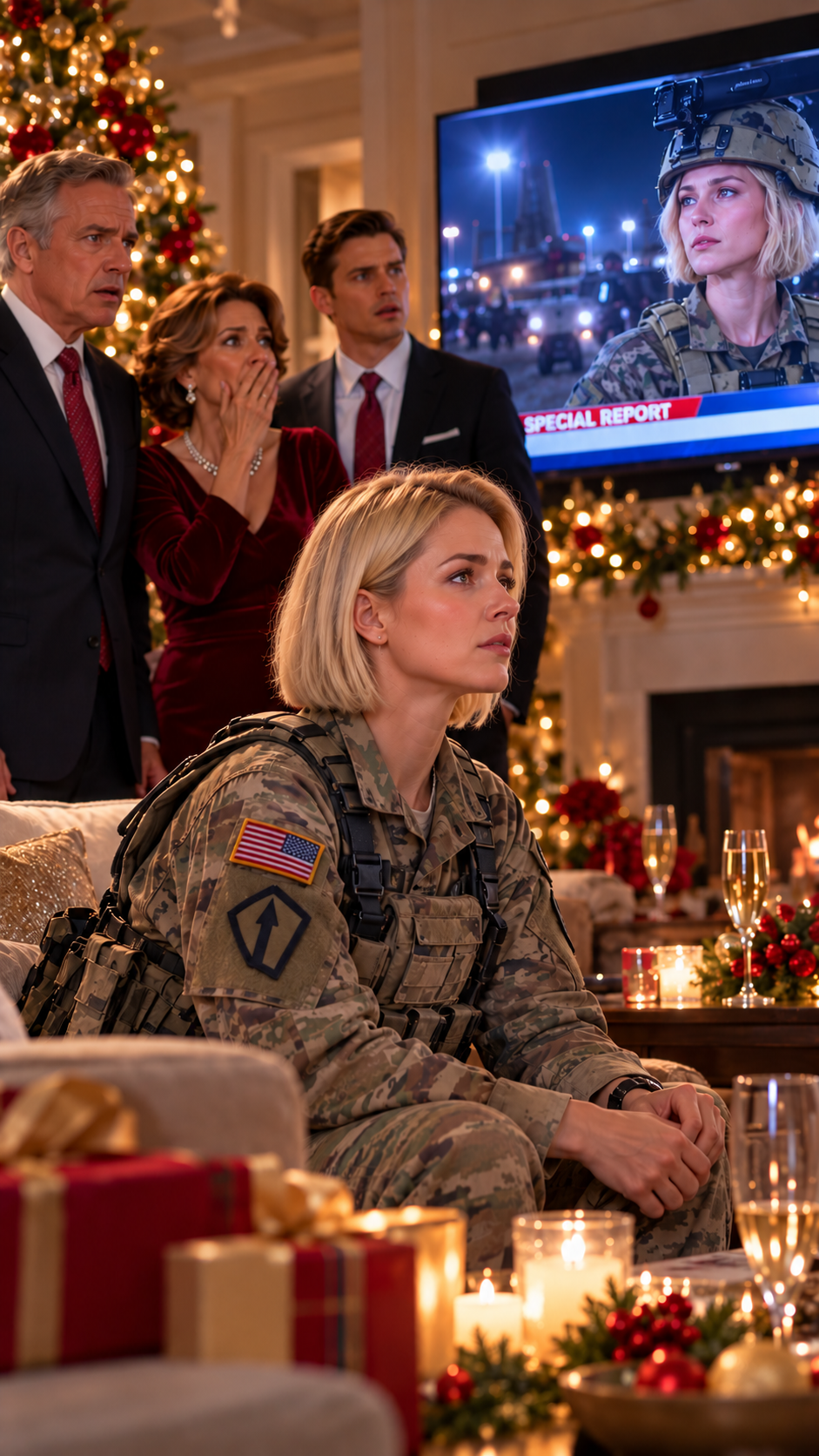
Because while my family was preparing for dinner, I was climbing toward a damaged tanker in a Colorado blizzard.
And I had no idea that before the night was over, someone would be watching.
Click here to continue reading: PART 2: The Man Trapped Beneath the Tanker Should Have Waited for Hazmat, But the Storm Was Making Every Second More Dangerous
Three Nights Before Christmas, My Father Asked Me to Stay Away—And I Realized He Had Already Decided Where I Belonged
Part 1 of 12

