
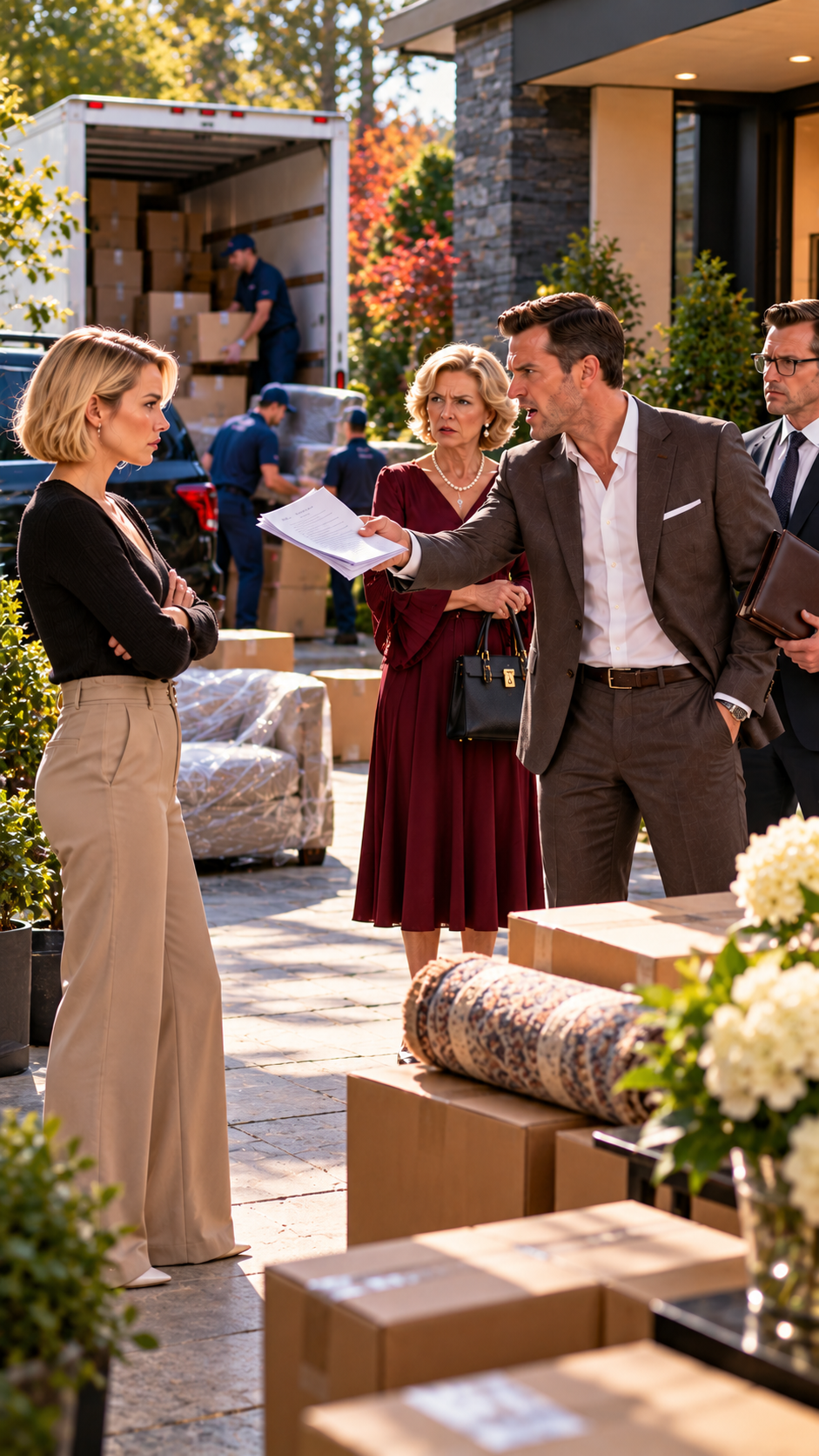
The first thing I noticed was the envelope lying crooked beneath the brass handle of my grandparents’ front door. It was not addressed to me, and it had been folded once down the middle as though whoever left it there had been in a hurry. I had been standing on the porch with two boxes balanced against my hip, enjoying the strange quiet of finally coming home, when I saw my brother’s name written across the front.
Evan Bennett.
I stared at it for several seconds before setting the boxes down.
The house behind me belonged to me now. That sentence still felt unfamiliar enough to make me pause whenever I thought it. For twenty-eight years, the property had been my grandparents’ place, the weathered white house at the end of Hawthorne Lane where I had spent summers, holidays, and more ordinary afternoons than I could count. My grandfather had planted the maple tree beside the driveway himself. My grandmother had measured every child’s height against the pantry door. The house had never been simply a building to me.
But legally, as of three weeks earlier, it was mine.
I picked up the envelope.
There was no stamp, no return address, and no indication that Evan had mailed it. I opened it with my thumb.
Inside was a single sheet of paper.
YOU NEED TO CALL MOM BEFORE YOU DO ANYTHING ELSE.
That was all.
I read it twice.
Then I looked down the quiet road.
No car moved past the house. No neighbor stood outside. The afternoon sun had settled behind the tall oak trees, leaving the porch in a cool patch of shadow. Somewhere in the backyard, wind chimes tapped together softly.
I folded the note and put it into my pocket.
My phone was already in my hand.
Mom answered on the fourth ring.
“You got it,” she said.
There was no greeting.
“What am I supposed to call you about?”
“You know what.”
“No, Mom. I don’t.”
She sighed in that familiar way she used whenever she wanted me to feel that I was being difficult.
“Evan spoke to me.”
“About what?”
“The house.”
I looked toward the front window.
“What about it?”
“You can’t honestly think this is settled.”
My grip tightened around the phone.
“It is settled.”
“Your grandfather’s will was complicated.”
“No. The will was very clear.”
“You weren’t there when all the decisions were made.”
“I was there when the attorney read the will.”
“That doesn’t mean you understood everything.”
I almost laughed.
I had spent the previous month understanding far more about inheritance law, property liens, probate, and estate taxes than I had ever wanted to learn. I had sat in the conference room of an estate attorney’s office while documents were reviewed line by line. I had signed forms until my hand cramped.
The property had been appraised at $1.2 million.
My grandparents had left it to me.
That part was not ambiguous.
“What does Evan want?” I asked.
Mom’s voice softened.
“He thinks you should sell.”
“That’s not happening.”
“You could split the money.”
“No.”
“He’s your brother.”
“And?”
The silence that followed lasted long enough for me to hear the refrigerator humming inside the kitchen.
Then Mom said, “You sound exactly like your grandfather.”
I wasn’t sure whether she meant it as an insult.
I decided not to ask.
After we hung up, I stood on the porch for another minute. I had expected resistance from Evan eventually. I had not expected it this quickly.
The inheritance had been finalized only eleven days earlier.
Since then, I had done exactly what I promised myself I would do.
I had paid the remaining mortgage balance.
I had cleared the property taxes.
I had settled the outstanding utility account.
I had paid the final medical expenses that had remained attached to the estate.
There had been an old contractor’s claim, a small credit-card balance, and a legal filing fee that nobody had remembered until the estate attorney found it. I paid those too.
By the time everything was finished, the house was free of debt.
I had also recorded the deed in my name.
The county records showed me as the sole owner.
I had a certified copy in a fireproof box inside the house.
Another copy was with my attorney.
A third sat in the bank’s safe-deposit box.
I had been careful because my grandfather had taught me to be careful.
He used to say that people rarely became unreasonable when they wanted something.
They became unreasonable when they believed someone else was going to stop them from getting it.
I carried the remaining boxes inside.
The hallway still smelled faintly of cedar and old books.
My grandmother’s grandfather clock stood against the far wall. I had wound it that morning, and its slow ticking seemed louder now that the house was empty.
I walked into the kitchen.
The yellow curtains were still there.
So was the small crack in the blue ceramic tile beside the sink.
I touched it with my fingertips.
For a moment, I could hear my grandmother laughing.
Then my phone buzzed.
A text from Evan.
WE NEED TO TALK TONIGHT.
I typed back.
About what?
Three dots appeared.
Then disappeared.
A minute later, another message arrived.
ABOUT WHAT GRANDPA REALLY INTENDED.
I stared at the screen.
That was the first moment I felt something cold settle beneath my ribs.
Not fear.
Recognition.
My grandfather had spent the last year of his life telling me to keep every legal document.
He had insisted that I meet his attorney.
He had asked me more than once whether I still had the small metal box he had given me when I was nineteen.
At the time, I thought he was simply being cautious.
Now I wasn’t so sure.
I went upstairs and opened the closet in his old study.
The metal box was still there.
I had not touched it since the funeral.
The key was taped beneath the third shelf, exactly where he had told me it would be.
I unlocked it.
Inside were insurance papers, an old bank statement, photographs, and a sealed envelope with my name on it.
My pulse changed.
I knew the handwriting immediately.
I opened the letter.
My grandfather had written it months before his death.
He told me the property had been intended for me for years. He explained that he had watched how each of us handled responsibility and that he trusted me to protect the house rather than treat it like a prize.
Then came a sentence that made me stop.
If Evan asks you to sell, do not let guilt make the decision for you.
I read that line again.
And again.
At the bottom, he had added another warning.
If someone arrives claiming I promised them the property, ask for the original documents. Do not accept explanations in place of records.
I sat down in his chair.
My grandfather had known.
Maybe not exactly what would happen.
But he had known enough to warn me.
I folded the letter carefully and returned it to the envelope.
Then I heard a vehicle outside.
I walked to the window.
A dark sedan had stopped across the street.
It sat there for perhaps thirty seconds.
Then it drove away.
I couldn’t see the driver’s face.
I told myself it was nothing.
That explanation lasted less than an hour.
At 8:17 that evening, someone knocked on my front door.
I opened it to find Evan standing on the porch.
He was wearing the charcoal jacket he usually reserved for business meetings. His hair was neatly combed, and he carried a leather folder beneath one arm.
Mom stood behind him.
Neither of them smiled.
Evan looked past me into the house.
“You’ve already moved in.”
“I’ve been moving boxes all day.”
Mom stepped closer.
“You should have waited.”
“For what?”
Evan opened the folder.
“A lawyer.”
I looked at him.
“What lawyer?”
He smiled.
“Someone who can explain why you don’t actually own what you think you own.”
For the first time that day, I felt the house behind me become very still.
I stepped back from the doorway.
“Then you’d better come inside.”
Evan’s smile disappeared.
Because I had already decided something.
If he was bringing a fight into my grandparents’ house, I was going to make sure every piece of it happened in the light.
Click here to continue reading: PART 2: The man Evan brought to prove I was wrong about the deed knew exactly what to say until one small question exposed him
The house was finally mine, but the first warning that something was wrong arrived before I had even finished unpacking
Part 1 of 12

