
For six weeks, Barbara Reynolds had been telling everyone who would listen that I was “a nurse.”
She never said it with open contempt. That would have been easier. Instead, she said it with a polished smile, the kind people use when they believe they are being generous to someone they consider less accomplished.
At first, I corrected her gently.
“I work at St. Victoria Medical Center.”
Barbara had smiled.
“That’s wonderful. Hospitals need good nurses.”
I remember the way Daniel’s fork stopped halfway to his mouth.
He looked at me, waiting.
I simply continued eating.
There are moments when correcting someone feels less important than understanding why they made the mistake in the first place.
Barbara had met me three times before she decided what kind of woman I was.
Three dinners.
Two Sunday lunches.
One charity reception.
Apparently, that was enough.
She knew my first name, my age, where I worked, and the fact that I was engaged to her only son.
What she didn’t know was that I had spent twelve years in medicine.
She didn’t know that I had started my career as a nurse.
She didn’t know that I had gone back to medical school while working impossible hours.
She didn’t know about residency, fellowship, overnight trauma cases, or the hundreds of decisions I had made while other people’s lives depended on me.
And she certainly didn’t know that I was currently the Chief of Cardiothoracic Surgery at St. Victoria.
Daniel knew all of it.
That was why he kept asking me the same question.
“Why are you letting her believe this?”
We were standing in our kitchen one Thursday night.
Daniel had his sleeves rolled up, and he was drying a wineglass with a towel even though the glass was already dry.
He only did that when he was irritated.
“She’s your mother,” I said.
“That’s not an answer.”
“It’s the reason I’m being patient.”
He put the glass down.
“She embarrassed you tonight.”
“She tried.”
“She told my aunt you were ‘a wonderful young nurse who keeps doctors organized.’”
I smiled faintly.
“That part was almost complimentary.”
“Emily.”
I looked at him.
His expression had changed.
There was no amusement left in it.
“I hate watching her do this to you.”
I stepped closer and touched his wrist.
“I know.”
“Then tell her.”
“No.”
“Why?”
I took a breath.
“Because if your mother only respects me after she hears the title ‘Chief of Cardiothoracic Surgery,’ then she doesn’t respect me. She respects the title.”
Daniel looked away.
For several seconds, the kitchen was quiet except for the refrigerator humming behind us.
Finally, he nodded.
“You really want to wait?”
“Yes.”
“For what?”
“For her to show me who she is.”
He gave me a tired smile.
“I’m afraid you already know.”
Maybe he was right.
But I still wanted to believe there was more to Barbara than the woman I had seen at those first dinners.
The first time she had asked what I did, I had tried to explain.
“I work in cardiac surgery.”
She had interrupted before I could finish.
“Oh, so you’re one of the nurses.”
The certainty in her voice had surprised me.
Not confusion.
Not curiosity.
Certainty.
So I let it go.
Part of me wondered what would happen if I simply stopped correcting people and watched what they did with the information they thought they had.
Barbara gave me an answer almost immediately.
At Sunday dinner, she placed a serving dish in front of me.
“You can help me in the kitchen after we eat.”
Daniel glanced up.
“Mom, Emily has work early.”
Barbara waved him off.
“Oh, nurses are used to odd hours.”
I looked at her.
She smiled.
I smiled back.
“Of course.”
After dinner, while we stood at the counter washing dishes, Barbara leaned toward me.
“You know, there’s absolutely nothing wrong with being practical.”
I rinsed a plate.
“I agree.”
“My son has always needed someone grounded.”
“I hope he found that.”
She laughed softly.
“I’m sure you’ll be a wonderful wife.”
The words sounded affectionate.
The meaning underneath them wasn’t.
She wasn’t telling me she thought I was right for Daniel.
She was telling me she thought my ambitions should stop where her expectations began.
That evening, Daniel apologized before we even reached the car.
“I’m sorry.”
“You didn’t say anything wrong.”
“I should have.”
“You’ll have opportunities.”
He frowned.
“What does that mean?”
I fastened my seat belt.
“It means I’m still watching.”
For the next few weeks, Barbara continued.
She gave me advice about keeping Daniel’s shirts pressed.
She told me which restaurants were “too expensive for ordinary people.”
She asked whether my student loans had been paid off.
She once suggested that I consider taking fewer hospital shifts after marriage because “a husband shouldn’t have to compete with a career.”
Daniel nearly dropped his coffee.
“Mom, Emily’s career is not a hobby.”
Barbara looked surprised.
“I never said it was.”
“You implied it.”
“I was only trying to help.”
I reached across the table.
“Daniel.”
He stopped.
Barbara looked pleased, as though she had won something.
I didn’t want a public argument.
Not yet.
The engagement brunch was supposed to be different.
That was what Daniel promised me.
“My mother has been planning this for weeks,” he said as we drove there.
“That’s reassuring.”
“She wants everything perfect.”
“That worries me more.”
He laughed.
The brunch was held at a private country club overlooking the lake.
The dining room had tall windows, pale linen tablecloths, fresh flowers, and enough polished silver to make the place feel more like a museum than a restaurant.
Barbara greeted us at the entrance.
She wore a cream-colored dress and a string of pearls.
She hugged Daniel.
Then she kissed my cheek.
“My future daughter-in-law.”
Her smile was perfect.
So was the pressure of her hand on my arm.
Inside, about thirty relatives and close friends had gathered.
I noticed something immediately.
The seating arrangement.
Daniel was placed between his father and an older cousin who owned a regional construction company.
Barbara had placed me near her.
Not beside Daniel.
Not even across from him.
Beside her.
Daniel noticed too.
He leaned toward me.
“Do you want me to switch?”
“No.”
“You sure?”
“Yes.”
“Why?”
“Because I’m curious.”
He smiled.
“You’re enjoying this.”
“Not exactly.”
Brunch began.
People asked about the wedding.
They discussed flowers, venues, invitations, and whether Daniel’s father wanted a band or a string quartet.
Barbara directed everything.
At one point, she turned to me.
“Emily, have you thought about what kind of meals you’ll make after you two marry?”
Daniel’s shoulders tightened.
“I can cook,” I said.
Barbara looked delighted.
“Oh, good.”
She turned to her sister.
“She says she can cook.”
Her sister laughed.
“I knew she had potential.”
Potential.
I swallowed my response.
Then Barbara stood and tapped her glass.
“I have one more little surprise.”
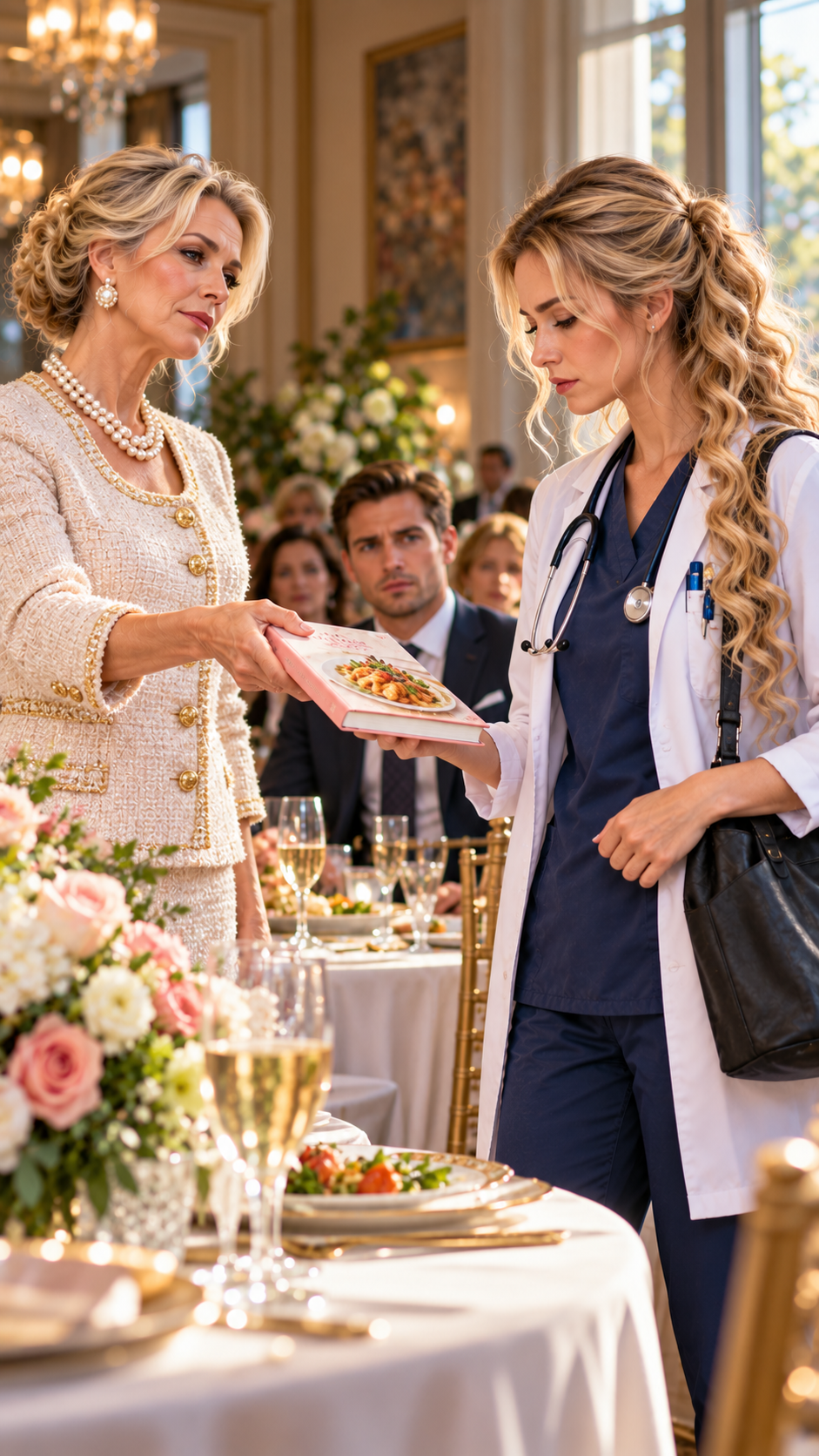
A server brought a wrapped package.
Barbara placed it directly in front of me.
“For you.”
Everyone watched.
I opened it.
Inside was a cookbook.
The cover read: Easy Family Meals for Busy Beginners.
For a moment, I simply stared at it.
Then I opened the front cover.
Barbara had written something inside.
“So Daniel never has to depend on hospital cafeteria food again. Love, Barbara.”
Laughter moved around the table.
Not everyone laughed.
Daniel certainly didn’t.
His hand closed around mine beneath the table.
I shut the book.
“Thank you.”
Barbara tilted her head.
“I’m sure you’ll find it useful.”
“A good meal can certainly make life easier.”
She smiled.
“That’s exactly what I thought.”
I looked at the inscription again.
Then I looked at her.
“Kindness helps too.”
The smile on Barbara’s face disappeared for less than a second.
But I saw it.
So did Daniel.
Someone at the far end of the table suddenly became fascinated with their coffee.
Barbara cleared her throat.
“Well. We all have different strengths.”
I nodded.
“We do.”
Before the conversation could continue, my phone vibrated inside my purse.
I ignored it.
It vibrated again.
Then again.
Only one type of call was allowed through my silent setting during family events.
The hospital.
My stomach tightened.
I looked at the screen.
ST. VICTORIA TRAUMA CENTER.
I stood.
“I need to take this.”
Barbara frowned.
“Now?”
I stepped into the hallway.
“Dr. Carter.”
The trauma coordinator answered immediately.
“Emily, we have a major interstate collision. Multiple incoming patients.”
“How many?”
“Twelve confirmed. Two critical.”
“What’s the worst?”
“Possible thoracic vascular injury. We don’t have full imaging yet.”
I was already reaching for my coat.
“Call cardiothoracic anesthesia. Get OR Three ready. I’ll be there in twenty minutes.”
I returned to the dining room.
Daniel stood before I reached the table.
“What happened?”
“Multi-car accident. They need me.”
Barbara blinked.
“Oh.”
I picked up my purse.
She looked around the table.
Then back at me.
“I suppose hospitals are always busy.”
“Yes.”
She gave a sympathetic little smile.
“Go change some beds.”
Daniel’s face hardened.
Barbara laughed.
“I’m joking.”
No one else did.
I looked at her.
For the first time since I had met her, I didn’t feel curious.
I felt finished.
Daniel pushed his chair back.
“Mom.”
His voice was quiet.
Barbara’s expression changed.
“What?”
“You’ve been doing this for six weeks.”
“I don’t know what you’re talking about.”
“You do.”
I touched his arm.
“Daniel.”
He looked at me.
I shook my head.
“There are patients waiting.”
He swallowed his anger.
I left.
The drive to St. Victoria took nineteen minutes.
I spent every one of them thinking about medicine instead of Barbara.
That was easy.
Medicine was honest.
A scan was a scan.
A blood pressure was a blood pressure.
A damaged vessel did not care about family status, wealth, or which country club you belonged to.
Patients needed answers.
My team needed decisions.
When I walked through the trauma doors, a resident met me with the first scan.
“Possible descending thoracic aortic rupture.”
“How unstable?”
“Pressure’s dropping.”
“OR?”
“Ready.”
I took the images.
There was no room for emotion anymore.
Only work.
And as I walked toward the operating room, I had no idea that the person waiting for me there would make the insult from that brunch suddenly seem very small.
Because less than an hour later, someone would arrive at St. Victoria whose name I knew better than almost anyone.
And I would have to decide whether the worst day of Barbara Reynolds’s life was also the moment her opinion of me finally changed.
Click here to continue reading: PART 2: The Emergency That Followed Me Home Turned a Family Insult Into a Decision No One at the Hospital Could Undo
She Had Already Decided Who I Was, Until One Quiet Detail Made Her Entire Judgment Impossible to Ignore
Part 1 of 12

