
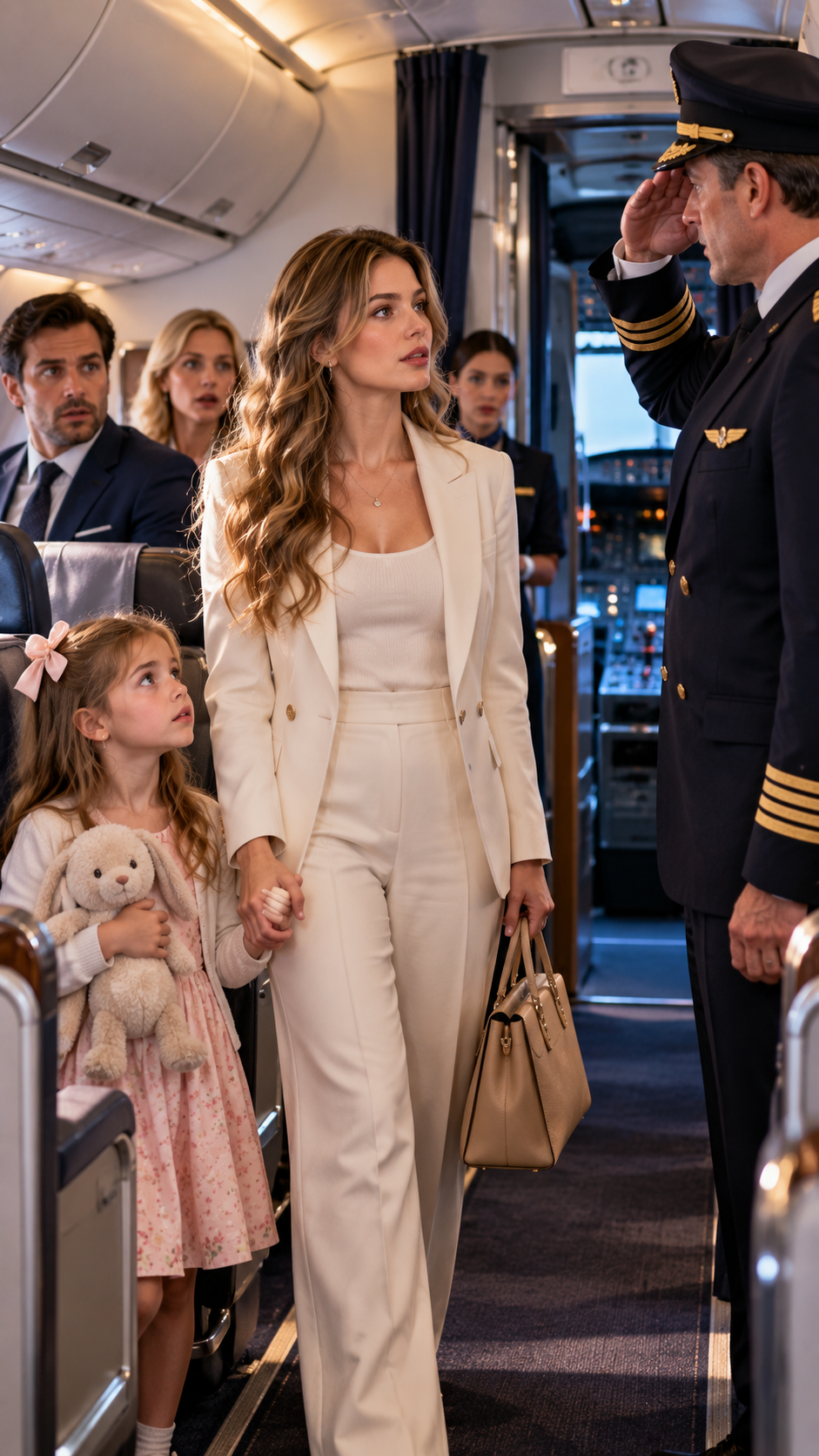
“Sir, you and your daughter need to move to the rear.”
The gate agent said it as though he were asking us to change seats at a restaurant, not surrender tickets I had spent two years saving for.
My daughter, Maya, looked at the number printed on our boarding passes and then at the wide first-class seats beside us. Her fingers tightened around mine.
“But Daddy,” she whispered, “these are ours.”
“I know.”
I kept my voice calm because seven-year-old children remember the way adults respond when something frightening happens. I didn’t want her to remember panic in my face.
The gate agent glanced toward the aisle behind him. A tall man in a navy suit stood there with an expensive leather briefcase and the impatient expression of someone accustomed to being accommodated.
“This passenger has an executive priority designation,” the agent explained. “There’s been a seating issue.”
I looked at the businessman, then back at the agent.
“Then fix the seating issue.”
His smile disappeared.
“Sir, I’m asking you to cooperate.”
I handed him my boarding pass.
“Row three. Seats A and B. We paid for them.”
He barely looked at the ticket before returning it.
“I understand. But the company has authorized an adjustment.”
An adjustment.
That was what they called it.
Maya didn’t understand the corporate language. She understood that a stranger was taking something she had been excited about since the day I told her we were finally going to the ocean.
She leaned against my side.
“Daddy, are we still going to Mama’s beach?”
The question hit somewhere deeper than the argument.
“Yes,” I said. “We’re still going.”
My name is Marcus Vance. I’m forty-one years old, a widower, a father, and a former Army sergeant.
I also have a prosthetic left leg.
Most days, I don’t think about it. I wake up, strap the prosthesis on, make breakfast for Maya, pack her schoolbag, go to work, come home, cook dinner, help with homework, and start again the next morning.
But strangers notice.
Some stare.
Some pretend they aren’t staring.
And some make assumptions.
The morning of that flight, the gate agent had looked at my worn boots, my cane, Maya’s faded jacket, and probably decided we were the easiest people to move.
He had no idea what that trip meant to us.
Two years earlier, my wife Elena had died after a long battle with cancer.
The disease had taken almost everything from us before it finally took her life—our savings, our house, our sense of normality, and eventually the strength she still tried to pretend she had.
But one thing she refused to surrender was the memory of the beach.
Wrightsville Beach.
It was where Elena and I had met years earlier, before marriage, before military deployments, before hospitals and medical bills.
She used to say the ocean made every problem look temporary.
During her final weeks, when she could barely sit upright, she asked me to promise something.
“Take Maya there someday,” she had whispered.
I had held her hand beside the hospital bed.
“I will.”
“Not when she’s older.”
Her eyes had moved toward our daughter, who was sleeping in a chair by the window.
“Take her while she still remembers me telling her about it.”
That promise became the reason I started saving.
I kept an old coffee can on top of our refrigerator.
Maya decorated it with crooked letters in pink marker.
MAMA’S BEACH FUND.
Every few days, she added coins.
Sometimes I put in twenty dollars.
Sometimes five.
Sometimes nothing.
There were weeks when the money disappeared into groceries or medication or one of the bills that seemed to arrive faster than my paycheck.
Still, we kept saving.
Eventually, we had enough for the plane tickets.
First class wasn’t about luxury.
It was about making the journey special.
Maya had never flown before.
I wanted her first flight to be something she remembered for the right reasons.
When we boarded that morning, her face had nearly glowed.
She ran her hand over the seat.
“Daddy, look at this!”
She opened the little storage compartment.
Then she discovered the window.
“I’m going to see the clouds!”
I laughed.
“You might.”
“Will we be above the birds?”
“Some of them.”
“Will Mama see us?”
I paused.
Then I smiled.
“I think she will.”
For those few minutes, I felt like I had kept my promise perfectly.
Then the gate agent arrived.
Now, standing there with Maya beside me, I had a choice.
I could make a scene.
I could demand a supervisor.
I could refuse.
I could tell everyone exactly how long it had taken me to save for those seats.
But Maya was watching.
And she had already begun to tremble.
I bent toward her.
“It’s okay.”
“It isn’t fair.”
“No,” I admitted quietly. “It isn’t.”
The agent gestured toward the aisle.
“Sir.”
I took a slow breath.
“Come on, sweetheart.”
I lifted our carry-on.
It was an old black bag with a broken zipper pull.
Nobody looking at it would have guessed what was inside.
Elena’s ashes were packed carefully in a small mahogany urn.
I had promised to bring her home to the ocean.
As we began walking toward the back, Maya held my hand with both of hers.
The cabin had gone strangely quiet.
Passengers watched.
A woman near the window lowered her newspaper.
An older man looked away.
Someone whispered.
I kept walking.
My cane tapped against the floor.
One step.
Then another.
The businessman remained in our row.
He didn’t look embarrassed.
He looked satisfied.
That hurt more than the humiliation.
Not because of the seat.
Because Maya was learning something I had spent years trying to protect her from.
She was learning that some people looked at what you owned before deciding what you deserved.
We had reached the second row when the cockpit door opened.
I heard it before I saw anyone.
The door clicked.
A pilot stepped into the aisle.
He was tall, broad-shouldered, and probably in his late forties. Silver threaded through his dark hair. His uniform was immaculate, and his posture had the unmistakable precision of someone who had spent years in the military.
He looked first toward the gate agent.
Then at the businessman.
Then at us.
His eyes stopped on my cane.
They moved to the small military challenge coin clipped to my bag.
Then to the identification card still tucked behind my boarding pass.
His expression changed.
He walked toward me.
I instinctively straightened.
“Sir?”
He didn’t answer immediately.
Instead, he looked directly at my face.
Then at the name on my identification.
His lips parted.
“Vance?”
I frowned.
“Yes.”
The captain took another step.
For a second, he seemed almost unable to believe what he was seeing.
Then something extraordinary happened.
He squared his shoulders.
His right hand rose sharply.
He saluted me.
The entire cabin seemed to stop breathing.
I stared at him.
Nobody had saluted me in years.
Not since the Army.
Not since the men who knew me before the limp, before Elena’s illness, before I became simply Maya’s exhausted father.
The captain held the salute.
I slowly raised my own hand.
Maya looked from me to him.
“Daddy?”
The captain lowered his hand.
His eyes were shining.
“Sergeant Vance,” he said, loud enough for the people around us to hear, “it is an honor to have you aboard.”
The gate agent looked confused.
“Captain, we have a seating—”
“No.”
The captain didn’t raise his voice.
He didn’t need to.
The single word stopped the agent.
The captain turned toward him.
“This man and his daughter are staying exactly where they were assigned.”
“But sir—”
“No.”
The captain glanced at the businessman.
“If there is a seating problem, you will solve it without punishing another passenger for someone else’s priority status.”
The businessman shifted uncomfortably.
I opened my mouth.
“Captain, it’s all right.”
He looked back at me.
“No, Sergeant. It isn’t.”
Then he studied my face again.
“You’re Marcus Vance.”
I nodded.
His voice became quieter.
“My brother used to talk about you.”
The air seemed to leave my lungs.
“Your brother?”
He gave a small nod.
“Daniel Hayes.”
The name struck like a sudden flash of light.
I remembered fire.
Smoke.
Metal.
A vehicle burning in a valley thousands of miles away.
And a young lieutenant trapped inside it.
My grip tightened around the handle of my cane.
“Daniel?”
The captain’s eyes filled.
“You remember him.”
I stared at the man in front of me.
Then I looked at Maya.
She was watching both of us.
“Daddy,” she whispered, “who is Daniel?”
I couldn’t answer immediately.
Because the man standing in front of me wasn’t simply a captain who had noticed an old veteran.
He was the brother of a soldier whose life had once depended on mine.
And from the way he was looking at me, I knew this flight had just become about something far bigger than a seat.
Click here to continue reading: PART 2: The Captain Knew the Name I Had Tried to Leave Behind, and His Next Question Made Me Realize This Flight Was Never Just About Our Seats
The Seats We Had Saved For Two Years Were Taken From Us—Until the Captain Walked Out of the Cockpit and Recognized the Man Behind My Cane
Part 1 of 12

