
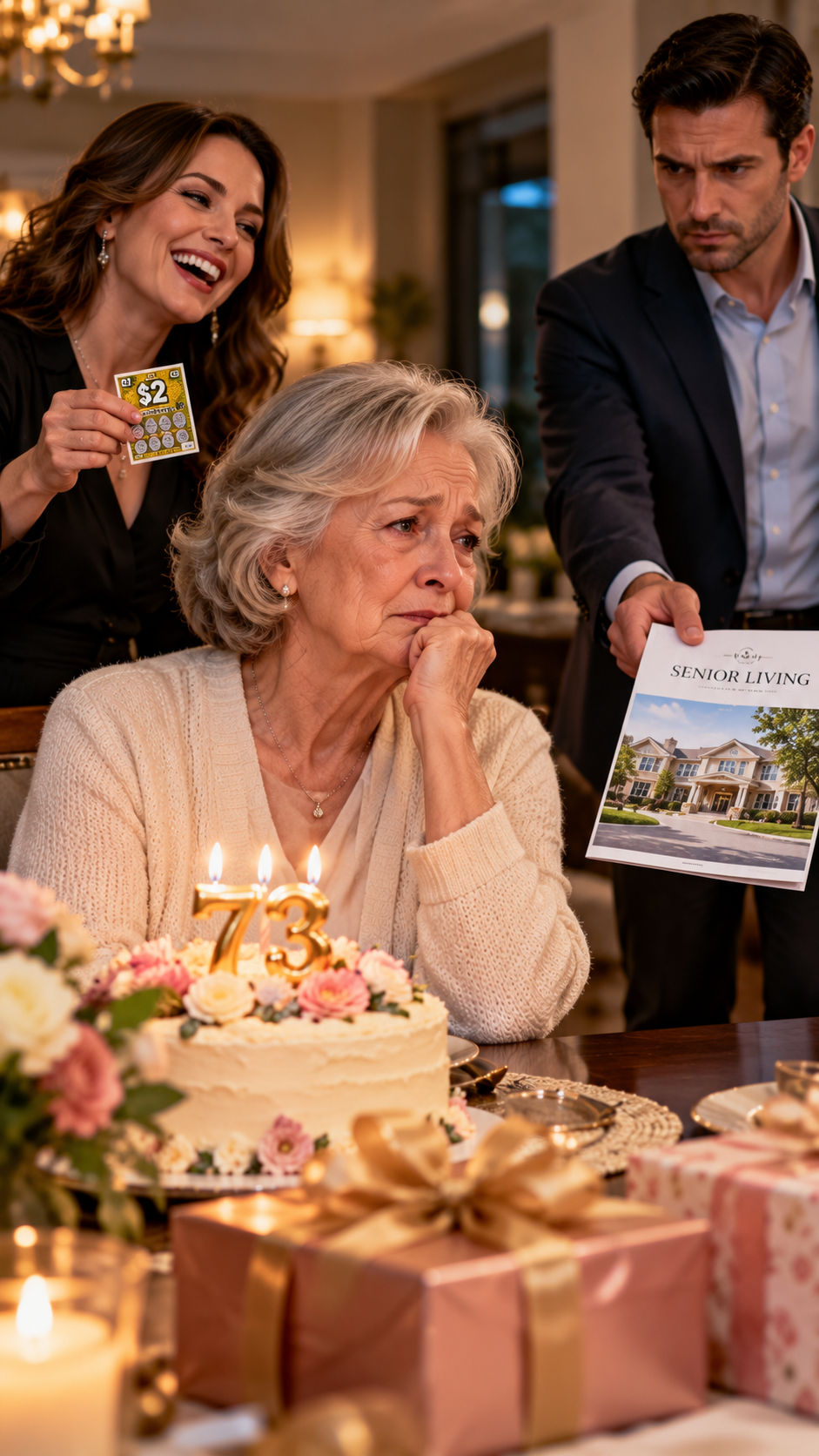
The laughter started before I even finished scratching the ticket.
Jessica had given me the smallest birthday gift imaginable: a two-dollar scratch-off, still carrying the little rectangular price sticker from the convenience store where she had bought it. She held it between two fingers as if she were presenting something ridiculous at a party.
“Happy seventy-third, Margaret,” she said. “Maybe this will finally make you rich.”
Colin laughed from across the kitchen island.
The children laughed because their parents were laughing.
I smiled because, at that moment, I had not yet decided whether I was going to laugh with them or cry.
Our kitchen in Austin was bright with late-afternoon sunlight. Someone had left a school backpack on the floor beside the refrigerator. A half-empty bottle of sparkling water stood next to the cake I had baked that morning. Vanilla frosting clung to the knife Jessica had used to cut the first slice.
There were no balloons.
There was no wrapped present.
There wasn’t even a card from the children.
The scratch-off was the entire celebration.
I picked it up and turned it over. The back still had the faint outline where the store’s adhesive price label had been peeled away. Jessica noticed me looking at it.
“What?” she asked.
“Nothing.”
“Don’t tell me you’re offended.”
“I didn’t say that.”
She grinned. “Come on. Scratch it. Maybe you’ll get lucky.”
Colin lifted his wineglass.
“To Mom’s retirement fund.”
That earned another round of laughter.
I sat at the kitchen table and used the edge of a quarter to scrape away the silver coating. Little curls of metallic dust gathered beneath my fingernail. I moved slowly across the first row, then the second.
At the third symbol, my hand stopped.
I stared at it.
For several seconds, I couldn’t hear the television in the living room or the children arguing over a game. I couldn’t hear Jessica complaining that the frosting was too sweet. I couldn’t even hear Colin asking whether I had won anything.
I scratched the remaining spaces.
Then I looked again.
My heartbeat changed.
I folded the ticket in half.
“Nothing,” I said.
Jessica burst out laughing.
“I knew it.”
Colin leaned forward. “Not even bus fare?”
“Apparently not.”
He raised his glass again.
“To bus fare.”
I smiled politely and slipped the ticket into the pocket of my beige cardigan.
Nobody saw me do it.
That was the first thing that changed my life.
The second was deciding not to tell them why.
My name is Margaret Vance, and at seventy-three, I had become remarkably good at keeping quiet.
Four years earlier, after my husband Arthur died, Colin had insisted I move into his home.
“You shouldn’t be alone,” he had told me.
I remember those words because I believed every one of them.
Arthur and I had been married for forty-six years. Our house had been full of ordinary things: his worn leather chair, my collection of blue ceramic bowls, photographs of Colin as a boy, gardening tools leaning against the garage wall.
After Arthur’s funeral, the rooms became unbearable.
Every hallway carried some trace of him.
Every morning, I woke expecting to hear him clearing his throat downstairs.
So when Colin offered me a room in his house, I accepted.
At first, it felt like family helping family.
Jessica welcomed me with a hug and told me how relieved she was that I wouldn’t be alone.
The children were delighted to have Grandma nearby.
I told myself I had been given a second home.
What I didn’t understand was how quickly being needed could turn into being expected.
The first thing I did was cook.
Jessica worked long hours at a law firm and often arrived home after seven. Colin’s schedule was unpredictable. The children had school, activities, appointments, projects, and the endless minor emergencies that seemed to fill every weekday.
So I made dinner.
Then I started packing lunches.
Then I began grocery shopping because I was already going to the store.
Laundry followed because the washing machine was running anyway.
After-school pickup happened because I was home.
No one ever sat me down and assigned these things.
That would have been easier to recognize.
Instead, each responsibility arrived disguised as a favor.
“Mom, could you grab the kids today?”
“Margaret, we’re out of milk.”
“Can you start dinner?”
“Would you mind folding these?”
Eventually, I stopped being asked.
People simply assumed I would handle it.
I told myself that this was what family did.
But somewhere along the way, the house stopped feeling like a home I shared with my son and began feeling like a place where my usefulness determined my value.
The realization came quietly.
One evening, several months before my birthday, I was carrying a basket of folded towels toward the upstairs hallway when I heard Jessica’s voice from the kitchen.
“She can’t stay here forever.”
I stopped.
Colin said something too softly for me to understand.
Jessica answered more clearly.
“She is becoming a burden.”
The basket suddenly felt heavier.
I stood in the hallway, motionless.
Colin sighed.
“She’s my mother, Jess.”
“And?”
There was a long silence.
Then Colin said, “What do you want me to do?”
I waited for him to defend me.
He didn’t.
That hurt more than Jessica’s words.
I quietly walked upstairs and put the towels away.
Neither of them ever knew I had heard the conversation.
And I never told them.
Instead, I began paying closer attention.
I noticed how Jessica spoke to me when she was tired.
I noticed how Colin asked about my health only when a medical appointment might interfere with childcare.
I noticed how quickly gratitude disappeared once something became routine.
Most importantly, I noticed how rarely either of them asked what I wanted.
That was why the scratch-off ticket mattered.
Not because of the money.
Not yet.
Because when I saw what was underneath that silver coating, I understood that something had happened which could change everything.
I waited until everyone had gone to bed that night.
The house became quiet.
I locked my bedroom door.
Then I removed the ticket from my cardigan pocket.
My hands trembled slightly as I unfolded it.
I checked the symbols again.
Then I checked the ticket number.
Then I checked it against the information on my phone.
My mouth went dry.
I sat down on the edge of the bed.
“No,” I whispered.
I checked it again.
There was no mistake.
I had won.
Not a few hundred dollars.
Not a few thousand.
The ticket was worth eleven million dollars before taxes, with the actual payout depending on the option I chose.
The two-dollar joke from Jessica had become the most valuable piece of paper I had ever held.
I didn’t sleep much that night.
By morning, I had made one decision.
Nobody in that house would know.
Not Colin.
Not Jessica.
Not the children.
Not yet.
The following Monday, I drove downtown alone.
I parked several blocks from the law office of Richard Sterling because I didn’t want anyone who knew my family to see me going inside.
Richard had handled Arthur’s estate.
He had also known me long enough to understand that I wasn’t the kind of woman who made decisions impulsively.
When I placed the ticket on his desk, he didn’t touch it immediately.
He looked at me.
Then he looked at the ticket.
Then back at me.
“Margaret,” he said carefully, “where did you get this?”
“My daughter-in-law gave it to me for my birthday.”
His eyebrows lifted.
“Does anyone else know?”
“No.”
“Good.”
He picked up the ticket with a pair of clean gloves.
“What do you want to do?”
I looked through the office window at the traffic moving along the street.
“I want to protect myself.”
Richard nodded.
That was the beginning.
Over the next several weeks, we handled everything quietly.
The ticket was secured.
The claim was processed.
The financial structure was established.
I learned more about trusts, tax planning, asset protection, and privacy than I had ever expected to learn at seventy-three.
And while Richard handled the legal details, I began making decisions about my own life.
One of those decisions involved a small yellow craftsman house not far from my sister Helen.
I had driven past it several times.
It had a narrow front porch, old oak trees in the yard, and a kitchen window that caught the morning sun.
I bought it in June.
I didn’t tell Colin.
I didn’t tell Jessica.
I didn’t even tell the children.
For the first time in years, I was building something that belonged entirely to me.
But I still lived in Colin’s house.
I still cooked.
I still folded towels.
I still smiled.
And I waited.
Ten months after that birthday, I finally learned what Colin and Jessica had been planning for me.
It happened during dinner.
Colin put his fork down.
Jessica glanced at him.
Then he reached beside his plate and pulled out a glossy brochure.
He slid it across the table.
I looked at the photograph on the cover.
A smiling elderly couple stood beside a landscaped courtyard.
Across the top were the words: Oakridge Estates Senior Living.
Colin cleared his throat.
“Mom, Jessica and I have been talking.”
Jessica gave me the same expression she used when she wanted to deliver bad news while pretending it was kindness.
“We think we’ve found somewhere wonderful for you.”
I looked at the brochure.
Then at my son.
“When?”
Colin hesitated.
“January first.”
It was only November.
I ran my finger slowly across the glossy cover.
“And you’ve already chosen a room?”
He nodded.
“We put down a refundable deposit.”
Jessica leaned toward me.
“You’ll have people around you. Activities. Medical staff. Meals. It’ll be much easier.”
“For whom?”
Neither of them answered.
I closed the brochure.
Then I looked at my son.
“Why January first?”
Colin shifted in his chair.
Jessica reached across and touched his wrist.
Finally, Colin said it.
“Lucas needs the downstairs bedroom.”
I looked at him.
My grandson.
The room I had occupied for nearly four years.
“The school situation is getting complicated,” Jessica added. “He needs more privacy.”
I nodded slowly.
“And you decided I should leave.”
“It isn’t like that,” Colin said.
But it was.
I could see it in his face.
I could hear it in the careful way he avoided my eyes.
I could feel it in the brochure resting beneath my hand.
For months, they had apparently been discussing where I would live.
They had chosen the place.
They had chosen the room.
They had chosen the date.
All without asking me.
I looked at the two people sitting across from me and felt something inside me settle.
Not anger.
Not panic.
Something quieter.
Something final.
“All right,” I said.
Jessica smiled with relief.
Colin exhaled.
Neither of them understood what I meant.
“I think that’s probably best,” I continued.
And that was the moment I stopped waiting for my family to remember that I had a life of my own.
I would make them remember.
Click here to continue reading: PART 2: They Thought They Were Sending Me Away Quietly, Until One Envelope Revealed Who Actually Had the Power to Decide What Happened Next
The Birthday Gift That Made Everyone Laugh, and the Tiny Secret I Slipped Into My Pocket Before Anyone Could Notice
Part 1 of 12

