
The first time Julian asked me to give up my baby, he did it so quietly that for several seconds I thought I had misunderstood him.
We were sitting across from each other in my apartment, with the evening traffic humming beyond the windows. Milo was three days old and sleeping against my chest, his tiny fingers curled around the edge of the blanket. Julian kept staring at him without reaching out.
“You need to think about what this will do to everyone,” he said.
I looked down at my son. “Everyone?”
“My family. My marriage. Your future.”
He said those words as if Milo were an expensive mistake on a spreadsheet.
I had known Julian was married from the beginning. I had known the rules I was breaking. What I had not understood was how easily he could separate his own actions from their consequences. When we met, he told me his marriage had been empty for years. He said he and Claire were practically strangers living under the same roof.
I believed him because I wanted to.
That was the part I had spent months trying not to admit.
When I discovered I was pregnant, Julian did not celebrate. He went completely still. Then he asked whether I was certain.
When I told him I intended to keep the baby, something changed in his face. He did not shout. He did not threaten me. He simply became distant, as though he had already begun planning how to make the problem disappear.
Milo’s birth changed me in ways I had never expected.
The nurses placed him against my chest, and I remember being frightened by how small he seemed. Then I saw his face. His eyes were slightly different from what I had imagined, and his muscles were softer than the babies I had seen in the maternity ward.
A pediatrician explained that Milo had Down syndrome.
The diagnosis landed heavily, but it did not change the one thing I knew immediately: he was my son.
Julian reacted differently.
He came to the hospital, stood near the door, and listened while the doctor explained what Down syndrome could mean for Milo’s development, health, therapies, and future.
When the doctor left, Julian rubbed his forehead.
“This wasn’t supposed to happen.”
I remember the exact way he said it.
Not “Are you okay?”
Not “What can I do?”
Not even “Is Milo okay?”
Just that one sentence.
This wasn’t supposed to happen.
Three days later, he came to my apartment with an envelope.
There was money inside.
A lot of it.
I pushed it back across the table.
“I don’t want your money.”
“You don’t understand what you’re dealing with.”
“I understand perfectly.”
“You’ll have medical bills. Therapy. Everything will cost money.”
“I’ll manage.”
He leaned forward. “Maya, be realistic. There are families who specialize in children like this.”
The room went silent.
I stared at him.
“Children like this?”
He looked away.
That was when I understood that his fear wasn’t really about Milo’s health. It was about what Milo represented.
Julian belonged to a family that treated reputation like an inheritance. His mother, Margaret Sterling, had influence, money, and connections. Julian had always described her as fragile and unwell, a woman who needed him every Sunday and depended on him for nearly everything.
Yet somehow, whenever he spoke about his family, I sensed a strange tension underneath the polished stories.
He wanted me to sign papers.
I refused.
He offered more money.
I refused again.
Then his voice hardened.
“If you make this difficult, you could lose more than you think.”
I picked up the envelope and held it out to him.
“Leave.”
He did.
Before he reached the door, he turned.
“You’ll regret making me choose.”
I watched him disappear into the hallway.
Milo stirred against my shoulder.
I lowered my face and kissed his forehead.
“You’re not a choice,” I whispered.
That night, after Milo finally fell asleep, I sat alone in the kitchen with Julian’s words replaying in my head. I knew I could not raise my son with someone who saw him as an embarrassment.
But there was another problem.
Julian had a wife.
For months I had told myself Claire didn’t need to know about me. Julian had insisted that telling her would destroy his family and accomplish nothing. He said she already suspected nothing. He said their marriage was complicated.
Now I wondered how much of that had ever been true.
I searched for Claire Sterling online.
Her photograph appeared almost immediately.
She looked nothing like the woman I had invented in my head.
She wasn’t glamorous in the way I expected. She looked ordinary, composed, almost gentle. There were photographs of her at charity events, beside Julian, beside an older woman I recognized as Margaret, and with a little boy who appeared to be about five.
I stared at that photograph for a long time.
The boy was smiling.
His name was Leo.
I closed the page.
I wasn’t sure whether I wanted Claire to know because it was the right thing to do or because some selfish part of me wanted her to force Julian to behave like a father.
Either way, I knew I could no longer pretend she didn’t exist.
The next morning, I wrote her an email.
I deleted it.
I wrote another.
Deleted that one too.
Finally, I sent a short message.
My name is Maya. You don’t know me, but I believe you have a right to know something about your husband.
The response did not come.
I waited one day.
Then two.
On the third morning, I received a message from an unknown number.
Who are you?
My hands went cold.
I replied.
I’m the mother of Julian’s newborn son.
There was no answer for several minutes.
Then one sentence appeared.
What did you say?
I told her the truth.
Julian had a son.
Milo had Down syndrome.
Julian had been trying to persuade me to give him up.
The reply came almost twenty minutes later.
Don’t contact me again.
I understood.
Of course she hated me.
Maybe she hated him more.
Maybe she hated herself for believing him.
I put the phone down and tried to move on with the morning.
Then another message arrived.
I need your address.
I stared at the screen.
I didn’t answer.
A second message appeared.
Please. I need to see your baby.
My stomach tightened.
I still didn’t know whether I was making a terrible mistake.
So I waited.
And for the next three mornings, nothing happened.
On the third morning, someone knocked on my apartment door.
Milo was asleep in his crib.
I approached the door slowly and looked through the peephole.
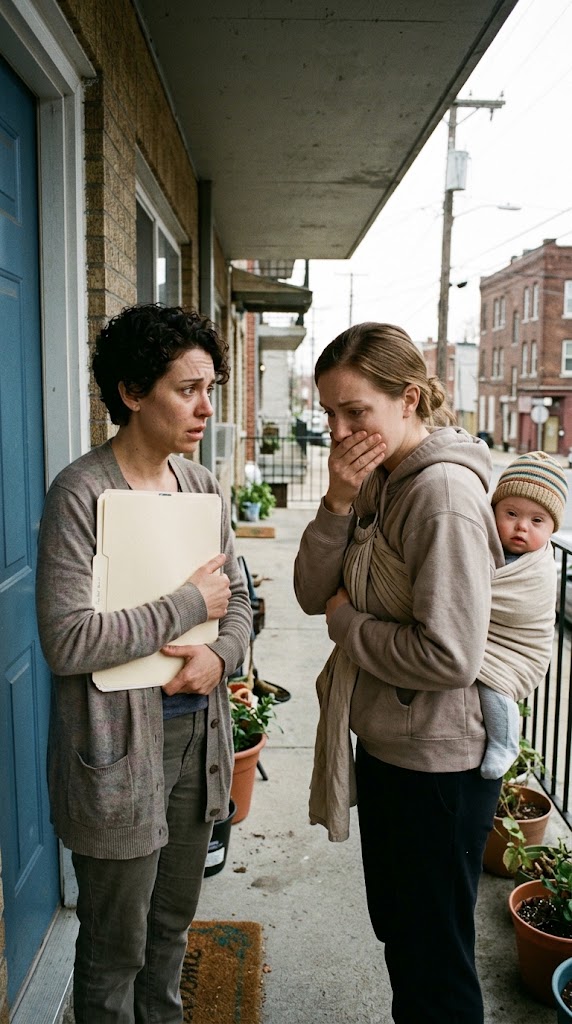
Claire Sterling stood in the hallway.
She wasn’t carrying a purse.
She wasn’t holding her phone.
She had a thick brown folder tucked beneath one arm.
Our eyes met through the glass.
Claire looked past me toward the crib.
Then she raised one trembling hand and covered her mouth.
I opened the door.
She looked at me for several seconds.
Then she looked at Milo.
Her face changed.
Not with anger.
With recognition.
And when she finally spoke, her voice was barely audible.
“Before you blame yourself for any of this, you need to know what Julian did to my first child.”
Click here to continue reading: PART 2: Claire Came Expecting the Other Woman, but the Folder in Her Hands Contained a Story Julian Had Buried for Eight Years
The Man Who Told Me My Son Was a Mistake Suddenly Wanted to Know Exactly Who I Had Contacted
Part 1 of 12

