
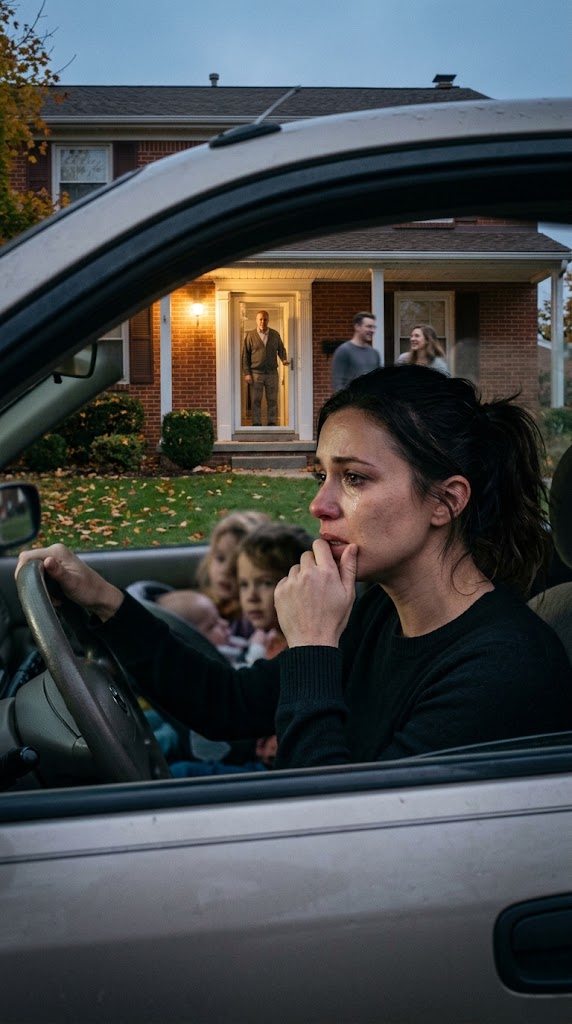
I woke before the children the next morning, although I had barely slept. My neck ached from spending the night half upright against the wooden headboard, and my eyes felt gritty and swollen. For several seconds, I stared at the motel ceiling without remembering where I was. Then the silence around me brought everything back.
Mark had cheated.
My parents had turned us away.
And three children were sleeping in a motel room because the people I had believed would always open their door to me had decided my marriage was more important than my safety.
I reached for my phone on the nightstand and opened the banking app. The numbers appeared beneath the pale blue glow of the screen. There was enough money to keep us afloat for a little while, provided I was careful. There was nowhere near enough to replace the life I had walked away from.
Most of our savings were in a joint account. Mark could see every transaction just as easily as I could, and that knowledge made my thumb hover over the screen. I transferred enough to cover food, gas, and a few nights of temporary housing. Then I stopped.
I was already imagining Mark’s accusations. He would say I was stealing. He would say I had abandoned the family and was draining our money. He might even convince himself that I had planned everything.
The truth was much simpler.
I was terrified.
At 7:16, my phone rang.
Mom.
For one foolish second, hope rose in me. Maybe she had spoken to Dad. Maybe she had realized what they had done. Maybe she was calling to tell me that the children could come back and sleep in their own beds.
I answered quietly.
“Hi, Mom.”
“Where are you?”
The question was so flat that my brief hope disappeared.
“At a motel.”
There was a pause.
“Oh, Sarah.”
I closed my eyes.
That tone was not concern. It was disappointment, and somehow that hurt more than anger would have.
“Dad sent us away,” I said.
“He was upset.”
“He wouldn’t even let his grandchildren sleep in two empty bedrooms.”
“You know how your father feels about divorce.”
“I’m not divorced.”
“You know what I mean.”
I got out of bed and walked toward the bathroom. The floor was cold beneath my feet. I closed the door gently so the children would not wake.
“Mom, Mark cheated on me for almost a year.”
“I know.”
“You know?”
“Your father told me.”
I stared at myself in the mirror. My hair was tangled, my face looked unfamiliar, and there was a red mark along my cheek from the pillow.
“He cheated on me for almost a year,” I repeated. “He lied to me. He brought another woman into our lives while I was raising our children and trusting him.”
“I’m not saying what he did was right.”
I almost laughed.
That sentence always sounded like a doorway to an excuse.
Mom continued before I could answer.
“But marriages survive terrible things. You have three children, Sarah. Sometimes you have to think beyond your own feelings.”
My hand tightened around the phone.
“My feelings?”
“I didn’t mean—”
“No. I want to understand. Is betrayal a feeling now? Is being lied to a feeling? Is finding out your husband has been carrying on another relationship behind your back just something I’m supposed to get over because we have children?”
Mom was quiet.
I knew what she was thinking.
She thought I was being difficult.
She thought I was making the situation bigger than it needed to be.
“Did Dad ask you to call me?”
Another pause.
Then she admitted, “He thinks you should go home before this gets worse.”
I looked through the small bathroom window. The parking lot was still gray with early morning light. A delivery truck idled beside the building.
“It got worse when he shut the door.”
I ended the call.
An hour later, Kevin texted.
You’ve always been dramatic. Just go home and deal with your marriage.
Before I could decide whether to answer, Jessica’s message appeared.
The kids need stability. Don’t punish them because you’re angry with Mark.
I read both messages twice.
Then I turned off my phone.
There was no argument I could make that would suddenly give them compassion. They had already decided what kind of woman I was. Explaining myself would only give them more words to use against me.
That afternoon, I found a furnished apartment above a laundromat on the edge of town.
It was not much.
Two bedrooms. Thin walls. A narrow kitchen with barely enough room for a small table. The hallway smelled faintly of detergent and old cooking oil. Whenever the industrial washers below entered their spin cycles, the floor trembled beneath our feet.
I signed a three-month lease.
Chloe slept beside me in the larger bedroom. Liam and Noah shared the other room. Our clothes stayed inside plastic storage bins because I refused to spend money on furniture we might not be able to keep.
The first grocery trip felt like an accounting exercise.
I compared prices on canned vegetables. I bought whatever meat was discounted. I learned which store marked things down on Thursday evenings. I found four mismatched plates at Goodwill and carried them home in a paper bag while Noah insisted that one of them looked like it belonged in a restaurant.
The children adjusted faster than I did.
Liam loved the rumbling machines beneath the apartment. He said they sounded like subway trains.
Noah liked sitting on the kitchen floor and feeling the vibration through the linoleum.
Chloe said almost nothing.
That frightened me.
One night, after the boys were asleep, I found her sitting on the edge of the bed with an envelope in her lap.
“What are you doing?”
She startled and tried to hide it.
“Nothing.”
“Chloe.”
She looked down.
Slowly, she opened the envelope.
Inside were several twenty-dollar bills.
“I thought you could use them.”
I sat beside her.
“Where did you get this?”
“My birthday money.”
My chest tightened.
“For rent,” she said. “You said we have to be careful.”
I took the envelope from her and placed it back in her hands.
“No.”
“But—”
“You keep it.”
“We need money.”
“I know.”
She looked at me with the serious expression children sometimes wear when they are trying to understand an adult problem.
“Are we poor now?”
The question nearly broke me.
I forced a smile.
“We’re rebuilding.”
“What’s that mean?”
“It means things are different, but different doesn’t mean finished.”
She studied my face.
“Are you sure?”
I reached over and tucked a strand of hair behind her ear.
“I am sure about one thing. You are nine years old. Your job is school, friends, homework, and arguing with your brothers about whose turn it is to use the television.”
A tiny smile appeared.
“Liam cheats.”
“I believe you.”
She laughed softly.
I handed her the envelope.
“Keep your money.”
She nodded.
After she went to sleep, I sat alone at the little kitchen table.
Rebuilding.
I repeated the word silently.
I had no idea yet what rebuilding would require.
The next morning, I asked for more hours at the dental office where I worked. I had spent years there, mostly keeping the administrative side organized, but now I needed every paycheck I could earn.
After the children went to bed, I opened my old accounting textbooks.
Before Liam was born, I had taken courses at the community college because I wanted to become a certified bookkeeper. Then Mark and I had decided that it made more sense for me to stay home more often once we had children.
At the time, I had accepted that decision without resentment.
Now I opened those old books again.
Numbers did not care that my marriage had collapsed.
Ledgers did not care that my parents had rejected me.
Spreadsheets did not ask whether I was angry.
They simply required the truth.
That steadiness felt strangely comforting.
My first bookkeeping client came through a patient at the dental office. Her name was Shirley, and she owned a small bakery. Her receipts were stuffed into plastic grocery bags, her invoices were scattered across her kitchen counter, and she had no clear idea what she owed in quarterly taxes.
“You can actually fix this?” she asked.
“I can try.”
She looked at the piles of paper.
“You don’t look very confident.”
“I’ve had a difficult week.”
She laughed.
“Fair enough.”
I spent four nights working through her records after my children were asleep.
On the fourth evening, I sent her the spreadsheet.
She stared at the screen.
“You made sense of all this?”
“Mostly.”
She looked at me.
“Do you want another client?”
I thought she was joking.
She wasn’t.
A week later, I had three clients.
Then five.
I began working early mornings, evenings, and weekends whenever Mark had the children.
But the divorce was beginning, and it was not peaceful.
Mark moved between apologies and anger.
One day he told me he still loved me.
The next, he accused me of turning the children against him because Chloe did not want to spend the night at his new apartment.
Then he argued that I should receive less child support because I had been the one who left.
My attorney corrected that assumption immediately.
“You didn’t abandon your children,” she told me. “You left a marriage. Those are different things.”
I held onto that sentence.
The divorce eventually became less explosive. There was no dramatic courtroom speech, no judge delivering some perfect declaration of justice.
There was paperwork.
There were signatures.
There were meetings that lasted too long.
The house was sold. We divided what we had. The children spent most school nights with me and regular weekends with Mark.
Less than two years later, Mark married Valerie.
By then, I barely cared.
My attention was elsewhere.
The bookkeeping work was becoming something I had not expected.
Shirley referred me to a restaurant owner. He introduced me to his cousin, who owned two landscaping companies.
My little side business was no longer little.
One evening, I looked around the cramped apartment after putting the children to bed. The washing machines below were shaking the floor. A stack of receipts sat beside my laptop. There was a bowl of cereal on the counter because I had forgotten to eat dinner.
I was exhausted.
But for the first time since my father closed that door, I was not wondering how to get my old life back.
I was wondering what I could build instead.
And that question changed everything.
Click here to continue reading: PART 2: I Had Left With Almost Nothing, Yet the Life Growing Around Me Was Becoming Something My Former Family Could No Longer Recognize
The Door Closed Behind Me, but the Hardest Part Was Realizing My Own Family Had Chosen the Man Who Betrayed Me
Part 1 of 12

