
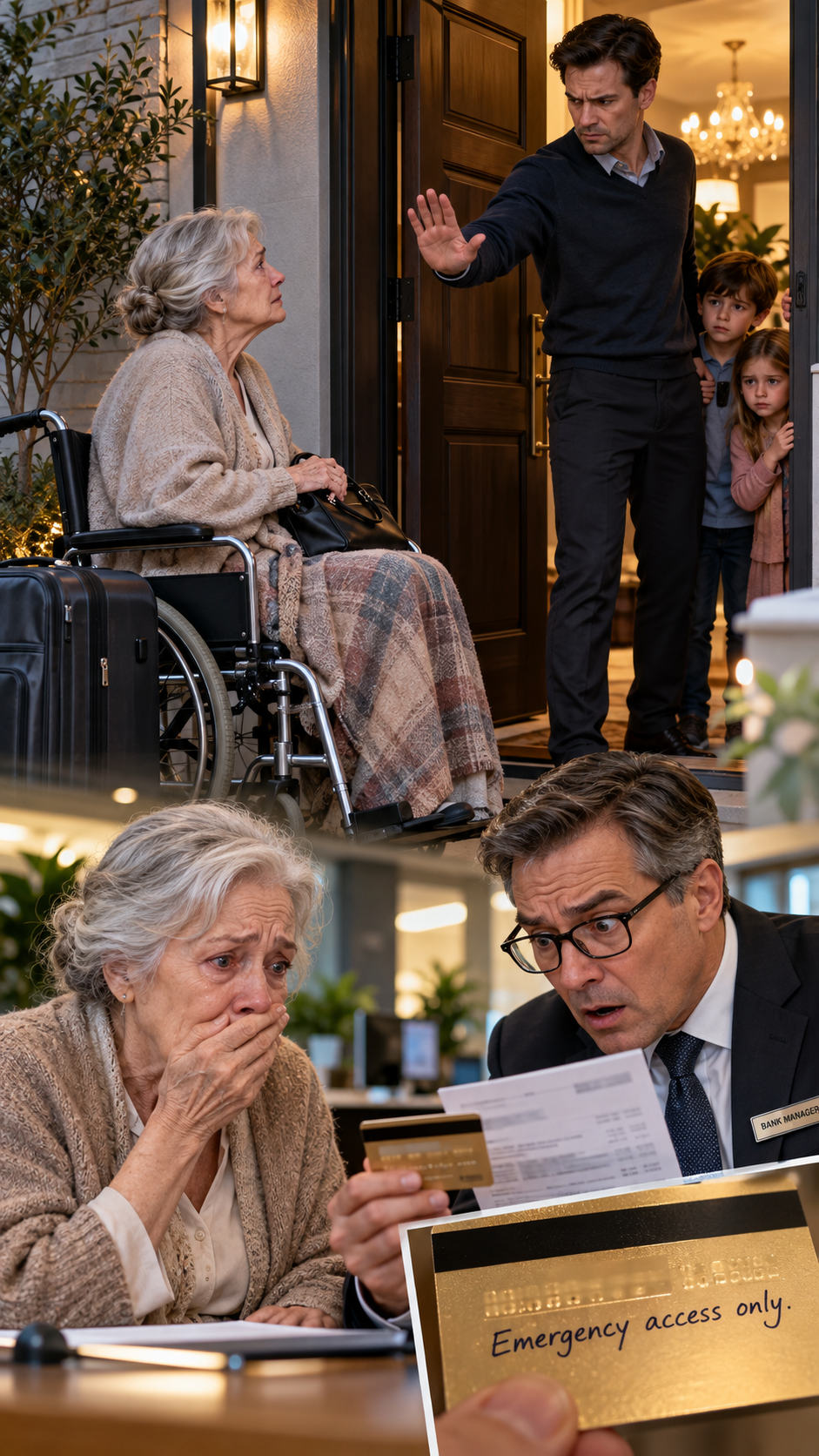
The rain had soaked the pavement by the time my son opened his front door, and I remember thinking that I had never felt more foolish standing on anyone’s porch. My wheelchair was damp beneath me, my left hip throbbed beneath the brace, and the small overnight bag hanging from the chair looked painfully inadequate for someone who had nowhere else to go. Marcus stared at me without moving. Behind him, I could hear children laughing.
“Mom?”
His voice contained surprise, but not relief.
I tried to smile. “I’m sorry I came without more warning. The rehabilitation center said I could manage with help, but I still can’t climb stairs. I only need somewhere to sleep for a little while. Maybe the downstairs room, if it’s free.”
Marcus glanced over his shoulder before looking back at me. His hand remained wrapped around the edge of the door. I had raised that hand once, holding it while he learned to walk across our kitchen floor. Now the same hand seemed to be measuring how quickly he could close the door.
“You should have called.”
“I did,” I said quietly. “Three times yesterday. You were probably working.”
“I was.”
“I thought you might not have heard the messages.”
His mouth tightened. “Sarah and I have a lot going on.”
I nodded. “I understand. I won’t stay long.”
The lie hurt as soon as I said it. I didn’t know how long my hip would take to heal. The surgeon had warned me that recovery could be slow, especially after the fall that had shattered the joint and left me dependent on a wheelchair. I had spent eight months grieving Arthur, my husband of forty-one years, and then six miserable weeks learning how to move through the world without trusting my own legs.
Marcus looked at the chair again.
“I don’t think this is going to work.”
The words were so ordinary that they took a second to register.
“What do you mean?”
“We don’t have the setup for this.”
“You have a guest room on the first floor.”
“That room is being used.”
“For storage?”
“Among other things.”
I could hear footsteps approaching behind him. Then a little voice called, “Dad, who is it?”
Marcus immediately turned.
“Go back inside, Chloe.”
“But Grandma came!”
The front door opened another inch, and I saw my granddaughter’s face appear beside his hip. Chloe was eleven, with the same dark eyes Marcus had inherited from me. Her expression changed when she saw the wheelchair.
“Grandma!”
She started forward.
Marcus put out an arm.
“Chloe, go inside.”
“But I want to hug her.”
“I said go.”
Her little brother Leo appeared behind her, confused by the sudden command. I lifted one hand toward them.
“It’s all right, sweetheart. Grandma’s fine.”
Chloe ignored her father and stepped onto the porch. She was already crying when she wrapped her arms carefully around my shoulders. I smelled her shampoo and felt something inside me crack open.
“I missed you,” she whispered.
“I missed you too.”
Leo came next. He squeezed my arm and asked whether my leg still hurt. I told him it did, but not as much when they were there.
Marcus stood rigidly beside us.
Sarah finally appeared behind him. She wore a cream-colored sweater, gold earrings, and the expression of someone who had just discovered an unexpected stain on an expensive carpet.
“Marcus,” she said, “we really need to talk about this.”
I looked from one face to the other.
“I’m not asking for much.”
Sarah folded her arms. “It isn’t just about space.”
“I know.”
“It’s about care. You need assistance.”
“I have a home-care nurse for part of the day.”
“And the rest?”
“I’ll manage.”
Marcus sighed. “Mom, this isn’t a hospital.”
“No,” I said. “I know.”
The rain tapped against the porch railing. Water ran from the edge of my coat onto the wheels of the chair. I suddenly became aware that I was blocking the doorway, that my bag was sitting crookedly against my ankle, and that my son’s neighbors might be watching through their windows.
I lowered my eyes.
“Just let me stay tonight,” I said. “Tomorrow I’ll figure something else out.”
Marcus looked uncomfortable.
Then he said the sentence I would remember for the rest of my life.
“You can’t stay here.”
I stared at him.
“Marcus.”
“I’m sorry.”
“You’re not.”
His eyes flickered.
For a moment, I thought he might change his mind. He had always been stubborn, but he had also once been tender. I remembered him at seventeen, sitting beside Arthur in the garage after wrecking his first car, crying because he thought we’d hate him. Arthur had put a hand on his shoulder and told him mistakes could be repaired.
I wondered where that boy had gone.
“Please,” I said.
Marcus stepped backward.
“We’ll call you tomorrow.”
“Marcus, don’t.”
He reached for the door.
Chloe shouted from inside, “Dad, Grandma needs somewhere to stay!”
Marcus’s face hardened.
“Chloe, enough.”
The door began closing.
I looked directly at him.
“I’m still your mother.”
His expression changed for half a heartbeat.
Then the door shut.
The sound was soft.
That somehow made it worse.
I sat beneath the porch roof while the rain thickened around me. My driver, who had been waiting near the curb, came over and crouched beside me.
“Mrs. Bennett, where should we take you?”
I looked at the closed door.
“I don’t know.”
He waited.
I wiped rainwater from my cheek and told myself it wasn’t tears.
“Take me home.”
My house was too large for one person now. Every room carried some trace of Arthur: his reading glasses on the study shelf, the old leather chair beside the window, the mug he refused to replace even after the handle had been repaired twice. Eight months after his death, I still caught myself listening for his key in the front door.
That night I ate soup at the kitchen counter because getting to the dining table with the wheelchair felt like more work than I could bear. My hip pulsed whenever I shifted. I took my medication, turned off the lights, and sat in darkness.
What hurt most wasn’t that Marcus had refused me a bed.
It was that he had looked at me as though I were an inconvenience he needed to remove.
Arthur would have opened the door.
I knew that.
Arthur would have carried the bags himself, rearranged furniture, called a doctor, and complained that I was apologizing too much.
The thought made me cry.
Later, unable to sleep, I rolled my wheelchair slowly toward Arthur’s study. I had barely entered the room since his funeral. Dust had settled along the edges of his desk, and a stack of unopened mail sat beneath the lamp.
I reached for the light.
Then I noticed the old wooden drawer beneath his desk.
It was slightly open.
I frowned.
Arthur had always been meticulous. He locked every drawer that contained anything important. I pulled it open and found old tax records, a fountain pen, two photographs, and a leather folder.
Nothing seemed unusual.
Then something hard slid from beneath the folder and struck the floor.
It was a bank card.
I picked it up.
The name on the front was Arthur Bennett.
The card was old enough that the lettering had begun to fade. I turned it over.
There was handwriting on the back.
An account number.
And four words.
Emergency access only.
I stared at the ink until my eyes blurred.
Arthur had never mentioned this account.
And suddenly, for the first time since Marcus closed that door, I wondered whether my husband had left something behind that he never intended our son to know about.
Click here to continue reading: PART 2: The Card Looked Ordinary Until the Bank Manager Read the Number, Then His Entire Manner Changed Before My Eyes
I Thought My Son Would Open His Door to His Widowed Mother, Until His Face Changed the Moment He Saw My Wheelchair
Part 1 of 12

