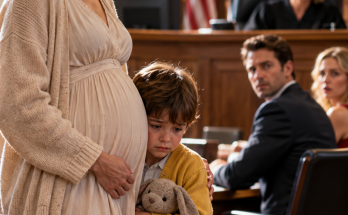
By the time we returned to Seattle, I had learned that there were some truths children could sense long before adults were ready to say them aloud. Chloe watched me from the back seat as we left the airport, her forehead resting against the window. Emma was asleep beside her, curled around the stuffed rabbit she had carried since she was four. Neither girl asked where we were going. They knew we were returning because the baby needed us, though neither understood what that meant.
The apartment I had rented was small, temporary, and painfully impersonal. Two bedrooms, a narrow kitchen, a sofa that smelled faintly of detergent, and a view of wet streets shining beneath the evening lights. I had chosen it because it was close to the hospital and the courthouse. I had not chosen it because I wanted to live there. Still, when Chloe walked inside, she put her backpack down and said, “It can be our place for now.” I admired her ability to make temporary things feel survivable.
The next morning, my attorney arrived with a stack of documents and the expression she wore whenever a situation had become more complicated than expected. She placed the papers on the kitchen table while the girls ate cereal in the next room. “The independent representative has reviewed the initial evidence,” she said. “The court wants everyone to cooperate before Leo is born.” I looked at the documents. “Including Jessica?” “Especially Jessica.”
Jessica had been staying in a private maternity unit under her lawyer's supervision. She had stopped speaking directly to Carter. She had also stopped answering questions about the trust. That silence had become meaningful. Once the Sterling family realized the inheritance clause would not survive the investigation intact, the warm welcome Jessica had received disappeared almost overnight.
Carter, meanwhile, was fighting on several fronts. His employment had been suspended. His father had resigned from the company board. Federal investigators wanted records of the payments made through Sterling Corporation. Oakfield had turned over internal communications, access logs, and security footage. Carter's lawyers were trying to separate him from the fraudulent paperwork while admitting enough involvement to avoid making the situation worse.
My attorney pushed a photograph across the table.
It showed Carter entering Oakfield eight months earlier.
“That's the day he signed the transfer authorization,” she said.
I stared at the photograph.
He was wearing the navy coat I had bought him for his birthday.
I remembered that coat.
I remembered him saying he had a business meeting.
I remembered kissing him goodbye.
I had spent months believing his lies were about another woman.
They had been about our child.
“You don't have to keep looking at this,” my attorney said.
“Yes, I do.”
She nodded.
“There is another issue.”
I looked up.
“Jessica's lawyer is arguing that she should retain custody because she carried the pregnancy and has been the baby's only parent during gestation.”
“Does she believe that?”
“I don't know.”
“Does she want Leo?”
My attorney paused.
“She says she does.”
“And the trust?”
“She says that has nothing to do with it.”
I almost smiled.
“Do you believe her?”
“No.”
That was enough.
Later that afternoon, I took the girls to the hospital for a supervised meeting with the child representative. We sat in a quiet consultation room where sunlight barely reached through the blinds. Chloe sat straight-backed in her chair. Emma swung her feet beneath the table.
The representative was a calm woman named Miriam Holt. She spoke to the girls directly rather than talking about them as though they weren't present.
“I understand you have a baby brother.”
Emma nodded.
“What's his name?”
“Leo.”
“Who chose that name?”
“Jessica did,” Chloe answered.
Miriam looked at her.
“And what do you think about having a brother you haven't met?”
Chloe thought carefully.
“I think it's not his fault.”
Miriam smiled gently.
“No. It isn't.”
Emma raised her hand as if she were in school.
“Can he come home with us?”
The room became quiet.
Miriam looked at me before answering.
“That's something the adults have to decide based on what's safest for Leo.”
Emma frowned.
“But Mom takes care of us.”
“I know.”
“She'll take care of him too.”
I reached across the table and took Emma's hand.
“That's enough.”
“No,” Emma whispered. “I want her to know.”
Miriam looked at me.
“She knows.”
On the way back to the apartment, Chloe was unusually quiet.
Finally, she said, “Mom, I don't understand something.”
“What?”
“Dad knew about Leo before he told us to leave.”
“Yes.”
“Did he know Leo was our brother?”
“Yes.”
She stared out the window.
“Then why did he say he was getting a son like we weren't already his children?”
I had no answer that would make sense to a nine-year-old.
“Because sometimes adults let their own wants become more important than the people already in front of them.”
She considered that.
“That's selfish.”
“Yes.”
“Did you love Dad?”
“Yes.”
“Do you still?”
I looked at the rain sliding down the glass.
“Some kinds of love don't disappear at the exact moment someone hurts you. Sometimes they simply stop being enough to keep a family together.”
Chloe nodded slowly.
She seemed satisfied.
That night, Carter called.
I almost ignored him.
Then I answered.
“How are the girls?”
“They're fine.”
“Can I talk to them?”
“No.”
“Lauren.”
“They aren't ready.”
“I need to tell them I'm sorry.”
“You can tell them when the court permits contact.”
His voice broke slightly.
“Please.”
I closed my eyes.
“You had years to be the father they needed.”
“I know.”
“No. You know now.”
He was silent.
Then he said, “I saw the photographs from the hospital.”
“What photographs?”
“The ones of Jessica's ultrasound.”
I said nothing.
“The baby looks healthy.”
“He isn't your heir.”
“I know.”
“Do you?”
“Yes.”
The answer came without argument.
That surprised me.
“I've lost everything,” he said.
“You lost things.”
“I lost my family.”
“You made choices that changed your family.”
He breathed slowly.
“Do you hate me?”
I looked toward the hallway.
Chloe and Emma were asleep.
“No.”
He seemed almost relieved.
“I don't forgive you,” I added.
“I understand.”
“And forgiveness isn't what we're discussing.”
“What are we discussing?”
“Whether you can learn to be Leo's father without making him carry the weight of your father's expectations.”
He was quiet for a long time.
“I don't know how.”
“Then learn.”
The call ended.
Two weeks later, the court ordered DNA testing.
There was no real uncertainty anymore, but the legal process required certainty in a form that could not be argued away.
The results arrived on a Tuesday.
Carter and I were confirmed as Leo's genetic parents.
Jessica was not.
I read the report twice.
Then I placed it beside the others.
My attorney looked at me.
“How do you feel?”
“Strangely calm.”
“Why?”
“Because for the first time, something about this story isn't a question.”
She nodded.
That evening, Chloe sat beside me on the sofa.
“Did they find out?”
“Yes.”
“Is he really ours?”
I looked at her.
“Yes.”
She smiled.
Then she asked, “When can we meet him?”
I didn't know.
Jessica's due date was approaching.
The custody hearing was scheduled for the following week.
And there was one remaining issue that no document had resolved.
Who would be in the delivery room?
Click here to continue reading: PART 6: When the Court Asked Who Should Stand Beside Jessica During the Birth, Carter Made a Choice That Changed How I Saw Him
Five Minutes After Signing Away Eleven Years, I Heard the Sentence That Made Taking My Daughters Across the Country Feel Like the Only Choice
Part 5 of 12