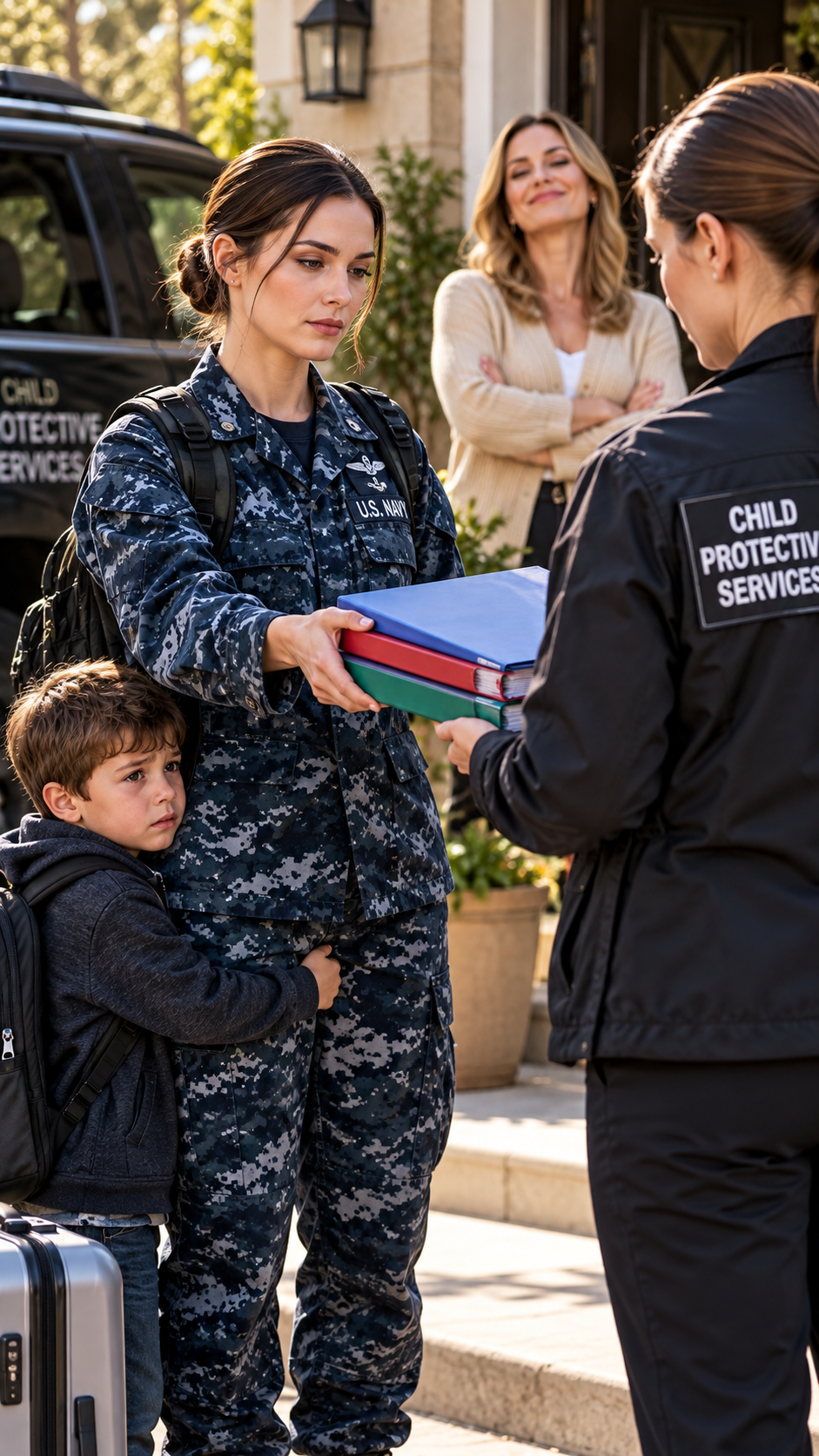
The first thing the woman from Child Protective Services noticed when I opened my front door was my son standing behind me with one sneaker fastened and the other hanging loose. The second was the expression on my face when she introduced herself. I recognized the look she gave me: the careful assessment of someone who had arrived expecting resistance and was already deciding how much of it she could tolerate.
“Rachel Bennett?” she asked.
“Yes.”
“My name is Dana Reyes. I’m an investigator with the Department of Social Services. I need to speak with you about your son, Eli.”
Behind my legs, five-year-old Eli stopped struggling with his shoelaces. His plastic dinosaur dangled from one hand. Outside, the July heat pressed against the porch windows, and the red soccer ball he had been carrying around the house all afternoon rested beside the door.
I glanced at the identification Dana held out. Her photograph matched her face, and the agency information was legitimate. I checked the date, returned the card, and looked directly at her.
“What is the nature of the complaint?”
“We received allegations concerning neglect, possible physical mistreatment, and inadequate supervision of a minor child at this address.”
The words landed with the precision of a blow delivered by someone who knew exactly where to aim.
Eli looked up at me. His eyes were blue, the same shade his father’s had been, and he was still young enough to believe that every problem could be solved if an adult explained it properly.
“Mom,” he whispered, “are we not going to the park?”
For one brief second, I forgot Dana was standing there. I wanted to kneel, gather my son into my arms, and tell him that the world was not allowed to frighten him simply because somebody had decided to make trouble. Instead, I placed a hand on his shoulder.
“We may have to go a little later, sweetheart. I need to answer some questions first.”
He studied my face, searching for the part of the answer I had left out.
“Did I do something wrong?”
“No.” I crouched until we were eye to eye. “You haven’t done anything wrong. Not one thing.”
When I stood again, I saw the first small change in Dana’s expression. She had expected anger, perhaps a demand to see a warrant, or a mother who would begin explaining herself before she knew what she was being accused of. I offered none of those things.
“Please come inside, Ms. Reyes.”
I had spent eleven years as an attorney in the United States Navy Judge Advocate General’s Corps. I had watched frightened sailors struggle to answer simple questions, examined witnesses who believed confidence could substitute for evidence, and sat across from officers whose careers depended on a single decision. The courtroom had taught me that the first person to lose control of a conversation was rarely the person who gained the most from it.
That afternoon, those lessons followed me into my own living room.
The house smelled faintly of lemon cleaner and peanut butter. A stack of clean laundry occupied one end of the sofa, waiting for me to fold it. Toy trucks were scattered beneath the coffee table, and a picture Eli had drawn of three people holding hands was attached to the refrigerator with a blue magnet.
Dana took in the room before opening her notebook.
“I need to ask you about the conditions in which Eli is living and the arrangements you have for his care.”
“Of course.”
“The report states that he is frequently left alone, that the home is not adequately maintained, and that he has unexplained injuries.”
I looked at her.
“Frequently left alone?”
“That is what was reported.”
“Eli is five. He attends kindergarten and a licensed after-school program. He is never left home alone. On Thursday afternoons, our neighbor watches him while I volunteer at a legal clinic on base. I can provide the program records and the neighbor’s contact information.”
Dana wrote something down.
“Are you currently assigned to a military installation?”
“Yes. Naval Station Norfolk. I am a commander in the Navy JAG Corps, working in military justice.”
Her pen paused for a fraction of a second.
I recognized the calculation. My position might have suggested that I understood official procedures, but it did not make me a better mother by default. Nor did it make me immune to an investigation.
“Your rank and profession don’t change our responsibilities,” she said.
“I wouldn’t expect them to.”
I meant it. If someone had raised a legitimate concern about my son, I wanted it examined. A child should never have to depend on a parent’s title, uniform, or reputation to be safe. But I also knew the damage a false allegation could cause, particularly when the person making it had already decided what the evidence was supposed to prove.
Dana continued. She asked about my working hours, who collected Eli from school, whether I had overnight assignments, and what happened when I needed to travel. I explained that my current position was shore-based and followed a regular schedule. I showed her the after-school program’s information and offered the contact details of the staff members who knew Eli.
Then she mentioned the photographs.
“The reporting party says there are images showing injuries on your son.”
My fingers tightened around the edge of the dining table.
“What injuries?”
“Bruising on his legs and arms. The report suggests the marks may have resulted from physical punishment.”
I looked toward the kitchen doorway, where Eli had arranged two dinosaurs on the floor and was making them fight over a toy truck.
The bruises were not a mystery to me. He had scraped his elbow on the playground, fallen from his bicycle, and knocked his shoulder against the dining table while chasing our dog. Each incident had been ordinary, brief, and painful in the way childhood accidents were painful. I remembered washing the dirt from his elbow while he complained that the water was too cold. I remembered the bicycle fall because he had insisted that a squirrel had deliberately distracted him.
I remembered taking photographs, too.
What I did not remember was giving anyone permission to turn those moments into evidence against me.
“Were the photographs dated?” I asked.
Dana turned a page in her folder.
“I don’t have the original files with me. I have copies submitted with the report.”
“Then I would like the original files and their associated information preserved if possible. I can provide medical records and photographs documenting the incidents.”
She studied me for a moment.
“You seem very familiar with this process.”
“I am familiar with evidence. This is my first time being investigated as a parent.”
Something in that answer made her stop writing. Not because I had intimidated her, but because I had refused to turn the conversation into a contest of authority.
She asked to inspect the rest of the house. I showed her Eli’s bedroom, the bathroom, the kitchen, and the fenced backyard. The refrigerator contained fresh food, the medicine cabinet was organized, and the smoke detectors were working. His bed was made except for the stuffed animals he had arranged in a row along the pillow.
Dana checked the locks and asked where I kept medication. I answered each question. I did not follow her around demanding to know what she was writing, and I did not pretend that cooperation meant I had nothing to fear.
When she finished, she asked to speak privately with Eli.
That was harder.
I wanted to remain beside him. I wanted to hear every question, every pause, and every answer that might later be interpreted by someone who had never watched him try to negotiate an extra bedtime story.
But the investigator had a job to do, and I had no reason to obstruct it.
I sat in the living room while Dana and Eli took seats at the dining table. I could see them through the open doorway, though I could not hear every word. She showed him a page of illustrated faces and asked him to point to the one that matched how he felt at home.
Eli chose the smiling face.
She asked whether anyone in the house frightened him.
He shook his head.
Then she asked whether his mother ever hit him.
He looked genuinely puzzled.
“My mommy doesn’t hit,” he said. “She uses the serious voice.”
I pressed my lips together.
Dana’s mouth moved as if she were trying not to smile. She asked what happened when Eli got into trouble.
“I sit in the quiet chair,” he explained. “And I lose cartoons.”
“What does your mommy do in the evening?”
“She reads books. Two books, unless it’s late. Then one really long book counts as two.”
I covered my mouth with one hand and pretended to cough.
The conversation continued. When Dana asked about the bruise on his shin, Eli described his bicycle accident in extraordinary detail, including the color of a neighbor’s recycling bin and the squirrel that had watched him fall.
By the time they finished, the sunlight had begun to slide away from the windows. Dana gathered her notes and told me that she had found no immediate safety concern. The investigation, however, would remain open while she reviewed the submitted photographs and contacted the relevant witnesses.
Then she added something that changed the room.
“The reporting party has also expressed an interest in seeking custody of Eli.”
I did not move.
“Seeking custody?”
“Yes. The person who made the report indicated that they would be willing to provide an alternative placement.”
Dana did not disclose the person’s identity. She did not need to.
Two days earlier, my older sister, Monica, had stood in my kitchen with her arms crossed while Eli played in the next room. She had been criticizing my work schedule again, insisting that a woman who spent her life in uniform could never provide a little boy with the emotional attention he needed.
“You’re always so determined to prove you can do everything yourself, Rachel,” she had said. “But being a mother isn’t a military assignment.”
I had asked her to stop.
She had looked toward Eli’s backpack and made one final remark.
“He needs a real home. Not a barracks with cartoons on the walls.”
I had told her to leave.
Now a government investigator had arrived with allegations that sounded suspiciously like Monica’s complaints, only dressed in official language.
After Dana departed, I closed the front door and leaned against it. For several seconds, I could hear nothing but the refrigerator humming in the kitchen. My legs felt unsteady, and I had to place a hand against the wall to keep myself upright.
Eli came running from the living room.
“Can we go to the park now?”
I looked at his face and felt the fear I had been holding back settle heavily in my chest.
“Not today, buddy.”
His shoulders lowered.
“Tomorrow?”
“Tomorrow.”
He considered that, then wrapped both arms around my waist. I held him longer than usual, breathing in the smell of his shampoo and the faint scent of grass on his clothes.
That evening, after he was asleep, I sat at the kitchen table and called my former commanding officer, retired Captain Lucas Hale. He had supervised me early in my legal career and had remained someone I trusted to distinguish between what felt true and what could be demonstrated.
I explained the visit, the allegations, the photographs, and the proposed custody arrangement.
He listened without interrupting.
When I finished, he asked one question.
“Do you know for certain that Monica made the report?”
“I know she has wanted me to lose custody of Eli.”
“That wasn’t what I asked.”
“No,” I admitted. “I don’t have proof yet.”
“Then that’s where you start. Not with what you suspect. With what you can establish.”
He instructed me to preserve every message, gather school and medical records, document my working hours, and obtain the after-school program’s attendance and pickup logs. He told me to make a chronology of every relevant interaction with Monica and to avoid confronting her while the investigation was active.
“She’s your sister,” I said quietly.
“Right now, she’s a potential witness in an active matter. Treat the evidence accordingly.”
After we hung up, I opened my laptop and created a document titled Eli Bennett — Child Welfare and Custody Chronology.
For four hours, I worked through records that had once seemed unimportant. Pediatric appointments. School attendance. Childcare receipts. My command calendar. Photographs of Eli playing in the backyard. Messages about his bicycle accident. The teacher’s notes describing him as cheerful, prepared, and eager to participate.
At 1:12 a.m., I discovered something I had not been looking for.
Our family photo-sharing account had been accessed repeatedly from a device I did not recognize. The login history showed nine suspicious sessions in six weeks. The account contained private photographs of Eli, including several images of the injuries Dana had mentioned.
I enlarged the timestamps and checked the available location information.
The device had connected from an area three blocks from Monica’s apartment.
I sat motionless, the blue light from the screen reflected in my glasses.
The earliest suspicious login had occurred on the evening Monica had asked me for money. She had called crying, saying she was in trouble and needed help until her next paycheck. I had transferred the money without asking many questions.
Now I was looking at evidence that someone had been accessing photographs of my child in secret.
I did not yet know whether Monica had filed the report. I did not know who had supplied the images or what else she might have been collecting.
But I understood something I had not understood when Dana first knocked.
This was not simply a family argument that had grown out of control.
Someone had been preparing for it.
And my son’s ordinary childhood had become the raw material.
Click here to continue reading: PART 2: My Sister Had Prepared a Case Against Me for Months, but the Records She Left Behind Began Telling a Different Story
The Knock at 4:47 P.M. Brought a Stranger to My Door, and My Sister’s Cruelest Accusation Finally Had a Witness
Part 1 of 12