
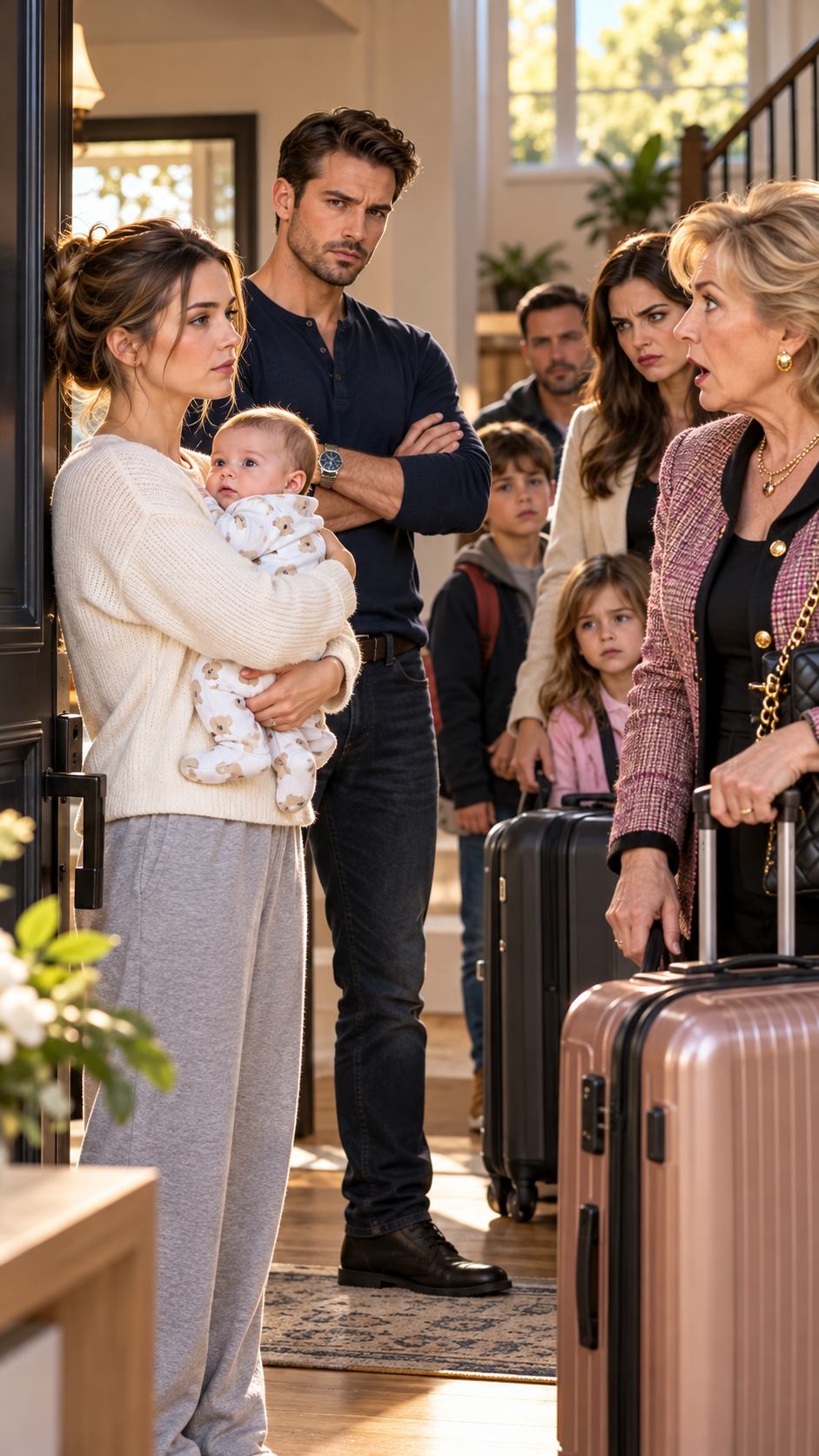
The first thing I noticed when I carried my newborn daughter through the front door was the smell of fresh paint. The second was how quiet the house felt. No television blared from another room. Nobody called after me to ask where I had been or why I had made a particular decision. There was only the soft rustle of Clara’s blanket and the faint creak of the wooden floor beneath my feet.
I stood in the entrance of the small brick house on Clover Ridge Drive, holding my eight-day-old daughter against my chest, and began to cry. Not the frightened, exhausted crying I had done in the hospital bathroom when labor seemed endless, but something quieter. For the first time in thirty-two years, I had a front door I could close without wondering who would open it again without knocking.
I pressed my lips against Clara’s forehead. Her skin smelled of baby lotion and warm cotton.
“We’re home now,” I whispered. “And this place belongs to us.”
My name is Jocelyn. I work as a pediatric occupational therapist, helping children develop the skills that allow them to move through the world with greater independence. I teach them how to navigate difficult environments, adapt to obstacles, and build confidence in their own abilities. For years, I had been good at explaining those things to other people while struggling to practice them in my own life.
My mother, Nancy, had always regarded independence as something a daughter could have only after her mother approved it. She never needed to shout to get her way. She had more subtle methods: a disappointed silence, a question that sounded like criticism, a favor that somehow became a debt, or a decision she announced so confidently that everyone else felt foolish for questioning it.
When I was a teenager, she walked into my bedroom without knocking, read papers on my desk, and asked why I was speaking to friends she considered unsuitable. If I objected, she would remind me that she was only trying to protect me. When I made choices she disliked, she spoke as though I had personally rejected everything she had sacrificed to raise me.
My father had been different. He listened before answering, and he could disagree without making me feel small. When my parents divorced, he became the person I called whenever I needed someone to tell me the truth without attaching a punishment to it. Then he died suddenly when I was fourteen, leaving behind a silence in our family that Nancy gradually filled with her own rules.
At eighteen, I left for university in another state. I told myself I was going for an education, which was true, but the distance also gave me something I had never possessed at home: room to make a mistake without having to defend myself afterward.
I earned my qualifications, found work I loved, and rented an apartment where I could choose the furniture, decide when to have visitors, and leave a book open on the kitchen table without someone treating the mess as evidence of a character flaw. I saved money carefully. Every deposit into my savings account represented another small promise to my future self that I would never again have to ask permission to live my own life.
Then I met David.
We were together for three years. He made me laugh during long shifts, remembered which tea I liked, and spoke about the future as though we were both going to be there. I believed we were building something dependable. When I discovered I was pregnant, I expected fear, difficult conversations, and a few sleepless nights. I did not expect him to disappear.
By my fourth month, David had grown distant. He stopped asking about appointments and began finding reasons to stay away from home. One afternoon, I returned from work and found his side of the closet empty. His apartment key lay on the kitchen counter beside a short note explaining that he wasn’t ready for fatherhood.
I read the note several times, searching for some sentence that might make the situation less final. There wasn’t one.
For weeks, I alternated between anger and grief. I wondered whether I had missed the signs, whether I should have asked more questions, and whether raising a child alone would be harder than I could imagine. Eventually, I realized that none of those questions would make David return.
My daughter would need stability. If another person chose not to provide it, I would have to build it myself.
I had been saving for a home since my early twenties. Eleven days before Clara was born, I signed the final paperwork on a modest 1953 brick ranch in a quiet neighborhood lined with mature trees. There was an elementary school a short distance away, a small patch of lawn in front, and enough space for a nursery, a bedroom, and a living room where I could eventually sit with my daughter while she learned to crawl.
The house wasn’t luxurious. Some of the kitchen cabinets needed work, and the previous owner had left a few scratches in the hallway floor. But the mortgage was manageable, the structure was sound, and the deed carried my name alone.
I painted Clara’s room a soft sage green while I was heavily pregnant. I chose the shade because it reminded me of leaves after rain. Nobody else needed to like it. That simple fact gave me more satisfaction than I expected.
Unfortunately, I made one mistake before the closing date: I told my mother about the purchase.
Nancy visited the property a few days later and walked through every room with her lips pressed together. She opened cupboards, examined the windows, and stood in the nursery as though she were inspecting a house someone had offered her for free.
“It’s smaller than I expected,” she said. “And are you sure this neighborhood is appropriate? You should have discussed such an important decision with me.”
I leaned against the nursery doorway, one hand resting on my stomach.
“I researched the neighborhood, Mom. I checked the schools and the property records. I’ve made my decision.”
Her eyes moved toward me.
“You always think you know everything once you’ve made up your mind.”
“I’m not saying I know everything. I’m saying I’ve decided where I’m going to live.”
For a moment, neither of us spoke. She looked at the freshly painted walls, then at the doorway, and finally at me. I recognized the expression. It was the one she wore when she realized I had made a choice she couldn’t easily reverse.
I should have understood then that she wasn’t finished with the subject.
Several weeks later, I found a postcard from a moving and storage company in my mailbox. It thanked me for requesting a consultation about long-term household storage. I hadn’t contacted the company, and I had no plans to store anything.
I assumed someone had entered the wrong address until another notification arrived by email.
The message confirmed an order for forty-eight moving boxes, with delivery scheduled to my new house. The payment had been made using Nancy’s credit card.
I read the email again, checking the address and order details. Everything was correct. Then I noticed a name copied into the confirmation: Pete, my brother-in-law.
Pete had recently lost his warehouse management job. My older sister, Krista, had three children and was struggling to cover the rent on their expensive townhouse. I knew their situation was difficult, and I had offered to help them look at their finances, but nobody had asked me for space in my home.
I called my mother.
“Did you order moving boxes to my address?”
There was a brief pause.
“Why are you going through my purchases?”
“Because they’re being delivered to my house.”
“Then you can keep them somewhere until they’re needed.”
“Needed for what?”
“Don’t start an argument over cardboard boxes, Jocelyn. You have enough to worry about with the baby coming.”
She ended the conversation before I could ask anything else.
I sat at my kitchen table with the email open on my laptop. The moving boxes, the storage consultation, Pete’s name, and my mother’s sudden interest in how much room the house had all began to fit together in a way I didn’t like.
I was still trying to convince myself there might be an innocent explanation when Clara shifted beneath my ribs.
I placed both hands over my stomach.
Whatever my mother was planning, I decided, she would not be making the decisions for my child.
I simply had no idea how soon I would have to prove it.
Click here to continue reading: PART 2: My Mother Announced Seven People Would Be Moving Into My House, but the Security Camera Revealed That Someone Had Already Tried to Get Inside
I Had Finally Bought a Home of My Own, but the Strange Moving Orders Arriving Before My Daughter’s Birth Suggested Someone Else Had Plans for It
Part 1 of 12

