
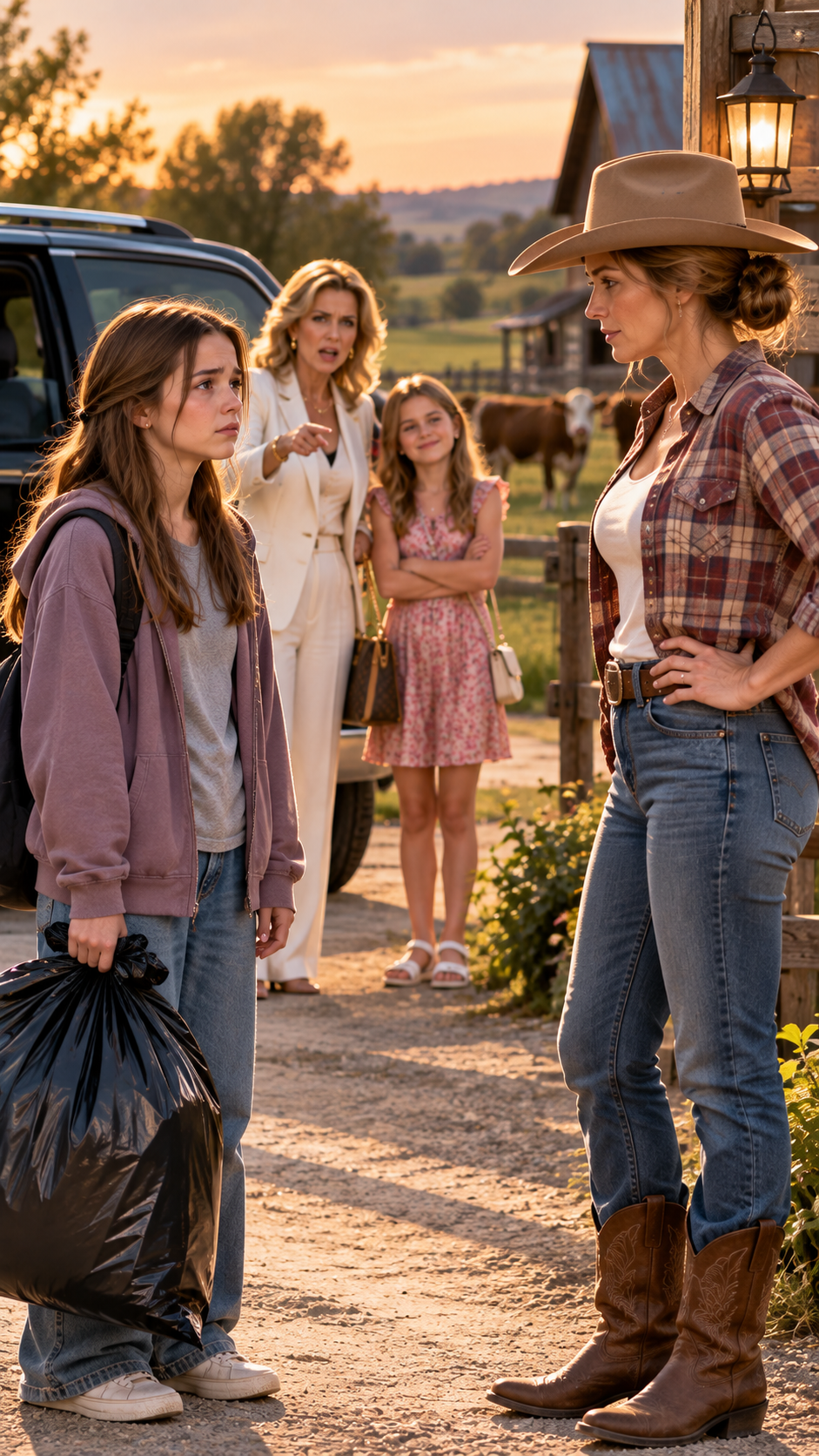
The garbage bag split before my mother had finished telling me why I could not come home with them.
One of its handles tore against my wrist, and a pair of jeans slid onto the gravel beside my shoes. I bent to retrieve them, more from instinct than embarrassment. My mother watched me struggle with the bag as if I had deliberately made an ordinary errand difficult.
“Your sister deserves real summers,” she said. “You have a way of ruining things for everyone.”
I was thirteen years old. My entire wardrobe for the next several weeks lay at my feet, stuffed into a black plastic sack that smelled faintly of detergent and the kitchen trash can. Beyond my mother’s car, a long ranch road disappeared between dry pastures and weathered fences. There was no sidewalk, no neighbor’s house within sight, and no sign telling me how far I was from the nearest town.
My father kept both hands on the steering wheel. He had not looked at me since we turned through the ranch entrance.
“Dad?” I asked.
He glanced toward the side mirror instead of answering.
“Can you at least tell me when you’re coming back?”
My mother opened her door. “Don’t make this harder than it needs to be, Hannah.”
That was her answer to almost everything I said when I was upset. If I cried, I was making a scene. If I asked a question, I was being difficult. If I tried to explain myself, I was turning a small disagreement into a family crisis.
I had learned to apologize before I understood what I had done wrong. Standing in Aunt June’s driveway, I almost did it again.
Instead, I held the broken bag against my chest and waited for my father to say something that might change the afternoon.
He finally spoke, but only to my mother.
“We should get going. Claire will be waiting.”
Claire was my younger sister, the daughter who could turn an ordinary weekend into a family event simply by wanting something. She was supposed to spend the summer at the beach, visit an amusement park, and take a trip with our parents before school resumed. My mother had spent weeks planning every detail. I had asked whether I could come along.
Apparently, that question had been the last straw.
The previous evening, Mom had accused me of making Claire feel uncomfortable because I refused to lend her a jacket she had borrowed without asking. Claire had cried. Dad had told me to be the bigger person. I had tried to explain that the jacket was a gift from my grandmother, but Mom interrupted before I could finish.
“You always need everything to be about you.”
Now, apparently, I was being sent away so that my sister could enjoy a summer without me.
My father shifted the car into gear.
I stepped backward as the tires began to roll. My mother did not wave. Dad did not lower his window. Their car moved past the cattle guard and onto the road, raising a pale cloud of dust that drifted toward me.
I watched until the taillights disappeared.
Then I stood alone with my clothes, the hot afternoon pressing against my skin, trying to understand how a family could leave one of its children behind so easily.
Twenty minutes passed before I heard the sound of an engine coming from the direction of the barn.
An old pickup truck rounded the corner, its paint faded beneath years of sun. A woman in a straw hat sat behind the wheel. She slowed when she noticed me, then stopped several yards away.
My aunt June climbed down from the cab.
She was my mother’s older sister, a broad-shouldered woman with silver beginning to show in her dark hair and hands roughened by decades of ranch work. I had visited her property before, usually for a day or two during holidays. I remembered the smell of hay in the barn, the noisy chickens near the kitchen, and the way she kept a jar of peppermints beside the telephone.
I had never imagined living there.
June looked at the bag, then at my face.
“Where are your parents?”
I swallowed.
“They said they’d come back in August.”
Her expression changed, but she did not immediately speak. She glanced down the empty road as if she expected my parents to reappear and explain themselves.
“They told me you’d be staying here,” she said carefully. “They didn’t tell me they were leaving you today.”
The words came out before I could stop them.
“Did I do something wrong?”
June’s face tightened. She walked toward me, took the damaged bag from my hands, and picked up the jeans lying in the dust.
“No, sweetheart.”
I wanted to believe her. I also wanted to know why my own mother had looked at me with such contempt. Those two feelings collided so violently that I could not speak.
June placed a hand on my shoulder.
“Let’s get you inside. It’s too hot to stand out here.”
Her house sat beyond the cattle pens, a low, sturdy farmhouse with a deep porch and a screen door that rattled whenever the wind came through. A pair of muddy boots rested beside the steps. Someone had left a garden hose running near the water trough, and a red-tailed hawk circled above the distant pasture.
Everything looked ordinary. That made my situation feel even stranger.
Inside, the kitchen was cool and smelled of coffee, dish soap, and the bread June had baked that morning. She set the bag on a chair and opened the refrigerator.
“Have you eaten?”
I shook my head.
She made grilled cheese sandwiches and cut an apple into wedges. I sat at the table, watching her move around the kitchen, waiting for the questions that usually followed trouble at home.
Why had I upset my mother? Why couldn’t I get along with Claire? Why did I insist on making everything complicated?
June asked none of them.
She put a plate in front of me and sat opposite me with her own cup of coffee.
“Your mother said August?” she asked.
I nodded.
“And she didn’t say anything about school, money, or how long you might be staying?”
“No.”
June lowered her eyes to the table for a moment. Her thumb moved slowly around the rim of her cup.
“All right,” she said. “We’ll sort out the practical things tomorrow.”
I ate because I was hungry, although every bite seemed to catch in my throat. When I finished, June showed me the spare bedroom at the end of the hallway. The room had a narrow bed, a wooden dresser, and a window overlooking the pasture. Fresh sheets covered the mattress. A folded quilt lay at the foot of the bed.
“You can unpack properly in here,” she said.
I looked at the garbage bag.
“I don’t have much.”
“Then we’ll make room for what you do have.”
She left me alone to change. I folded my clothes into the dresser, smoothing each shirt before putting it away. It was a pointless task, but it gave my hands something to do. When I reached the bottom of the bag, I found a photograph of Claire and me at a school picnic. Claire was smiling at the camera. I was looking toward our mother, who stood outside the frame.
I placed the photograph facedown in the drawer.
That night, I could not sleep.
The ranch made noises I did not recognize. Something scraped against the side of the house. A cow called from the pasture, and the wind pushed branches against the window screen. Every time headlights crossed the distant road, I sat up, convinced my parents had returned.
They never did.
The following morning, June knocked gently and asked whether I wanted eggs or oatmeal. After breakfast, she took me to town to buy school supplies and a few things I needed for the ranch. She did not pretend that everything had been arranged. She told me she would contact my parents and find out what they had planned.
She tried that afternoon.
I sat on the porch while she spoke on the telephone inside. Through the open window, I could hear only her side of the conversation.
“You cannot leave a child here without discussing her care.”
A pause.
“I’m not asking whether Claire has plans. I’m asking what you’ve arranged for Hannah.”
Another pause, longer this time.
June’s voice became quieter.
“No. That is not an answer.”
When she came outside, she carried a small notebook. She wrote down a number, shut the cover, and slipped it into her pocket.
“What did they say?” I asked.
“They said they’ll send your school records and some paperwork.”
“Are they coming back?”
June looked at me for a long moment.
“I don’t know.”
It was the first answer anyone had given me that did not pretend to certainty.
The days settled into a routine. I helped June feed the chickens, gather eggs, and carry water to the smaller garden behind the house. She showed me how to close gates properly and why a loose latch could create an expensive problem before breakfast. In the evenings, we ate at the kitchen table while the sky turned orange beyond the pasture.
She never treated me as a burden, but she did not pretend I could stay forever without making arrangements. She contacted the school, organized my records, and kept a file of every letter that arrived from my parents.
The first envelope contained a notarized guardianship form.
The second contained copies of my school documents.
Neither included a personal note.
I read the paperwork twice, searching for some explanation hidden between the official lines. There was none. My parents had signed what was necessary to leave me with June, then returned to their lives.
Meanwhile, Claire began posting photographs online.
In one, she stood on a beach with Dad behind her, holding two enormous ice creams. In another, she posed beside Mom outside a theme park. Later came pictures from a ski resort, even though I had never known we were planning a winter trip. Near Christmas, Claire posted a photograph from a cruise ship, wearing a red sweater and smiling beneath strings of lights.
I was absent from every picture.
At first, I invented explanations. Perhaps my parents would bring me on the next trip. Perhaps they were waiting until I apologized. Perhaps they would realize how much time had passed and decide that the arrangement had gone too far.
I kept my hopes small enough to protect them.
June never told me to stop hoping. She simply continued showing up.
When I woke from a nightmare, she left the hallway light on. When I struggled with a school assignment, she sat beside me while I worked through it. When I made mistakes with the cattle, she explained what I had missed instead of telling me I was incapable.
One afternoon, after I had accidentally left a gate unlatched, she found me standing beside the fence, staring at the muddy tracks where two young calves had wandered into the wrong enclosure.
“I messed up,” I said before she could speak.
June examined the tracks.
“Yes, you did.”
My stomach tightened.
She turned toward me.
“So what do we do now?”
I blinked.
“Get them back?”
“That’s a start.”
We spent the next hour guiding the calves toward the correct pasture. June showed me how to approach them without startling them, how to position myself so they would move toward the opening, and how to check every latch afterward. When we finished, she handed me a bottle of water.
“Everybody makes mistakes,” she said. “What matters is whether you learn enough not to repeat them.”
I looked at the gate.
At home, mistakes had been evidence that I was a disappointment. Here, a mistake was something I could understand, correct, and learn from.
That difference began changing me, although I did not yet have words for it.
By the end of August, my parents had not called once.
September arrived with cooler mornings and the smell of damp earth after a brief rain. School began. June drove me into town on the first day, waited until I was safely inside the building, and picked me up that afternoon.
I watched every passing car on the way home.
None belonged to my parents.
When we reached the ranch, June parked beside the house and switched off the engine.
“Hannah,” she said, “I need you to understand something.”
I stared at my hands.
“Your parents have made their decision. Whatever reasons they give, you are not responsible for their choice.”
My eyes burned.
“Maybe if I had been nicer to Claire—”
“No.”
Her voice was firm enough to stop me.
“You can be kinder to your sister. You can learn to handle disagreements better. We all can. But none of that makes it acceptable for your parents to abandon their responsibility to you.”
I looked toward the barn because I could not bear to look at her.
June waited until I was ready to speak.
“What if they don’t come back?”
She rested one hand on the steering wheel.
“Then we’ll decide what comes next. You won’t have to figure it out alone.”
I nodded, but the fear remained. A thirteen-year-old cannot simply stop wanting her parents to love her because they have demonstrated that they will not.
That evening, I went to bed before dinner and cried into the pillow. I tried to do it quietly, as I had learned to do at home. No one came to tell me I was making a scene.
The next morning, June knocked on my door and asked me to help her check the north pasture.
The work was waiting. The cattle needed feeding. School assignments had to be completed. The world continued demanding ordinary things from me, even when my own life no longer felt ordinary.
So I got dressed and went outside.
I was still waiting for my parents to return, but I had begun to learn how to live while they did not.
I did not yet understand that Cedar Ridge would become the place where I learned nearly everything that mattered about responsibility, money, land, and the difference between being wanted and being valued.
I only knew that my mother had left me beside a gravel driveway with my clothes in a garbage bag.
And my aunt had opened her door.
Click here to continue reading: PART 2: The Ranch Taught Me to Count Every Dollar, Read Every Contract, and Stop Waiting for My Family to Choose Me
The Afternoon My Mother Left Me on a Gravel Driveway and Drove Away Without Looking Back
Part 1 of 12

