
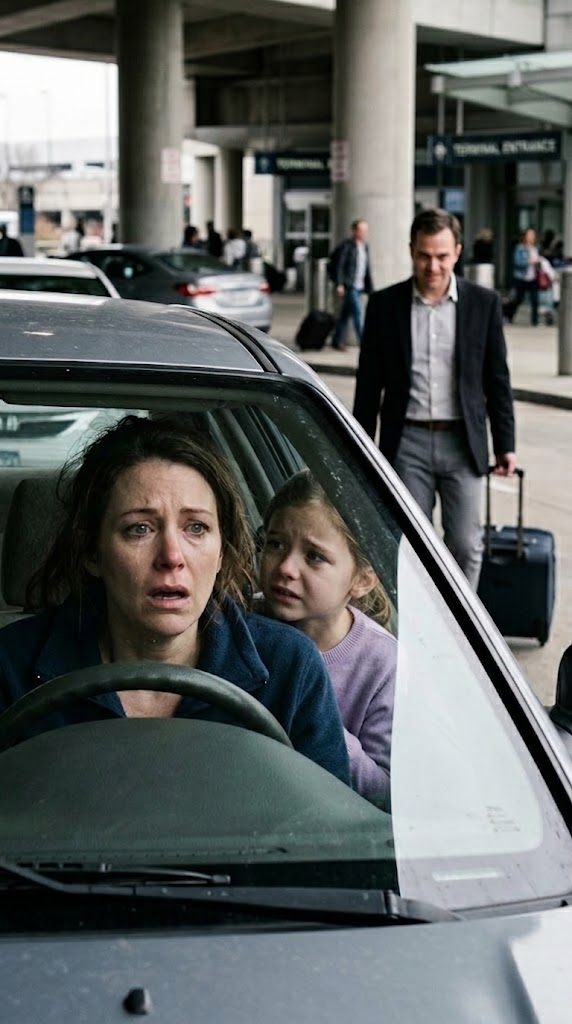
At 7:12 on Tuesday morning, my eight-year-old daughter told me she was afraid to go home, and I realized that the man I had just watched enter an airport terminal might never have intended to leave town.
I was sitting behind the wheel of my silver Subaru Outback outside Terminal 2 at Cleveland Hopkins International Airport. Rain dotted the windshield, and the wipers swept it aside with a tired, rubbery squeak. My husband, Grant Mercer, had disappeared through the automatic doors carrying his leather travel bag. According to him, he was flying to Charlotte for an insurance conference that would keep him away for two days.
I had kissed him goodbye beside the curb, reminded him to call when he landed, and promised to send him a photograph of Millie in her new school sweater. He had smiled, leaned through the open passenger window, and told me not to let our daughter talk me into buying another ridiculous stuffed animal on the way home.
It had been an ordinary exchange between a married couple. Grant had even straightened the collar of my coat before walking away. I remembered that small gesture later, when I was trying to understand how a person could touch someone with such apparent tenderness while planning something that might destroy their life.
Millie sat in the back seat with her purple backpack on her lap. Usually, she filled every quiet stretch of a car ride with questions. She wanted to know why clouds sometimes looked green before a storm, whether dolphins slept with one eye open, and whether our old neighborhood cat had a secret family living somewhere else. That morning, however, she had barely spoken.
I assumed she was tired. She had been restless the previous night, complaining that the radiator in her bedroom clicked whenever the heat came on. I had checked the thermostat, tucked her back into bed, and promised we would ask Grant to look at it after his trip.
I was reaching for the gearshift when her voice came from behind me.
“Mom?”
I glanced into the rearview mirror. Her fingers were clenched around the straps of her backpack so tightly that her knuckles had turned pale.
“What is it, sweetheart? Are you feeling sick?”
She shook her head.
“We can’t go home.”
For a moment, I thought I had misunderstood her. Outside the car, a shuttle bus pulled away from the curb. A man in a bright yellow rain jacket hurried toward the terminal, holding a briefcase above his head. Traffic moved around us, horns sounding in short, impatient bursts.
“What do you mean?” I asked.
Millie leaned forward between the front seats. Her face looked drained of color, and her eyes kept flicking toward the airport doors.
“I heard Dad planning something bad for us. We can’t go back to the house.”
My hand remained on the gearshift. I had spent nine years working as an emergency dispatcher for the Cuyahoga County Regional Communications Center. I had heard people struggle to explain fires, crashes, medical emergencies, and violence unfolding in rooms where children were supposed to feel safe. I knew that fear did not always arrive as screaming. Sometimes it came through a quiet voice that had already spent hours deciding whether anyone would believe it.
I turned in my seat so she could see my face.
“Millie, listen to me. You’re not in trouble. Whatever you heard, you can tell me. I’ll listen.”
She looked down at her backpack.
“It was Sunday night. You were working.”
I remembered the shift. A pileup on Interstate 90 had kept our team busy until nearly midnight, and I had come home exhausted enough to fall asleep with the bedside lamp on. Grant had told me he was feeling unwell and planned to turn in early. I had barely seen him before leaving for work.
Millie explained that she had woken up thirsty. The radiator in her bedroom had begun making a sharp ticking sound, so she carried her cup downstairs rather than wait for the noise to stop. As she reached the staircase, she heard Grant speaking in the laundry room.
“He was whispering,” she said. “Like he didn’t want anyone to hear him.”
“Was he talking to somebody?”
“I think so. He had the little phone.”
I frowned. “What little phone?”
“The black one. Not his normal phone. He keeps it in the toolbox behind the paint cans.”
I stared at her through the mirror. Grant had a habit of putting household things wherever they happened to be convenient, but I had never seen a second phone in his toolbox. The image was oddly specific: the metal toolbox in the basement, the cans of leftover paint stacked against the wall, and a small black device hidden among things that had not been touched in months.
“What did you hear him say?”
Millie swallowed. She seemed to be choosing her words carefully, the way an adult might when giving a statement to a police officer.
“He said that after you took him to the airport on Tuesday, nobody would be home. He said it would be easy because everybody would think he was on his business trip.”
My stomach tightened.
“What else?”
“He talked about the furnace.”
The word seemed to hang in the car between us.
For almost a week, Grant had been complaining about the heating system in our old Craftsman bungalow on Maplecrest Avenue in Lakewood. He said it was making an unusual smell in the basement. He had checked the thermostat twice, opened a panel near the furnace, and warned me not to adjust anything while he was away. He had insisted that he would call a technician after returning from Charlotte.
I had believed him. Grant worked in insurance, understood contracts and household finances, and was usually confident when discussing practical problems. When he told me something needed attention, I tended to assume he had a reason.
Now I could hear his warnings differently.
“What about the furnace, honey?”
“He said people would think it stopped working properly. He said everything would be finished before lunchtime.”
I felt a chill that had nothing to do with the rain.
“What would be finished?”
“I don’t know.” Her lower lip trembled. “He said nobody would have to worry about the money anymore.”
I looked toward the terminal, where strangers passed beneath the glass canopy carrying coffee cups and rolling suitcases. I wanted to tell myself that children misunderstood conversations. I wanted to believe Millie had heard a few disconnected sentences and assembled them into something frightening.
Then she told me the part that made denial impossible.
“Dad laughed, Mom.”
I waited.
“He said nobody would get hurt unless they were supposed to.”
A horn blared behind me. The driver of a delivery van was motioning impatiently for me to move away from the curb. I released the brake, pulled forward, and turned into the airport parking structure instead of heading toward the highway.
Millie watched me in the mirror.
“Are we going home now?”
“No.”
“Are we going to school?”
“Not yet.”
She began crying silently, tears gathering on her cheeks without a sound. I parked on the third level, away from the busiest lanes, and turned off the engine. The rain drummed against the concrete openings along the side of the structure. For several seconds, I simply listened to it while I forced myself to think.
I had to separate what I knew from what I feared. My daughter had overheard a conversation about an empty house, a malfunctioning furnace, a deadline before noon, and money. Grant had concealed a second phone. He had recently persuaded me to sign documents for a life insurance policy worth $742,000, explaining that the money would protect Millie’s future if anything happened to either of us.
The amount had seemed unusually precise, but he worked with insurance policies every day. When I questioned it, he had handed me his expensive pen and pointed to the signature lines, assuring me that the paperwork was routine.
I had signed because I trusted my husband.
That trust now felt like a door I had left unlocked.
“Millie,” I said, keeping my voice steady, “you did the right thing by telling me. I need you to stay with me and do exactly what I say for a little while. Can you do that?”
She nodded.
I checked the time. It was 7:18 a.m. Grant’s flight was scheduled to leave at 8:05. If Millie had understood correctly, the airport was part of his plan because it gave him an alibi. But I had no proof he would carry out anything dangerous, and I could not afford to confuse suspicion with certainty.
Then I saw him.
Grant emerged through the same automatic doors he had entered minutes earlier. His travel bag was gone. His coat was buttoned, and he moved quickly while looking over his shoulder. He stopped near the taxi stand, raised a phone to his ear, and spoke briefly before climbing into a yellow cab.
I sat motionless as the taxi pulled away.
He had told me he was flying to Charlotte. He had walked into the terminal carrying a bag, then come back out without it. He was not moving like a man who had missed his flight by accident. He was moving like someone who needed to get somewhere without attracting attention.
“Mom?” Millie whispered.
I forced my eyes away from the taxi.
“Stay in your seat and keep your seat belt on.”
I started the Subaru and followed the cab from a distance, careful not to close the gap or draw attention to us. I wasn’t going to confront Grant in the street. I needed to know whether he was heading home, and I needed time to contact the police if he was.
The taxi left the main road and entered Lakewood. My grip tightened around the steering wheel as familiar storefronts and rain-darkened houses passed by. Each turn brought us closer to Maplecrest Avenue, where the furnace waited in our basement and where Grant believed he had left his wife and daughter behind.
The cab finally turned onto our street.
Grant stepped out in front of our house, paid the driver, and waited until the vehicle disappeared around the corner. He glanced toward the neighboring properties, then walked toward the side entrance carrying a small container and a dark bundle I could not identify from where I was parked.
I pulled into a recessed driveway several houses away and switched off the engine.
My daughter had told me we could not go home.
Now I was watching my husband return to it, and for the first time in nine years of marriage, I understood that the person I needed protection from might be the person who had promised to protect us.
Click here to continue reading: PART 2: The Man Who Claimed to Be Flying to Charlotte Returned to Our House Carrying Something He Never Expected Me to Notice
My Daughter’s Whisper at the Airport Turned an Ordinary Tuesday Morning Into Something I Could Never Explain Away
Part 1 of 12

