
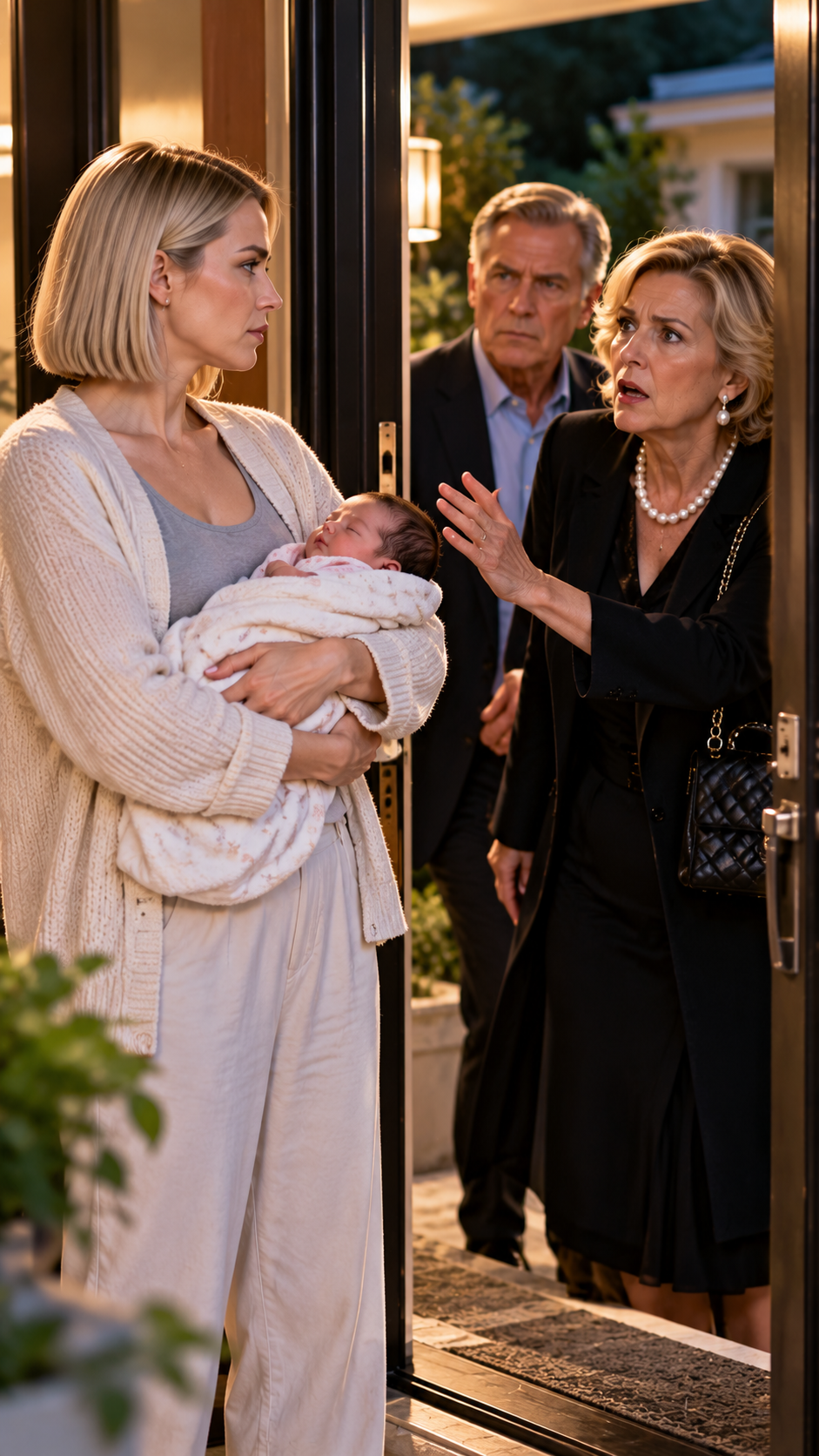
The first contraction came while my father was cutting the roast beef, and I had to press my fingernails into my palm to keep from crying out. Around the dining table, nobody noticed. My mother was telling my younger sister, Vanessa, about an expensive restaurant renovation, and my father was complaining that the potatoes had gone cold. The chandelier cast a warm glow over the polished silverware, the crystal glasses, and the people who had spent eight months treating my pregnancy like a disgrace. I sat at the far end of the table with one hand beneath my stomach, waiting for the pain to pass.
It didn’t pass so much as retreat, leaving behind a deep ache that wrapped around my lower back. I glanced at the clock above the kitchen doorway. Ten minutes had passed since the first contraction. Another wave was beginning, tightening across my abdomen with a force that made conversation difficult to follow. My hospital bag was already packed. My maternity records sat inside a folder on the passenger seat of my car, and my obstetrician had warned me that labor could begin at any time. At thirty-nine weeks, I had spent the previous night sleeping in short, uncomfortable stretches. Still, I had come to dinner because my mother had insisted that avoiding the family gathering would prove I was hiding something.
I waited until I could speak without gasping. Then I placed my fork beside my plate and looked at my parents.
“I think the baby is coming. I’m about to give birth.”
My mother’s reaction was so immediate that, for one bewildering second, I thought she had misunderstood me. She laughed. Not a nervous chuckle or a startled sound, but a full, delighted laugh that made her lift her wineglass to her lips. Vanessa looked at her, then at me, and joined in. My father continued cutting his meat as though I had announced that the weather might change.
My mother finally lowered her glass. “Please don’t turn tonight into another performance, Claire.”
I stared at her. “I’m serious.”
“You’re always serious when you want everyone looking at you.”
Another contraction began, and I gripped the edge of the table. My knuckles whitened. I tried to breathe the way the nurse had taught me during my prenatal appointments, slowly through my nose and out through my mouth. Across from me, Vanessa tilted her head, studying my expression with the detached interest she might have given an actress in a bad television drama.
“The real question,” she said, “is why you expect us to celebrate a child when nobody even knows who the father is.”
The words landed with a familiarity that made them hurt in a different way. I had heard versions of that accusation since the middle of my pregnancy. At first, I had argued. I had brought medical records to my parents’ house, explained the fertility treatment, and answered every question they claimed they needed resolved. Eventually, I understood that their doubts were not caused by missing information. They were sustained by a decision they had already made.
My husband, Daniel, had died in a highway accident when I was twelve weeks pregnant. One phone call had divided my life into everything that existed before his death and everything I had been forced to build afterward. I remembered the police officer’s careful voice, the unfamiliar living room in which I received the news, and the way I had stood beside our bed for nearly an hour afterward because I could not bear to sit where Daniel had last sat beside me.
The pregnancy had been planned. Daniel and I had gone through fertility treatment after months of consultations, tests, and conversations about the future. We had preserved reproductive material at a clinic and followed a documented treatment schedule. There were signed consent forms, dated appointments, and medical records that traced the process from its beginning. I had believed that explaining those facts would be enough for my parents.
Instead, they seized upon Daniel’s frequent business travel and the timing of his death. They suggested that I had concealed an affair, invented a pregnancy story, or manipulated the circumstances to obtain money. The more I explained, the more they demanded. When I stopped explaining, they called my silence suspicious.
My father had never been particularly affectionate, but before Daniel died, he had at least treated my marriage as legitimate. Daniel was successful, disciplined, and generous with people he trusted. He had built a cybersecurity company from a small operation into a thriving business, and his reputation had made my father proud to be associated with him. My parents enjoyed inviting Daniel to dinner, introducing him to their friends, and talking about his accomplishments as though they had helped create them.
After his death, their interest in his success changed into an interest in his estate.
Daniel’s shares had passed to me under the arrangements we had made together. Our estate documents protected my interests and those of our unborn child. My parents had expected that his wealth would eventually support the wider family, particularly Vanessa, whose luxury-event business had struggled to become profitable. They had never openly described that expectation as an entitlement. They preferred phrases such as helping one another, keeping money within the family, and remembering who had supported us before we became successful.
When I declined to provide Vanessa with additional funding, the accusations about my pregnancy grew louder. She suggested that my refusal to help her was evidence of my dishonesty. My parents repeated her suspicions until they sounded like established facts.
Now, as I sat in labor at their dining table, I realized how thoroughly they had confused financial generosity with obedience.
“I’m thirty-nine weeks pregnant,” I said. “You’ve seen my medical records. You know Daniel and I planned this child.”
My mother dabbed the corner of her mouth with a napkin. “We know what you’ve told us.”
“Mom, the clinic documents—”
“Enough.”
Vanessa leaned back in her chair. A small, satisfied smile appeared on her face. “You can’t expect people to believe whatever story suits you just because you have paperwork.”
I looked at her, searching for some sign that she understood the cruelty of what she was saying. We had grown up sharing a bedroom during summers at our grandparents’ house, borrowing each other’s clothes, and whispering secrets long after our parents thought we were asleep. I remembered defending her when classmates mocked her, and lending her money when she was embarrassed to ask our parents. I could still remember the exact sound of her laughter when we were young enough to believe that growing older would make us kinder.
That girl seemed very far away.
The next contraction forced me to bend forward. A sharp pressure spread through my pelvis, and my breath caught in my throat. I reached for my water glass, but my hand shook hard enough that the rim struck my teeth.
My father finally looked up.
“You’re not going to do this here.”
I blinked at him. “Do what?”
“Make a scene at dinner.”
For a moment, I couldn’t find an answer. The pain was intensifying, and I had begun to understand that my body was no longer interested in waiting for my family’s permission. Yet my father seemed more troubled by the possibility of embarrassment than by the fact that his daughter might be entering labor.
“I’m not choosing when this happens,” I said.
He returned to his plate. “Then stop making it everyone’s problem.”
A sudden warmth spread beneath my chair.
I froze.
At first, I thought I had spilled the water. Then I felt the unmistakable sensation of fluid running down my legs, soaking the fabric of my dress and collecting beneath the table. My water had broken.
For several seconds, the room went silent. The ticking clock sounded unnaturally loud. Vanessa’s smile vanished. My mother stared at the floor, her eyes moving from the darkening fabric to the spreading puddle beneath my chair.
I waited for her to stand. I waited for my father to reach for his phone. I waited for one of them to say that we needed to leave immediately.
My mother took a breath.
“Well,” she said, looking at the mess, “you need to make sure that gets cleaned up before you go.”
I heard the words clearly, but something inside me refused to accept them at first. This was my mother. She had held me when I was a child with a fever. She had once driven through a snowstorm to collect me from college after I called her crying. She knew I was frightened of hospitals, and she knew how desperately Daniel and I had wanted this baby.
Yet she was standing beside a dinner table, concerned about the floor.
I placed both hands on the table and slowly pushed myself upright. The chair scraped against the wood. My dress clung uncomfortably to my legs, and another contraction was already gathering, but the strange numbness spreading through me made it possible to stand without shaking.
“Is anyone going to take me to the hospital?”
My father gave a short, dismissive laugh.
“You’re an adult, Claire. You can drive yourself.”
I looked at him for a long moment. There was no confusion in his expression, no uncertainty, and no indication that he might reconsider if I asked again. He had heard me. He simply did not believe my emergency deserved his inconvenience.
My mother reached for her wineglass.
Vanessa glanced toward the hallway. “You should probably hurry. If this is really happening.”
I turned away before she could see what her words did to me. I no longer wanted to convince any of them. I no longer wanted to prove that my daughter belonged to the man I had loved, or that my pain was real, or that I deserved the smallest amount of concern from the people who had raised me.
I walked into the hallway, using the wall for support when another contraction seized my back. My hospital bag was waiting beside the front door. I had placed it there before leaving home because I wanted everything ready if labor started during dinner. Now I was grateful for that small act of preparation.
As I reached for the bag, Vanessa called after me.
“Maybe you should contact the actual father. He might be more interested in showing up.”
I stopped with my hand on the doorknob.
Behind me, the dining room remained bright and orderly. I could hear the faint clink of silverware as someone moved a plate. They were waiting for me to turn around, to cry, to shout, or to beg them to reconsider. My family had become so accustomed to my attempts at reconciliation that they mistook them for weakness.
I looked back once.
“I’ll remember tonight.”
My father lifted one hand in a gesture of impatience. “Do whatever you want.”
I opened the door and stepped into the cold evening air.
The drive to the hospital took forty minutes. I kept both hands on the steering wheel, slowed whenever a contraction made it difficult to concentrate, and pulled into a safe place once when the pain became too intense to continue. My phone rested in the cup holder. Daniel’s name was still among my favorite contacts, though calling it had become a useless reflex I had to fight whenever something frightened me.
I considered calling my parents one more time. The thought lasted only a moment.
At the hospital entrance, a nurse hurried toward my car with a wheelchair. I explained that my water had broken and that my contractions were becoming stronger. They took me inside, asked for my medical information, and helped me change into a hospital gown. When the admissions clerk asked whether someone would be joining me, I told her that I had come alone.
She glanced at me, then gently continued with the paperwork.
That small kindness nearly broke me.
Six hours later, after a long night of pain, exhaustion, and repeated instructions to breathe, my daughter was born. Her first cry filled the room with a fierce, unmistakable sound. I began crying before the nurse had finished settling her against my chest.
She was warm and impossibly small, with a damp tuft of dark hair and tiny fingers that curled against my skin. I studied her face, searching for Daniel in the shape of her nose and the curve of her mouth, though I knew newborn features changed quickly. I imagined him standing beside the bed, laughing through tears, asking whether she had his stubborn chin.
The emptiness beside me hurt more than I could explain.
But when my daughter opened her mouth and let out another indignant cry, I found myself smiling.
“Grace,” I whispered. “Your name is Grace.”
I held her close and rested my cheek against her head. I could not give her the father who should have been there. I could not undo the accident or change the people waiting somewhere outside the hospital’s quiet walls. But I could choose what happened next.
I promised her that she would never have to earn a place in my life. She would never have to produce evidence that she deserved to be loved. She would never be asked to tolerate cruelty simply because the person delivering it shared her blood.
As morning light began filtering through the blinds, I realized that my parents had made a decision the previous evening. They had refused to stand beside me at the moment I needed them most.
Now I had a decision of my own to make.
Click here to continue reading: PART 2: My Husband Had Left Behind More Than an Inheritance, and the First Person to Visit Me Knew Why My Family Was Afraid
The Night My Family Refused to Believe Me, I Discovered Exactly How Little My Unborn Daughter Meant to Them
Part 1 of 12

