
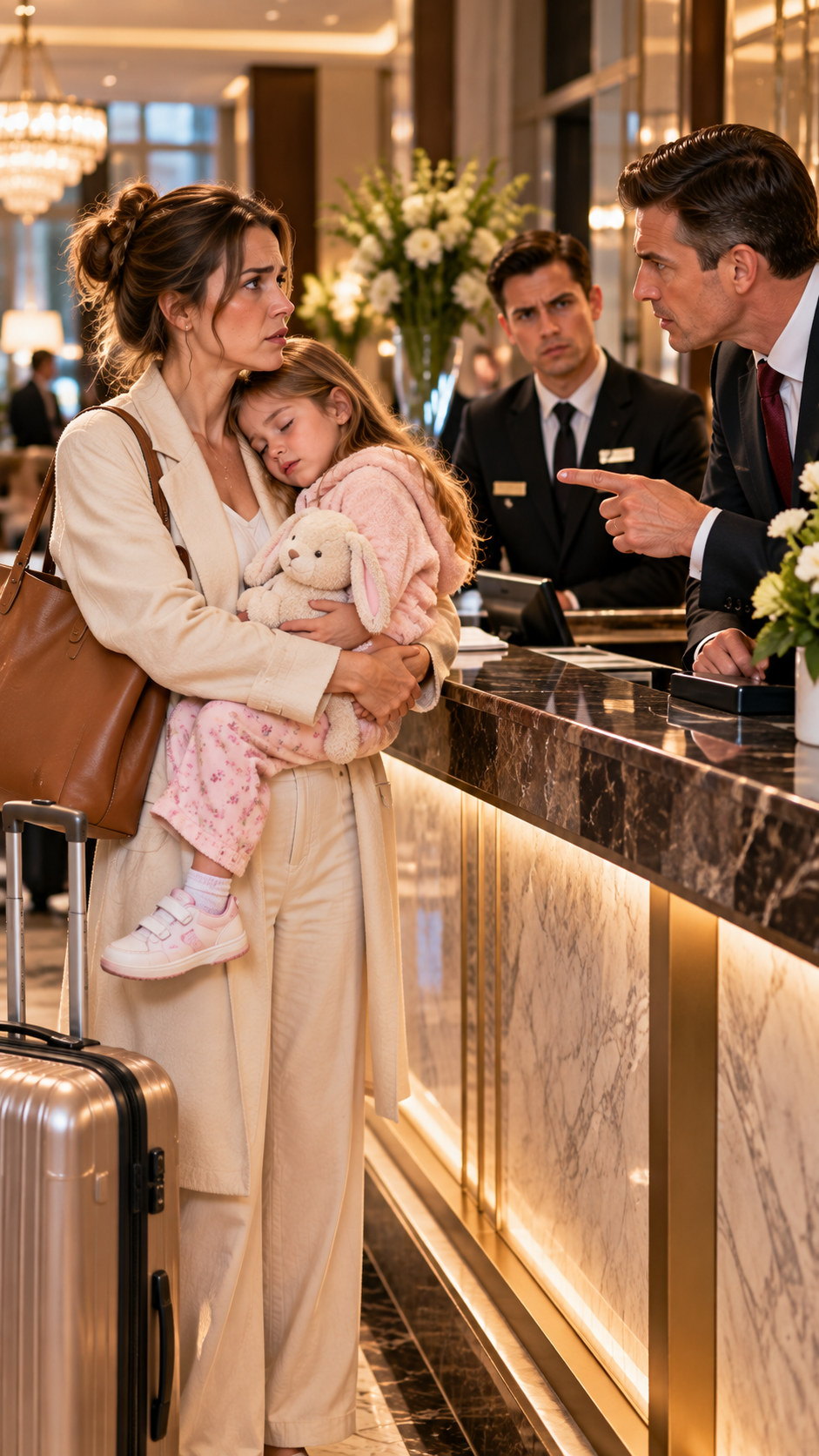
“Perhaps a budget motel near the highway would suit you better,” the receptionist said, glancing at my daughter as though she were an inconvenience rather than a child who had fallen asleep in her mother’s arms.
I looked at him for a moment, waiting for the hint of a smile that would tell me he was joking. There was none. His gold name badge read Patrick, and his immaculate uniform seemed almost designed to emphasize how carefully he had dressed for a job he was performing so carelessly. Behind him, a second receptionist leaned against the counter, watching us with barely concealed amusement. My six-year-old daughter, Lily, slept against my shoulder, unaware that two men were discussing whether we deserved to be there.
The hotel’s marble floor reflected the chandeliers above us. A soft piano melody drifted through the lobby, mixing with the quiet clatter of luggage wheels and the muted conversations of guests returning from dinner. I held Lily with my right arm and a bouquet of red roses in my left hand. Several stems had bent during our long journey, and a loose petal lay near my boot.
My jacket was old brown leather, softened by years of wear. My boots were practical rather than fashionable, and my backpack had a frayed strap. None of those things was unusual. I had spent much of my career traveling between hotels, sometimes arriving in tailored suits and sometimes wearing whatever made a long flight bearable. Tonight, I had chosen comfort because my daughter had already endured an exhausting day.
Apparently, comfort had been mistaken for poverty.
“I have a confirmed reservation,” I said quietly. “The name is Clara Vance.”
Patrick typed something into his computer, frowned, and tried again. His fingers stopped moving.
“I’m sorry. I don’t see anything.”
“The reservation was arranged through our corporate office. Could you check the executive booking block?”
He glanced at the screen as if the suggestion itself were unreasonable.
“We’re completely full tonight.”
“I understand that you have a busy evening. I still have a reservation.”
He leaned back slightly. “There’s a corporate gala in the ballroom. We’re accommodating executives, investors, and a number of very important guests. We can’t simply create another room because someone insists they booked one.”
The other receptionist, Karl, gave a small laugh.
I recognized the name of the gala’s principal sponsor. My company had negotiated the conference agreement six months earlier, and I had personally approved the contract. I also knew how many rooms had been allocated to the organizers and how the executive reservations were supposed to be handled.
I did not mention any of that.
Instead, I shifted Lily higher against my shoulder. Her stuffed rabbit was tucked between us, one floppy ear pressed beneath her chin. She had fallen asleep in the taxi, just minutes before we reached the hotel. Waking her now would mean another round of tired questions, tears, and the difficult business of convincing a little girl that a strange room was safe enough for sleep.
Tomorrow was the third anniversary of her father’s death. I had promised her that we would continue our tradition, even though traveling to Chicago for work had complicated our plans.
Every year, Lily chose a vase, and I bought red roses. We arranged the flowers together and remembered something funny her father, Daniel, had done. It was a small ritual, but it belonged to the two of us. Daniel had died after sixteen months of cancer treatment, when Lily was three. She remembered fragments of him: his laugh, the way he lifted her onto his shoulders, and how he invented names for stars she could barely see.
I had bought the roses at the airport because I knew the following morning would be busy. I had not wanted to search an unfamiliar city for flowers while my daughter wondered whether I had forgotten her father.
Now I stood beneath a gold hotel crest, listening to an employee suggest that I take my sleeping child somewhere cheaper.
“Would you please contact the general manager?” I asked.
Patrick’s expression tightened.
“Mr. Haines is overseeing the gala. He can’t be interrupted every time someone has trouble finding a reservation.”
“I am asking you to check a booking, not interrupt a private dinner.”
Karl folded his arms. “Maybe you should try somewhere less expensive. There are several places down the road.”
Lily stirred.
“Mommy?”
“I’m here, sweetheart.”
She settled against my shoulder again, her fingers tightening around the rabbit. I kissed the top of her head and kept my voice low.
Patrick watched us with an expression that suggested my patience was a performance he had already decided to distrust.
I had founded Vance Hospitality eleven years earlier, starting with a struggling twenty-eight-room property outside Denver. My husband had helped me through the first difficult years, checking invoices at our kitchen table and reminding me that a business could not survive on beautiful rooms alone. It survived because people felt welcome inside them.
Our first hotel had a handwritten sign behind the reception desk: EVERY GUEST DESERVES TO FEEL SEEN.
I had insisted on keeping that principle as the company expanded. We eventually acquired properties in several cities, invested in staff training, and built a reputation for hospitality that went beyond expensive furniture and polished stone.
At the Grand Regent, those words had been engraved beneath the reception counter.
Patrick stood directly above them.
I felt no desire to humiliate him. Not yet. I wanted to understand whether his behavior was an isolated lapse in judgment or a symptom of something deeper. I had learned that scheduled inspections often produced misleading results. When managers knew an owner was visiting, suddenly every corridor gleamed, every employee smiled, and every complaint was handled with extraordinary speed.
An unannounced visit was different. It revealed what happened when employees believed no one important was watching.
I had not intended to conduct an inspection that evening. I had arrived early because of a flight delay and a last-minute change in my schedule. The hotel’s management expected me two days later.
Patrick did not know that.
A service door opened behind the reception desk, and a housekeeper emerged carrying folded towels. She was in her fifties, with dark hair streaked with gray and braided neatly behind her head. Her maroon vest bore a simple name badge: LUPITA.
She noticed Lily first, then the flowers, then my face.
Finally, she looked at Patrick.
“Is there a problem, ma’am?” she asked.
“My reservation isn’t appearing in the main system.”
Lupita turned toward the computer.
“Did you check the corporate holding block?”
Patrick’s jaw tightened. “I checked.”
“The secondary corporate tab, too?”
“I know how to do my job.”
She kept her voice even. “I only asked because the executive bookings didn’t transfer properly last month.”
Karl made an impatient gesture. “This is reception business, Lupita. You have rooms to prepare.”
“No,” she replied. “I have towels to deliver. But someone standing here with a sleeping child deserves a proper answer.”
I studied her face. She was not trying to impress me. She did not know my identity, and she had no reason to believe that helping me would benefit her. She had simply seen a problem and decided it was worth addressing.
Patrick turned back to the computer, his movements sharper now. He clicked through several screens, entered my name again, and opened another tab.
Then he stopped.
His shoulders stiffened.
Karl noticed the change. “What is it?”
Patrick swallowed.
“Suite 904.”
He checked the screen again, as though the reservation might disappear if he looked away.
“Executive booking. Confirmed two weeks ago.”
The silence that followed seemed to stretch across the entire lobby.
Patrick straightened and turned toward me. His expression changed so quickly that I could almost see him searching for a replacement personality.
“Ms. Vance, I apologize. There appears to have been a system issue.”
“No,” I said.
He stopped.
“You hadn’t checked the correct screen. That is different from the system failing.”
“I was under the impression—”
“You were under an impression before you checked the facts.”
His eyes moved toward my jacket, then my boots, then the backpack strap hanging over my shoulder. He understood what I meant, although I could tell he was not yet prepared to admit it.
“Your suite is available,” he said. “I’ll prepare your keycards immediately.”
Karl suddenly became fascinated by the computer beside him.
I looked at him. “You seemed amused when I asked for help.”
“Not at you, ma’am.”
“What was amusing, then?”
He did not answer.
Patrick printed the registration details and handed me two keycards. His apology was polite, practiced, and entirely too late to erase what had happened.
I could have shown him my identification. I could have called the general manager and explained that two employees had tried to send the company’s founder to a cheaper motel while she carried her sleeping daughter. Instead, I accepted the cards and adjusted Lily in my arms.
She was more important than my anger.
Lupita offered to carry my backpack. After a moment’s hesitation, I accepted. My shoulder had begun to ache, and the kindness of her gesture made the earlier exchange feel even uglier.
We crossed the lobby toward the elevators.
Just before the doors closed, I glanced back.
Karl leaned toward Patrick and muttered something. His voice was quiet, but the lobby was quieter.
“Some people just enjoy making trouble.”
Lupita heard him. I saw the color leave her face.
I said nothing.
The elevator doors met with a soft metallic click, sealing us away from the reception desk. In the mirrored wall, I could see Lily sleeping against me, her rabbit pressed to her cheek and the damaged roses held awkwardly in my free hand.
I had come to Chicago to work, to remember my husband, and to give my daughter a peaceful night.
Instead, I had discovered something about my own hotel that no report had ever revealed.
The staff had looked at us and decided what kind of people we were before bothering to learn our names.
And the worst part was that, even after the reservation appeared, one of them still believed we were the problem.
Click here to continue reading: PART 2: The Housekeeper Recognized the Name on the Welcome Card, but I Asked Her to Keep the Discovery Between Us
A Sleeping Child, a Crushed Bouquet, and the Receptionist Who Decided We Were Too Poor to Stay
Part 1 of 12

