
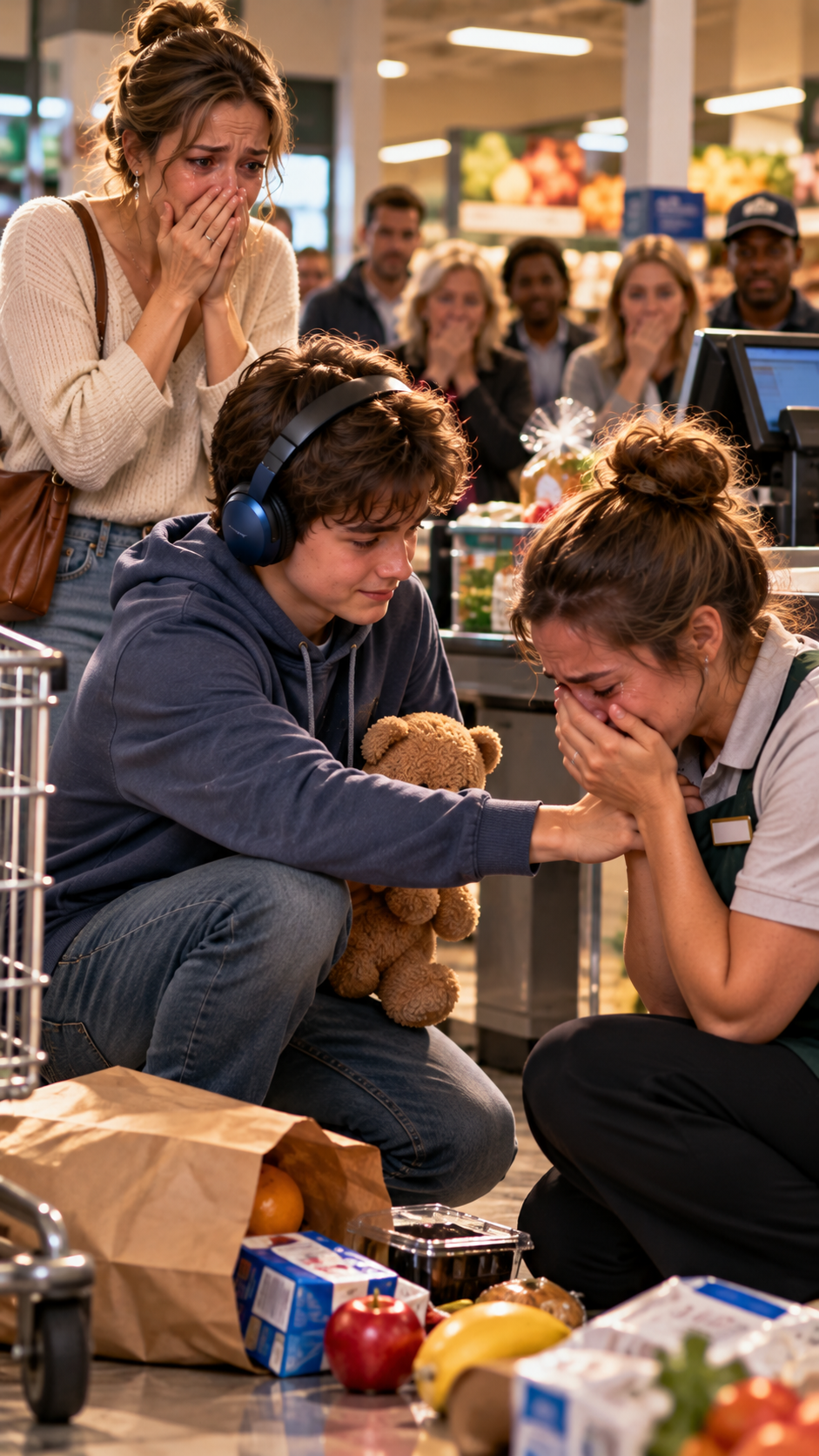
The automatic doors slid apart, releasing a breath of refrigerated air that smelled faintly of oranges, floor cleaner, and freshly baked bread. Marcus stood beside the entrance with a ten-dollar bill folded between his fingers, watching his fifteen-year-old brother study the grocery store as though it were a complicated machine whose moving parts might suddenly change direction.
“You remember the plan?” Marcus asked.
Theo nodded once, then looked down at the money in his hand. He had folded the bill into quarters, carefully aligning the edges. When he was nervous, small tasks became important. A crooked fold, an unexpected noise, or a question asked too quickly could occupy his attention long after everyone else had forgotten it.
“Chocolate bar,” Theo said. “Pay at register three. Take the receipt. Come back outside.”
“Exactly.”
“Don’t buy anything else.”
“Right. Nothing else.”
“And I don’t need to tell them my name?”
“No, buddy. You can say hello if you want. You don’t have to explain anything. Mrs. Bennett knows you.”
Theo glanced through the glass toward the checkout counters. Register three was occupied by a woman with silver threaded through her brown hair, a woman who had watched him grow from a frightened little boy hiding behind Marcus’s jacket into a teenager capable of navigating familiar aisles without assistance.
“Will you stay here?”
Marcus felt the question settle somewhere beneath his ribs. “That’s what I promised, isn’t it?”
“You won’t follow me?”
“No. I’ll wait right here.”
Theo rubbed his thumb over the folded bill. Marcus knew that expression. His brother was measuring the distance between what he wanted to accomplish and what he feared might happen before he returned.
They had rehearsed this moment for weeks. They had practiced finding the chocolate, approaching the register, placing money on the counter, waiting for change, and remembering the receipt. They had even rehearsed what to do if the cashier asked a question Theo didn’t understand.
Now that the actual moment had arrived, Marcus wanted to abandon the entire exercise, walk inside beside him, and pretend the lesson could wait another month.
But Theo had asked to try. And Marcus had promised to let him.
“You’ve got this,” he said, keeping his voice light. “I’ll be the guy standing outside looking ridiculous.”
Theo considered that. “You already look ridiculous.”
Marcus laughed before he could stop himself.
A small smile appeared on Theo’s face. It was brief, but it loosened the tightness around his mouth. He straightened the hem of his shirt, checked that the ten-dollar bill remained in his hand, and stepped toward the entrance.
Marcus watched him disappear between the automatic doors.
For several seconds, he remained motionless. The glass reflected his own face over the moving shapes inside the store, and he had the peculiar sensation of standing on the wrong side of something important.
He was twenty-five years old. He had learned how to cook three meals well enough to survive on them, how to compare prices at the pharmacy, and how to recognize the early signs that Theo was becoming overwhelmed. He knew which school administrators returned calls and which ones required a second email. He could tell the difference between his brother’s ordinary hand movements and the quicker, sharper motions that meant the world was becoming too loud.
What he had never learned was how to stop being afraid on Theo’s behalf.
Six years earlier, when Marcus was nineteen and Theo was nine, their mother had called him into the kitchen after dinner. A suitcase stood beside the refrigerator, and a stack of papers had been placed neatly on the table. Their mother wore a pale blouse and a new wedding ring that caught the overhead light whenever she moved her hand.
She had already packed Theo’s clothes.
Marcus remembered that detail more clearly than anything she said.
“There are places that can give him the kind of support he needs,” she explained. “People who are trained for children like Theo. They have the facilities, the staff, the experience.”
Marcus looked at the papers without touching them.
“What places?”
“Residential care. A specialized program. We have to think about what’s best for him.”
“What’s best for him,” Marcus repeated.
Their mother folded her hands. She spoke quietly, almost apologetically, as though a gentle tone could soften the shape of the decision she had already made.
“Your stepfather and I have discussed it. We can’t keep doing this forever.”
Marcus stared at the suitcase. One of Theo’s blue socks protruded from the zipper.
“He’s nine.”
“I know how old he is.”
“He’s a child.”
“I know that, Marcus.”
“Then why is his suitcase packed?”
For the first time, she looked away.
She described missed appointments, exhausting mornings, arguments about routines, and the constant pressure of caring for a child whose needs did not always fit conveniently into their household. She said she was overwhelmed. She said she needed help. Some of those statements were true, and Marcus understood more than he wanted to admit.
What he could not accept was the conclusion she had reached.
Theo was not a broken appliance that required a better-equipped workshop. He was a little boy who arranged his toy cars by color, memorized the names of every bus route he saw, and became frightened when people argued in rooms where he couldn’t find a quiet corner.
He was also the child who had once waited beside Marcus’s bedroom door for nearly an hour because he had heard Marcus crying and didn’t know whether entering would make things worse.
Marcus pushed the papers away.
“He’s staying with me.”
Their mother blinked. “You can’t possibly understand what you’re agreeing to.”
“Then explain it.”
“Marcus—”
“No. Explain it without telling me he’s a problem you need to send somewhere.”
The conversation ended badly. Their mother accused him of being young, stubborn, and incapable of seeing the bigger picture. Marcus accused her of treating her son’s existence as an inconvenience. Neither apologized.
By the end of the week, Theo’s suitcase had disappeared from beside the refrigerator, but their mother’s commitment to raising him had not returned. Over the following months, she withdrew from the daily responsibilities she had once managed. Eventually, Marcus became the person Theo relied on for nearly everything that mattered.
There was no dramatic moment when Marcus transformed into a perfect caregiver. There were missed buses, burnt dinners, confusing school forms, and nights when he sat at the kitchen table with his head in his hands because he could not work out why a seemingly harmless change had left Theo unable to sleep.
He learned by paying attention.
He learned that Theo could tolerate a crowded room if he knew where the exits were, but an unexpected announcement over a loudspeaker could send him searching for somewhere quiet. He learned that giving three instructions at once often produced worse results than giving one instruction and allowing time for it to settle.
He learned not to mistake silence for understanding or distress for defiance.
Most importantly, he learned that helping Theo did not mean doing everything for him.
At first, Marcus accompanied his brother everywhere. He helped him choose groceries, ordered food for him, answered questions directed at him, and explained his behavior before anyone could misunderstand it. The arrangement made their outings easier, but Marcus gradually realized that his own efforts to protect Theo could become another barrier between his brother and the world.
Theo needed room to make choices, including small choices that carried no serious consequences if he got them wrong.
So they began practicing.
At home, Theo learned to prepare eggs, measure cereal, sort laundry, and follow a written schedule for getting ready in the morning. Marcus put labels on drawers until Theo no longer needed them. They took the bus together before attempting familiar routes separately. At first, Theo walked only a few steps ahead of Marcus. Later, he carried the fare himself.
Every achievement seemed ordinary to other people.
To Marcus, each one was proof that the boy his mother had once considered impossible to care for was building a life in his own way.
School, however, remained difficult.
Some teachers were patient and attentive. Others seemed irritated when Theo needed extra time to answer a question or reacted badly to a sudden noise. The worst experiences came from other children, who discovered that provoking Theo could produce a reaction they found entertaining.
Dylan was the most persistent.
He had a talent for noticing exactly what unsettled Theo and then pretending he had done nothing wrong. He would make noises behind him in class, move objects Theo had arranged, or whisper insults when a teacher turned away. If Theo covered his ears or struggled to explain himself, Dylan treated the response as a performance.
One afternoon, the situation became far worse.
Marcus arrived at school to find Theo sitting in a small office, his shoulders drawn forward and his hands pressed against his ears. A teacher explained that there had been an incident in the classroom. Several pencils had been scattered across the floor, papers had been torn, and Theo had become so distressed that the lesson had stopped.
Dylan had recorded part of it.
The video showed Theo crying, covering his ears, and struggling to regain control. It did not show what had happened immediately beforehand. It did not show the repeated taunts, the deliberate noises, or the way Dylan and his friends had laughed as Theo became overwhelmed.
Within days, the recording had spread among students.
Someone called Theo dangerous. Another boy referred to him as broken. Marcus complained to the school and asked why the recording had been allowed to circulate, but the damage had already traveled farther than any formal response could reach.
Theo did not ask why the other students were laughing at him. He asked Marcus whether people could tell that he had not wanted to make a mess.
Marcus told him the truth: the recording did not tell the whole story.
He also promised that they would keep practicing the things Theo wanted to learn. He would not let one cruel afternoon determine the limits of his brother’s life.
That promise was part of what brought them to the grocery store on Fourth Street.
They had shopped there for years. Theo liked the predictable arrangement of the aisles, the neat rows of cereal boxes, and the small bakery counter near the back where warm rolls were placed in paper bags. The store was rarely silent, but its sounds were familiar enough that he could usually manage them.
Mrs. Bennett, the cashier at register three, had become one of the people Theo trusted.
She never rushed him through a transaction. If he needed to count his money twice, she waited. If he wanted the receipt, she handed it directly to him rather than placing it beside the coins and assuming he would remember to take it. She greeted him without turning every visit into a conversation about his autism.
The first time Theo had paid for something himself, he had stood at the counter clutching a packet of crackers while Marcus quietly explained the amount of money required. Mrs. Bennett had waited through every pause. When Theo finally completed the transaction, she told him to have a good afternoon as naturally as she would have said it to anyone else.
Theo remembered that.
He remembered the people who gave him time.
For months, Marcus had helped him practice increasingly independent shopping trips. They started with a single item and a familiar cashier. Then Theo carried the money himself. Later, he placed the item on the counter, waited for the total, and completed the payment without Marcus speaking.
The final step was simple in theory: Theo would enter the store alone, purchase one chocolate bar, and return outside.
They chose Saturday because the store usually became quieter in the middle of the afternoon. They chose ten dollars because it was enough for the chocolate and left room for an unexpected price change. Marcus had checked the route, reviewed the instructions, and asked Theo whether he wanted to postpone.
Theo had said no.
Now Marcus stood outside, trying to trust the preparation they had done together.
Through the glass, he caught a glimpse of his brother turning toward the confectionery aisle. Theo walked slowly, keeping his hands close to his sides. He paused at the end of the aisle, checked the sign overhead, and proceeded in the direction they had practiced.
Marcus let out a breath.
Five minutes passed.
He watched customers enter and leave, resisting the urge to check inside every few seconds. At ten minutes, he glanced at his phone, then immediately felt foolish. Theo had no phone of his own, and staring at a screen would not make the transaction happen faster.
The store doors opened. A man came out carrying two grocery bags. A woman entered with a toddler holding her hand.
Marcus looked through the glass again.
He could no longer see Theo.
He told himself that his brother might be waiting in line. Perhaps someone had asked him a question. Perhaps the chocolate he wanted was on a higher shelf and he was deciding whether to ask for help.
All of those possibilities were ordinary.
He repeated that to himself as another minute passed.
Then, just as he began to consider breaking his promise and going inside, the automatic doors flew open.
Mrs. Bennett hurried toward him.
She was crying.
“Marcus?” she called, her voice catching as she crossed the pavement. “You’re Theo’s brother, aren’t you?”
Marcus felt the blood drain from his face.
“Where is he?”
Mrs. Bennett reached for his arm, then seemed to think better of it. Her eyes were wet, and she was struggling to catch her breath.
“Come inside,” she said. “Please. You need to see what your brother has done.”
For one suspended second, Marcus could hear nothing but the hum of the refrigeration units through the glass.
Then he ran.
Click here to continue reading: PART 2: The Scene at Register Three Made Marcus Question Everything He Had Taught His Brother About Trusting Strangers
He Had Spent Six Years Teaching His Brother to Face the World, but One Ordinary Saturday Would Test Everything They Had Built Together
Part 1 of 12

