
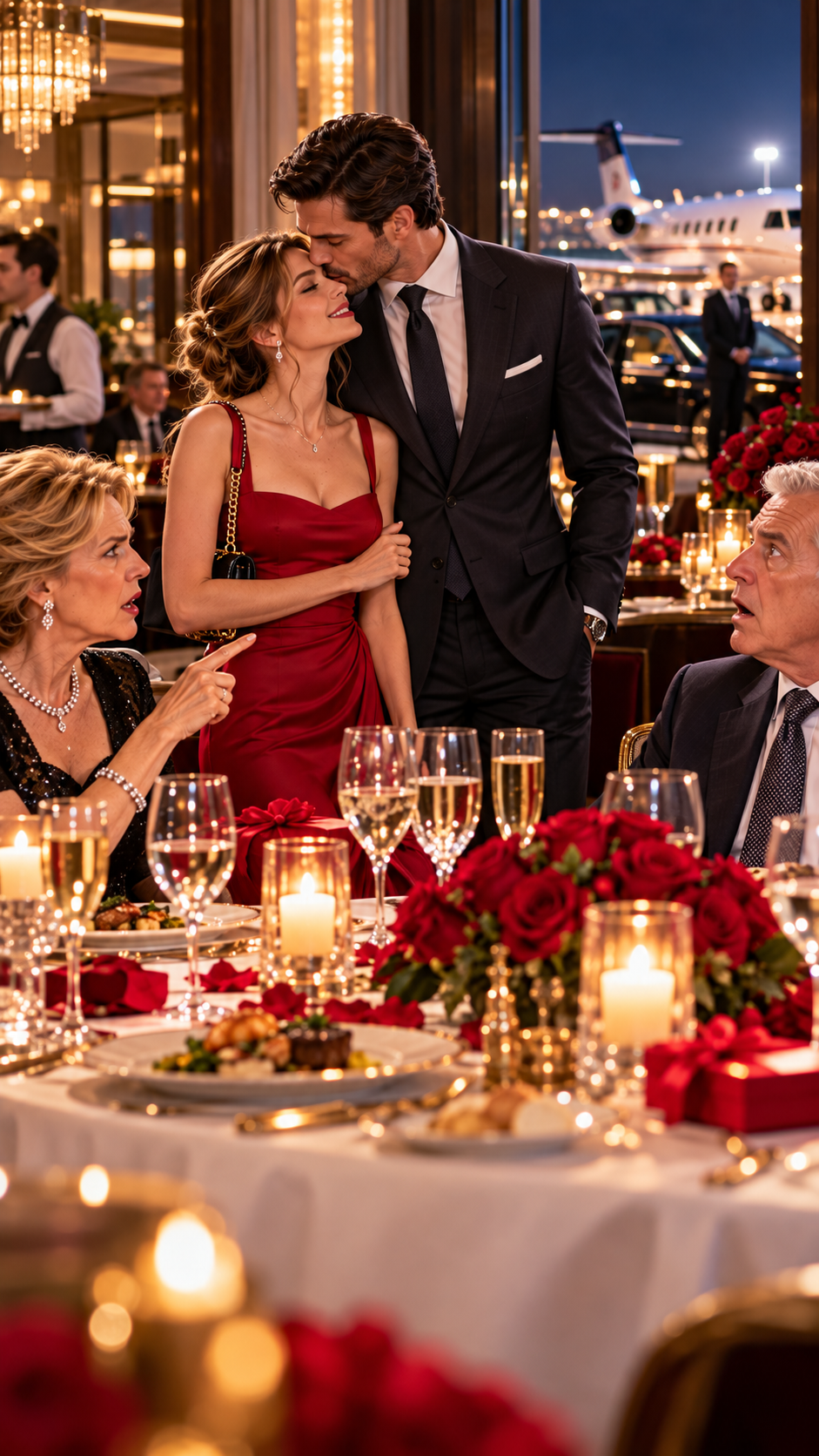
My mother waited until the waiter had poured the second glass of wine before deciding to explain why I would always be a disappointment to her.
“No man will ever want you,” she said, cutting into her filet mignon with the careful precision she used whenever she wanted to make an unpleasant point. “You’re simply too difficult. Some women understand how to make a relationship work. Others spend their lives wondering why nobody stays.”
The restaurant was quiet enough that I heard a fork strike a porcelain plate at the next table. A pianist near the windows was playing an old love song, its melody drifting beneath the conversations and the soft clink of expensive glassware. Somewhere behind me, a waiter laughed at something a colleague whispered. Nothing about the evening suggested that my mother had just reduced her youngest daughter to an example of everything a woman should avoid becoming.
I folded my napkin across my lap and looked at the small red rose beside my plate.
“Mom,” my older sister Vanessa said, with the weary affection of someone pretending to mediate a disagreement she secretly enjoyed, “you can’t expect everyone to have the same life.”
She glanced at me and smiled.
“Although I do think having a family changes your perspective.”
There it was. The comparison we had been circling since the appetizers arrived.
Vanessa had a husband, two children, a large house in an affluent suburb, and a social media account filled with carefully arranged photographs of school events, holidays, and restaurant openings. My parents spoke about her as though she had successfully completed a difficult examination that the rest of us had somehow failed to take.
I was forty years old, childless, and married to a man my family had never met. To them, those facts were not separate pieces of information. They were evidence of a single, embarrassing conclusion: I had spent my life making the wrong choices.
My father lifted his wineglass.
“Your mother isn’t trying to hurt you,” he said. “She wants you to be happy. She worries that you’re getting older and making things unnecessarily difficult for yourself.”
I almost laughed at the phrase unnecessarily difficult.
For seven years, I had listened to variations of that speech. When I declined a family vacation because a business acquisition needed my attention, I was accused of being obsessed with work. When I refused to lend Vanessa money without seeing a business plan, I was called controlling. When I stopped attending gatherings where my decisions became the evening’s entertainment, my absence was treated as proof that I was antisocial.
Every boundary became an insult. Every refusal became a character flaw. Every success I quietly achieved was dismissed as luck or someone else’s contribution.
And because I rarely defended myself, my family had become comfortable believing their own version of me.
Vanessa tilted her head.
“You could still meet someone, you know. But you have to stop treating every little thing like a negotiation.”
“Some people enjoy being single,” I replied.
My mother made a small, dismissive sound.
“That’s what people say when they have no other choice.”
I watched her take a sip of wine. Her diamond bracelet caught the candlelight, throwing a tiny reflection across the white tablecloth. I had bought her that bracelet for her sixtieth birthday, after she mentioned it several times during a family lunch. She had thanked me, worn it to dinner that evening, and then spent the following week telling relatives that Vanessa had chosen it.
I hadn’t corrected her then, either.
My silence had become a kind of family currency. They spent it whenever they needed to feel superior, and I had allowed them to believe there would always be more.
Tonight, however, something inside me had settled into a different kind of stillness.
I had chosen the restaurant. I had arranged the reservation. I had asked the staff to prepare the private dining room, and I had invited my parents and sister with a simple explanation: I wanted to celebrate Valentine’s Day with my family before leaving the country for a few days.
I had not mentioned Paris.
I had not mentioned the private jet.
And I had certainly not explained that the restaurant where they were eating belonged to a business empire they had never bothered to ask me about.
I wanted one evening in which my family could speak freely, without the protection of polite strangers or the distraction of an audience. I wanted to know whether they could sit across from me, look me in the eyes, and see a person rather than an unfinished project they were entitled to repair.
So far, the answer was becoming painfully clear.
My father leaned forward, lowering his voice as though he were about to offer me something valuable.
“Look at your sister. She has a husband who adores her, two beautiful children, and a home. People respect that. There’s a certain stability to it.”
“And what do people respect about me?” I asked.
He hesitated.
My mother answered before he could.
“You have potential. That’s what we’ve always said. But potential doesn’t mean much if you never build a proper life around it.”
I looked at her.
“I’m forty, Mom. What part of my life do you think I’ve forgotten to build?”
She set down her fork.
“Don’t start arguing. That’s exactly what I mean when I say you’re difficult.”
Vanessa lowered her eyes to hide a smile.
I recognized that expression. She had used it since we were teenagers, whenever our mother criticized me and she wanted to make sure nobody mistook her silence for sympathy.
When Vanessa got into trouble at school, I helped her prepare explanations for our parents. When she wanted to borrow my savings for a holiday, I agreed because she promised to repay me. When she announced her first business idea, I spent an entire weekend examining the numbers and explaining why her projected costs were unrealistic.
She called me negative. My parents told me to be supportive.
Six months later, Vanessa abandoned the idea and told relatives it had never been serious.
I had learned early that helping my sister did not mean she would respect me. It meant she would remember that I was useful until the next time my advice contradicted what she wanted to hear.
“What would make you happy, then?” my father asked. “A husband? Children? Someone to take care of you? You can’t keep living as though you don’t need anybody.”
“I never said I didn’t need anybody.”
“Then why are you so determined to do everything yourself?”
Because I had spent years discovering that dependence could be dangerous when the people offering help believed they were purchasing authority over my life.
Because I had learned that a financial favor could become a permanent obligation, and a family promise could disappear the moment it became inconvenient.
Because I had watched people confuse generosity with permission to control.
I could have told them all of that. I could have explained the years I had spent studying financial statements, negotiating contracts, evaluating distressed businesses, and building relationships with investors who understood the difference between confidence and recklessness.
Instead, I reached for my water.
“I’m doing all right,” I said.
My mother gave a thin smile.
“Of course you think so.”
The words should have hurt more than they did. Perhaps the damage had accumulated gradually, until the latest insult was no longer a wound but a familiar pressure against an old scar.
A waiter appeared to ask whether we wanted another bottle of wine. My father ordered the restaurant’s most expensive red without looking at the menu. Vanessa requested a dessert platter for the table, even though our main courses had barely been cleared.
They behaved as if the evening were an occasion arranged for their pleasure.
In a sense, it was. I had wanted to give them one last opportunity to meet me without the usual excuses. I had paid for the private room because I wanted privacy, not because I needed to impress them. I had selected the restaurant because it represented something meaningful to me, not because I expected gratitude.
My family had interpreted the invitation differently.
My mother surveyed the room.
“At least you chose somewhere respectable,” she said. “For a moment, I thought you’d take us to one of those trendy places where they serve three leaves on a plate.”
Vanessa laughed.
“Maybe she’s finally learning.”
I glanced toward the closed dining-room doors.
There was a time when I would have hurried to fill the silence after a remark like that. I would have explained that I had made the reservation months in advance, that the chef had earned international recognition, or that the restaurant’s reputation was built on more than expensive ingredients.
I no longer felt the need.
My phone vibrated beside my plate. A message appeared on the screen.
Two hours until departure. The aircraft is ready whenever you are.
I turned the phone facedown.
Vanessa noticed.
“Work?”
“Something like that.”
“You really should switch off sometimes,” she said. “It’s Valentine’s Day.”
“I agree.”
She blinked, apparently surprised that I had not argued.
My mother dabbed her mouth with a napkin.
“Speaking of Valentine’s Day, I saw a lovely photograph of Vanessa and Daniel this morning. They had flowers delivered to the house. Two dozen roses, apparently.”
“Three dozen,” Vanessa corrected.
“Oh, three dozen. Daniel knows how to treat a woman.”
My sister looked at me with an expression of practiced concern.
“Does your husband do things like that?”
I could have told her that Marcus had sent flowers to my office that morning, along with a handwritten note that made me smile every time I remembered it. I could have explained that he knew I disliked extravagant gestures in public but loved the quiet rituals of our life together.
Instead, I asked, “Why do you want to know?”
Vanessa’s expression tightened.
“I’m only asking.”
“Then the answer is that I’m happy.”
My mother sighed.
“You always make simple questions difficult.”
I looked at the rose beside my plate again. Its petals were beginning to curl at the edges, and a drop of water had gathered on one leaf. The flower had been placed there by a member of staff who knew how I liked the tables prepared.
I wondered how many small details my family had passed without noticing during their lives.
The room’s door opened briefly as a waiter entered with a tray. Beyond him, I caught a glimpse of the main dining area, where couples leaned toward one another beneath warm lights. A young man helped his companion remove her coat. An older couple shared a dessert from a single plate.
Then the door closed.
My father was telling Vanessa about a property he had seen advertised. She was describing the kind of boutique hotel she wanted to open, using phrases like premium experience and exclusive destination without offering a single figure to explain how the business would operate.
I listened.
She mentioned that she was looking for investors. She complained that commercial lenders had become difficult. She said the opportunity would disappear unless she could secure the money soon.
My mother turned toward me.
“You know people who invest in things like that, don’t you?”
“Some.”
“Then perhaps you could introduce her to someone.”
Vanessa brightened immediately.
“I’d appreciate that. It would be wonderful if you could finally use those connections for something that benefits the family.”
There was the real reason for the conversation. The criticism had merely cleared the ground for a request.
I put down my glass.
“Send me the business plan.”
Vanessa frowned.
“Why?”
“So I can evaluate it.”
“Evaluate it? I’m asking for an introduction, not a lecture.”
“An introduction to whom?”
“Someone with money.”
“That isn’t a business strategy.”
Her cheeks colored.
“You see?” my mother said to my father. “Everything has to become a challenge with her.”
I looked at the three of them, and for the first time that evening, I understood precisely what I had been waiting to discover.
They did not need to know the truth about my life before they decided how much respect I deserved. They had already made their decision. Any evidence that contradicted it would be treated as an inconvenience.
The door opened again.
This time, the waiter stepped aside and held it for someone entering from the corridor.
I saw the black suit first, then the familiar silver watch at the man’s wrist. He paused just inside the room, scanning the table until his eyes found mine.
His expression softened.
“Good evening, sweetheart.”
My husband crossed the room toward me.
He bent down and kissed my cheek, his hand resting briefly against my shoulder. The scent of his cologne mingled with the roses and the warm aroma of dinner.
“Sorry I’m late,” he murmured. “The meeting ran longer than expected.”
I smiled.
“You made it.”
“Of course I did.”
He straightened, glanced at the untouched dessert platter, and then looked at the three people sitting opposite me.
My mother’s wineglass stopped halfway to her mouth.
My father stared at Marcus as though someone had quietly replaced the person he expected to see with a stranger.
Vanessa’s lips parted.
For several seconds, nobody said anything.
Then Marcus turned back to me, his expression calm and affectionate.
“Sweetheart, the private jet is ready for Paris. We need to leave in about two hours if we’re going to make the schedule.”
My mother’s fingers tightened around the stem of her glass.
Vanessa pushed her chair backward so quickly that its legs scraped against the floor.
“Your husband?”
Marcus looked at her.
“My wife,” he answered, taking the empty chair beside me.
And for the first time in seven years, my family had to confront the possibility that the woman they had spent so long underestimating had been living a life they knew absolutely nothing about.
Click here to continue reading: PART 2: My Husband Revealed His Name, but the Documents on My Phone Held the Truth My Family Had Never Thought to Ask About
The Valentine’s Dinner Where My Family Mistook My Silence for Defeat and Never Imagined Who Was About to Walk Through the Door
Part 1 of 12

