
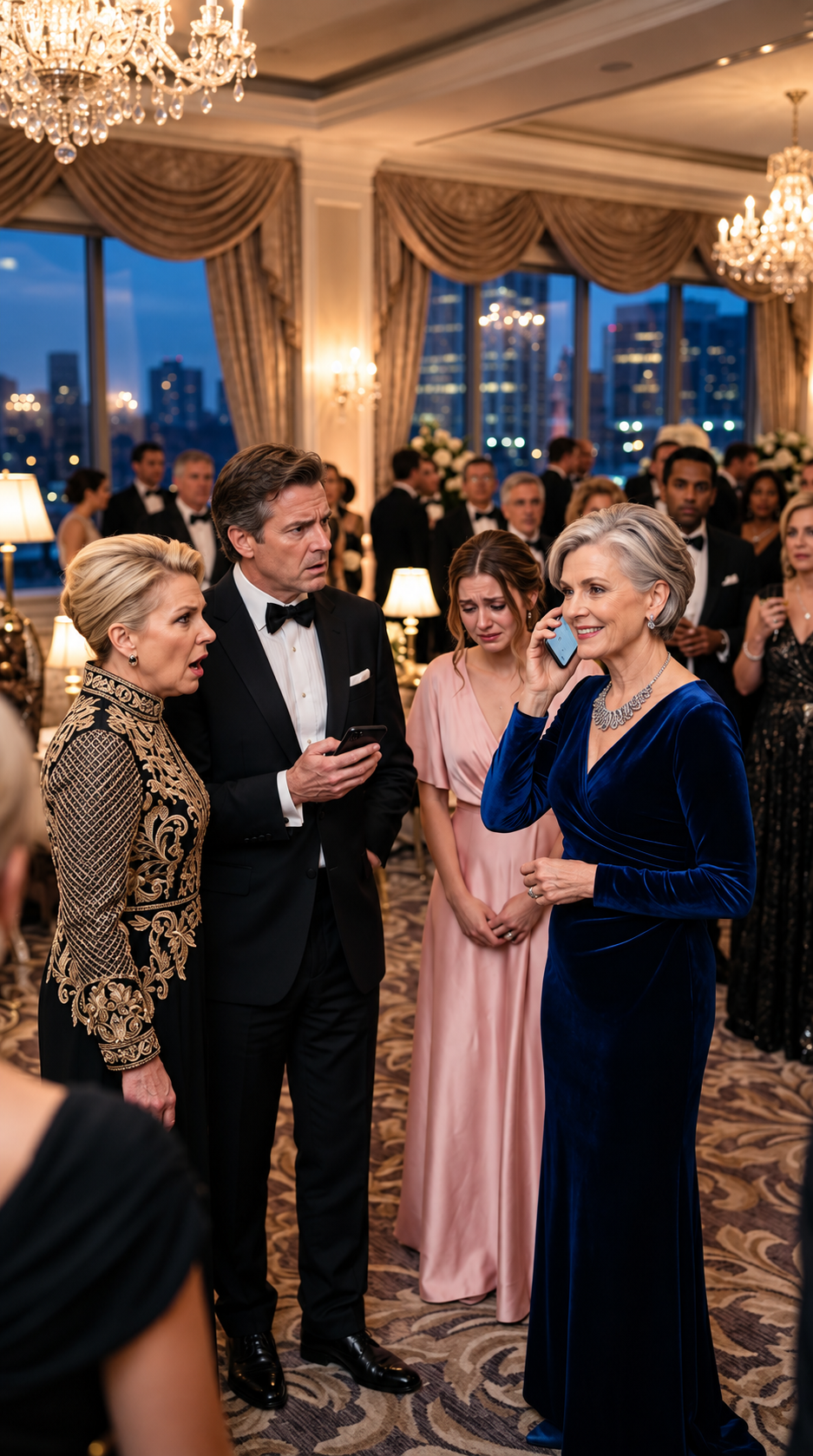
The first thing I noticed was the silence.
It arrived before the insult had fully settled over the room, spreading through the elegant dining hall as thirty guests turned toward the woman standing opposite me. Victoria Whitmore held a crystal champagne flute in one hand and regarded me with the cool impatience of someone who had just discovered an unexpected stain on an expensive dress.
“You are not someone I need to entertain,” she said, her voice sharp enough to reach the far end of the table. “Please understand that you are not important enough to speak to me.”
For a moment, nobody moved. A waiter paused beside a silver tray. Somewhere near the fireplace, a woman gave a nervous little laugh and immediately regretted it. The soft music continued playing, absurdly cheerful against the sudden discomfort.
My daughter, Emma, stood beside me in a pale blue evening dress. Her fingers had been resting lightly against my arm, but now they tightened until I could feel her trembling.
I looked at Victoria, then at the hand I had extended to greet her. She had never taken it.
I could have withdrawn it immediately. Instead, I allowed another second to pass before lowering my hand to my side.
“My apologies,” I said calmly. “I thought we were here to celebrate our children’s engagement.”
Victoria’s mouth curved into something that was not quite a smile.
“We are. But there are certain expectations at gatherings like this, Catherine. People generally understand where they belong.”
Across the room, her husband, Richard Whitmore, let out a low chuckle. He was a broad-shouldered man in his early sixties, with silver hair carefully combed back and a dark dinner jacket that fitted him perfectly. His expression suggested that his wife’s behavior amused him more than it embarrassed him.
He lifted his glass toward me.
“Don’t take it personally. Victoria has a very demanding schedule. Perhaps you’d find the kitchen staff easier company.”
A few guests looked down at their drinks. One man adjusted his cuff links. Nobody challenged him.
Emma’s face drained of color.
“Mr. Whitmore, that’s my mother,” she said. “You cannot speak to her that way.”
Richard glanced at his son, Andrew, as if expecting him to restore order. Andrew stood near the end of the table, one hand wrapped around a champagne glass. He was thirty-two, handsome in the polished, carefully maintained way of someone who had spent his life among people who valued appearances.
He looked at Emma.
Then he looked away.
That small movement told me more than either insult had.
My name is Catherine Bennett. I was fifty-eight years old, a widow, and the founder of a private investment firm headquartered in Boston. I had spent nearly three decades learning how people behaved when money, status, and personal advantage entered the same room.
But on that October evening at the Whitmore estate near Greenwich, Connecticut, I had not come as an investor.
I had come as Emma’s mother.
My daughter had asked me to attend the engagement dinner because she wanted the two families to become acquainted before the wedding. She had spent weeks talking about the arrangements, the guest list, and the possibility of finally having a family celebration that did not feel like a business function.
She had also warned me about Victoria.
“She’s particular about everything,” Emma had told me over the telephone several days earlier. “Clothes, manners, where people sit, what they drink. Sometimes she says things without thinking.”
I had asked whether Andrew stood up for her when his mother became difficult.
There had been a pause.
“Usually, he tries to keep everyone happy.”
At the time, I had accepted that answer. I had been married long enough to understand that families developed habits, and I had raised Emma to make her own judgments about the people she loved. I was not going to reject her fiancé because his mother sounded exhausting.
Still, as I stood in that enormous dining room beneath a chandelier that probably cost more than my first house, I remembered the hesitation in Emma’s voice.
I wished I had paid closer attention.
The Whitmores had invited thirty guests, most of them executives, investors, wealthy business owners, and people whose names appeared regularly in financial magazines. Their estate overlooked manicured gardens, and the driveway had been lined with luxury cars from the moment we arrived.
Inside, every surface seemed designed to communicate importance. Oil paintings filled the walls. Fresh white roses stood in arrangements tall enough to obscure conversations across the table. The silverware shone beneath warm lights, and the champagne had been poured into glasses so delicate that I was afraid a careless movement might break one.
My own navy dress was simple, well tailored, and comfortable. I wore a small pair of pearl earrings that had belonged to my late husband, Daniel.
I had not dressed to compete with anyone.
Apparently, that had been my first mistake in Victoria’s eyes.
When she initially asked about my work, I answered honestly but without offering a résumé.
“I work in investments,” I told her. “My firm helps businesses grow, usually by providing capital and strategic support.”
She looked me over from my shoes to my face.
“How modestly put.”
I could not tell whether she meant it as a compliment, so I gave her a polite smile.
“I find the work interesting.”
“I’m sure you do,” she replied, already turning toward a guest who had been waiting to speak with her.
I had been about to introduce myself properly when she interrupted me with her declaration that I was not important enough to speak to her.
Now the room had become a stage, and Victoria seemed determined to make certain everyone understood who occupied the highest position on it.
Emma took a breath.
“Victoria, I would appreciate it if you apologized.”
Her future mother-in-law stared at her.
“Excuse me?”
“You heard me. My mother came here because Andrew and I are getting married. She deserves basic respect.”
Victoria placed her glass on a nearby table with deliberate care.
“Emma, darling, this is precisely why young people should learn how society works before they enter it. Marriage connects families, and families have reputations to protect. Your mother may be perfectly pleasant, but that doesn’t mean she belongs in every conversation.”
I watched Emma’s shoulders stiffen.
She had inherited her father’s dark eyes and my habit of pressing her lips together when she was trying not to cry. Seeing that familiar expression on her face brought back a memory of her at nine years old, standing in a school hallway after another child had mocked her for wearing a secondhand coat.
Back then, I had knelt in front of her and told her that somebody else’s cruelty was not a reliable measure of her worth.
I wanted to say those words again.
Instead, I waited to see whether the man she planned to marry would say something first.
Andrew finally moved.
“Mother, perhaps we should get dinner started,” he suggested.
He did not ask Victoria to apologize. He did not tell his father to stop. He merely attempted to move the conversation somewhere less uncomfortable.
Richard gave him an approving nod.
“Exactly. There’s no reason to spoil a pleasant evening.”
I looked at Andrew.
He met my eyes for a fraction of a second, and I saw the discomfort there. It might even have been shame. But discomfort that never becomes action is of little use to the person being hurt.
Emma slowly released my arm.
“I’m sorry, Mom,” she whispered.
I turned toward her.
“You have nothing to apologize for.”
“I should have prepared you.”
“No, sweetheart. You should never have to prepare someone you love for being treated with contempt.”
Her eyes filled with tears, and she quickly looked toward the windows.
I felt something inside me settle. It was not anger in the way people often imagine it: no racing pulse, no desire to raise my voice, no sudden need to win a public argument. It was quieter than that.
It was recognition.
For twenty-seven years, I had built a business while raising a daughter without her father. Daniel died unexpectedly when Emma was still young, leaving me with a grieving child, a modest collection of assets, and a future I had not planned to face alone.
In the months after his death, I learned how quickly sympathy could turn into advice from people who had never carried my responsibilities. Some told me to sell what we owned and find a safe job. Others assumed I would eventually marry someone wealthy enough to rescue us.
I did neither.
I worked. I studied markets late into the night. I met business owners who needed capital but could not persuade traditional lenders to look beyond their balance sheets. I learned to distinguish a temporary setback from a broken business model, and confidence from arrogance.
My firm began with a handful of clients and grew one carefully evaluated investment at a time. Over the years, we acquired significant stakes in several successful companies. I became accustomed to negotiations in which every sentence had financial consequences and every signature could affect hundreds of employees.
I also learned that wealth could make people generous, frightened, disciplined, or cruel. Money did not create character so much as give existing character more room to operate.
That was why I had never considered expensive clothing or impressive houses reliable evidence of a person’s value.
And that was why the Whitmores’ behavior bothered me more than their opinion of my dress.
They had not simply insulted a stranger. They had humiliated the mother of the woman their son claimed to love, in a room full of witnesses, while their son stood silently nearby.
Victoria lifted her glass again, apparently satisfied that the matter had been settled.
“Shall we sit down? The caterers have prepared a wonderful menu.”
The guests began moving toward their places. Conversation resumed in fragments, although several people kept glancing in our direction. A waiter approached me with a chair, and I thanked him before taking my seat beside Emma.
I noticed that our place cards had been arranged at the far end of the table, several seats away from Richard and Victoria. That alone would not have bothered me. There were thirty guests, and seating arrangements were rarely perfect.
But the card bearing my name had been placed beside a service door.
The door opened and closed as staff moved between the dining room and the kitchen. Each time it swung inward, a trace of warm air carried the smell of roasted herbs, butter, and freshly baked bread.
I looked at the place card, then at the long table where Victoria had seated her closest business associates.
It was a small detail, but it fit the evening too neatly to ignore.
Emma leaned closer.
“Please don’t let them ruin this for you.”
I touched her hand beneath the table.
“They haven’t.”
She looked unconvinced.
I wanted to explain that I was not pretending to be unaffected. I was making a decision about what deserved my attention. There was a difference between feeling an insult and allowing the person who delivered it to dictate what happened next.
Across from us, Andrew began discussing an upcoming business conference with a man who ran a manufacturing company. His voice was easy and confident now that the uncomfortable exchange had passed.
He seemed relieved that the room had returned to normal.
I wondered how many times he had mistaken silence for peace.
The first course arrived. Small plates of seared scallops were arranged with an elaborate sauce, and the guests discussed restaurants, travel, and a recent charity auction. Victoria presided over the conversation as if she were hosting a television program.
Whenever someone mentioned a company or a person she admired, she responded immediately. When a quieter guest tried to contribute, she often interrupted before the thought was complete.
Richard told a story about a difficult acquisition that his company had supposedly rescued from collapse. He described his negotiations with a rival executive in triumphant detail, leaving out any mention of the lawyers and financial partners who had made the transaction possible.
Several people laughed at his punch lines.
I listened without joining in.
I knew the name of the company he was describing. My investment team had evaluated it years earlier and rejected the opportunity because its contracts were too dependent on one customer. Another firm eventually bought it, only to discover that the apparent profits had been inflated by unusually generous payment terms.
Richard’s version of events made him sound like a brilliant strategist who had recognized a hidden opportunity.
The real story had been considerably less flattering.
I filed that observation away, although I had no reason yet to connect it to the Whitmores’ current affairs.
After the main course, Victoria began discussing the wedding.
She spoke about the guest list, the venue, and the photographs she wanted for society publications. Emma listened politely, offering suggestions when asked. Andrew occasionally agreed with his mother, then turned to Emma and smiled as though that settled everything.
When Emma mentioned that she wanted a smaller ceremony, Victoria’s expression tightened.
“A wedding like this is an opportunity to bring the right people together,” she explained. “You only do it once, ideally. It would be a shame to waste the occasion on an ordinary arrangement.”
Emma looked at me briefly.
I said nothing. This was her wedding, and I wanted her to decide what mattered to her without turning every disagreement into a contest between mothers.
But I noticed that Andrew did not ask what his fiancée wanted.
Instead, he told his mother that they could discuss the details later.
Again, he had chosen delay over disagreement.
As the plates were cleared, Richard raised his glass and announced that the evening represented more than a family celebration. It was, he said, the beginning of a promising alliance between two households with complementary strengths.
He spoke of tradition, ambition, and the importance of surrounding oneself with people who understood success.
Then he turned toward me.
“And of course, every family contributes in its own way.”
The sentence was delivered with a pleasant smile, but its meaning was unmistakable. Several guests glanced down the table toward my place beside the service door.
Emma’s fingers curled around her napkin.
I could have answered him. I could have listed the businesses I had helped build, the employees whose jobs had been preserved through difficult restructurings, and the investors who trusted my judgment with their money.
Instead, I looked at Richard and asked a simple question.
“What do you consider the most important contribution a family can make?”
He appeared surprised that I had spoken.
“Why, its reputation, naturally. Its standing in the community. The opportunities it creates for the next generation.”
“Nothing about how its members treat one another?”
Richard’s smile remained, but the warmth disappeared from it.
“Of course. Good manners are important.”
“Then I imagine we agree on more than it first appeared.”
Victoria set down her fork.
I could see the irritation building behind her eyes. She had expected me to remain quiet, grateful for the invitation and embarrassed by my place at the table. Instead, I had asked a question that required her husband to defend the very behavior they had displayed.
Before he could respond, she leaned forward.
“Catherine, I think you are confusing a private family dinner with some sort of public forum.”
“No,” I said. “I believe I am finally understanding what kind of dinner this is.”
Her face hardened.
And for the first time that evening, I saw that Victoria Whitmore was not merely offended by my presence.
She was afraid of losing control of the room.
I had not yet decided what I would do about that. I had only decided that I would no longer help her maintain the illusion that her behavior was acceptable.
Then my phone vibrated inside my handbag.
The screen lit up with a message from Michael, my chief investment officer. I had not expected to hear from him until the following morning, when we were scheduled to review several pending transactions.
I glanced at the notification.
It concerned the Whitmore Group.
I read the first line, then the second.
The noise of the dining room seemed to recede.
Three days earlier, Michael had sent me a preliminary due diligence report containing questions about the company’s financial disclosures. We had been considering a substantial transaction involving Richard’s manufacturing conglomerate and a robotics supplier called Precision Dynamics.
The proposed deal was worth approximately $420 million.
I had agreed to let our analysts investigate the outstanding issues before making a final decision. At that stage, I believed the discrepancies might have reasonable explanations.
Now Michael was asking whether I was available for an urgent call.
I slipped the phone back into my handbag and looked toward Richard.
He was laughing with two executives, speaking with the confidence of a man who believed the most important decision of his evening had already been made.
I wondered what he would say if he knew how close he was to losing the deal he had been boasting about for months.
Then I wondered something more important.
If I walked away from the investment, would I be protecting my company from an unacceptable risk—or allowing a personal insult to influence a business decision that deserved to stand on its own?
I would not punish a company simply because its chairman was unpleasant. Hundreds of employees depended on the decisions made by its leadership, and they had done nothing to deserve collateral damage.
But neither would I ignore evidence because I happened to be seated at the same dinner table as the man responsible.
I needed to separate those questions before acting.
Victoria interrupted my thoughts by addressing a guest beside her.
“Richard’s group is about to enter a remarkable new phase,” she announced. “We have every reason to believe the next few months will be extraordinary.”
Richard gave a modest wave, although his expression suggested he enjoyed every word.
“The final details are being handled,” he said. “I expect we’ll have something worth celebrating very soon.”
My phone vibrated again.
This time, Michael’s message contained a sentence that made me sit straighter.
The outstanding customer agreements had still not been produced, and the auditors had identified additional questions about how revenue was being recorded.
I looked at the message for several seconds.
Then I closed my handbag.
The Whitmores had spent the evening teaching me how little they thought of people they considered insignificant. Their behavior had revealed a problem with their judgment, but the financial report pointed toward something potentially more serious.
The dinner was no longer simply an unpleasant family gathering.
It was the place where two separate concerns had collided: the character of the people asking for my firm’s money, and the unanswered questions surrounding the business they wanted me to finance.
I lifted my eyes toward Richard Whitmore.
He was still smiling.
He had no idea that I was about to make the most consequential telephone call of the evening.
Click here to continue reading: PART 2: One Phone Call Turned a Room Full of Smug Smiles Into a Gathering of People Desperate to Know Who I Really Was
The Engagement Dinner Where Thirty Powerful Guests Watched a Mother Be Humiliated by the Family Her Daughter Was About to Join
Part 1 of 12

