
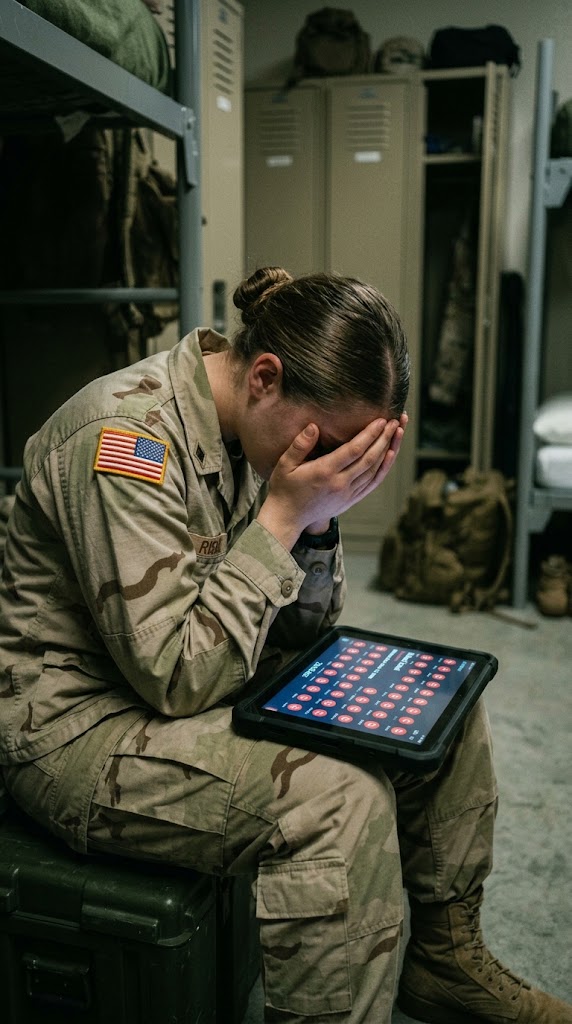
At 6:51 on a rainy Tuesday evening, I watched my husband look directly into his phone while another woman rested against him, and I understood that I had run out of time to pretend I knew the man I had married.
“Evan, listen to me. My mother has collapsed. She’s having chest pain, and I cannot get off the installation. You need to go to her house and take her to the hospital.”
He glanced at me through the screen. The woman beside him lifted her head slightly, then settled against his shoulder again. I recognized the living room behind them, down to the blue quilt draped over the couch and the brass lamp my father had left us. I had chosen that lamp because Evan once told me it made the room feel warm.
Now its golden light fell across a stranger’s bare feet and my husband’s relaxed expression.
“Did you hear what I said?” I asked.
Evan exhaled as though I had interrupted something important. “Clara, I’m busy.”
“My mother is eighty-two years old. Mrs. Nolan found her on the kitchen floor. She says her chest hurts, and she’s getting weaker. You’re less than half an hour away from her house.”
He looked at the woman again. She did not move away. She did not ask whether someone was dying. Her hand remained spread across his shirt, her fingers resting there with the ease of someone who believed she had every right to touch him.
Then Evan returned his attention to the camera.
“That’s not my problem. Figure it out.”
For a moment, the words seemed to hang in the space between us. I could hear rain tapping the narrow window beside my desk, the low hum of the ventilation system, and a radio somewhere down the corridor announcing a security update. My fingers tightened around the phone.
I had spent twenty-two years in the Army learning how to respond when circumstances became dangerous. I had coordinated emergency transport, rerouted medical supplies during severe weather, and made decisions while other people waited for someone to tell them what to do. I knew how to keep my voice steady when every second mattered.
Yet nothing in my training had prepared me for watching my husband dismiss my mother’s emergency because helping her would inconvenience him.
“Okay,” I said.
I ended the call before he could answer.
My name is Clara Carter. I was forty-five years old, a logistics officer stationed at Fort Briar, a military installation near the Kentucky–Tennessee border. Evan and I had been married for nearly eighteen years. We owned a house together, shared ordinary routines, attended family gatherings, and had accumulated enough history that I once believed there could be no important truth about him left for me to discover.
I had mistaken familiarity for knowledge.
The trouble had begun that afternoon, although I had no reason to expect the evening would become a dividing line in my life. I had spent most of the day reviewing transport schedules and resolving a supply discrepancy that threatened to delay an upcoming training exercise. The coffee in my office had burned on the warming plate, and I had been too occupied to replace it.
Shortly after four, a security incident triggered a temporary lockdown. Personnel were instructed to remain on the installation until the security team completed its assessment. Vehicles could not pass through the gates without direct authorization, and even those with urgent personal circumstances were required to wait for clearance.
My commanding officer knew I had an elderly mother living alone. He listened while I explained the situation, contacted the appropriate personnel, and tried to find a way to release me. The answer remained the same: not yet.
I was frustrated, but I understood the procedure. An active security restriction could not be suspended simply because one person had a family emergency.
Then my phone rang at 6:42.
The caller was Mrs. Nolan, my mother’s neighbor. She was nearly seventy-nine and had lived across the street from my mother for years. They checked on each other, exchanged garden vegetables, and occasionally argued over whose turn it was to bring home-baked food to the neighborhood gatherings.
When her name appeared on my screen, I answered immediately.
“Mrs. Nolan? Is everything all right?”
“Oh, Clara.” Her voice shook so badly that I sat upright. “It’s your mother. She’s down on the kitchen floor. She says her chest feels tight, and she doesn’t want me to call anybody.”
I pushed my chair back. “Is she conscious?”
“Yes, but she’s very pale. She keeps telling me she’s fine. She isn’t fine. I can see that.”
“Stay with her. Don’t let her try to stand up. I’m coming.”
The promise escaped before I could consider whether I could keep it.
I called my commanding officer again and explained that the situation had deteriorated. He was already working on the request, but the security restriction had not been lifted. I could not leave the building, let alone drive across the county.
My mother, Margaret Lowe, had lived alone since my father died. She was eighty-two, fiercely independent, and offended by almost any suggestion that age had changed her abilities. She still tended her roses, carried her own groceries, and insisted that hiring someone to clean her house was an extravagant way to forget how to use your hands.
She also had a talent for minimizing pain.
When I was a child, she once finished preparing Sunday dinner with a badly sprained wrist because she did not want my father to worry. After he died, she continued mowing the lawn until I practically begged her to let someone else handle it. If a doctor told her to rest, she treated the instruction as an opening offer in a negotiation.
I knew that if she had admitted to chest pain, she was frightened enough to stop pretending nothing was wrong.
Evan was the obvious person to call. Our house was less than thirty minutes from hers. He knew where she kept the spare key, which entrance at Mason Ridge Medical Center was closest to the emergency department, and how to talk her into accepting help without making her feel helpless.
More importantly, I believed he would go.
We had argued before. We had disappointed each other. Our marriage had acquired the usual collection of unspoken resentments and routines that neither person wanted to examine too closely. But I had never imagined he would refuse to help my mother in a medical emergency.
I called him expecting a brief exchange, perhaps an irritated question about why I could not leave the base, followed by the sound of his car starting.
Instead, I saw Serena Blake.
I did not know her name at the time. I only knew that she was sitting on my couch, touching my husband as if the two of them had spent many comfortable evenings together. Evan had not tried to explain her presence, turn the camera away, or even pretend the situation was innocent.
He had chosen indifference over a lie.
That realization hurt, but there was no room to examine it yet. My mother needed medical care, and I was still responsible for finding it.
I called Mrs. Nolan again. She answered on the first ring.
“Clara, she’s getting weaker.”
“Has she lost consciousness?”
“No, but she’s barely talking now. She keeps apologizing for making a fuss.”
“Tell her she isn’t making a fuss. Tell her I’m working on it.”
Mrs. Nolan’s breathing was uneven. I could hear movement in the background and my mother’s faint voice insisting that someone should not have to leave supper unfinished because of her.
I opened my contacts and began calling people.
My cousin was out of state on a business trip. My mother’s closest friend no longer drove after dark. The pastor who had known my parents for decades was leading an evening service, and his wife told me he would leave as soon as he could arrange someone to cover his responsibilities. I thanked her, ended the call, and looked at the clock.
Every minute felt heavier than the one before it.
I could hear my father’s voice in my memory, telling me that a plan was only useful if it survived contact with reality. In the Army, we always prepared alternatives. If one transport route failed, another had to be ready. If a vehicle became unavailable, we found a replacement. You did not keep asking the same broken system to produce a different result.
I needed another person who could reach my mother.
Then I remembered Arthur Reed.
Arthur was a retired mail carrier who had delivered letters in my mother’s neighborhood for almost thirty years. He had known my parents long before I joined the Army. Even after retirement, he visited Mom regularly, sometimes bringing tomatoes from his garden, sometimes peaches, and sometimes a small repair he had completed in his garage because he had noticed something at her house needed fixing.
He was not family by blood, but he had become part of the neighborhood’s structure in the way a familiar streetlight or an old oak tree did. You noticed his presence most clearly when something went wrong and everyone instinctively looked for him.
I found his number in the emergency file my mother had insisted I prepare after my father’s death.
He answered on the second ring.
“Clara? What’s happened?”
“Arthur, Mom has collapsed. She has chest pain. I’m stuck on base because of a security lockdown, and I can’t get anyone else to her.”
There was a brief silence, but it was not hesitation.
“I’m getting my keys.”
“Arthur, I don’t even know if—”
“Don’t worry about the rest. I’m on my way.”
He hung up before I could thank him.
I returned to Mrs. Nolan and told her someone was coming. She said she would stay beside my mother until Arthur arrived. Then I stood in the corridor with my phone pressed to my ear, watching two soldiers carry a crate of equipment past the office doors.
The world around me continued to function. Radios crackled. Doors opened and shut. Somewhere, a printer began producing a stack of documents. The ordinary noises seemed almost offensive beside the possibility that my mother might die while I waited for permission to leave a building.
Twenty-five minutes later, Mrs. Nolan called again.
“He’s here, Clara.”
I closed my eyes.
Through the phone, I heard Arthur’s voice as he entered the house. He spoke to my mother in the same calm tone he had used when helping her carry groceries after my father’s funeral.
“All right, Margaret. We’re going to get you checked out.”
“Oh, Arthur, you don’t need to do all that. I’m probably just tired.”
“You can explain that to the doctor on the way.”
“I don’t want to trouble you.”
He gave a small laugh. “You’ve been troubling me since I still had dark hair. I think I can survive one more evening.”
For the first time since the call began, I heard my mother stop arguing.
I stayed on the line until Arthur confirmed that he had her safely in his vehicle and was heading toward Mason Ridge Medical Center. Then I thanked him, although the words seemed painfully inadequate.
He told me to keep my phone close and let him know if I needed anything else.
At 8:09, a doctor from the hospital called.
My mother had suffered a mild heart attack.
The doctor explained that she was stable and receiving treatment. Arthur had brought her in promptly, and the medical team was able to begin evaluating her without a dangerous delay. Had she remained at home much longer, the damage could have been substantially worse.
I asked whether I could speak with her.
“Not just yet,” the doctor said. “She’s being monitored. We’ll update you as soon as we can.”
I thanked him and ended the call.
Then I walked to the end of the corridor, beside a vending machine that hummed against the wall, and cried where nobody could see me.
I did not cry loudly. I did not collapse into a chair or call someone to tell them how frightened I was. Tears simply slipped down my face while I stared at a patch of worn flooring and tried to absorb the fact that my mother was alive, that a stranger in the most meaningful sense of the word had come to help her, and that my husband had refused.
A young sergeant passed me on his way to another office. He glanced at me, continued walking, and returned a few minutes later with a fresh cup of coffee. He set it on the table beside me without asking questions.
I thanked him.
He nodded once and left.
At 9:11, I opened my banking application to check whether I had enough available money to cover any unexpected expenses during Mom’s recovery. I had learned long ago that fear became easier to manage when I could identify the practical tasks waiting on the other side of it.
Near the top of the transaction list was a charge for $218.63.
Riverton Chophouse.
The transaction had been processed at 7:18 p.m., while Arthur was helping my mother into his truck.
The amount included dinner for two, wine, and dessert.
I stared at the screen until it dimmed.
Evan had not called to ask whether my mother was alive. He had not sent a message to ask where she had been taken. He had not even pretended to be concerned.
He had simply continued with his evening.
I turned off my phone and looked through the rain-streaked window toward the distant runway lights. For years, I had explained away the small absences in our marriage. The forgotten promises, the unexplained charges, the way he could be charming to a room full of strangers and impatient with the person standing beside him.
I had treated each incident as an isolated failure because admitting they formed a pattern would have required me to reconsider the life I had built.
Now I had a clear answer to a question I had been avoiding.
My marriage had not ended because another woman was sitting on my couch.
It had ended because, when my mother was fighting for her life, Evan had looked me in the eye and decided that helping her was not worth his time.
I switched my phone back on and opened the secure portal for my attorney, Dana Cole. Months earlier, after my father’s estate had been settled, Dana had helped me organize my property records and separate accounts. At the time, I had regarded the work as prudent administration, the sort of preparation I recommended to anyone who wanted to avoid unnecessary confusion later.
I had not yet understood how much I would need those protections.
I found Dana’s number and typed a message asking her to call me as soon as she could.
Then I opened my calendar, located the first available appointment, and placed my phone face down on the table.
I was not going to beg Evan to explain what I had seen.
I was not going to let him turn my mother’s emergency into an argument about my tone, my career, or the inconvenience of being asked to help.
For the first time in eighteen years, I was going to take his actions at face value.
And by morning, he would discover that my quiet answer had not been an invitation to forget what happened.
It had been the beginning of my decision to leave.
Click here to continue reading: PART 2: Thirty-Eight Missed Calls, a Hidden Trust, and the Financial Boundaries Evan Never Thought His Wife Would Enforce
The Video Call That Forced Clara Carter to See Her Eighteen-Year Marriage in a Different Light
Part 1 of 12

