
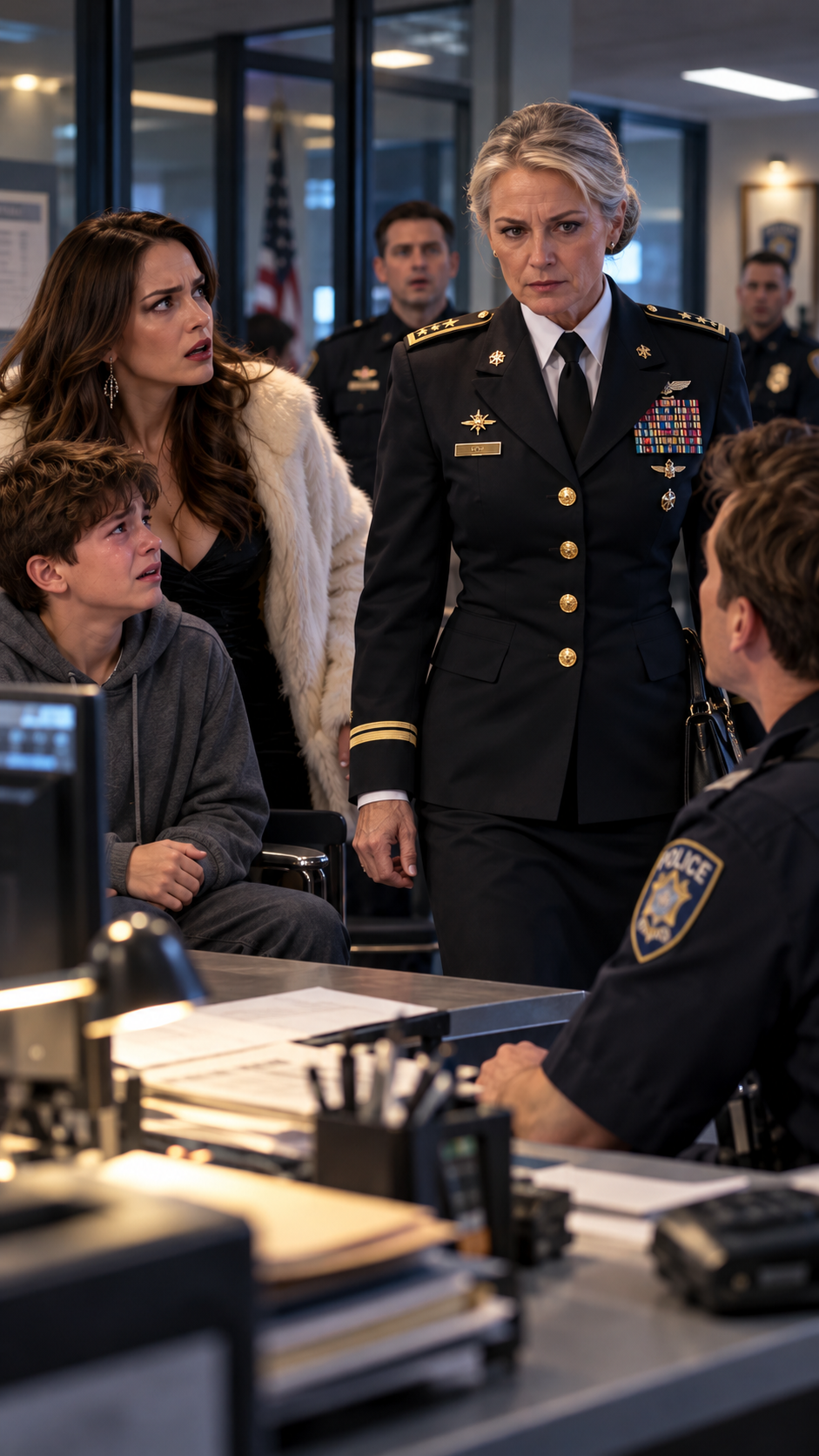
At 2:47 in the morning, Eleanor Grant heard her grandson whisper that his father had chosen his wife over him again. Then Noah told her he was sitting in a police station with blood dried beneath a bandage above his eye, accused of hurting the woman who had struck him.
“Grandma, please come get me.”
Eleanor was already sitting upright. The bedroom was dark except for the pale digits of the clock on her nightstand. Her reading glasses lay beside a bottle of pain cream, and the rain tapping against her window sounded unusually loud. At seventy years old, she had learned that panic rarely helped anyone. But the frightened voice on the phone made it difficult to remember the lesson.
“Noah, take a breath. Tell me where you are.”
“The Lincoln Park station. They brought me here because Lydia told them I pushed her down the stairs.”
“Did you?”
“No!” His answer came so quickly that she heard his breath catch afterward. “She came after me in the hallway. She had that heavy brass candlestick from the table. I tried to get away, but she hit me here.” He paused. “Dad says I must have made her lose control.”
Eleanor swung her feet to the floor.
For several seconds, she said nothing. She was trying to separate what she knew from what she feared. Noah had never been a child who invented elaborate excuses. He could be stubborn, sensitive, and occasionally careless with his schoolwork, but cruelty had never come naturally to him. He was the boy who apologized to the dog when he accidentally stepped on its tail.
“Has anyone asked you to sign anything?”
“They gave me papers. I haven’t signed them.”
“Good. Don’t sign anything you don’t understand. Ask to speak to the officer handling your case. Stay where other people can see you, and don’t argue with Lydia or your father. Do you understand?”
“Yes.”
“I’m coming.”
“Grandma?”
“I’m here.”
“What if Dad never believes me?”
The question landed harder than the accusation itself. Eleanor closed her eyes for one brief moment, then reached for the sweater draped over the chair.
“Let me worry about your father. You concentrate on staying calm until I arrive.”
She ended the call and dressed in the clothes nearest at hand: dark trousers, a gray sweater, and the sneakers she wore for errands. Her hands were steady as she tied the laces. That steadiness had once been useful in rooms where frightened witnesses contradicted themselves and dangerous men tried to intimidate investigators. Tonight, she needed it for a different reason.
Before leaving, she opened the bottom drawer of her dresser. Beneath old photographs and a folded retirement letter sat a worn leather wallet. Inside was her retired law-enforcement identification, its edges softened by years of handling. She had not carried it regularly since leaving Chicago’s Major Crimes Unit, but she slipped it into her coat.
She did not intend to use an old title to frighten anyone. She wanted to know why a child had been brought to a station in the middle of the night, why his injury was being treated as evidence against him, and why the people who should have protected him were apparently helping to build the accusation.
Outside, the pavement shone beneath the streetlights. Eleanor backed out of her driveway and headed toward Lake Shore Drive, keeping both hands on the wheel.
The city was quiet, but her thoughts were not.
When Noah was seven, his mother had died, leaving him with a grief too large for his small body. Eleanor remembered him standing in her kitchen in striped pajamas, asking whether his mother could still see him when the clouds covered the sky. She had held him until his questions stopped, though she had never found an answer that satisfied either of them.
In the months that followed, he began sleeping with a hallway light on. He wanted Eleanor to sit outside his bedroom until he fell asleep. On Sundays, when his father, Mark, came to collect him, Noah often clung to her waist and asked whether he could stay one more night.
Mark had been grieving too. Eleanor understood that. She had watched her son move through the funeral like a man walking underwater, performing the necessary tasks without appearing to feel any of them. For a long time, she had worried about him as much as she worried about Noah.
Then Mark met Lydia.
At first, Eleanor welcomed the relationship. Lydia was polished, sociable, and attentive. She remembered birthdays, sent thoughtful messages, and seemed willing to build a home that included a child who had already lost too much. Eleanor bought her a blouse one Christmas and invited her to Sunday lunches, making a deliberate effort to avoid treating her as an outsider.
For a while, the arrangement seemed to work.
The changes began with small complaints. Noah was becoming difficult, Lydia said. He challenged instructions and manipulated his father by bringing up his dead mother whenever he wanted something. He had trouble accepting that Mark deserved happiness again.
Eleanor listened. She knew grief could make children unpredictable, and she never assumed that a child’s behavior was perfect simply because he was hurting. She offered suggestions, asked questions, and encouraged Mark to spend time alone with his son.
But every conversation seemed to end with Noah being blamed for another disagreement.
When he forgot a school assignment, Lydia called him irresponsible. When he became quiet at dinner, she said he was sulking. When he asked to visit Eleanor, Lydia insisted he was trying to make his father feel guilty.
Mark began repeating those judgments.
“He has to understand that we’re a family now,” he told Eleanor once over the telephone.
“He already has a family,” she replied. “You’re his father. That hasn’t changed.”
Mark had sighed as though she were making his life unnecessarily difficult. After that, their conversations grew shorter.
Noah stopped calling as often. Invitations to spend weekends with Eleanor were canceled, usually with explanations delivered by Lydia. He had homework, Lydia said. He had been disrespectful. He had decided he would rather stay home.
When Eleanor called the house, Noah rarely answered. Sometimes Lydia said he was asleep. Other times, she claimed he did not want to speak to anyone because he was angry with his father.
Eleanor sensed something was wrong, but suspicion alone could not tell her what had happened behind a closed door. She refused to accuse Lydia without evidence, and she knew that openly challenging Mark might push him farther away.
Now, driving through the darkness, she regretted every occasion on which she had accepted a convenient explanation because she lacked proof of anything worse.
The station appeared ahead, its entrance illuminated against the wet pavement. Eleanor checked the dashboard clock. Twenty minutes had passed since Noah called.
She parked, took the leather wallet from her coat, and walked inside.
The waiting area smelled of disinfectant, stale coffee, and damp clothing. A young officer behind the desk was typing when she approached.
“I’m here for Noah Grant.”
The officer glanced at her. “Are you his mother?”
“His grandmother.”
“Please wait. We’re still sorting out the circumstances.”
“Then I suggest you tell me which officer is responsible for the case.”
Her voice was neither loud nor aggressive. It simply carried the expectation that a direct question deserved a direct answer.
The young man studied her face. Then his eyes dropped to the wallet she had placed on the counter. He opened it enough to see the identification.
His expression changed.
“Commander Grant?”
“Retired,” Eleanor said. “Not deceased.”
He straightened in his chair. Before he could answer, she saw Noah at the far end of the room.
Her grandson sat hunched in a plastic chair, his hoodie sleeves pulled over his hands. A white bandage covered the cut above his left eyebrow. His face looked drained of color, and his eyes moved between the floor and the adults standing nearby.
Mark was there, arms crossed tightly over his chest. Lydia stood beside him in a carefully arranged outfit, one hand resting against her ribs as if she had suffered a serious injury. Her eyes were red, though Eleanor saw no tears.
When Noah noticed his grandmother, he started to rise.
Mark turned sharply. “Mom, what are you doing here?”
Eleanor walked toward them without taking her eyes off Noah.
“My grandson called me from a police station in the middle of the night. What did you expect me to do?”
“He attacked Lydia,” Mark replied.
Noah’s shoulders drew inward. “I didn’t.”
“Don’t start again,” Mark snapped.
Eleanor stopped between them.
She did not raise a hand or tell her son to be quiet. She simply stood where he would have to address her before he could continue berating the boy.
For the first time since she entered the building, Mark said nothing.
Eleanor turned to Noah. “Tell me what happened. Start with what you were doing before anyone raised their voice.”
Lydia gave a short, incredulous laugh.
“You’re going to take his word over mine? He’s been acting out for months.”
“I haven’t decided whose account is accurate,” Eleanor said. “I’m asking him to explain his.”
Lydia’s smile tightened.
Noah swallowed. “I asked Dad if I could spend the weekend with you. He said maybe, but he wanted to change before we talked about it. When he went upstairs, Lydia followed me into the hallway.”
“What did she say?”
“She told me I was ruining their marriage. She said every time I asked to see you, I was making Dad choose between us.”
“That is not what happened,” Lydia interrupted.
Eleanor held up one hand, not looking at her. “He hasn’t finished.”
Noah glanced at his father, then lowered his gaze.
“She said she could make Dad send me to relatives in Ohio if I kept trying to leave the house. I told her I wasn’t trying to ruin anything. I just wanted to go somewhere I didn’t have to argue.”
“And then?”
“She picked up the candlestick.”
Lydia stood abruptly. “This is absurd. He came at me first.”
Eleanor turned to her. “You told the officers that Noah pushed you down the stairs. Which hand did he use?”
Lydia blinked. “Both hands.”
Noah spoke so quietly that everyone leaned toward him.
“One hand was covering my eye.”
The room fell silent.
Mark’s crossed arms loosened. He looked at the bandage on his son’s face as though he were seeing it properly for the first time.
Eleanor noticed the change, slight as it was. Her son had spent months explaining away Noah’s distress, but this was the first time the details of Lydia’s account had forced him to pause.
Before anyone could speak again, a door opened near the reception desk. A middle-aged captain stepped into the waiting area, glanced toward Eleanor, and stopped.
“Commander Grant?”
“Captain Miller.”
Recognition passed between them. They had worked together on several investigations years earlier, and Eleanor remembered him as a careful officer who preferred evidence to appearances.
Miller approached, his expression serious. “Could I speak with you privately for a moment?”
Eleanor looked at Noah.
“Stay here,” she told him gently. “I’ll be right back.”
In the captain’s office, Miller closed the door and lowered his voice.
“We have a complication. The hallway cameras at the house weren’t recording. Someone reported a malfunction at eleven-oh-eight tonight.”
Eleanor frowned.
The emergency call had come in at 2:39 a.m., according to Miller. That left several hours between the reported camera failure and the incident that brought Noah to the station.
“Who reported the malfunction?”
“We’re checking. The initial entry doesn’t tell us enough.”
Eleanor glanced through the office window. Lydia sat in the waiting area beside Mark, her posture composed. She was not looking at either of them. She was staring directly toward the captain’s office.
Then Noah reached for his backpack.
He fumbled with the zipper, searching inside it. The moment Lydia saw what he was trying to retrieve, her expression changed so completely that Eleanor almost missed the movement.
Almost.
The color drained from Lydia’s face.
Eleanor turned back toward Miller.
“Captain, I believe your investigation has just acquired something more important than a missing camera recording.”
Click here to continue reading: PART 2: The Evidence Hidden in a Cracked Phone Begins to Undo a Story That Everyone Except the Injured Boy Had Been Willing to Believe
The Phone Call That Forced a Retired Commander to Face the One Family Secret She Could No Longer Ignore
Part 1 of 12

