
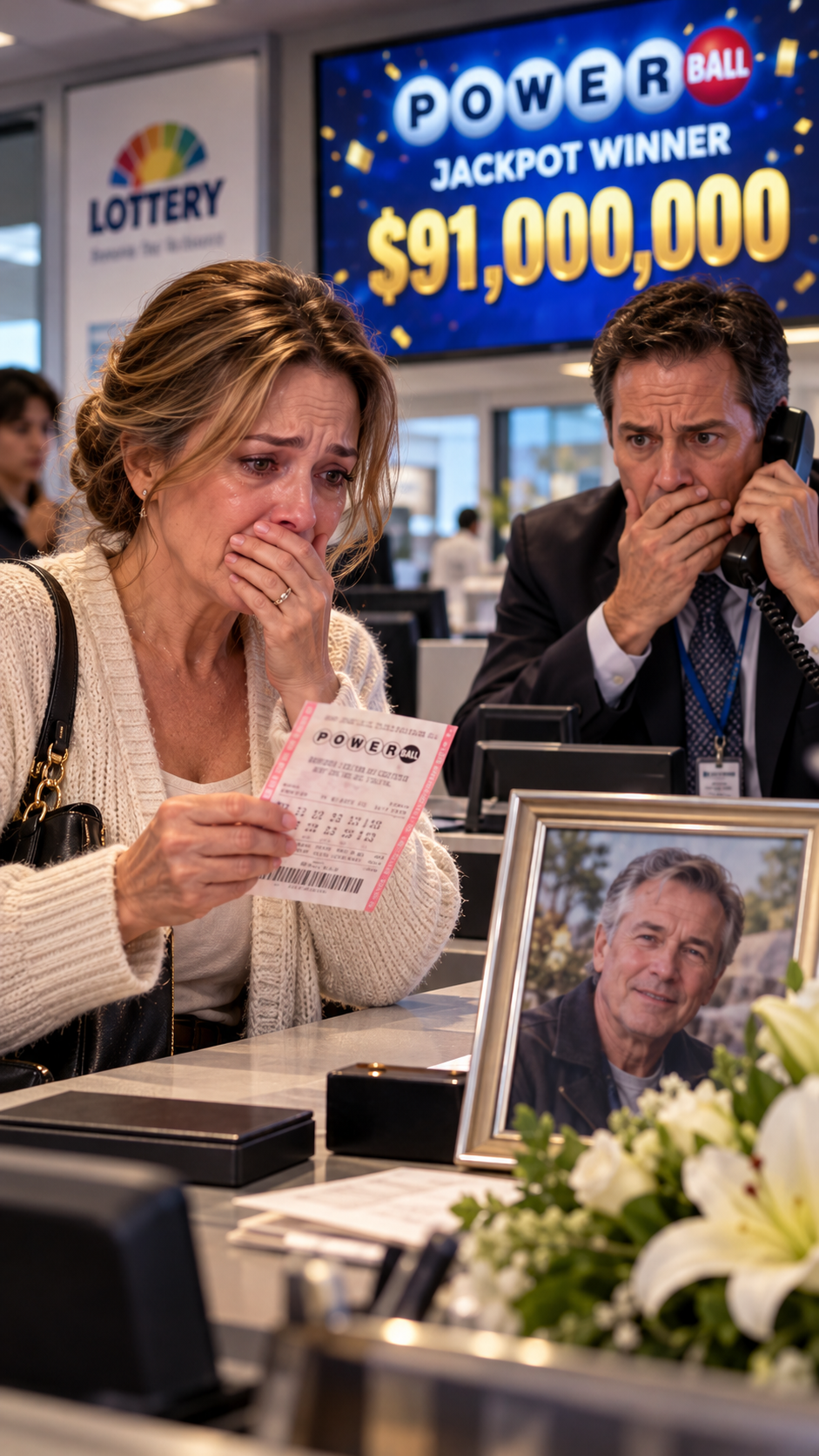
The morning Daniel Mercer asked me to wait a year, he could barely keep his fingers wrapped around mine. His hospital room smelled of disinfectant and the bitter coffee a nurse had abandoned beside the window. Outside, rain dragged thin silver lines down the glass. I had been awake for most of the night, watching his breathing and pretending I didn’t understand what the doctors had told me.
“Claire,” he said, drawing my attention back to him. “I need you to do something for me.”
I leaned closer. “Anything.”
He studied my face with an intensity that frightened me more than his illness. Daniel had always been direct, even when the truth was uncomfortable. Now, with his body weakened by months of treatment, he seemed to be gathering every remaining ounce of strength for a conversation he had rehearsed in his mind.
“When I’m gone, don’t check the lottery ticket I gave you. Not for twelve months. Wait exactly three hundred and sixty-five days.”
I stared at him, certain I had misunderstood. “A lottery ticket? Daniel, what are you talking about?”
“It’s important.”
“Then tell me why.”
His eyes shifted toward the closed door. For a moment, I thought he was listening for someone in the corridor. When he looked back at me, his expression had softened, but the urgency remained.
“I can’t explain everything now. I need you to trust me on this one thing.”
I wanted to argue. I wanted him to spend whatever time remained talking about our life together, the house we had bought, the small traditions we had built over nearly two decades. Instead, he was asking me to make a promise about a piece of paper whose significance I couldn’t begin to understand.
“Three hundred and sixty-five days,” he repeated. “Please, Claire. Don’t look at the numbers before then.”
I squeezed his hand. “I promise.”
He closed his eyes, and for several seconds I believed the conversation was over. Then he opened them again.
“And whatever Marcus says afterward, don’t sign anything until you’ve had it examined properly.”
My stomach tightened. Marcus was Daniel’s older brother and the executive who had helped run Mercer Development for years. His name had come up repeatedly during the previous week, usually when Daniel thought I was asleep. Whenever I asked whether something was wrong at the company, Daniel told me he was sorting out business matters.
“Why would Marcus want me to sign anything?”
Daniel’s thumb moved weakly across my knuckles. “Because he’ll tell you it’s necessary.”
“That doesn’t answer my question.”
“No,” he admitted. “It doesn’t.”
I searched his face for another explanation, but the effort of speaking was exhausting him. A nurse came in to check his medication, and Daniel turned toward the window. I stayed beside him, unsettled by the strange combination of the lottery ticket and his warning about his brother.
Eleven minutes later, my husband was gone.
There was no dramatic final speech, no sudden revelation that made the room feel different. His breathing simply became shallower until it stopped. The nurse returned, called the doctor, and moved quietly around the bed. I held Daniel’s hand until someone gently asked me to let go.
I remember the clock on the wall. I remember a cart rattling past the open doorway. I remember thinking that I should call someone, although I couldn’t imagine whom I was supposed to call first.
Most of all, I remember the promise.
After the hospital staff had given me time alone with him, I noticed a faded blue envelope tucked beneath the edge of his pillow. My name was written across it in Daniel’s familiar handwriting. The envelope had been folded carefully at the corners, as though he had carried it around before deciding where to leave it.
Inside was one lottery ticket.
On the back, he had written four words in dark blue ink: THREE HUNDRED SIXTY-FIVE DAYS. TRUST ME.
I turned the ticket over. There were numbers printed in neat rows, a barcode, and a date that meant nothing to me. I had never been a regular lottery player. Daniel occasionally bought a ticket when he stopped for gasoline, usually as an afterthought while paying for something else.
I slipped it back into the envelope.
For several days, the ticket seemed almost offensive in its ordinariness. Daniel was dead, and I was holding a piece of paper that might have been worth nothing at all. I could have checked the numbers in seconds. Instead, I placed the envelope inside the drawer of my bedside table.
The funeral took place on a gray Thursday. Friends brought casseroles, neighbors left flowers, and people who hadn’t spoken to Daniel in years arrived to tell me how much he had meant to them. I thanked everyone, accepted their embraces, and watched the house fill with the low murmur of people trying to be helpful.
Marcus arrived late.
He wore a charcoal suit that fit him perfectly and carried the solemn expression of a man attending an important corporate function. His wife, Vivian, walked beside him in a black dress and oversized sunglasses. They offered condolences, but their attention soon drifted toward the study, where Daniel had kept business records and correspondence.
“We’ll need to arrange a meeting soon,” Marcus told me after the last guests had left. “There are matters concerning the company and Daniel’s estate that can’t be delayed.”
I was standing near the kitchen sink, rinsing cups that no one had asked me to wash. “I haven’t even finished arranging the funeral.”
“I understand. But the business doesn’t stop because we’re grieving.”
Vivian rested a hand on his arm. “Marcus is only trying to make things easier for you, Claire. These things can become overwhelming.”
Her tone suggested that I had already demonstrated my inability to cope.
I said nothing. At the time, I had no desire to fight with anyone. I wanted to sit in Daniel’s chair, look at his reading glasses beside the newspaper, and somehow make sense of the silence that had settled over the house.
Three days after the burial, Marcus returned with Vivian and a lawyer carrying a leather briefcase.
They arrived shortly before lunch. I had been sorting Daniel’s mail when the doorbell rang, and for a foolish moment I thought it might be a friend bringing food. Instead, Marcus stepped into the foyer without waiting for an invitation.
“We won’t take much of your time,” he said.
The lawyer introduced himself as Mr. Bennett and placed his briefcase on the dining table. Vivian removed her gloves and glanced around the room as though she were inspecting a property she expected to acquire.
Marcus spread several documents across the polished wood.
“These are routine matters,” he explained. “We need to clarify some outstanding obligations before the estate can be settled.”
I sat down and began reading.
The first document described an alleged debt of nearly eight hundred thousand dollars owed by Daniel to Mercer Development. The second claimed that our house had been pledged as collateral. A third contained language authorizing certain transfers of property should the debt remain unpaid.
I read the pages again, more slowly.
“Daniel never told me he borrowed this money.”
Marcus folded his arms. “He handled it privately.”
“Then why does the agreement say the house secured the debt?”
“Because that’s how the arrangement was structured.”
I looked at the signature beneath the final paragraph. It resembled Daniel’s handwriting, but something about it bothered me. The downstroke of the M was too sharp. The final stroke of his surname ended abruptly, unlike the long, sweeping line he usually made when signing documents.
“Where is the original agreement?”
Mr. Bennett adjusted his glasses. “These copies should be sufficient for the present purpose.”
“Should be?”
Marcus gave an impatient sigh. “Claire, we’re not here to debate every sentence. Sign the acknowledgment, and the attorneys can resolve the rest.”
I put down my pen.
“I’ll have someone review it first.”
Vivian laughed softly. “Someone? Who exactly? Your old teaching colleagues?”
Before marrying Daniel, I had worked as a forensic accountant. I had spent years examining suspicious financial records, tracing transfers through layers of companies, and explaining complicated fraud schemes to investigators and attorneys. I had testified in federal proceedings and helped uncover a construction kickback operation involving falsified invoices and hidden payments.
I had left that career when Daniel’s business responsibilities expanded and our personal life became more demanding. I began teaching mathematics at a middle school, partly because I enjoyed the work and partly because I wanted a quieter life.
Marcus and Vivian knew I had been a teacher. They had never bothered to ask what I had done before that.
“I’m sure I’ll find someone,” I told her.
Marcus pushed the documents toward me. “You need to understand something. Daniel’s financial obligations don’t disappear because he died. If you refuse to cooperate, the company will protect its interests.”
“Then the company can wait until the documents have been reviewed.”
For the first time, Marcus looked genuinely irritated. He gathered the papers into a stack and told me they would return soon. Vivian followed him to the door, pausing just long enough to give me a look of weary disapproval.
When they had gone, I locked the door and stood with my hand on the knob.
The house was quiet again, but the quiet had changed. Until that afternoon, grief had been the only thing pressing against me. Now there was something else: the suspicion that Daniel had left me in the middle of a problem he had not been able to explain.
I returned to the dining table and studied the copies Marcus had left behind. He had taken the originals with him, but the printed pages contained enough details to raise questions. The alleged loan had been approved during the final weeks before Daniel entered hospice care. The collateral description did not match the legal description of our property. One page referred to a company account that had been closed months earlier.
None of those discrepancies proved fraud. They did, however, make the paperwork impossible to accept at face value.
That evening, I retrieved the blue envelope from my bedside drawer. I placed it beside the documents and looked at Daniel’s handwriting.
Whatever Marcus says afterward, don’t sign anything until you’ve had it examined properly.
The warning no longer sounded like a passing concern. It sounded deliberate.
I put the envelope back in its hiding place and opened my laptop.
Daniel had asked me to wait a year before checking the ticket. He had not asked me to stop asking questions.
Click here to continue reading: PART 2: The Family That Wanted My Signature Had No Idea What I Could Find in Their Financial Records
My Dying Husband Made One Last Promise Necessary, and His Family Gave Me Every Reason to Break It
Part 1 of 12

