
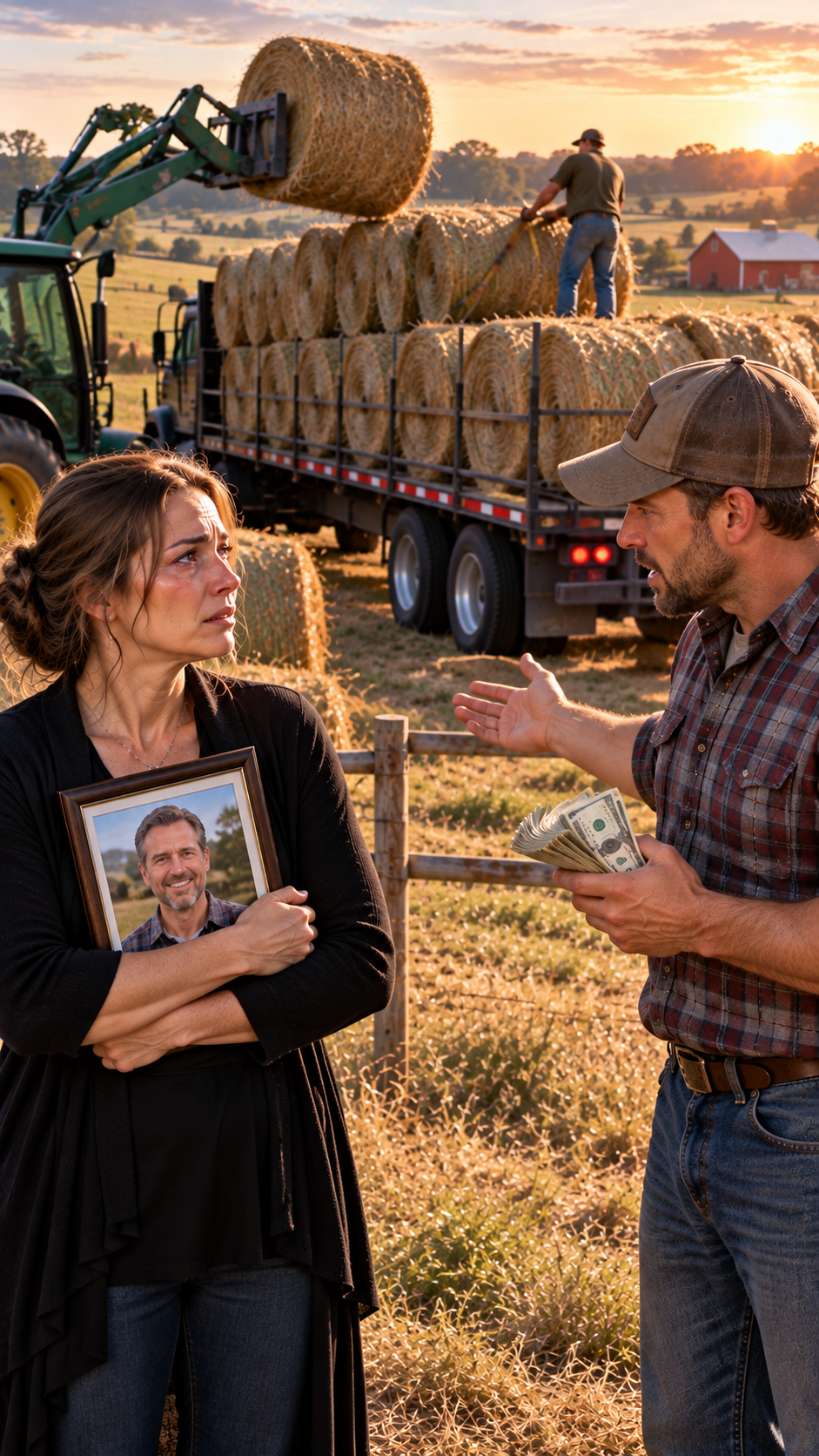
The first thing my brother-in-law did after stealing the hay my husband had spent his final weeks cutting was sit at my kitchen table and tell me I ought to be grateful he had handled the sale. He even poured himself another cup of coffee while he explained how much trouble he had saved me.
Outside, the September sun beat down on the Nebraska Sandhills. The grass beyond our barn had faded to the color of old straw, and the wind carried dust across the yard in thin, restless sheets. Our cattle stood along the fence, shifting their weight and flicking their tails at flies. They had no idea that the feed meant to carry them through winter had disappeared.
Dwayne Haller set his cup beside the sugar bowl. He was fifty-six, broad through the middle, with sandy hair that had begun to thin and a face that always seemed to be wearing an expression of injured patience. He had his brother Tom’s long jaw, but none of Tom’s quiet steadiness.
“I got eight dollars a bale,” he said. “Cash. Considering the circumstances, Karen, that isn’t bad.”
I looked at him across the table. The black dress I had worn to Tom’s funeral still hung over the back of the dining-room chair because I had not found the strength to put it away. My shoes sat beneath it, their soles marked with pale cemetery dust.
“Eight dollars for what?”
He glanced toward the window, as though the answer ought to have been obvious.
“The hay. All of it. Two hundred and twelve bales. You don’t need that much trouble right now, and I found somebody willing to take the lot.”
For several seconds, I heard nothing but the refrigerator humming and the wall clock ticking above the pantry door.
Tom had cut that hay himself. He had climbed onto the tractor in June when the doctors had already told us his time was short. By July, he could barely finish breakfast without resting, but he had insisted on checking the north field every morning. He wanted those bales stacked before the weather turned. He wanted the cattle fed, the fences mended, and the ranch ready for the months when a person couldn’t always get out of the yard without chains on the tires.
He had done all of it because he knew I would be left to manage the place.
And now his brother was telling me the hay was gone.
“You sold it?” I asked.
Dwayne leaned back. The chair creaked beneath him.
“I just said I did.”
“Without asking me?”
His mouth tightened. “Tom was my brother. I know how things work around here. You have enough on your plate. Somebody had to make decisions.”
I folded my hands on the table so he would not see them tremble.
“You knew Tom cut that hay for our cattle.”
“Karen, don’t start.”
“I haven’t started anything.”
He sighed heavily, the way people sigh when they want an audience to believe the other person is unreasonable.
“You can’t keep this place running alone. Not with Tom gone. Maybe this is a good time to think about selling some of the herd. Maybe the whole operation, eventually. You could move closer to town. You wouldn’t have to worry about fences, machinery, or frozen water tanks.”
I looked through the window at the north pasture. From the kitchen, I could see the gate Tom had repaired in August. He had worked on it for nearly an hour, stopping twice to lean against the post until his breathing settled. When I told him to come inside, he said he wanted to finish one more thing.
That had been Tom’s way of saying goodbye without admitting he was doing it.
“Who bought the hay?” I asked.
Dwayne blinked. “What?”
“I want the buyer’s name.”
He waved a hand. “Somebody local. It isn’t important.”
“It is to me.”
He shifted forward and planted his elbows on the table.
“Look, I got the money. I can give you your share once we sort things out. You ought to be thanking me for taking care of it.”
I had taught third grade in Merriman for years before Ben was born. Later, I kept the books for several ranches in the county. I knew how to balance accounts, track payments, and find the missing amount in a ledger full of numbers. Dwayne seemed to believe grief had erased all of that.
“How much did you say you received?”
“Eight dollars a bale.”
“Two hundred and twelve bales at eight dollars each comes to seventeen hundred and ninety-six dollars.”
He stared at me.
“I know how to multiply, Karen.”
“Then you know what you sold.”
His expression hardened. For a moment, I thought he might finally understand that I was not confused, not helpless, and not going to accept whatever explanation he chose to hand me.
Instead, he pushed his chair back.
“You always were like this. Tom could never make a decision without you checking every number. The man worked himself to death trying to keep you comfortable, and you still want to interrogate everybody.”
My fingers tightened against one another beneath the table.
Tom had worked himself nearly to death. That much was true. But he had not done it to keep me comfortable. We had built the ranch together, one hard season after another, and neither of us had ever mistaken survival for comfort.
Dwayne picked up his hat.
“I’ll let you settle down. We can talk about the rest later.”
He walked toward the back door without asking whether I wanted him to stay. The screen banged shut behind him, and his pickup started a few seconds later. I watched the dust rise along the driveway until the truck disappeared beyond the cottonwoods.
Then I stood in the kitchen, looking at the empty space where he had been sitting.
My husband had been dead for a little more than a week. We had buried him on Saturday, under a sky so clear that I could see the far hills beyond the cemetery. On Tuesday, his brother had arrived to tell me that the work Tom had left behind for us had been sold out from under me.
I did not cry.
I washed Dwayne’s cup, dried it, and returned it to the cupboard. Then I opened the drawer beside the stove and took out Tom’s small black notebook.
He had carried it in the pocket of his work shirt for years. Its cover was softened at the corners, and the pages smelled faintly of grease, dust, and the peppermint candies he kept in the tractor cab. He wrote down everything that mattered to the ranch: fuel purchases, veterinary appointments, rainfall, repairs, the dates when particular fields were cut.
Tom had never been good at explaining what he felt. He could repair a baler in a blowing storm and diagnose a sick calf before the veterinarian arrived, but if I asked whether he was frightened about his illness, he would ask whether we had enough coffee.
I opened the notebook to July.
The hay tally was there, written in his square, careful handwriting. Two hundred and twelve bales from the north eighty. The figures had been underlined once. Beside them was a short note about the weight and quality of the crop.
I ran my thumb across the page.
Those bales were not just grass compressed into round bundles. They were the difference between keeping our cattle and hauling them to a sale barn before winter. They were months of feed for forty cow-calf pairs, a season’s work, and the final promise Tom had made without asking whether I wanted him to make it.
He had said, “I want the hay put up before I’m done.”
I had answered, “You don’t have to prove anything to anybody.”
He had stared past me toward the field.
“I’m not proving anything.”
At the time, I believed him. I still did.
We had bought our ranch in 1998, when we were both thirty-one. It was a hundred and sixty acres of Nebraska grassland, with a house that leaned slightly toward the west and a barn that seemed to be waiting for an excuse to collapse. We had borrowed eleven thousand dollars from Tom’s mother for the down payment. The banker in Valentine studied our paperwork and warned us that the land would not care whether we were good people.
Tom said that suited us fine.
We were never wealthy. In a good year, we kept forty pairs of cattle and put away enough hay to avoid buying feed at winter prices. In a bad year, we stretched the bank balance, postponed repairs, and hoped the next calf crop would be better. Tom hauled for the local cooperative during winter, while I worked at the school and later managed the accounts for neighbors who preferred working cattle to working with numbers.
We knew the price of diesel, the cost of a broken hydraulic line, and the sound a sick calf made before it stopped trying to stand. We also knew how quickly a single mistake could undo a year’s work.
Dwayne knew those things, too. He had grown up on the same family ground, although he had never taken to ranching the way Tom had. Their father had left most of the land to Tom because Tom was older and, in their father’s judgment, more dependable. Dwayne received an old pickup and a little money.
The decision had left a bitterness that never quite disappeared.
For years, Dwayne had told stories about how Tom got the land because he was the favorite. Sometimes he said it jokingly. Sometimes he said it after a few drinks, when the joke no longer sounded like one. Tom usually let him finish, then changed the subject.
I once asked Tom why he never defended himself.
“What’s the point?” he said.
“He makes it sound as if you took something from him.”
Tom was repairing a hinge on the barn door. He tightened the last bolt and tested the hinge twice.
“Dad made his choice.”
“And you’re just going to let Dwayne stay angry?”
Tom glanced at me.
“I can’t do his growing up for him.”
That was the closest he came to explaining the distance between them.
Our son, Ben, was seventeen now. He had Tom’s height and broad shoulders, my stubborn chin, and a habit of going quiet when he was angry. He had been nine when Tom first let him steer the tractor across the lower field, and by fourteen he could handle the rake with a confidence that made me nervous.
Ben had wanted to call the sheriff when Dwayne left that morning. I could tell from the way he stood in the barn doorway, his hands clenched at his sides, watching his uncle’s truck disappear.
“Mom, we can’t let him get away with this.”
I turned the notebook over in my hands.
“We haven’t decided what we’re going to do.”
“He stole Dad’s hay.”
“I know.”
“He lied to you.”
“I know that, too.”
“Then why aren’t you doing anything?”
I looked at him. His face was red from the heat, and his eyes were wet with a fury he was trying to keep under control.
“Because I’m deciding what to do first.”
He shook his head and walked back toward the barn. A moment later, I heard the tractor start. Ben drove it toward the empty stackyard, where the hay should have been lined up in neat rows.
I stood alone in the kitchen for a long time.
The sheriff’s office was a reasonable drive away. I could report the sale, explain that Dwayne had no authority to dispose of our property, and give them Tom’s records. The value of the hay was far beyond the money Dwayne claimed to have received. There would be questions, statements, perhaps a criminal investigation.
I could do all of that.
But the cattle still needed feeding, and the weather would not wait for a case to move through the courts. I had perhaps four weeks to replace the hay before the cold nights became a serious problem. Buying enough feed at the current price could drain what little cash remained in our account.
I also knew that once I called the sheriff, there would be no putting the matter back into the kitchen where it had begun. Dwayne would defend himself. His wife would take his side or refuse to speak. Tom’s eighty-four-year-old mother would be forced to watch her sons’ families tear themselves apart.
None of that meant Dwayne should escape responsibility.
It meant I had to decide what kind of responsibility would actually help us survive.
I took a sheet of paper from the drawer and wrote down the numbers. Forty pairs. Two hundred and twelve bales missing. Seventy dollars a bale was a fair estimate for comparable hay in our area. The total value was close to fifteen thousand dollars, not the seventeen hundred and ninety-six Dwayne had accepted.
I added the cost of replacement feed, the interest on the ranch loan, and the money we would need to keep the operation running until spring.
The result was ugly.
At dusk, I carried Tom’s notebook to the porch. The north field stretched away from the house, its cut ground lying bare beneath the fading light. I could still see the tire tracks from the tractor, running in long parallel lines toward the far fence.
Tom had driven those tracks with his body failing around him. He had known he was dying. He had known I would have to continue without him. Yet he had gone out every morning and worked until the heat drove him inside.
I opened the notebook again and read the tally.
Two hundred and twelve.
I had counted those bales myself in July. I had walked the stackyard with a clipboard, checking each row as Tom called out the numbers. We had joked that the stack looked better than the barn. He said it would look even better when winter came and the cattle were fed.
I closed the notebook.
Tomorrow, I decided, I would find out who had bought our hay. I would ask the buyer what Dwayne had told him, whether the full load had been delivered, and whether there was any chance of getting it back.
If the answer was no, I would call the sheriff.
I had not forgiven Dwayne. I had not even begun to consider it. But before I let anger decide the future of the ranch, I wanted to know exactly what had happened to the last thing Tom had worked so hard to leave us.
That night, I put on my coat and went out to check the cattle. The air had cooled, and the grass moved in the breeze like dark water. Near the gate, one of the older cows lifted her head and watched me approach.
I rested my hand on the top rail.
“Your feed is coming,” I told her.
I did not know whether that was a promise or a lie.
Click here to continue reading: PART 2: The First Buyer Had a Reason to Regret His Bargain, but the Missing Hay Was Only the Beginning
Three Days After We Buried My Husband, His Brother Told Me the Winter Hay Was Already Gone
Part 1 of 12

