
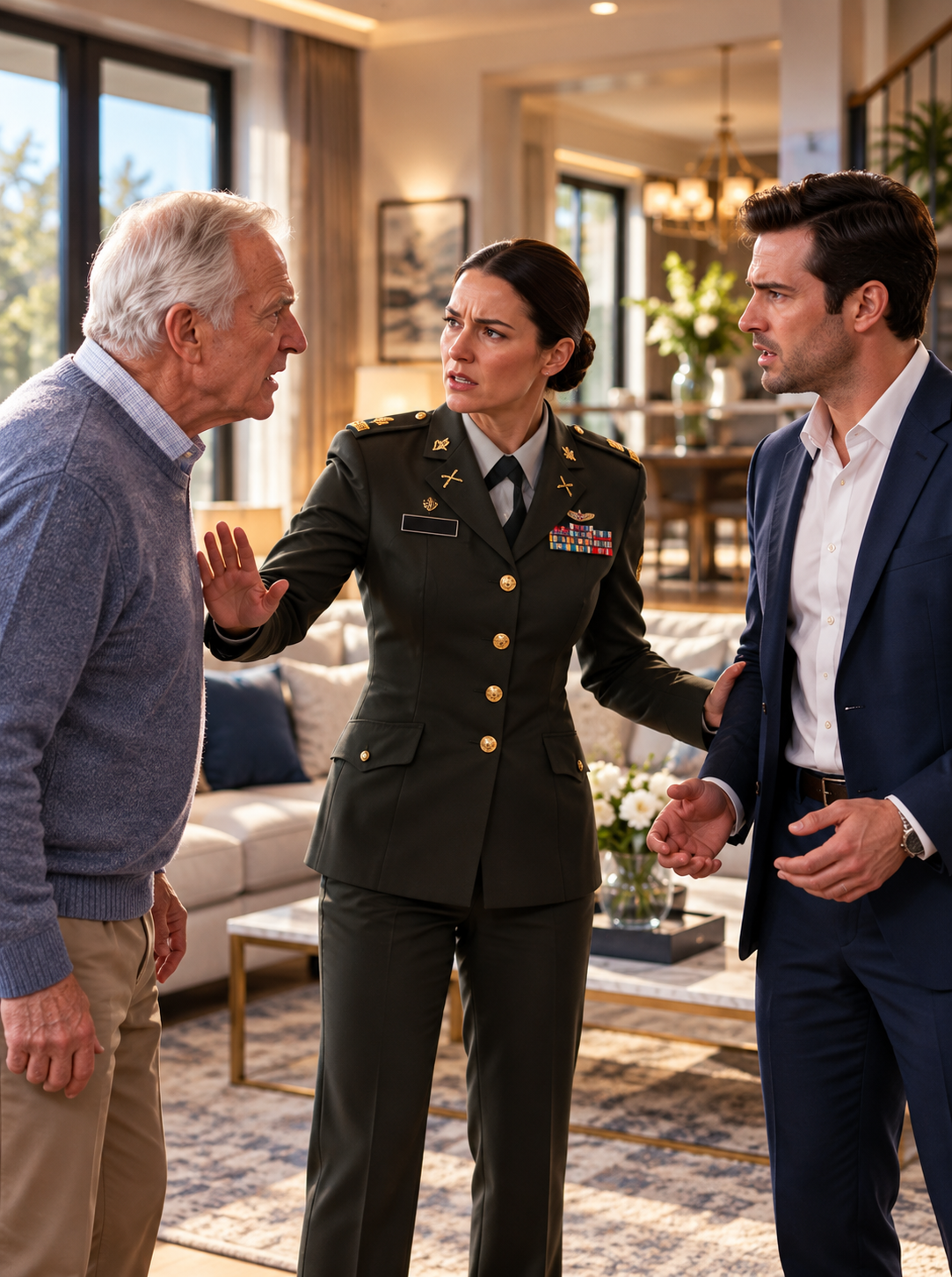
“If you bring up my military savings again, you will get one answer from me, and it will be no.”
I spoke quietly enough that my father had to stop stirring his coffee to hear me. Across the dining table, Vivian Bennett held her fork suspended above her plate, a piece of roasted potato balanced on its edge. The smile she had been wearing moments earlier remained on her face, but something behind it had gone still.
Outside, rain tapped against the dark windows. Inside, the dining room smelled of rosemary, furniture polish, and the vanilla candle Vivian had placed beside the centerpiece. Everything in the house looked arranged for a magazine photograph. The silverware was straight, the napkins folded into triangles, and the water glasses aligned precisely with the plates.
My father, Harold, sat at the head of the table. At fifty-seven, he had begun to develop a permanent crease between his eyebrows. It deepened whenever Vivian was displeased with someone, and that evening it was already visible.
Vivian lowered her fork.
“Elena, darling, nobody is attacking you. I was simply saying that you have more money than you know what to do with.”
I looked at the untouched vegetables on my plate. I had driven nearly an hour to have dinner with them during a brief period of leave, and I had spent the first twenty minutes listening to Vivian explain why the curtains in the guest bedroom needed replacing. Now she had moved on to my finances.
“I know exactly what to do with my money,” I said.
She gave a small laugh, the thin, brittle sound I remembered from my teenage years.
“Of course you do. The Army has certainly taught you to be independent. But families help each other. Your father and I are thinking about our future, and it would be comforting to know that we have a little support if something unexpected happens.”
“Then you should plan your finances around the money you actually have.”
My father put down his spoon.
“Elena,” he began.
He always said my name like a warning directed at me, even when someone else had started the argument. It was a habit so old that I could predict the rest of the conversation before he opened his mouth. He would ask me to be patient, suggest Vivian had not meant anything offensive, and remind me how difficult it was to keep a marriage peaceful.
He rarely asked Vivian to change anything.
She leaned back in her chair. Her blonde hair fell neatly over one shoulder, and the diamond on her right hand caught the light.
“I only meant that your savings could make a real difference. You have your military income, your bonuses, all those benefits. We aren’t asking you to empty your accounts.”
“That’s generous of you.”
Her eyes narrowed.
“I don’t appreciate the sarcasm.”
“And I don’t appreciate being treated like a financial resource.”
My father looked from her to me. He opened his mouth, then reached for his coffee instead.
Vivian noticed. She always noticed when he failed to support her quickly enough.
“Harold, tell her what I mean. We’re not strangers. We’re family.”
I turned toward him.
“Do you believe I’m obligated to give you my savings?”
He stared into his mug. A thin ring of coffee had dried near the handle.
“No one’s saying obligated.”
“Then what are you saying?”
“Your stepmother is thinking about security. That’s all.”
Vivian nodded vigorously, grateful for the escape route he had opened.
“Exactly. Security. We have spent years looking after this household, and it would be nice to have somewhere comfortable to gather everyone. A place near the lake, perhaps. A house with enough bedrooms for holidays. Somewhere your father could finally relax.”
There it was again: the lake house she had been mentioning for weeks.
She had shown me photographs on her phone during an earlier visit. A white property with a broad deck, large windows, and a private dock. The listing price had been high enough that I assumed she was merely indulging a fantasy.
Apparently, she had started imagining my savings as part of the purchase price.
“You should speak to a mortgage adviser,” I said. “They can tell you what you can afford.”
“We already have,” Vivian replied.
The speed of her answer made me look up.
She recovered quickly, reaching for her wineglass.
“We’ve looked into a few things. Nothing serious. We haven’t committed to anything.”
My father rubbed his thumb along the handle of his mug. His shoulders had drawn inward, and his gaze stayed fixed on the tablecloth.
I had seen that posture before. I had seen it when Vivian criticized my grades, when she complained about the cost of my school lunches, and when she told me that military service was a convenient way for young people to avoid becoming responsible adults.
It was the posture of a man who knew something was wrong but hoped that remaining quiet would prevent him from having to choose a side.
I was twenty-nine years old, an Army combat medic. I had spent years learning to make decisions under pressure, to distinguish facts from assumptions, and to keep my hands steady when another person’s life depended on what I did next.
Yet one dinner at my father’s house could still make me feel sixteen again.
That was why I put my fork down carefully before answering.
“My savings are not available for your house. My credit is not available for your house. My name is not available for your house. Please make your plans without including me.”
Vivian’s smile disappeared.
“You make everything sound so hostile.”
“I’m being clear.”
“After everything your father and I have done for you?”
My jaw tightened.
There was the familiar accounting. Vivian never made a request without eventually producing a bill for my childhood.
She had married my father when I was fourteen, five years after my mother died. At first, I had wanted us to become a family. I had tried to help around the house, thanked her for meals, and asked whether she needed anything from the grocery store when I came home from school.
The effort had not bought affection. It had simply given her more opportunities to measure what I cost.
When I was sixteen, she once stood at the kitchen island with a stack of bills and announced that keeping another person alive was more expensive than most people understood. She listed groceries, electricity, laundry detergent, shampoo, and the extra gas required to drive me places.
My father had been in the next room. I remembered the television continuing to play while I waited for him to say something.
He never did.
Years later, I enlisted partly because the Army offered educational opportunities, but also because I needed a life in which my existence did not require constant justification. I wanted a paycheck that belonged to me, a room no one could enter without permission, and the freedom to open my mail without wondering who might have read it first.
I had achieved those things. I had saved diligently, avoided unnecessary debt, and built an emergency fund because I knew how quickly circumstances could change.
Vivian knew those things, too.
She knew I was careful with money. She knew I rarely borrowed and that I had maintained a strong credit history. She knew I had spent years overseas, where my earnings accumulated while my personal expenses remained relatively low.
She had mistaken those facts for an invitation.
“I am grateful for what Dad provided when I was growing up,” I said. “That doesn’t mean you can decide what I owe you.”
“That’s an ugly way to talk about family.”
“Then stop making family sound like a debt.”
For several seconds, the only sound was rain running through the gutter outside.
My father finally raised his head.
“Vivian didn’t mean you should hand over everything you’ve saved.”
I watched him carefully.
“Did she ask you to talk to me about my money?”
His eyes shifted toward her.
It lasted less than a second, but I saw it.
Vivian set her glass down with a sharper movement than necessary.
“Harold and I discuss our future. That’s what married people do.”
“I’m asking Dad a question.”
“And he’s answering you.”
“No,” I said. “He’s explaining why you shouldn’t be held responsible for what you said.”
My father flinched. Vivian’s cheeks colored.
“You’ve become terribly confrontational,” she said. “I don’t know whether it’s the Army or all that time away, but you seem to think everyone is against you.”
“I think people should ask before they involve me in their financial decisions.”
“Fine. Then let me ask. If we found a way to make the lake house work, would you consider helping us?”
“No.”
“You haven’t even heard the details.”
“I don’t need to.”
Her expression hardened. For the first time that evening, she stopped pretending the conversation was about family security.
“You have thousands sitting in accounts while your father and I are trying to build something for our retirement. Surely you can understand that money does more good when it’s used.”
“It’s being used. It’s securing my future.”
“And what about ours?”
“That is something you and Dad need to work out.”
She turned to my father, waiting for him to restore the balance of power. He stared at his hands.
Then she looked at me again, and I recognized the calculation in her face. She was deciding whether to push harder or retreat until another opportunity appeared.
She chose to push.
“Well, I suppose we’ll have to manage without you. It’s just disappointing to see someone with so much refuse to help the people who raised her.”
I stood and folded my napkin beside my plate.
“I’m going to make this very simple. If you bring up my military savings again, I will stop being polite about it. I will deal with you directly, and you will understand exactly why none of my money belongs to you.”
My father looked up at last.
I held his gaze.
“Do you understand what I’m telling you, Dad?”
He looked frightened, but not surprised.
That detail mattered more than anything Vivian had said.
He wasn’t reacting like a man hearing an outrageous accusation for the first time. He looked like someone who had been waiting for a conversation he hoped would never happen.
Vivian folded her arms.
“You’re threatening me in my own home?”
“No. I’m setting a limit.”
“You’re being ridiculous.”
“Then you shouldn’t have a problem respecting it.”
I picked up my jacket from the back of the chair. My father pushed his chair away from the table as if he might follow me, but he did not stand.
“Elena, please. Let’s not end the evening like this.”
I paused beside the doorway.
“How would you prefer to end it? With me agreeing to pay for a house I don’t want?”
“That’s not what I said.”
“Then tell me what you did say.”
He looked at Vivian.
She stared back at him, and whatever answer he had been preparing disappeared.
I left without waiting for another excuse.
The rain had stopped, leaving the driveway dark and glossy beneath the porch lights. As I walked to my car, I could see my father through the dining room window. He was still seated at the table, his head lowered while Vivian spoke to him with sharp, deliberate movements.
For a moment, I wanted to go back inside. I wanted to tell him that I wasn’t asking him to choose between loving his wife and loving his daughter. I was asking him to recognize that love did not give anyone permission to take what belonged to another person.
But I had explained that distinction for years, and it had never changed anything.
I drove away.
During the journey back, I tried to persuade myself that the evening had been nothing more than an unpleasant family argument. Vivian was ambitious, demanding, and accustomed to getting her way. My father avoided conflict. Those were familiar problems, not necessarily dangerous ones.
I repeated that explanation until it almost sounded convincing.
Three days later, sitting in my barracks room thousands of miles from home, I discovered why my father’s expression had troubled me.
Someone had already begun using my identity.
And the person who knew me well enough to do it had counted on my distance, my silence, and my father’s willingness to look away.
Click here to continue reading: PART 2: A Single Credit Alert Led Me Toward a Secret My Father Had Already Helped Conceal
The Dinner Where My Stepmother Made One Last Mistake and My Father Revealed More Than He Intended
Part 1 of 12

