
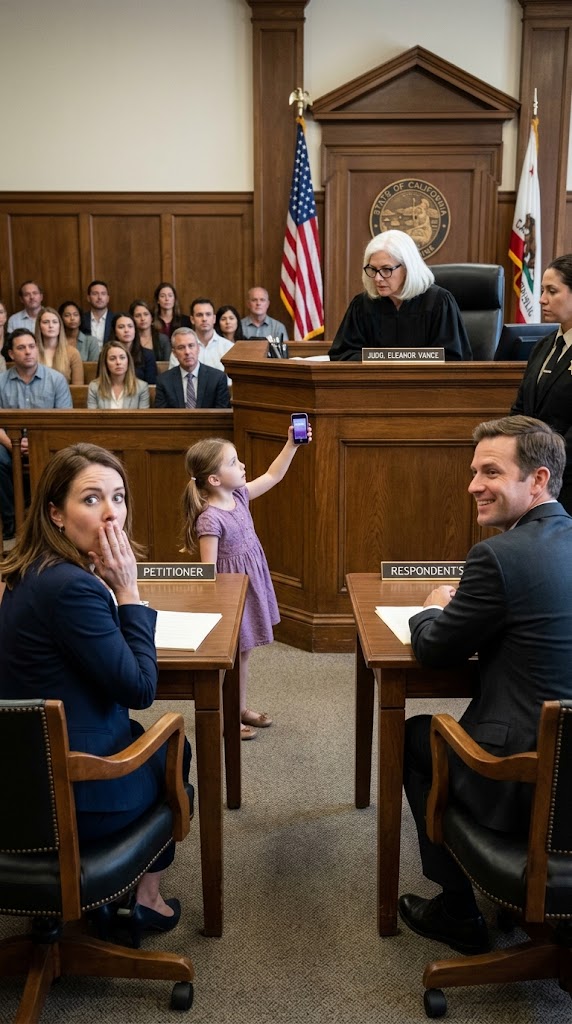
“Your Honor, I am asking for the house, sole custody of our daughter, and a court order preventing my wife from interfering with either one.”
Daniel Bennett delivered his request with the calm confidence of a man ordering lunch. He stood beside his attorney in a charcoal suit, one hand resting on the table, his wedding ring catching the fluorescent light. Across the aisle, I sat so rigidly that my shoulders had begun to ache. My lawyer, Rebecca Hayes, had warned me that Daniel would make the hearing ugly. I had not expected him to sound quite so pleased about destroying my life.
Judge Margaret Collins glanced down at the documents before her. The courtroom smelled faintly of old paper and floor polish. Somewhere behind me, a chair creaked. Daniel’s attorney was already preparing to explain why his client deserved the home we had shared for eleven years and why I, the mother of his six-year-old daughter, supposedly posed a danger to the child.
Then Lily stood up.
She was wearing the pale yellow dress I had ironed for her that morning, the one with tiny embroidered flowers around the collar. Her white tights had slipped a little around her ankles, and one of her shoes was untied. She had been quiet for most of the hearing, sitting beside a court-appointed support worker near the back wall. Now she reached into her dress pocket and drew out a small purple phone.
“Your Honor,” she said, her voice barely carrying across the room, “Mom doesn’t know I have this.”
Daniel’s expression changed before anyone else moved. His lips parted, and the color seemed to drain from his face. For a second, he looked less like the successful businessman who had spent the morning describing my supposed failures and more like someone who had just heard a lock turn behind him.
“Where did she get that?” he demanded.
The judge raised one hand. “Mr. Bennett, you will wait until I ask you to speak.”
Lily clutched the phone against her chest. I looked at my daughter, then at my husband, trying to understand what could possibly connect the two expressions I had just witnessed. I had never seen that device before. I had no idea what was stored inside it, who had given it to her, or why a six-year-old child had decided to bring it into a courtroom.
But I knew Daniel well enough to recognize fear when I saw it.
Three months earlier, I would have laughed at the suggestion that my husband was capable of building a case against me. I would have defended his character, explained his difficult temperament, and insisted that whatever trouble we were experiencing was temporary. I had spent eleven years believing that the man who held my hand at our wedding was fundamentally the same man who sat beside me at breakfast, asked about Lily’s school day, and kissed us both before leaving for work.
I was wrong about more than I wanted to admit.
My name is Claire Bennett. Before marriage and motherhood reshaped my daily life, I worked as a forensic accountant. I spent seven years tracing suspicious transactions, examining financial statements, and finding the small inconsistencies that exposed much larger deceptions. I knew how to follow money through a maze of accounts. I understood how people hid liabilities behind respectable paperwork and how a perfectly ordinary document could conceal an extraordinary lie.
Then I married Daniel, and gradually, without ever making a formal decision to do so, I stopped looking at my own life with that same professional skepticism.
His construction company had grown quickly during the first years of our marriage. We bought a comfortable house in a quiet neighborhood, replaced our aging cars, and started talking about the future as though financial security were something we had permanently achieved. My inheritance from my parents helped us buy the property. My credit history supported several early business loans. I also contributed savings I had accumulated before leaving my career to care for Lily.
Daniel always called those contributions our foundation. I believed him when he said we were building something together.
When the company began losing money, however, his language changed. Expenses I questioned became evidence that I did not understand business. Bills I wanted to review were described as distractions. Whenever I asked why a supplier had not been paid or why a loan payment had increased, Daniel accused me of undermining him when he needed support.
“You know I have to make decisions quickly,” he once told me, closing his laptop before I could examine a spreadsheet. “I can’t stop to explain every detail to you.”
I remembered the sentence because it had surprised me. Daniel had once admired my ability to notice details. Now he seemed to regard that ability as an insult.
The real fracture came when I discovered his affair with Vanessa, his twenty-eight-year-old office manager. I found a message on a tablet he had left charging in our bedroom. The message itself was ordinary enough: a dinner reservation, a reference to a hotel, a private joke about something that had happened the previous evening. It was the familiarity that hurt most. He had been sharing pieces of his life with another woman while returning home to tell me I was imagining problems.
I confronted him that night after Lily had gone to bed. My hands were trembling, but I kept my voice low because I did not want our daughter to hear us through the hallway.
“How long has this been going on?”
Daniel looked at the screen, then at me. He did not appear embarrassed. He did not ask what I had seen or attempt to explain the messages. He simply exhaled as though I had created an inconvenience.
“You’ve been useful to me, Claire,” he said. “That doesn’t mean I need you involved in every part of my life.”
I stared at him, waiting for the words to change meaning. They did not.
Two weeks later, he filed for divorce.
His petition described me as emotionally unstable, financially irresponsible, and incapable of providing a suitable home for Lily. The man who had once trusted me to manage our household finances now portrayed me as someone who could not be trusted with a bank statement. The man who had left our daughter with me every day while he traveled for business suggested that my parenting had become a source of danger.
Daniel had hired an expensive family-law firm. I learned that he had consulted his mother, Eleanor, before filing. She had always treated me politely in public, but she had never entirely accepted that her son had chosen a wife who would question him. Once the divorce began, her reservations became something much more deliberate.
She started appearing at the house without warning, bringing groceries we had not requested and asking Lily questions about our arguments. She would crouch beside my daughter and speak in a sugary voice that made my skin tighten.
“Does Mommy get upset with you, sweetheart?”
Lily would look at me before answering.
“Sometimes Mommy tells me to put my toys away.”
Eleanor would sigh as though my daughter had confessed to something terrible. “Well, all mothers get overwhelmed.”
At the time, I thought she was merely being intrusive. I did not understand that she was collecting fragments of ordinary family life and preparing to give them a different meaning.
The first time I realized how far Daniel was willing to go, he showed his attorney photographs of Lily crying beside an overturned dinner plate. The pictures had been taken on an evening when she accidentally knocked her dinner onto the kitchen floor. I remembered the crash of ceramic, the sauce spreading across the tiles, and Lily’s frightened face when Daniel suddenly raised his voice.
He had insisted that she stand beside the mess while he photographed her. I had protested, telling him she was already upset and needed reassurance, not a camera pointed at her. He accused me of making excuses for bad behavior.
Later, after Lily had calmed down, I cleaned the kitchen and sat with her on the sofa until she fell asleep against my shoulder. I assumed the incident would become one of those unpleasant family memories that eventually lost their sharpness.
Instead, Daniel presented the photographs in court as proof that I had frightened our daughter.
“Look at her expression,” he told the judge. “This is what happens when her mother loses control.”
My stomach tightened so severely that I had to press my feet against the floor to keep them still. He had not merely misunderstood what happened. He had taken the evidence of his own cruelty and assigned it to me.
Beside him, Eleanor dabbed her eyes with a folded tissue.
“Claire screams at Lily all the time,” she testified. “That child is terrified of upsetting her mother.”
I looked at Lily, who was sitting quietly with the support worker. Her small hands were folded in her lap. She had learned, during the past several weeks, that adults could say things about her family that she did not know how to correct. I wanted to stand up and tell the court everything I had seen, but Rebecca touched my wrist beneath the table.
“Let her finish,” she whispered. “We will respond with evidence.”
Rebecca had become my anchor in a process that seemed designed to make me doubt my own memory. She was precise, patient, and difficult to intimidate. She had also noticed something that Daniel appeared to have forgotten: I had not spent seven years working in forensic accounting without learning to preserve records.
Throughout our marriage, I had kept copies of tax returns, loan statements, business summaries, and household accounts. At first, I had done it out of habit. Later, when Daniel’s explanations about the company’s finances became inconsistent, I began organizing the documents more carefully. I did not yet know what I would find. I only knew that the numbers no longer matched the stories I was being told.
Three weeks before the hearing, I discovered transfers from our joint accounts to a company controlled by Vanessa. The payments had been divided into smaller amounts and recorded under descriptions that looked routine at first glance. When I compared them with the business statements Daniel had previously shared with me, the discrepancies became impossible to dismiss.
I gave the records to Rebecca. She arranged for an independent forensic accountant to examine the transactions and began requesting the original documents behind several loans connected to the house.
The preliminary findings were alarming. Hundreds of thousands of dollars appeared to have moved through accounts connected to Vanessa’s company. There were also signs that Daniel had used our jointly owned home as security for a business loan without my informed consent. One document carried a signature that was supposed to be mine.
It did not look like my signature.
I did not tell Daniel what we had discovered. I had spent too many years watching him become defensive whenever I asked an ordinary question about money. If he suspected that I had evidence he could not control, I feared he would destroy records, transfer assets, or find another way to make the truth harder to establish.
Even with those financial questions unresolved, I understood that the custody case required more than proof that Daniel had mishandled money. A judge needed to know what was happening to Lily and whether either parent was using her as a weapon in the divorce.
That was why the photographs frightened me. Daniel had managed to turn a moment of distress he had caused into a story about my supposed instability. Eleanor had reinforced that story under oath. Their version of our home was beginning to take shape in a courtroom, and I had no recording of the events they were misrepresenting.
I had the documents. I had my memories. I had a lawyer who believed me.
But I could not make a six-year-old explain what she had seen without risking more pressure on a child who already seemed afraid to speak.
Now, in the courtroom, Lily was standing with a purple phone in her hands.
Judge Collins leaned forward, her expression softening without losing its authority.
“Lily, you don’t have to explain anything you aren’t comfortable explaining. Can you tell me whether this belongs to you?”
Lily nodded.
“Did someone ask you to bring it here today?”
She shook her head.
Daniel shifted in his chair. His attorney whispered something to him, but Daniel barely seemed to hear. His eyes remained fixed on the phone.
Rebecca leaned toward me. “Did you know she had a device like that?”
“No,” I whispered.
I was certain of the answer. I had never bought Lily a phone, and I had never seen her carrying one. Yet she held it as though it were precious, her thumb resting against the edge of its purple case.
The judge asked the court officer to stand near Lily and told the lawyers that no one would question the child aggressively. The room settled into a strained quiet.
Then Lily looked toward me.
For an instant, I saw the little girl who used to run into the kitchen whenever she heard my key in the front door. Her eyes were wet, and her lower lip trembled, but she did not put the phone away.
“Daddy said Mommy would have to leave,” she whispered. “But I heard him talking about it before.”
Daniel pushed back from the table so abruptly that his chair scraped against the floor.
“Lily, sweetheart, you remember what we discussed.”
The judge’s voice cut through the room.
“Mr. Bennett, sit down. Now.”
Lily flinched at the sound of his voice, even though the judge was not speaking to her. I watched her shoulders rise and her fingers tighten around the phone.
And in that small movement, I understood something that none of Daniel’s photographs had shown.
My daughter was not afraid of being asked to tell the truth.
She was afraid of what her father might do when she did.
Click here to continue reading: PART 2: The Little Purple Phone Forced the Judge to Stop the Hearing, and My Husband’s Panic Revealed More Than His Words Ever Could
My Husband Asked the Court to Take Everything From Me, but Our Daughter Was Holding Something He Never Expected to See
Part 1 of 12

