
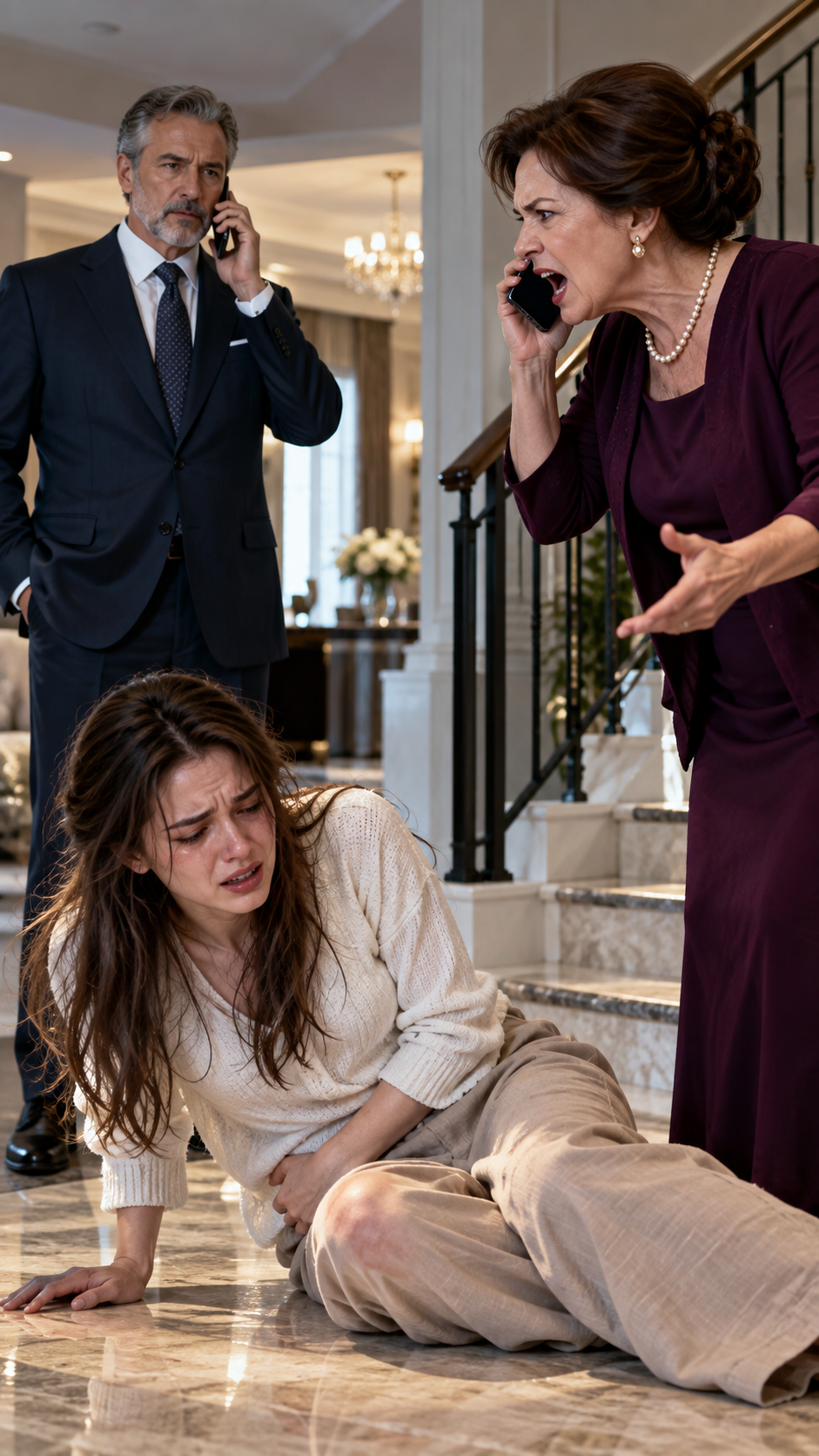
The marble beneath my cheek was so cold that, for several seconds, I mistook the sensation for the numbness spreading through my body. I tried to lift my head, but pain tightened around my ribs, and the staircase above me blurred into a pale ribbon of polished wood and cream-colored walls. Somewhere nearby, a telephone rang once before my mother-in-law answered it. Her voice carried through the entrance hall with the effortless confidence of someone who had never expected to be contradicted in her own house.
“Arthur, you need to come and collect your daughter. We have reached the end of our patience with her. Frankly, she has become more trouble than she is worth.”
Eleanor Whitcomb spoke as though she were canceling an inconvenient appointment. I could see the hem of her expensive trousers from where I lay, along with the immaculate black shoes she wore inside the house despite repeatedly criticizing the way I tracked rainwater across the kitchen floor. She didn’t look down at me. She didn’t ask whether I could breathe. She simply turned slightly toward the tall windows, apparently more concerned with the conversation than with the woman lying injured several feet behind her.
My husband, Preston, stood beside the console table near the front door. He was adjusting the cuff of his pale blue shirt, a small movement he often made when he wanted to appear composed during an uncomfortable conversation. I looked directly at him, hoping he would finally say something, anything, that acknowledged what had just happened. His gaze passed over me for a moment before returning to his mother. He remained silent.
That silence hurt almost as much as my ribs.
I tried to remember the exact sequence of events. There had been an argument about documents Preston wanted me to sign. I had asked why my name appeared on a financial guarantee connected to one of his family’s businesses. He had called the question unnecessary. Eleanor had joined us in the hallway, insisting that I was embarrassing everyone by treating an ordinary family matter as though it were a criminal investigation. Then there had been movement on the stairs, a sharp exchange of words, and the terrible instant when the railing seemed to slip beyond my reach.
My memories came in fragments. I knew I had fallen. I knew I was hurt. But I couldn’t yet separate the physical shock from the fear that had settled over me when I realized neither my husband nor his mother was rushing to help.
On the telephone, my father answered something I couldn’t hear.
Eleanor gave a short, dismissive laugh. “You seem to have misunderstood me, Arthur. I’m offering you an opportunity to take responsibility for your daughter again. We have done everything we reasonably could, and this is what we get in return.”
My father spoke again. His voice was quieter than hers, but I recognized the firmness beneath it. I had heard that tone when I was a child and he was explaining why a promise mattered, or when a stranger had tried to intimidate someone who couldn’t afford to defend himself. It was the voice he used when he had stopped arguing and started paying attention.
“If my daughter has been injured, Eleanor, I expect an honest account of what happened and an explanation of why no one has called for medical assistance.”
For the first time, Eleanor looked toward me. Her expression tightened, not with concern, but with irritation that I was still conscious enough to hear her conversation.
“Oh, she’s alive,” she replied. “And perfectly capable of causing another scene, I imagine. Don’t make this more dramatic than it needs to be.”
My father said something else, and her eyebrows rose.
“Are you threatening me?” she asked, almost amused. “You should think carefully before making demands of this family.”
There was a pause.
Then my father delivered a single sentence that changed the atmosphere in the room, although Eleanor didn’t understand why.
“Do not move anything, destroy anything, or ask anyone to change their account of what happened today.”
She laughed again. “You have no idea who you’re talking to.”
“I know exactly who I’m talking to,” he answered.
Eleanor ended the call.
I watched her slide the phone into her handbag. Preston finally approached, but he stopped far enough away that he didn’t need to bend down or touch me. His face had the strained expression of a man inconvenienced by a situation he had hoped to keep private.
“You shouldn’t have turned this into a family confrontation,” he said.
I stared at him, struggling to understand how he could possibly believe that was the important thing to say.
“I fell down the stairs.”
He looked toward the entrance, where Eleanor was already instructing someone to bring her a glass of water.
“I know what happened.”
“Then call an ambulance.”
He hesitated for a moment, as though considering whether my request might create unnecessary complications. Finally, he took out his phone. I closed my eyes and concentrated on breathing while he spoke to the emergency operator in a clipped, carefully controlled voice that omitted the argument entirely.
By the time the paramedics arrived, I had begun shaking. One of them knelt beside me and asked whether I could move my fingers and toes. Another checked my breathing and carefully secured my shoulder. When they asked how I had fallen, I looked toward Preston. He stood several steps away, his hands clasped in front of him.
“I lost my footing,” I said.
The words came automatically. They were easier than explaining the argument, easier than admitting that I couldn’t yet remember every movement clearly, and easier than confronting the possibility that the people around me might use my confusion against me.
The paramedic nodded but continued asking questions. He recorded my answers without suggesting what I should say. As they prepared to move me onto a stretcher, I heard Eleanor speaking to a housekeeper about the disruption to the afternoon’s schedule.
Not once did she ask whether I would recover.
The journey to the hospital passed in flashes of light, traffic, and unfamiliar voices. At the emergency department, medical staff examined me, ordered imaging, and began treating the injuries caused by the fall. I had two fractured ribs, a significant shoulder injury, and bruising that spread across my side. The doctors explained that I would need time to heal and that certain movements could cause considerable discomfort for several weeks.
I was relieved to hear that my injuries could be treated. Yet beneath that relief was a growing dread about what would happen once I left the hospital.
My seven-year-old daughter, Lily, had been in the house when the argument occurred. I didn’t know what she had heard, whether anyone had explained why I was being taken away in an ambulance, or whether Eleanor had already begun telling her a version of events in which I was the person responsible for everything.
I tried calling Preston, but he didn’t answer.
A message arrived several minutes later.
Lily is with my mother. Rest and stop worrying about things you cannot control.
I read it twice. There was no question about my condition, no offer to bring Lily to see me, and no acknowledgment that his daughter might be frightened. His concern appeared to begin and end with ensuring that I remained away from the house.
I had spent almost nine years married to Preston Whitcomb, convincing myself that his family’s manner was simply the unavoidable consequence of wealth, social expectations, and generations of living according to rules I had never learned. They valued expensive restaurants, private clubs, immaculate gardens, and conversations in which nobody admitted uncertainty. My own life had always been simpler. I worked part-time as a speech therapist at an elementary school, helped children overcome communication difficulties, and spent my evenings reading with Lily or preparing lunches for the following day.
The Whitcombs often treated those routines as evidence that I lacked ambition. Preston rarely said so directly. He preferred a small smile, a raised eyebrow, or a remark about how fortunate I was to have married into a family that could provide so much.
I had once believed that his quiet manner meant he was kinder than his parents. Now, lying in a hospital bed, I wondered how much of that belief had been built on my willingness to overlook what he refused to say.
An attorney arrived that afternoon carrying a worn leather briefcase. I assumed Preston had sent him to discuss medical arrangements or the possibility of returning home. Instead, he introduced himself as Jonathan Hale and explained that my father had retained him.
“Your daughter is safe,” Jonathan said before I could ask about Lily. “She’s currently with your father, and arrangements are being made to ensure she remains properly cared for.”
I felt my shoulders loosen for the first time since the fall.
“Dad went to get her?”
“He did. He also asked me to come here because there is a legal matter you need to understand before anyone approaches you with additional paperwork.”
He placed a folder on the small table beside my bed. Inside were copies of documents filed by Preston’s family requesting emergency custody of Lily. The application described me as emotionally unstable, financially irresponsible, and temporarily incapable of providing a safe home for my daughter.
I read the allegations slowly, hoping that I had misunderstood them.
“They know I take care of her,” I whispered. “I’m the one who takes her to school, attends her appointments, helps with her reading, and stays home when she’s sick.”
Jonathan didn’t dismiss my distress with reassuring generalities. He explained which statements required evidence, which allegations appeared inconsistent with the available records, and what steps could be taken to protect Lily’s interests during the proceedings.
“Your father understands your role in her life,” he said. “He wants the facts preserved before anyone has an opportunity to distort them.”
I looked again at the documents. The words seemed to turn an ordinary life into something unrecognizable. My modest salary had become proof of financial weakness. My injuries had become evidence of parental incapacity. Even my habit of avoiding arguments had apparently been interpreted as an inability to make independent decisions.
“How can they do this while I’m lying here?”
“An application is not a judgment,” Jonathan replied. “We will respond through the proper legal process.”
He opened a second folder and showed me a financial agreement carrying my name. The document appeared to make me personally responsible for a substantial obligation connected with one of the Whitcomb companies. A signature appeared at the bottom of the page.
I knew immediately that something was wrong.
The letters resembled my handwriting, but the final curve of the signature was too narrow, and the capital in my surname lacked the small backward stroke I had used since school. I had signed thousands of documents throughout my life. I knew the difference between my actual signature and a convincing imitation.
“I didn’t sign this.”
Jonathan watched my face carefully.
“Your father had reason to question it as well. We need to determine where the document came from, who prepared it, and whether other records support or contradict its contents.”
My thoughts returned to the papers Preston had brought home during the previous year. He would arrange them across the kitchen table and explain that they concerned insurance, property administration, or routine financial updates. If I asked to read every page, he would sigh and tell me the accountants had already reviewed everything. Sometimes I signed because I trusted him. Other times I signed because I was tired of being made to feel foolish for asking questions.
Now I could no longer tell which decisions had been careless and which had been deliberately engineered to keep me uninformed.
The door opened, and my father walked into the room.
Arthur Dawson looked much as he always had: an ordinary brown cardigan over a buttoned shirt, comfortable shoes, and the same slightly weathered face I remembered from childhood. He carried no grand gestures or expressions of righteous anger. He simply came to my bedside, took my hand, and looked at me as though everything else in the room could wait.
“I’m here, sweetheart.”
I began to cry.
For years, Dad had asked whether I was genuinely happy with Preston. I had answered that marriage required compromise, that every family had difficult personalities, and that I was learning to fit into a different world. He had never demanded that I leave. He had never threatened Preston or attempted to control my decisions. He had simply listened, occasionally asking a question that stayed with me long after our conversations ended.
Now he didn’t remind me of any warning I had ignored.
He sat beside me and allowed me to cry until I could speak again.
“Lily is safe,” he said. “You need time to recover, and we’ll make sure nobody takes advantage of that.”
I looked at the folders Jonathan had left open.
“Dad, what is happening? Why would they try to take Lily away from me? And why is my name on a document I never signed?”
He glanced at Jonathan before answering.
“Those are the questions we’re going to establish the answers to. Not through guesses, not through anger, and certainly not by allowing anyone to frighten you into accepting their version of events.”
Jonathan closed the folder and explained that my father’s earlier professional experience had made him particularly careful about preserving evidence. Dad had spent decades working in federal legal and investigative roles involving financial misconduct, institutional corruption, and cases in which influential people believed their reputations could protect them from scrutiny.
I turned toward him in disbelief.
“You always told me you worked in government administration.”
“I did,” he said. “That description wasn’t untrue. It simply wasn’t the whole story.”
I remembered his old sedan, his habit of comparing grocery prices, and the simple brick house where he had lived since retiring. He had never spoken about powerful people or complicated investigations. He had attended school performances, repaired broken furniture, and spent his weekends helping neighbors with ordinary problems.
Nothing about the father I knew resembled the intimidating figure Eleanor seemed to imagine he must be.
Perhaps that was precisely why I had never understood how much he knew about the ways people concealed wrongdoing behind respectable appearances.
Dad leaned closer.
“Listen to me carefully. You don’t have to solve every problem tonight. You only have to tell the truth as you remember it, and let us protect the evidence while you recover.”
For the first time that day, I felt something stronger than fear. It wasn’t confidence that everything would turn out well. It was the knowledge that I no longer had to face every decision alone.
Jonathan gathered his papers and prepared to leave. Before he reached the door, his phone vibrated. He read the message, then returned to the bedside.
“Someone claiming to represent the Whitcomb family’s insurance provider has been asking hospital staff about your condition and the identities of your visitors,” he said. “The hospital declined to release the information.”
Dad’s expression changed almost imperceptibly.
“Did they explain why they needed it?”
“They said it was related to an incident report.”
Dad looked at the closed folder containing the disputed signature.
“Then they can make their request through the proper channels.”
Jonathan nodded.
I stared at the papers, thinking about Eleanor’s laughter, Preston’s silence, and my father’s warning not to let anyone alter the account of what happened.
Whatever had begun on that staircase had not ended when the ambulance carried me away.
And somewhere beyond the hospital walls, the people who had spent years insisting that I was too insignificant to understand their affairs had begun to realize that I might know more than they expected.
Click here to continue reading: PART 2: The Financial Agreement Carried My Name, but One Small Mistake Revealed That Someone Had Rewritten My Life
My Mother-in-Law Called My Father While I Lay Injured, Never Imagining What His First Question Would Reveal
Part 1 of 12

