
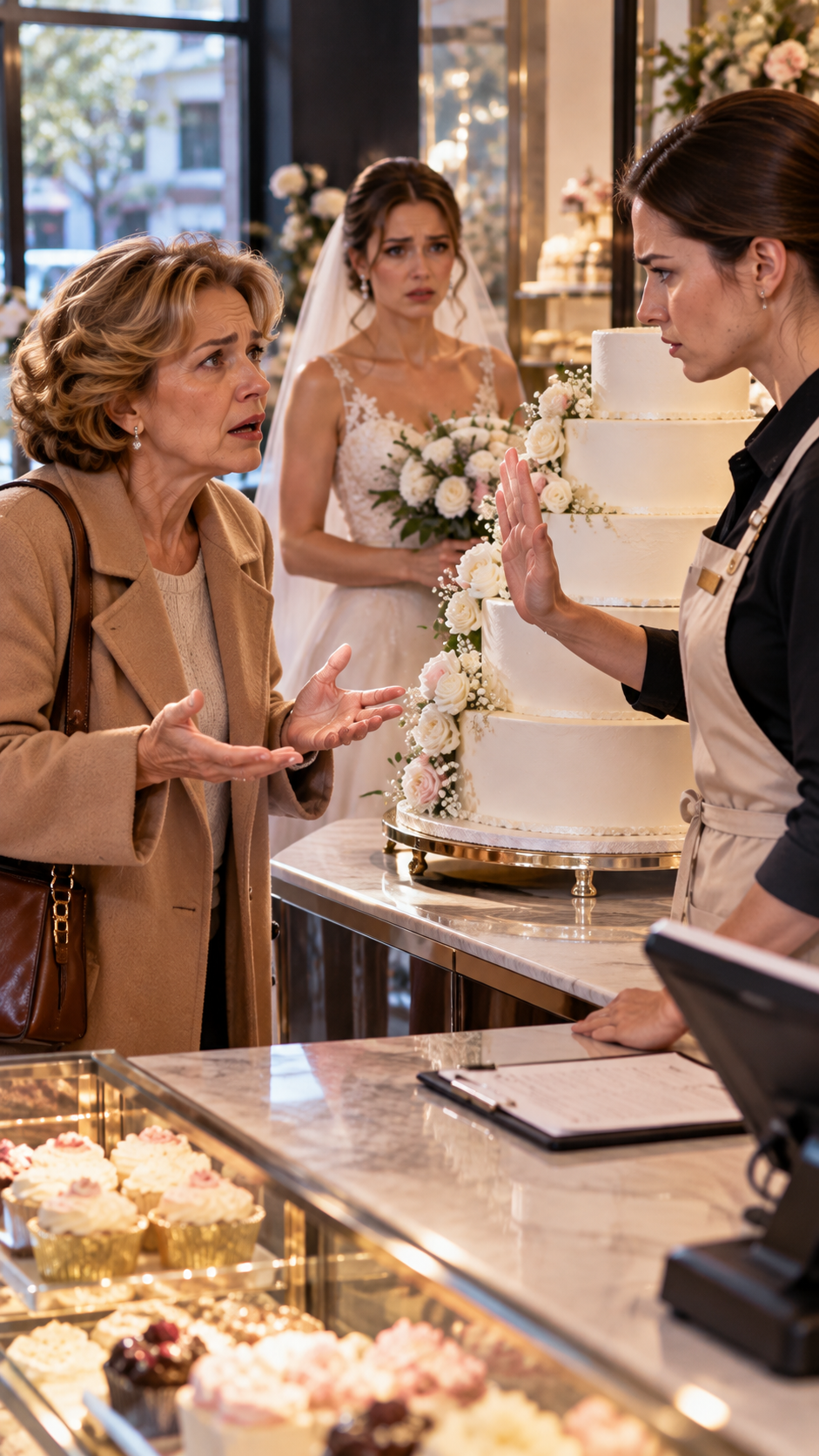
The baker stopped smiling the moment she read the name on my order. One second earlier, she had been reaching for a clipboard behind the counter. The next, she stood perfectly still, her eyes moving from the computer screen to my face as though she were trying to decide how much trouble the truth would cause.
“Could you give me a moment, please?” she asked.
I glanced at the clock above the display case. It was nearly eleven, and I still had flowers to collect, place cards to check, and a hundred other details to settle before my daughter’s wedding the following morning. My feet ached from walking through shops since breakfast, and the smell of warm sugar coming from the bakery had made me realize I hadn’t eaten anything substantial all day.
“Of course,” I said. “Is there a problem with the order?”
She didn’t answer immediately. Instead, she clicked something on the computer, read it again, and pressed her lips together.
“I’m afraid there’s a note attached to this order.”
“What kind of note?”
She looked at me with an expression that was almost apologetic. “I’m not permitted to release the cake to you.”
For a moment, I genuinely thought I’d misunderstood her. I had paid the deposit weeks earlier, confirmed the design twice, and arranged the final payment with my daughter, Emma. The bakery had even sent us photographs of the finished cake the previous afternoon.
I let out a short laugh, expecting her to join in.
“I’m Emma’s mother,” I explained. “The order is under her name, but I’m collecting it for her. She has a thousand things to do today, and I promised I’d take care of this.”
“I understand.”
“Then perhaps you could check the note again.”
“I already have.”
Her voice remained polite, but she no longer looked uncertain. Whatever she had discovered on that screen had changed an ordinary collection into something she considered serious.
I took the order confirmation from my handbag and placed it on the counter. My hands were beginning to feel clammy, though the shop was comfortably cool.
“Here is the reference number. The balance has been paid. Emma gave me permission to collect it, and I can call her right now if you need to speak with her.”
The baker glanced at the printed confirmation before returning to her screen.
“It’s not a payment issue, Mrs. Harris.”
My surname sounded strange in her mouth. Not because she pronounced it incorrectly, but because she said it with the careful restraint people use when delivering news they know another person will dislike.
“What exactly does the note say?”
She hesitated.
“It says the cake must not be handed over to Laura.”
I stared at her.
“Laura is me.”
“I realize that now.”
“Then you can see why this doesn’t make any sense.”
She looked down at the keyboard. “The instruction was added yesterday. Whoever called said she was the bride and specifically requested that the cake not be released to you.”
The words settled between us, one after another, each more bewildering than the last.
Someone had called this bakery pretending to be Emma. Someone had used my name. And someone had gone to the trouble of preventing me from collecting a cake that my daughter had entrusted to me.
I had spent twenty-six years raising Emma, helping her through school, sitting beside her when her first serious relationship ended, and watching her grow into a woman who could make her own decisions. She was marrying Ryan the following day, and I had never seen her happier. There was no reason for her to arrange something like this.
“Could you show me the date and time of the call?” I asked.
The baker turned the monitor slightly, although not far enough for me to read everything on it. She pointed to the note and its timestamp.
“Yesterday afternoon.”
“Did the caller give a name?”
“She said she was the bride.”
“Did she provide a telephone number?”
The baker opened another field and studied it.
“Yes. There’s a number recorded here.”
“Is it Emma’s?”
“I don’t know. I haven’t compared it with the number on the original order.”
I pulled my phone from my bag.
“Then let’s call the bride.”
Emma answered on the third ring. Behind her voice, I could hear the muffled bustle of people moving around the wedding venue and someone asking where a box of decorations had been placed.
“Mom? Are you at the bakery?”
“Yes, sweetheart. I’m here, but something rather strange has happened.”
“What sort of strange?”
I watched the baker as I spoke. She had moved away from the counter, giving me a little privacy while remaining close enough to hear if she needed to confirm anything.
“They won’t release the cake to me. Apparently, someone called yesterday and told them not to give it to Laura.”
There was a brief silence.
“Who told them that?”
“They say the caller claimed to be you.”
“What?” Emma’s voice sharpened. “No, I didn’t call them.”
“That’s what I thought. Can you speak to the baker for a moment?”
I handed over my phone. The baker introduced herself, asked Emma to confirm several details from the order, and checked the information against what she had on the screen. Emma answered every question without hesitation, including the design specifications and the collection arrangements we’d discussed earlier in the week.
The baker’s shoulders gradually relaxed.
“I apologize, Emma,” she said. “I can verify that you’re the bride and that your mother is authorized to collect the cake. I’ll remove the restriction now.”
She listened for a moment, then nodded, even though Emma couldn’t see her.
“Yes, I understand. I’ll make sure everything is ready.”
When she returned the phone, I could hear my daughter exhaling in relief.
“Mom, take a picture of the note if they’ll let you. I want to know exactly what it says.”
“I will.”
“And don’t worry about the cake. I’ll call you again in a few minutes.”
Her attempt to reassure me was familiar. Emma had always tried to sound calm when she was worried, a habit she had developed long before she was old enough to understand that adults could recognize fear hidden inside a cheerful voice.
The baker removed the restriction and disappeared through a swinging door into the preparation area. I remained at the counter, looking at the order confirmation in my hand.
It should have been over. A mistaken instruction had been corrected, the bride had confirmed my identity, and the cake would soon be loaded into my car. Any sensible person would have accepted that explanation and moved on.
But I couldn’t stop thinking about the timing.
Whoever had made the call knew the wedding was the next day. They knew the cake would be collected that morning. And they had chosen a method that would inconvenience me without damaging the cake or preventing the wedding outright.
It felt less like a mistake than a message.
A few minutes later, the baker returned with a large white cake box balanced on a wheeled trolley. The box was tied with a broad ribbon to keep the lid secure, and a small card attached to the handle showed the order number I’d memorized during the weeks of planning.
“Here it is,” she said. “It’s exactly as requested. Three tiers, ivory frosting, the sugar flowers around the lower edge, and the small arrangement on top.”
I leaned forward to inspect the box. “It looks perfect.”
“Your daughter has excellent taste.”
“She does.”
I reached for the trolley, but the baker kept one hand on its handle.
“Mrs. Harris, before you go, may I ask you something?”
I straightened.
“Certainly.”
She looked toward the front windows, where sunlight reflected off the parked cars outside. When she spoke again, her voice was quieter.
“I believe I’ve seen the woman who made that call.”
My fingers tightened around the strap of my handbag.
“You recognize her?”
“I’m not certain she was the caller. I only remember her because she came in here a few weeks ago.”
“Was she alone?”
“No. She was with a man.”
The baker described him as tall, with gray beginning at his temples. He had worn a navy jacket, even though the weather had been warm, and there was a small scar close to his left eyebrow. She remembered his wedding ring because he had removed it briefly while trying on a sample of icing from a spoon, then slipped it back on before leaving.
I felt the floor shift beneath my feet, although I knew it hadn’t moved.
My husband, David, had a small scar near his left eyebrow. He was tall, his hair had been silvering at the temples for years, and he owned a navy jacket he wore whenever he wanted to look respectable without dressing formally.
“Are you sure?” I asked.
The baker shook her head. “I don’t want to tell you something I’m not certain about. I remember the man clearly, but I didn’t know who he was at the time. He and the woman spent a little while looking at the display cakes. I thought they were planning a celebration.”
“Did you hear what they were discussing?”
“Not really. They were standing near the sample table. The woman asked about designs, and the man seemed to be explaining something to her.”
I thanked her, though I barely heard my own voice.
She helped me secure the box in the back of my SUV. I checked the straps twice, made sure the cake was level, and thanked her again before climbing into the driver’s seat.
For several minutes, I sat without starting the engine.
My first thought was that there had to be an innocent explanation. David might have accompanied a colleague to the bakery. Perhaps a friend was organizing a celebration. Perhaps the woman had been a relative of someone we knew, and the baker had mistaken a resemblance for certainty.
Yet each explanation collapsed under the same question: why would anyone connected to David try to stop me from collecting Emma’s wedding cake?
I started the car and drove toward home.
The roads were busy with people carrying flowers, balloons, and shopping bags. Outside a florist, a young man struggled to fit a bundle of white roses into the back of a small car. A delivery van blocked one lane near the traffic lights, and a woman in a blue dress crossed the road with a garment bag held above her head to protect it from the wind.
Everywhere I looked, people were preparing for celebrations.
My own daughter was about to be married. I should have been thinking about her dress, the ceremony, and the speech I had promised to give at the reception. Instead, I kept seeing David’s face in my mind and wondering why a stranger might have reason to hide him from me.
When I finally reached our house, I carried the order confirmation inside before returning to the car for the cake. I placed the paperwork on the kitchen counter, checked the time, and listened to the quiet hum of the refrigerator.
David wasn’t home yet.
I took out my phone and called Emma again, but she didn’t answer. She was probably busy with the venue coordinator, her bridesmaids, or Ryan’s family. I didn’t want to add another problem to her already crowded day.
So I made myself a cup of tea, sat at the kitchen table, and tried to arrange my thoughts into something reasonable.
The baker’s description had been too specific to dismiss. If David had visited the shop with another woman, I needed to know why. If he had nothing to hide, he could explain it in a few sentences.
I opened the note-taking application on my phone and wrote down the telephone number attached to the bakery’s suspicious instruction. I hadn’t asked the baker to read it aloud again, but I had photographed the screen after she removed the restriction, making sure the relevant details were visible.
The number meant nothing to me.
I checked it against my contacts anyway, searching for a familiar name or an old business connection. There was nothing.
Then I looked at the photograph again. The number had been entered the previous afternoon, and the caller had apparently known enough about the wedding to speak with confidence.
My tea cooled untouched beside me.
When I heard David’s car pull into the driveway, I stood so quickly that my chair scraped across the floor.
He came through the back door carrying his keys and a folded list of errands. He looked tired, but not unusually so. His shirt sleeves were rolled to his elbows, and his hair was slightly disheveled from the wind.
“Everything all right?” he asked, noticing my expression.
I placed my phone on the table between us.
“I need to ask you about something that happened at the bakery today.”
He glanced at the screen, then at me.
“What happened?”
I had planned to begin gently. I had intended to give him every opportunity to explain before I mentioned the woman. But when I looked at him, I remembered the baker’s description, the false instruction, and the way she had hesitated before telling me what she knew.
I tapped the photograph.
“Do you recognize this number?”
David looked down.
For one fleeting moment, something changed in his face. It was so slight that another person might have missed it: a tightening around the mouth, a pause before his eyes moved back to mine.
Then he shook his head.
“No.”
I studied him, waiting for the rest of the answer.
It never came.
Click here to continue reading: PART 2: My Husband Recognized Something He Refused to Explain, and the Number on My Phone Was Only the Beginning
The Wedding Cake Was Paid For, Yet One Unexpected Instruction Turned an Ordinary Errand Into a Family Mystery
Part 1 of 12

